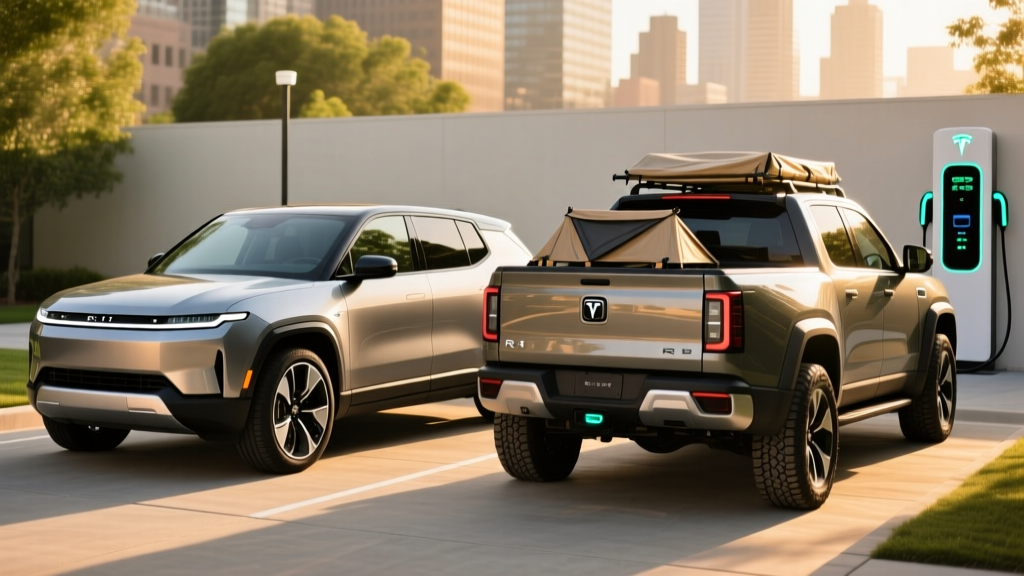
If you are researching a Rivian purchase in 2026, you are likely toggling between the R1S three-row SUV and the R1T pickup, comparing trims, and trying to figure out what your monthly payment will actually look like. Rivian's in-house financing — often referred to in search as "Rivian finance rates" — is one piece of a larger cost puzzle that includes federal tax credits, state rebates, insurance, and charging infrastructure. This review breaks down the 2026 R1S and R1T lineup with exact EPA range figures, charging speeds, battery chemistry, pricing by trim, and a realistic look at financing and ownership costs so you can make a data-driven decision.
2026 Rivian Lineup at a Glance: R1S and R1T Trims
For the 2026 model year, Rivian offers the R1S (three-row SUV) and R1T (crew-cab pickup) across three primary configurations: Dual-Motor AWD with the Standard battery, Dual-Motor AWD with the Large battery, and the Tri-Motor AWD with the Max battery. A base Dual-Motor Standard trim was introduced to lower the entry price, while the Tri-Motor variant targets performance buyers who want supercar-rivaling acceleration in a truck or SUV body.
| Spec | Dual-Motor Standard | Dual-Motor Large | Tri-Motor Max |
|---|---|---|---|
| Battery Capacity (usable) | ~92 kWh (LFP) | ~112 kWh (NMC) | ~141 kWh (NMC) |
| EPA Range — R1S | 270 mi | 352 mi | 410 mi |
| EPA Range — R1T | 270 mi | 352 mi | 420 mi |
| Horsepower | 533 hp | 533 hp | 850 hp |
| 0–60 mph | 4.5 sec | 4.5 sec | 2.9 sec |
| Drivetrain | AWD (dual-motor) | AWD (dual-motor) | AWD (tri-motor) |
| Max DC Fast Charge | 200 kW | 220 kW | 220 kW |
| 10–80% DCFC Time | ~28 min | ~30 min | ~36 min |
| Level 2 Home Charge Rate | 11.5 kW (~25 mi/hr) | 11.5 kW (~25 mi/hr) | 11.5 kW (~25 mi/hr) |
| Towing Capacity | 7,700 lb (R1T) | 7,700 lb (R1T) | 7,700 lb (R1T) |
Source: fueleconomy.gov and Rivian official specifications.
Real-World Range: What to Actually Expect
Rivian's EPA range numbers are competitive for the adventure-truck segment, but the boxy aerodynamics and substantial curb weight (over 6,800 lb for the R1T) mean highway efficiency takes a hit compared to sleeker sedans. The R1T Dual-Motor Large achieves roughly 73 MPGe combined per fueleconomy.gov, translating to about 46 kWh per 100 miles. City driving with regenerative braking can improve efficiency to around 40 kWh/100mi.
If your typical use case involves highway road trips in winter, the Max battery pack is the practical choice for avoiding frequent charging stops. For daily commuting under 60 miles round-trip, the Standard pack is more than sufficient and costs significantly less.
Charging Speed: DC Fast Charging and Home Setup
Charging speed is where Rivian has made meaningful progress with its second-generation platform. The Dual-Motor Standard (LFP) and Dual-Motor/Tri-Motor (NMC) packs have different charge curve behaviors worth understanding.
| Charging Level | Power / Rate | Miles Added Per Hour | Notes |
|---|---|---|---|
| Level 1 (120V outlet) | ~1.4 kW | ~3 mi/hr | Emergency/trickle only |
| Level 2 (240V, 48A) | 11.5 kW | ~25 mi/hr | Full charge overnight (~10–14 hrs for Large) |
| DC Fast Charge (Standard) | Peak 200 kW | ~140 mi in 20 min | LFP sustains peak longer |
| DC Fast Charge (Large/Max) | Peak 220 kW | ~150 mi in 20 min | Tapers significantly above 80% SoC |
The NMC packs in the Large and Max configurations hit peak charge rates only when preconditioned and between roughly 10–40% state of charge (SoC). After 60%, the curve tapers — a 60–80% session can take nearly as long as the 10–60% portion. Rivian's navigation system automatically preconditioned the battery when you route to a charger, which is essential for achieving advertised speeds. The LFP Standard pack is more tolerant of regular 100% charging and holds its peak charge rate slightly longer, making it practical for daily full-charge habits.
For home charging, a Level 2 wall connector on a 60-amp circuit (delivering 48 amps continuous) is the standard recommendation. Expect a full overnight charge from 20% to add roughly 250+ miles by morning on the Large pack. Installation costs typically range from $800 to $2,500 depending on your electrical panel capacity and run distance — consult a licensed electrician for a site-specific quote.
Pricing, Trims, and the Federal Tax Credit
Rivian's 2026 pricing reflects its premium positioning, though the introduction of the Dual-Motor Standard trim brought the entry point below $75,000 for the first time.
| Trim / Configuration | R1S MSRP | R1T MSRP | §30D Credit Eligible? |
|---|---|---|---|
| Dual-Motor Standard | $74,900 | $69,900 | Yes (R1T); R1S subject to SUV MSRP cap of $80,000 ✓ |
| Dual-Motor Large | $84,900 | $79,900 | R1T eligible (under $80K cap); R1S exceeds $80K SUV cap ✗ |
| Tri-Motor Max | $99,900 | $94,900 | Both exceed MSRP caps ✗ |
Under current IRS §30D rules, the new clean vehicle credit offers up to $7,500, split into two halves: $3,750 for meeting critical-minerals sourcing requirements and $3,750 for battery-component sourcing. To qualify, buyers must also meet income caps ($150,000 single / $300,000 joint modified AGI), and the vehicle must be under the MSRP cap ($55,000 for sedans, $80,000 for SUVs and trucks). The R1T qualifies as a truck, giving it the $80,000 MSRP ceiling; the R1S is classified as an SUV with the same $80,000 cap.
As of 2026, the point-of-sale transfer option allows eligible buyers to apply the credit directly at purchase, reducing the financed amount. However, battery-sourcing requirements have tightened year over year, and not all Rivian configurations may qualify for the full $7,500 — some may receive only $3,750 or none at all depending on supply-chain compliance at the time of delivery. Always verify current eligibility with your tax professional and the IRS's official vehicle eligibility list before committing to a purchase.
Rivian Finance Rates: What Buyers Are Seeing in 2026
Rivian offers in-house financing through Rivian Financial Services, alongside options from third-party lenders and credit unions. As of early 2026, buyers with excellent credit (740+) are reporting APRs in the range of 4.9% to 6.5% for 60- and 72-month terms through Rivian's captive lender. Rates for 84-month terms typically run 0.5–1.0% higher. Buyers with good credit (680–739) may see rates between 6.5% and 8.5%.
Here is what a realistic financing scenario looks like for the R1T Dual-Motor Standard, assuming a $7,500 point-of-sale tax credit and a 10% down payment:
| Item | Amount |
|---|---|
| MSRP | $69,900 |
| Federal §30D Credit (POS) | –$7,500 |
| Adjusted Price | $62,400 |
| Down Payment (10%) | –$6,240 |
| Amount Financed | $56,160 |
| APR (72 months, 740+ credit) | 5.9% |
| Estimated Monthly Payment | ~$928 |
Comparing this to a third-party lender or a local credit union is always worthwhile. Some credit unions offer EV-specific loan products with rates 0.5–1.0% below captive lenders for well-qualified borrowers. Additionally, some states offer rebates or incentives that can be stacked with the federal credit — check your state energy office or the Alternative Fuels Data Center for current programs.
A note on leasing: Rivian leases are available but the §30D credit treatment differs. Under the commercial clean vehicle credit (§45W), leased vehicles may pass through a $7,500 lease incentive regardless of the buyer's income or the vehicle's MSRP cap — a potential workaround for buyers who exceed income limits or choose higher trims. Consult your tax advisor for specifics.
Interior, Cargo, and Technology
The R1S offers three rows of seating with 104.4 cubic feet of total cargo volume (behind the first row) and 10.6 cubic feet of front trunk (frunk) space. Third-row legroom measures 30.4 inches — adequate for children but tight for adults on long trips. The R1T provides a 4.5-foot bed with a powered tonneau cover, an innovative Gear Tunnel (available on Large and Max trims) offering 11.6 cubic feet of lockable cross-cab storage, and the same 10.6 cu ft frunk.
Rivian's infotainment system runs on a 15.6-inch center touchscreen with a clean, responsive interface. Wireless Apple CarPlay and Android Auto are not supported — Rivian uses its own embedded platform with native navigation, Spotify, and over-the-air (OTA) updates. The Driver+ package provides Level 2 driver assistance including highway assist and lane centering, but this is not autonomous driving — you must remain fully engaged with hands on or near the wheel at all times.
Notable tech highlights include the Rivian Waypoints navigation system with automatic charger routing and battery preconditioning, a built-in air compressor for tire management, and the Camp Kitchen accessory (R1T) that slides out from the Gear Tunnel. Drawbacks include the lack of Apple CarPlay/Android Auto, occasional OTA update glitches reported by owners, and the premium price point relative to competitors like the Ford F-150 Lightning or Chevrolet Silverado EV.
Warranty and Long-Term Ownership
Rivian provides an 8-year/100,000-mile battery and driveunit warranty, with a general vehicle warranty of 5 years/60,000 miles. The battery warranty guarantees that the pack will retain at least 70% of its original capacity during the coverage period. For the LFP Standard pack, long-term degradation data is still accumulating as of 2026, but LFP chemistry generally offers superior cycle life (2,000–3,000+ full cycles) compared to NMC (~1,000–1,500 cycles), making it well-suited for high-mileage daily drivers.
Maintenance costs for Rivian vehicles are low relative to internal-combustion trucks — no oil changes, transmission fluid, or spark plugs. Expect to budget for tire replacement (these are heavy vehicles that wear tires faster), cabin air filters, brake fluid checks, and wiper fluid. Insurance premiums tend to run 15–25% higher than comparable gas trucks due to repair costs and parts availability, so obtaining quotes before purchase is essential.
Pros, Cons, and Who Should Buy
Pros
- Class-leading combination of off-road capability and on-road performance
- Tri-Motor variant delivers 850 hp and sub-3-second 0–60
- Over 400 miles EPA range on Max pack
- Innovative storage (Gear Tunnel, frunk) on R1T
- OTA updates continuously improve the vehicle
- 8-year/100,000-mile battery warranty
Cons
- High starting price; many trims exceed §30D MSRP caps
- No Apple CarPlay or Android Auto
- Third-row space in R1S is tight for adults
- Real-world highway range falls 15–20% below EPA
- Insurance premiums above segment average
- Service center network still expanding in rural areas
- Adventure-oriented families who need towing, cargo space, and off-road capability without sacrificing daily comfort.
- Tech-forward buyers who value OTA updates, embedded navigation, and a premium digital experience over phone-mirroring.
- Performance truck enthusiasts who want the Tri-Motor's 850 hp and don't mind the premium price.
- Daily commuters with home charging access and sub-80-mile round trips (Standard or Large pack).
Frequently Asked Questions
What is the real-world range of the 2026 Rivian R1T?
The R1T Dual-Motor Large achieves an EPA-estimated 352 miles. In real-world highway driving at 70 mph, expect 290–320 miles. In cold weather (below 30°F), plan for 240–280 miles. The Tri-Motor Max extends this to roughly 340–370 real-world highway miles.
How fast does the Rivian R1S charge at a DC fast charger?
The Dual-Motor Large and Tri-Motor Max peak at 220 kW, achieving a 10–80% charge in approximately 30–36 minutes when preconditioned. The Standard LFP pack peaks at 200 kW with a 10–80% time of roughly 28 minutes. Charging above 80% slows significantly — plan to charge to 80% on road trips for optimal time efficiency.
Does the Rivian R1T qualify for the $7,500 federal EV tax credit?
The R1T Dual-Motor Standard ($69,900 MSRP) falls under the $80,000 truck MSRP cap and is potentially eligible for the full $7,500 credit, subject to buyer income limits ($150K single / $300K joint) and battery-sourcing compliance. Higher trims may exceed caps or face sourcing limitations. Always verify on the IRS official eligibility list and consult a tax professional.
What Rivian finance rates can I expect in 2026?
Well-qualified buyers (740+ credit score) are seeing APRs between 4.9% and 6.5% for 60–72 month terms through Rivian Financial Services. Credit unions may offer slightly lower rates. An R1T Dual-Motor Standard with the $7,500 point-of-sale credit and 10% down could yield monthly payments around $928 over 72 months at 5.9% APR.
Is the Rivian R1S worth buying over the Tesla Model X or BMW iX?
The R1S excels in off-road capability, rugged utility, and three-row seating with genuine adventure credentials. The Model X offers faster Supercharger access and gullwing doors but is pricier. The BMW iX is a more refined luxury cruiser but lacks off-road chops and a third row. Choose the R1S if you need real off-road ability and three rows; choose the iX for luxury highway cruising; choose the Model X for charging-network convenience.
What is Rivian's battery warranty?
Rivian covers the battery and driveunit for 8 years or 100,000 miles, whichever comes first, with a guaranteed minimum capacity retention of 70% during the warranty period.