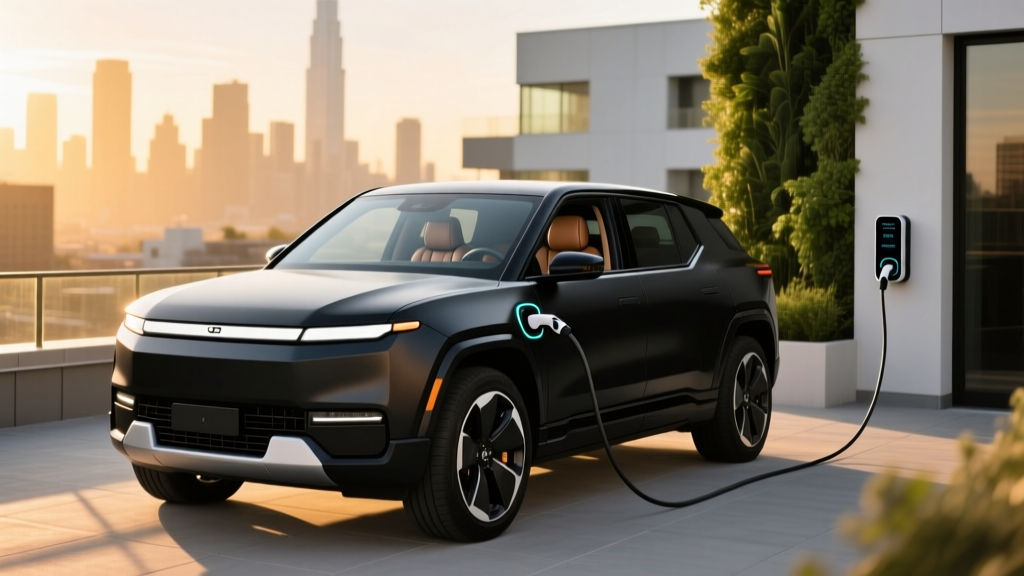
If you've been searching how much is a Rivian R1S, the short answer is that the 2026 Rivian R1S starts at roughly $75,900 before destination and options — but the real number you'll pay depends heavily on which battery pack, motor configuration, and trim you choose. The R1S remains one of the only three-row electric SUVs built from the ground up for genuine off-road capability and family hauling, and its pricing has shifted as Rivian introduced the more affordable Dual-Motor Standard battery alongside the performance-oriented Tri-Motor and Quad-Motor variants.
Below, we break down every 2026 R1S configuration, what you'll actually spend after the federal tax credit, and whether the numbers add up against the Tesla Model X, BMW iX, and upcoming three-row competitors.
2026 Rivian R1S Price by Trim and Configuration
Rivian sells the R1S across four main powertrain configurations for 2026. Unlike legacy automakers with dozens of trim permutations, Rivian keeps it relatively simple: you pick a motor count, a battery size, and then layer on packages. Here is the current MSRP matrix before destination ($1,800), before any state or federal incentives.
| Configuration | Battery | HP / lb-ft | 0-60 mph | MSRP |
|---|---|---|---|---|
| Dual-Motor Standard | 92 kWh (usable, LFP) | 533 hp / 610 lb-ft | 4.5 sec | $75,900 |
| Dual-Motor Max | 141 kWh (usable, NMC) | 533 hp / 610 lb-ft | 4.5 sec | $85,400 |
| Tri-Motor Max | 141 kWh (usable, NMC) | 850 hp / 1,103 lb-ft | 2.9 sec | $99,900 |
| Quad-Motor Max | 141 kWh (usable, NMC) | 1,025 hp / 1,198 lb-ft | 2.6 sec | $114,500 |
Destination adds $1,800 across the board. The popular Adventure Package (air suspension, tow package, Camp Kitchen-ready wiring) adds roughly $4,500, and premium paint colors run $500–$2,500. A well-equipped Dual-Motor Max with the Adventure Package typically stickers around $91,000–$94,000 before incentives — the configuration most buyers actually order.
Federal Tax Credit and True Out-of-Pocket Cost
Under current IRS §30D rules, the R1S may qualify for up to $7,500 in federal tax credit, but eligibility is not automatic. Three hurdles apply:
- MSRP cap: SUVs must sticker at or below $80,000. This means the Dual-Motor Standard ($75,900) qualifies on price, but the Dual-Motor Max, Tri-Motor, and Quad-Motor all exceed the cap at base MSRP — and adding options pushes them further over.
- Buyer income cap: Modified adjusted gross income must not exceed $300,000 (joint), $225,000 (head of household), or $150,000 (single).
- Battery sourcing: Critical-mineral and battery-component requirements tighten annually through 2032. Rivian sources LFP cells from suppliers with varying compliance; confirm current-year sourcing status on the IRS clean-vehicle list before purchasing.
Point-of-sale transfer is available, meaning the $7,500 can be applied as a down-payment reduction at delivery rather than waiting for tax filing — but only if you meet all three criteria above.
| Line Item | Amount |
|---|---|
| Base MSRP | $75,900 |
| Destination | $1,800 |
| Federal §30D credit (if eligible) | −$7,500 |
| Effective price (before state incentives) | $70,200 |
State incentives can stack on top. California's CVRP, Colorado's innovative motor vehicle credit, and various utility rebates can shave another $2,000–$7,500 depending on your jurisdiction. Check your state's energy office for current figures, as these change frequently.
EPA Range vs. Real-World Range
Rivian offers three battery sizes for 2026:
| Pack | Usable Capacity | Chemistry | EPA Range | Efficiency |
|---|---|---|---|---|
| Standard | 92 kWh | LFP | 258 mi | 2.1 kWh/mi (48 MPGe) |
| Large (discontinued for 2026) | — | — | — | — |
| Max | 141 kWh | NMC | 352 mi | 2.4 kWh/mi (42 MPGe) |
The LFP Standard pack is notable: it tolerates daily charging to 100% without the degradation concerns of NMC, making it practical for commuters who can charge at home every night. The NMC Max pack is better for road trippers who need the longest single-charge legs and don't mind keeping daily SoC between 20–80%.
Charging Speed: DC Fast Charge and Home Level 2
The R1S uses the NACS (Tesla-style) connector natively on 2025+ models, giving it direct access to Tesla's Supercharger network — the most reliable DC fast-charging network in the U.S. — without an adapter. Earlier CCS-equipped R1S vehicles can use the Supercharger network via a Rivian-provided adapter.
| Charging Level | Power | Speed |
|---|---|---|
| Level 1 (120V household) | 1.4 kW | ~3 mi/hr |
| Level 2 (240V, 48A home charger) | 11.5 kW | ~25 mi/hr |
| DC Fast Charge (Standard LFP) | Peak 200 kW | 10–80% in ~28 min |
| DC Fast Charge (Max NMC) | Peak 220 kW | 10–80% in ~30 min |
A critical nuance: the R1S's charge curve tapers significantly above 80% SoC, as is typical for all lithium-ion packs. That 10–80% time is the relevant metric for road trips; charging from 80–100% can take nearly as long as the first 70%. On a road trip, plan your stops around the 10–80% window for optimal throughput.
For home charging, a 48-amp Level 2 wall connector on a 60-amp circuit will fully replenish the Max pack in roughly 12–13 hours — practical for overnight charging. Expect to budget $800–$2,500 for a professional Level 2 installation depending on your electrical panel's capacity and proximity to your parking spot. A 200-amp panel upgrade, if needed, can add $1,500–$3,000.
Interior Space, Cargo, and Family Practicality
The R1S seats up to seven across three rows, though the third row is best suited for children or short-trip adults. Here are the key dimensions:
- Cargo behind 3rd row: 10.6 cu ft
- Cargo behind 2nd row (3rd row folded): 46.7 cu ft
- Cargo behind 1st row (all rear rows folded): 88.2 cu ft
- Front trunk (frunk): 11.0 cu ft — one of the largest in the segment, easily fitting two carry-on bags
- 2nd-row legroom: 38.5 inches
- 3rd-row legroom: 30.4 inches
The frunk is a major differentiator vs. the Tesla Model X, which has a far smaller front trunk. Combined cargo capacity with the frunk included is competitive with midsize three-row ICE SUVs like the Toyota Highlander.
Towing capacity is rated at 7,700 lbs on Dual-Motor models — among the highest in the electric SUV segment and enough for most boat trailers, campers, and horse trailers. Note that towing at or near max capacity cuts range by approximately 40–50%, so plan charging stops accordingly on long hauls.
Driver Assistance, Tech, and Notable Drawbacks
Rivian Driver+ combines adaptive cruise control, lane-centering, and automatic lane changes on divided highways. It's competent and confidence-inspiring on long interstate drives, but it does not match the hands-free capability of GM's Super Cruise or Ford's BlueCruise on mapped highways. Rivian has been developing a more advanced hands-free system, but as of the 2026 model year, Driver+ remains a hands-on system.
The infotainment system runs on a 15.6-inch central touchscreen with a clean, responsive interface. Wireless Apple CarPlay and Android Auto are not offered — Rivian uses its own native navigation and media apps, which are well-integrated but a sticking point for buyers who prefer phone projection. The digital instrument cluster is 12.3 inches, and a head-up display is not available.
- No wireless Apple CarPlay or Android Auto
- Third-row space is tight for adults on longer trips
- Service center network is still expanding — some owners in rural areas face long drives for warranty work
- Insurance premiums run 15–25% higher than comparable ICE SUVs due to repair costs and parts availability
- Max-pack charging speed lags behind Hyundai/Kia's 800V E-GMP platform (which can do 10–80% in ~18 min)
Warranty and Long-Term Ownership
Rivian provides a competitive warranty package:
- Battery pack: 8 years / 175,000 miles (retaining at least 70% of original capacity)
- Powertrain (motors, gearbox): 8 years / 175,000 miles
- Bumper-to-bumper: 5 years / 60,000 miles
- Corrosion: 5 years / unlimited miles
The 175,000-mile battery warranty exceeds the federal minimum (8 years / 100,000 miles) and matches or beats most competitors. The 70% capacity-retention threshold is standard for the industry. Based on fleet data from Rivian's delivery van program (which shares battery architecture), early degradation curves suggest most owners will retain 90%+ capacity at 100,000 miles under normal use.
R1S vs. Key Competitors: Is It Worth Buying?
The R1S occupies a unique niche. Here's how it compares to the most relevant alternatives:
| Spec | Rivian R1S Dual-Motor Max | Tesla Model X LR | Kia EV9 GT-Line AWD |
|---|---|---|---|
| Base MSRP | $85,400 | $79,990 | $73,900 |
| EPA Range | 352 mi | 335 mi | 270 mi |
| 0-60 mph | 4.5 sec | 3.8 sec | 5.0 sec |
| 3rd-Row Legroom | 30.4 in | 32.7 in | 32.0 in |
| Towing Capacity | 7,700 lbs | 5,000 lbs | 5,000 lbs |
| Max DC Charge | 220 kW | 250 kW | 236 kW (800V) |
| Federal Credit Eligible | Partial (Standard only) | Yes (LR) | Yes (select trims) |
- You need genuine off-road capability (8.7 inches of ground clearance, up to 14.9 with air suspension)
- Towing is a regular use case (7,700 lbs crushes the competition)
- You want the largest frunk in the three-row EV segment
- You prefer Rivian's adventure-oriented brand identity and community
- Third-row adult comfort is a priority (Model X or a PHEV like the Grand Cherokee 4xe offers more room)
- Fastest DC charging matters most (Kia EV9's 800V architecture is quicker)
- You need hands-free highway driving (GM's Super Cruise or Ford's BlueCruise)
- Budget is tight — the Kia EV9 starts $11,500 lower and still offers three rows
Who the R1S Suits Best
The Rivian R1S is ideal for active families who tow, camp, or explore unpaved roads and want to do it without burning fossil fuels. Its combination of 352-mile range, 7,700-lb towing, genuine off-road chops, and a massive frunk makes it the most versatile three-row EV on the market. If your life revolves around ski trips, boat launches, and national park campgrounds, nothing else in the EV space matches the R1S's breadth of capability.
It's less ideal for buyers who primarily need a commuter vehicle with occasional third-row use — the Kia EV9 or a plug-in hybrid minivan will cost less and serve that use case adequately. And if you're a tech-first buyer who wants the most advanced autonomous driving features, Tesla's FSD (Supervised) and GM's Super Cruise offer more capability, though both still require driver engagement.
Pros
- Class-leading towing (7,700 lbs)
- Massive 11 cu-ft frunk
- Genuine off-road capability with air suspension
- NACS native — direct Supercharger access
- LFP Standard pack allows daily 100% charging
- 175,000-mile battery warranty
Cons
- Most trims exceed $80,000 MSRP cap for tax credit
- No Apple CarPlay or Android Auto
- Third row is tight for adults
- DC charging speed trails 800V competitors
- Service centers still expanding in rural areas
- High insurance premiums
Frequently Asked Questions
What is the real-world range of the Rivian R1S?
The EPA rates the R1S Dual-Motor Max at 352 miles combined. In real-world highway driving at 70–75 mph, expect 290–310 miles. In freezing temperatures, plan for 240–270 miles. The Standard LFP pack's 258-mile EPA rating translates to roughly 220–240 miles in mixed real-world use.
How fast does the R1S charge?
On a DC fast charger, the Max pack peaks at 220 kW and charges from 10–80% in about 30 minutes. The Standard LFP pack peaks at 200 kW with a similar 28-minute 10–80% time. At home on a 48-amp Level 2 charger (11.5 kW), you'll add about 25 miles per hour of charging.
How much does the R1S cost after tax credits?
The Dual-Motor Standard at $75,900 is the only configuration that falls under the $80,000 MSRP cap for the federal §30D credit. If you meet income and battery-sourcing requirements, the effective price drops to roughly $70,200 including destination. Higher trims do not qualify for the federal credit due to the MSRP cap.
Does the Rivian R1S qualify for the federal EV tax credit?
Only the Dual-Motor Standard configuration qualifies on MSRP grounds (under the $80,000 SUV cap). You must also meet IRS income limits ($300K joint, $150K single) and the vehicle must satisfy current-year battery-sourcing requirements. Always verify eligibility on the IRS clean vehicle credit page before purchasing, as sourcing compliance changes periodically.
Is the Rivian R1S worth buying vs. the Tesla Model X or Kia EV9?
If you need towing capacity, off-road capability, and a huge frunk, the R1S is the best three-row EV available. If you prioritize third-row adult comfort, the Model X wins. If budget is the top concern, the Kia EV9 starts over $11,000 lower and still offers three rows with competitive range.
What are the biggest pros and cons of the R1S?
Pros: class-leading towing, genuine off-road capability, massive frunk, NACS/Supercharger access, 175,000-mile battery warranty, and an LFP option for daily charging to 100%. Cons: most trims don't qualify for the federal tax credit, no phone projection, tight third row, and DC charging speed trails 800V rivals.
Sources: EPA Fuel Economy, IRS §30D Clean Vehicle Credit, Rivian R1S Specifications.