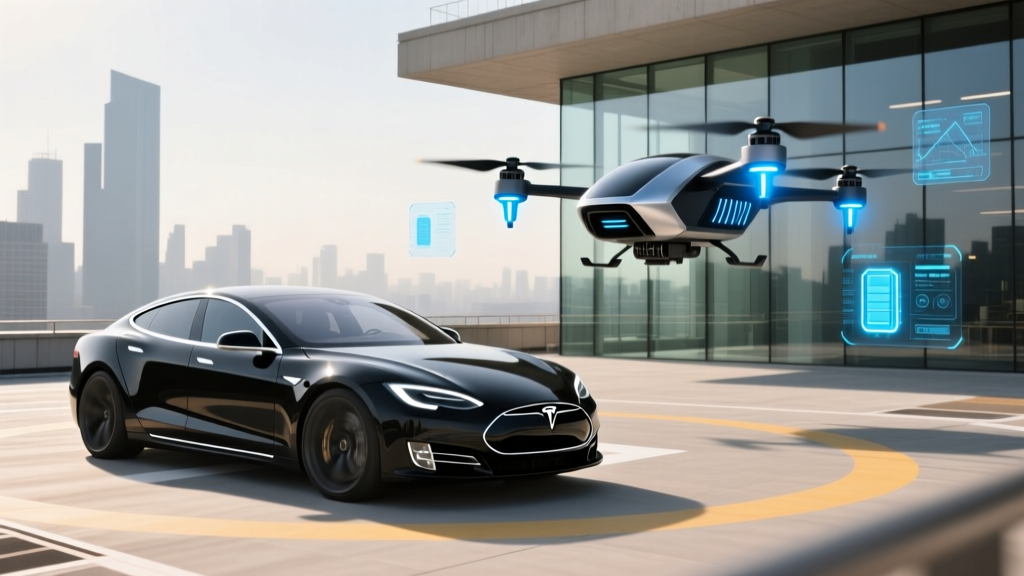
If you've been searching for a Tesla flying vehicle, you're not alone — the term trends every time Elon Musk teases futurism on X or a viral eVTOL concept video circulates. But as of 2026, Tesla does not manufacture an airplane, air taxi, or any roadable aircraft. What Tesla does build is the fastest-accelerating production sedan on the planet: the Tesla Model S Plaid. For buyers who want aircraft-grade acceleration without leaving the tarmac, this is the real-world machine worth evaluating.
Below, we break down the 2026 Model S lineup — the Long Range and the tri-motor Plaid — with exact EPA range figures, charging curves, battery chemistry, tax credit eligibility, and the cold-weather realities that spec sheets omit.
2026 Tesla Model S: Quick Verdict
The Model S remains Tesla's flagship sedan and the benchmark for luxury EV performance. The Long Range delivers over 400 miles of EPA range with dual-motor AWD, while the Plaid trades roughly 40 miles of range for 1,020 horsepower and a 1.99-second 0-60 mph time that rivals hypercars costing five times as much. Neither variant flies, but the Plaid's launch feels close.
| Spec | Model S Long Range | Model S Plaid |
|---|---|---|
| EPA Range | 402 miles | 359 miles (320 mi w/ 21" wheels) |
| Battery (usable) | ~95 kWh, NMC | ~95 kWh, NMC |
| Drivetrain | Dual-motor AWD | Tri-motor AWD |
| Horsepower | 670 hp | 1,020 hp |
| 0-60 mph | 3.1 sec | 1.99 sec |
| Peak DC Fast Charge | 250 kW | 250 kW |
| 10-80% DCFC Time | ~27 min | ~27 min |
| Level 2 Rate | 11.5 kW (~44 mi/hr) | 11.5 kW (~44 mi/hr) |
| MPGe (combined) | 120 MPGe | 116 MPGe |
| Base MSRP | $74,990 | $89,990 |
| Battery Warranty | 8 yr / 150,000 mi | 8 yr / 150,000 mi |
Range and Efficiency: EPA vs. Real-World
The EPA rates the Model S Long Range at 402 miles and the Plaid at 359 miles on 19-inch Tempest wheels (dropping to 320 miles on the optional 21-inch Arachnids). These are strong numbers, but EPA tests include generous city-regen cycles that flatter every EV.
Real-World Range Expectations (2026 Model S Long Range):
- Highway (70 mph, 75°F): ~330-350 miles
- Highway (70 mph, 30°F): ~270-300 miles (15-25% cold-weather loss)
- Mixed city/highway (mild): ~370-390 miles
- Plaid, aggressive driving: 280-310 miles (tri-motor energy draw is significant)
The Model S heat pump helps mitigate winter losses compared to older resistive-heater EVs, but sustained cold still reduces range materially. Plan for it.
Efficiency lands at 120 MPGe combined (Long Range) or roughly 28 kWh/100 miles, per fueleconomy.gov. The Plaid's tri-motor setup and performance tires reduce efficiency slightly to 116 MPGe. If you hypermile with gentle acceleration and strong regen, you can approach EPA stickers; if you drive the Plaid like it begs to be driven, expect to charge more often.
Charging Speed: DC Fast, Level 2, and the Supercharger Advantage
Tesla's Supercharger network remains the gold standard for public charging reliability. The Model S peaks at 250 kW on V3 Superchargers, adding up to 200 miles in 15 minutes under ideal conditions. However, peak kW is not sustained kW — the charge curve tapers significantly above 60% state of charge.
| Charging Method | Power / Rate | Speed | Notes |
|---|---|---|---|
| DC Fast Charge (V3 Supercharger) | 250 kW peak | 10-80% in ~27 min | Tapers hard above 60%; precondition via nav |
| DC Fast Charge (V4 Supercharger) | 250 kW (CCS-native) | Similar to V3 | NACS connector, no adapter needed |
| Level 2 (Tesla Wall Connector) | 11.5 kW / 48A | ~44 miles per hour | Full charge in ~9 hours (empty to full) |
| Level 2 (Public J1772) | 7.2-11.5 kW | ~28-44 mi/hr | NACS-to-J1772 adapter included |
| Level 1 (120V outlet) | ~1.4 kW | ~5 miles per hour | Emergency/trickle only |
Charging-curve reality: You'll see 250 kW only between roughly 10-30% SoC on a preconditioned battery. By 60%, you're down to ~100 kW; by 80%, roughly 50 kW. This is normal for NMC chemistry at high SoC. Always navigate to a Supercharger using the car's built-in nav to trigger battery preconditioning — arriving cold can cut charge speed by 40% or more.
At home on a Tesla Wall Connector (11.5 kW / 48 amps on a 60A circuit), expect a full overnight charge from near-empty in about 9 hours. Most owners charge 20-80% daily, which takes roughly 5 hours — easily handled while you sleep. Installation typically costs $800-$2,000 depending on panel proximity and whether a 240V/60A circuit already exists.
Performance: The Plaid Is the Closest Thing to a Tesla Flying Vehicle
No Tesla leaves the ground, but the Model S Plaid's 1.99-second 0-60 mph time generates longitudinal g-forces that rival takeoff in a light aircraft. The tri-motor setup (one front, two rear) delivers 1,020 horsepower and continuous torque vectoring that makes the car feel smaller than its 4,766-pound curb weight suggests.
The Long Range is no slouch either — 670 hp and a 3.1-second 0-60 mph time outpace most V8 sports sedans. Both variants feature adaptive air suspension that adjusts ride height by speed, dropping the car at highway speeds for aero efficiency and raising for driveway clearance.
The yoke steering wheel remains standard on the Plaid (optional on Long Range). It's polarizing: great for track visibility and a clear view of the 12.3-inch instrument cluster, awkward for low-speed parking maneuvers and three-point turns. A round wheel is available at no extra charge if you order it at purchase.
Interior, Cargo, and Tech
The 2026 Model S interior is minimalist but functional. The 17-inch center touchscreen runs Tesla's latest software with a responsive UI, integrated navigation, and access to streaming apps. A rear-seat 8-inch touchscreen controls climate and entertainment for passengers.
Cargo and passenger dimensions:
- Rear legroom: 35.4 inches (competitive with BMW 5 Series)
- Cargo (rear trunk): 26.3 cu ft
- Frunk (front trunk): 3.1 cu ft
- Total with rear seats folded: ~64 cu ft
The liftback design gives the Model S a practical advantage over traditional sedans — the hatch opening is wide enough for luggage, golf bags, or a week's groceries. The frunk is modest but useful for charging cables.
Driver assistance: Basic Autopilot (adaptive cruise + lane centering) is standard. Full Self-Driving (Supervised) is a $8,000 option or $99/month subscription. This is an SAE Level 2 system — the driver must remain engaged, hands on wheel (or torque-monitored via the yoke), eyes on road. It is not autonomous driving and does not replace driver attention.
Pricing, Trims, and Federal Tax Credit Eligibility
| Trim | Base MSRP | As-Tested (typical) | Federal §30D Credit | Effective Price |
|---|---|---|---|---|
| Long Range | $74,990 | $79,490 (w/ FSD) | Up to $7,500* | ~$67,490 - $71,990 |
| Plaid | $89,990 | $97,490 (w/ FSD + 21" wheels) | Up to $7,500* | ~$82,490 - $89,990 |
*Federal tax credit eligibility is subject to IRS §30D rules including buyer income caps, battery critical-mineral sourcing, and point-of-sale transfer. See IRS.gov for current requirements.
Tax credit caveats for the Model S:
- MSRP cap: Sedans must be under $55,000 to qualify — the Model S exceeds this cap and is not eligible for the new-vehicle §30D credit as of 2026.
- Used EV credit (§25E): If you buy a qualifying used Model S for under $25,000, you may be eligible for up to $4,000 (30% of sale price, capped). Income caps apply ($75K single / $150K joint).
- Point-of-sale transfer: For eligible vehicles, the credit can be applied at purchase as a down-payment reduction. This does not apply to the Model S new due to the MSRP cap.
Bottom line: if you're buying a new Model S in 2026, budget the full MSRP. The federal new-vehicle credit does not apply to sedans priced above $55,000. State incentives (California, Colorado, etc.) may still offer rebates — check your local DMV or energy office.
Battery Chemistry, Warranty, and Longevity
The Model S uses NMC (nickel manganese cobalt) lithium-ion cells in a structural pack. NMC offers higher energy density than LFP, enabling the 400+ mile range, but requires the 80% daily charge limit for optimal longevity. Tesla recommends charging to 100% only before long trips.
Battery warranty: 8 years / 150,000 miles, whichever comes first, with a minimum 70% capacity retention threshold. If your pack degrades below 70% within the warranty period, Tesla will repair or replace it. In practice, Tesla's NMC packs typically retain 85-90% capacity at 100,000 miles based on fleet data.
Out-of-warranty battery replacement for the Model S runs $15,000-$22,000 depending on labor and whether a refurbished pack is used. Third-party EV shops are increasingly offering module-level repairs for $5,000-$8,000, but this is still early-stage infrastructure.
Pros, Cons, and Who Should Buy
Pros
- Class-leading 402-mile EPA range (Long Range)
- Plaid's 1.99-sec 0-60 is supercar territory at sedan pricing
- Supercharger network: 50,000+ stalls globally, highest uptime
- Over-the-air updates continuously add features
- Liftback cargo versatility (26.3 cu ft + frunk)
- Air suspension adjusts ride height automatically
Cons
- Not eligible for federal new-vehicle tax credit (MSRP > $55K cap)
- Yoke steering divisive; round wheel requires special order
- No Apple CarPlay or Android Auto (Tesla-native only)
- Rear seat comfort trails Mercedes EQS and BMW i5
- Build quality improving but still inconsistent vs. German rivals
- Plaid range drops to 320 mi on 21" wheels — plan accordingly
Who the Model S suits best:
- Road trippers who want 400-mile range and Supercharger access
- Performance sedan buyers cross-shopping the Porsche Taycan, BMW i5 M60, or Lucid Air
- Tech-forward commuters who value OTA updates and integrated software
- Not ideal for: Budget-conscious buyers (no tax credit), families needing third-row seating (look at Model X or Rivian R1S), or those who prioritize traditional luxury materials over tech minimalism
Is the Model S Worth It vs. Competitors?
The Model S competes with the Lucid Air Pure ($69,900, 419-mi range), BMW i5 M60 ($84,100, 295-mi range), and Porsche Taycan 4S ($103,800, 277-mi range). The Lucid Air beats the Model S on range and interior space. The BMW and Porsche win on build quality and ride refinement. The Model S wins on acceleration (Plaid), charging infrastructure (Superchargers), and software integration.
If you need the most range per dollar, the Lucid Air Pure is compelling. If you want a proven, high-performance EV with the best charging network and don't mind paying a premium, the Model S Plaid remains the benchmark. Just don't expect it to fly.
Frequently Asked Questions
Does Tesla make a flying vehicle or flying car?
No. As of 2026, Tesla manufactures only ground vehicles: the Model S, Model 3, Model X, Model Y, Cybertruck, and Semi. Elon Musk has discussed eVTOL concepts informally, but Tesla has no announced flying vehicle program. Companies like Joby Aviation and Archer are developing air taxis, but these are not Tesla products and are not available for consumer purchase.
What is the real-world range of the 2026 Tesla Model S?
The EPA rates the Long Range at 402 miles and the Plaid at 359 miles. In real-world highway driving at 70 mph, expect 330-350 miles (Long Range) and 280-310 miles (Plaid). Cold weather (below freezing) reduces range by 15-25%, bringing the Long Range to roughly 270-300 miles on a winter road trip.
How fast does the Model S charge at home and on road trips?
On a Tesla V3 Supercharger, the Model S peaks at 250 kW and charges 10-80% in approximately 27 minutes (with battery preconditioning). At home on a Tesla Wall Connector (11.5 kW / 48A), it adds about 44 miles of range per hour, fully recharging overnight in roughly 9 hours.
Does the 2026 Tesla Model S qualify for the federal EV tax credit?
No. Under IRS §30D rules, new sedans must have an MSRP under $55,000 to qualify for the $7,500 credit. The Model S starts at $74,990 and exceeds this cap. However, a used Model S purchased for under $25,000 may qualify for the §25E used-EV credit of up to $4,000, subject to buyer income limits.
Is the Model S Plaid faster than a Porsche Taycan Turbo S?
Yes, in a straight line. The Plaid's 1.99-second 0-60 mph time beats the Taycan Turbo S (2.4 seconds). However, the Taycan offers superior handling dynamics on a road course, a more traditional luxury interior, and 800V architecture for sustained fast charging. Choose the Plaid for drag-strip dominance; choose the Taycan for track-day nuance.
What is the Model S battery warranty?
Tesla covers the Model S battery and drive unit for 8 years or 150,000 miles (whichever comes first) with a minimum 70% capacity retention guarantee. If the battery degrades below 70% within that period, Tesla will repair or replace it at no cost.