Rivian R1S Max Pack at a Glance
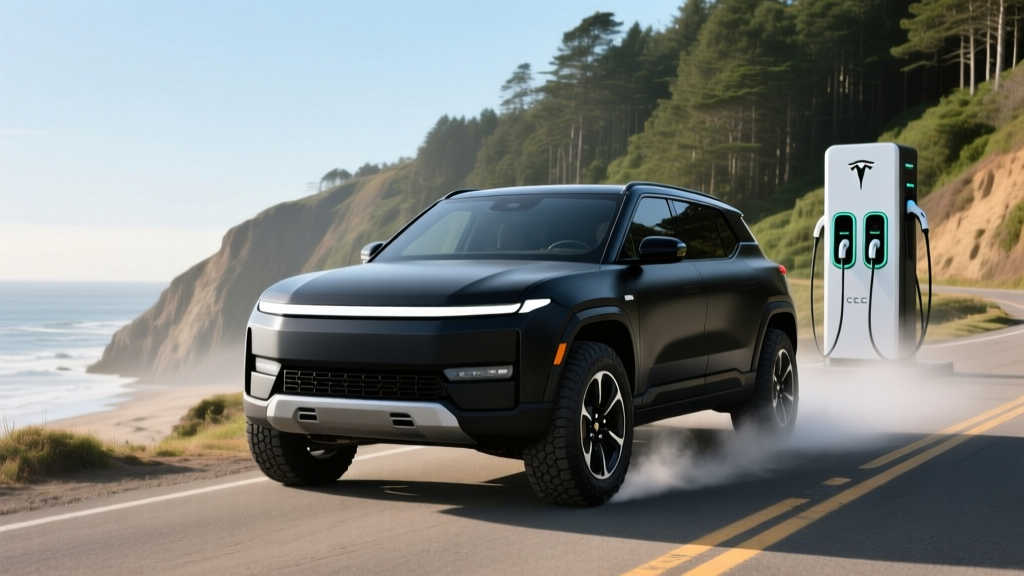
The Rivian R1S Max Pack is the long-range flagship of Rivian's three-row electric SUV lineup. Built on the company's second-generation platform with a 149 kWh NMC battery, it targets buyers who need genuine 400-mile range without sacrificing passenger or cargo space. It's also one of the few large electric SUVs that can tow seriously while maintaining competitive efficiency.
But a 400-mile EPA sticker doesn't tell the whole story. Cold weather, highway speeds, and a massive battery that charges at a relatively modest 220 kW peak rate all shape the real ownership experience. This review breaks down every spec that matters — from sustained charging curves to IRS §30D tax credit eligibility — so you can decide whether the Max Pack justifies its premium price.
| Spec | Value |
|---|---|
| EPA Range | 400 miles |
| Battery Capacity | 149 kWh usable (NMC chemistry) |
| Drivetrain | Dual-Motor AWD |
| Horsepower | 665 hp |
| 0–60 mph | 4.5 seconds |
| Max DC Fast Charge | 220 kW (peak) |
| 10–80% DC Charge Time | ~42 minutes |
| Level 2 Home Charging | 11.5 kW (~25 mi/hr) |
| MPGe (Combined) | 73 MPGe |
| Efficiency | 46 kWh/100 mi |
| Towing Capacity | 7,700 lbs |
| Base MSRP | $99,900 |
| Battery/Powertrain Warranty | 8 years / 175,000 miles |
Real-World Range: What 400 EPA Miles Actually Means
EPA Estimated Range: 400 miles
Real-World Expectation: 320–360 miles at highway speeds (70–80 mph); 280–320 miles in freezing temperatures; 370–400 miles in mixed city/suburban driving with regen braking.
The R1S Max Pack's 400-mile EPA rating places it among the longest-range electric SUVs available. According to fueleconomy.gov, the Dual-Motor AWD Max Pack achieves 73 MPGe combined, which translates to roughly 46 kWh consumed per 100 miles of driving.
That efficiency number sounds high — and it is, relative to smaller EVs — but it's competitive for a 6,800-pound, three-row SUV pushing a large frontal area through the air. The real-world story depends heavily on how you drive:
- City and suburban driving (30–55 mph): Regenerative braking recovers significant energy. Expect to match or approach the 400-mile sticker, especially in mild weather.
- Highway cruising (70–80 mph): Aerodynamic drag dominates. Plan for 320–360 miles before needing a charge stop. At 80 mph in 90°F+ heat with A/C running, the lower end of that range is realistic.
- Cold weather (below 32°F): Battery chemistry slows, cabin heating draws energy, and the heat pump works harder. Expect 280–320 miles. Rivian's heat pump helps mitigate losses compared to resistive heating, but a 149 kWh battery still loses meaningful capacity in deep cold.
- Towing: With a trailer in the 5,000–7,700 lb range, range drops dramatically — often to 180–220 miles depending on trailer aerodynamics and terrain. This is the reality for all large EVs when towing.
The Max Pack's large battery gives it a buffer that smaller-pack EVs simply can't match. Even at 70% of EPA range in worst-case conditions, you still have ~280 miles — enough for most single-day trips without a charge stop.
Battery Chemistry, Degradation, and Warranty
The R1S Max Pack uses a 149 kWh (usable) nickel-manganese-cobalt (NMC) lithium-ion battery. NMC chemistry offers higher energy density than LFP (lithium iron phosphate), which is why Rivian reserves it for the Max Pack — fitting that much capacity into the vehicle's skateboard platform requires every advantage in energy density.
The trade-off: NMC batteries are more sensitive to sustained high states of charge and extreme heat. Rivian recommends daily charging to 85–90% for routine use and reserving 100% charges for road trips. The battery management system includes active liquid thermal management to keep cells in the optimal temperature window.
Warranty coverage: Rivian covers the battery and drive system for 8 years or 175,000 miles, whichever comes first. The warranty guarantees the battery will retain at least 70% of its original capacity during that period. This is competitive with — and in mileage terms, exceeds — the standard 8-year/100,000-mile battery warranties offered by most competitors.
Based on industry-wide NMC degradation data, owners can expect roughly 8–12% capacity loss over the first 100,000 miles under normal use patterns, with degradation slowing significantly after the initial break-in period. The 175,000-mile warranty ceiling reflects confidence in long-term durability.
Charging Speeds: DC Fast Charging and Home Level 2
| Charge Level | Power (kW) | Rate (mi/hr added) | Notes |
|---|---|---|---|
| Level 1 (120V household) | ~1.4 kW | ~3 mi/hr | Emergency/trickle only; full charge takes days |
| Level 2 (240V, 48A home charger) | 11.5 kW | ~25 mi/hr | Full 10–100% in ~13 hours |
| Level 2 (240V, 32A portable) | 7.7 kW | ~17 mi/hr | Rivian Wall Connector or equivalent |
| DC Fast Charge (peak) | 220 kW | ~480 mi/hr (peak) | Sustained only to ~30% SoC; tapers significantly above 80% |
| DC Fast Charge (10–80%) | ~150 kW avg | — | 10–80% in approximately 42 minutes |
Understanding the charge curve: The 220 kW peak rate is impressive, but it's a peak — not a sustained rate. Like all large NMC batteries, the R1S Max Pack charges fastest between roughly 10% and 30% state of charge (SoC). Above 50%, the rate tapers to protect cell health, and above 80%, it drops sharply. That 10–80% time of ~42 minutes reflects the average across the curve, not the peak.
For context, a 149 kWh battery charging at a sustained 220 kW would theoretically fill from 10–80% in about 28 minutes. The 42-minute reality reflects the physics of large-battery charging. If you're road-tripping, plan your stops around 20–25 minute sessions that take you from ~20% to ~65% SoC — that's the sweet spot where the charge rate stays high.
Home charging reality: At 11.5 kW on a 48-amp Level 2 home charger, you'll add roughly 25 miles of range per hour. A full charge from 10% to 100% takes about 13 hours — which is fine for overnight charging. If you drive 60 miles daily, you'll recover that in roughly 2.5 hours of Level 2 charging each night. Most Max Pack owners will rarely need to charge to 100% at home; setting a daily limit of 85% means even shorter charge sessions.
Connector: The R1S ships with the NACS (North American Charging Standard) connector, giving it native access to the Tesla Supercharger network as well as all NACS-equipped public chargers. CCS adapters are available for legacy infrastructure.
Performance and Driving Dynamics
The Dual-Motor AWD R1S Max Pack produces 665 horsepower and hits 0–60 mph in 4.5 seconds. For a vehicle weighing nearly 6,800 pounds, that's genuinely quick — though buyers cross-shopping the Quad-Motor variant (1,025 hp, 3.0 seconds) will note the performance gap.
The Dual-Motor setup uses one electric motor per axle, providing true all-wheel drive with torque vectoring. Rivian's air suspension offers adjustable ride height (up to 14.9 inches of ground clearance in Off-Road mode) and automatically lowers at highway speeds for aerodynamic efficiency.
Towing: The Max Pack is rated to tow 7,700 pounds — best in class for an electric SUV. The large battery makes towing feasible for moderate distances, though range drops to roughly 180–220 miles with a heavy trailer. Rivian's integrated trailer brake controller and tow-specific drive modes help manage the load.
Ride quality is a strong point. The air suspension absorbs road imperfections effectively, and the low center of gravity (battery pack under the floor) keeps body roll controlled through corners. It's not a sports SUV, but it handles its mass with composure that rivals the BMW X5 and Mercedes GLS in the luxury three-row segment.
Interior Space, Cargo, and Technology
The R1S seats up to seven passengers across three rows. Second-row captain's chairs (standard on higher trims) reduce capacity to six but improve access and comfort. Key interior dimensions:
- Cargo volume (behind 3rd row): 10.4 cu ft
- Cargo volume (3rd row folded): 46.7 cu ft
- Cargo volume (2nd and 3rd rows folded): 88.2 cu ft
- Front trunk (frunk): 11.0 cu ft — lockable, drainable, useful for groceries or gear
- Front legroom: 41.3 inches
- Second-row legroom: 38.5 inches
- Third-row legroom: 30.4 inches — best suited for children or short trips
The third row is tighter than a Chevrolet Tahoe's but competitive with midsize three-row SUVs like the Kia EV9 and Tesla Model X. Most families will use the third row for children or occasional passengers and fold it flat for cargo.
Infotainment and tech: The R1S runs Rivian's proprietary software on a 15.6-inch center touchscreen and a 12.3-inch digital instrument cluster. Wireless Apple CarPlay and Android Auto are not supported — Rivian's native system handles navigation, media, and vehicle controls directly. Over-the-air (OTA) updates add features regularly.
Driver assistance: Rivian's Driver+ system provides adaptive cruise control, lane centering, and highway assist. This is an SAE Level 2 system — the driver must remain engaged and hands on or near the wheel at all times. It is not a self-driving system and should not be confused with Level 4 autonomous platforms like Waymo. Driver+ is competent for highway cruising but less assertive than Tesla's Autopilot or GM's Super Cruise in lane-change scenarios.
Pricing, Trims, and Federal Tax Credit Eligibility
The R1S Max Pack starts at a premium price point. Here's how the lineup breaks down for the Dual-Motor AWD Max Pack configuration:
| Trim / Configuration | Base MSRP | Est. Federal Credit | Est. Net Price |
|---|---|---|---|
| Dual-Motor AWD Max Pack (Adventure) | $99,900 | See eligibility notes | Varies |
| Dual-Motor AWD Max Pack (Ascend) | $105,900 | See eligibility notes | Varies |
| As-tested (Ascend + packages) | ~$110,000–$115,000 | See eligibility notes | Varies |
Federal tax credit (§30D) — critical eligibility details: The R1S Max Pack is classified as an SUV, which means the MSRP cap is $80,000 under current IRS rules. At $99,900 base, the R1S Max Pack exceeds the MSRP cap and does not qualify for the $7,500 federal tax credit under §30D. This is a significant consideration for buyers comparing it to lower-priced competitors.
Additionally, §30D has buyer income limits (modified adjusted gross income of $300,000 for joint filers, $225,000 for heads of household, $150,000 for individual filers) and battery component/critical mineral sourcing requirements that change annually. Always verify current eligibility on IRS.gov and consult a tax professional before making purchase decisions based on credit availability.
Some buyers may qualify for state-level incentives, utility rebates, or employer programs that can offset the purchase price. Check your state's energy office and local utility for current programs.
Pros, Cons, and Who Should Buy the R1S Max Pack
Pros
- 400-mile EPA range — among the longest of any electric SUV
- 7,700-lb towing capacity with integrated brake controller
- Genuine off-road capability with air suspension and 14.9" ground clearance
- 175,000-mile battery warranty exceeds most competitors
- NACS connector provides native Supercharger access
- Spacious frunk (11 cu ft) adds practical cargo flexibility
- Strong OTA update track record adds features post-purchase
Cons
- $99,900+ starting price exceeds §30D federal tax credit MSRP cap
- 42-minute 10–80% DC charge time is slower than some competitors (Hyundai Ioniq 5: ~18 min)
- No wireless Apple CarPlay or Android Auto — native system only
- Third-row legroom (30.4") is tight for adults
- High energy consumption (46 kWh/100 mi) means expensive public charging sessions
- Driver+ is competent but not class-leading among Level 2 systems
Who the R1S Max Pack Suits Best
Buy the R1S Max Pack if: You need three rows, genuine 350+ mile real-world range, serious towing capability, and off-road competence — and your budget supports a $100K+ vehicle without relying on the federal tax credit. It's ideal for active families, outdoor enthusiasts, and buyers replacing a large ICE SUV who want range confidence on road trips.
Consider alternatives if: Federal tax credit eligibility is essential to your budget (look at the Kia EV9 or Tesla Model Y), you prioritize the fastest possible DC charging (Hyundai/Kia E-GMP platform), or you rarely need a third row (the Rivian R1T truck or a two-row SUV may be more practical).
Frequently Asked Questions
What is the real-world range of the Rivian R1S Max Pack?
The EPA rates it at 400 miles. In real-world highway driving at 70–80 mph, expect 320–360 miles. In freezing temperatures, that drops to 280–320 miles. City and suburban driving with regenerative braking can approach the full 400-mile sticker in mild conditions.
How fast does the R1S Max Pack charge on DC fast chargers and at home?
On DC fast chargers, it peaks at 220 kW but averages roughly 150 kW across the 10–80% curve, completing that session in about 42 minutes. At home on a 48-amp Level 2 charger (11.5 kW), it adds approximately 25 miles of range per hour, with a full charge taking around 13 hours.
Does the Rivian R1S Max Pack qualify for the $7,500 federal EV tax credit?
No. The R1S Max Pack starts at $99,900, which exceeds the $80,000 MSRP cap for SUVs under IRS §30D. Even lower-trim Rivian configurations that fall under the cap must also meet buyer income limits, battery sourcing requirements, and other criteria. Always check IRS.gov for current rules.
How does the R1S Max Pack compare to the Tesla Model X and Kia EV9?
The Model X offers more third-row space and access to the Supercharger network (which the R1S now also has via NACS) but costs more and has a less robust off-road capability. The Kia EV9 is significantly less expensive, qualifies for some tax credits, and charges faster on DC, but offers only ~300 miles of range and 5,000 lbs of towing. The R1S Max Pack occupies a unique niche: longest range, highest tow rating, and genuine off-road ability in the three-row EV space.
What battery chemistry does the R1S Max Pack use, and how long will it last?
It uses NMC (nickel-manganese-cobalt) chemistry for its 149 kWh usable battery. Rivian warrants the battery for 8 years or 175,000 miles with at least 70% capacity retention. Industry data suggests 8–12% degradation over the first 100,000 miles with normal charging habits (avoiding frequent 100% charges and extreme heat exposure).
Is Rivian's Driver+ system self-driving?
No. Driver+ is an SAE Level 2 driver-assistance system. It provides adaptive cruise control and lane centering on highways, but the driver must remain fully engaged, monitor the road, and be prepared to take over at any time. It is not autonomous and should not be treated as a substitute for attentive driving.
Can the R1S Max Pack tow a camper or boat?
Yes. With a 7,700-pound tow rating and an integrated trailer brake controller, the R1S Max Pack can tow most mid-size travel trailers, boat trailers, and utility trailers. However, expect range to drop to approximately 180–220 miles when towing near maximum capacity, depending on trailer aerodynamics and terrain.