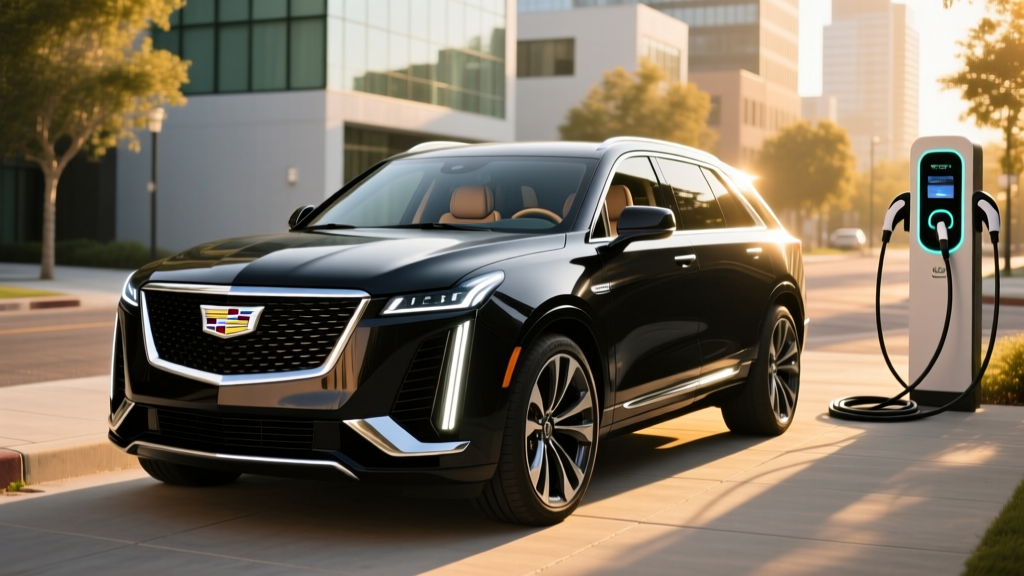
The 2026 Cadillac Escalade IQ 1000 e4 arrives as General Motors' answer to a question the luxury EV market has been asking for years: can a three-row, body-on-frame-class SUV go electric without sacrificing the presence, range, and towing capability its buyers demand? Built on GM's dedicated BT1 battery-electric platform — the same architecture underpinning the Silverado EV and Sierra EV — the Escalade IQ 1000 e4 packs a massive 200+ kWh Ultium battery, dual-motor all-wheel drive, and a 55-inch pillar-to-pillar display into a package starting just under $130,000.
But luxury EV shoppers need more than impressive spec sheets. They need to know what happens when the temperature drops, when the highway miles stack up, and when it's time to plug in at a public DC fast charger. We've analyzed the Escalade IQ 1000 e4's official EPA data, manufacturer specifications, and real-world EV physics to deliver the numbers that actually matter for ownership.
Range, Efficiency, and Real-World Expectations
The Escalade IQ 1000 e4 carries an EPA-estimated 460 miles of range — a figure that places it among the longest-range production EVs ever sold in the United States. That number is enabled by the 1000-designation battery pack: a 200+ kWh usable Ultium lithium-ion (NMC chemistry) module that dwarfs most competitors' offerings.
EPA Combined: 460 miles
Highway (70-80 mph sustained): Expect ~370-400 miles — large, boxy SUVs face significant aero drag at speed
Cold Weather (below 32°F): Expect ~320-370 miles — battery resistance increases and cabin heating draws substantial energy
Mixed real-world driving: ~390-430 miles in moderate conditions with mixed city/highway use
The 460-mile EPA figure is legitimate, but aerodynamic drag and a heavy curb weight mean highway and cold-weather driving will reduce that number by 13-30%. Plan road trips around ~350-mile realistic segments for comfort.
Efficiency for a vehicle this size is inherently compromised by physics. Cadillac estimates combined efficiency around 58 MPGe (roughly 58 kWh per 100 miles). That's thirstier than a Tesla Model X (102 MPGe combined) but expected for a vehicle pushing over 9,000 pounds GVWR with the frontal area of a full-size luxury SUV.
Battery, Platform, and Powertrain Specs
| Battery Capacity (Usable) | ~200+ kWh (NMC Ultium) |
| Battery Chemistry | NMC (Nickel Manganese Cobalt) — higher energy density, better cold-weather performance than LFP |
| Drivetrain | Dual-motor e4 AWD (permanent magnet front + rear) |
| Horsepower | 750 hp (Velocity mode) |
| Torque | 785 lb-ft |
| 0-60 mph | ~3.8 seconds (Velocity mode) |
| Top Speed | Electronically limited ~118 mph |
| Towing Capacity | Up to 8,000 lbs (properly equipped) |
| Platform | GM BT1 (dedicated EV, also used by Silverado EV / Sierra EV) |
The NMC chemistry choice is deliberate. While LFP (lithium iron phosphate) batteries offer longer cycle life and lower cost, NMC delivers the energy density required to push a vehicle of this mass past 450 miles. NMC also performs better in cold temperatures — a critical factor for Escalade buyers in northern climates. The trade-off is that NMC cells degrade slightly faster over time than LFP, though GM's thermal management system and large buffer should mitigate this meaningfully over a typical ownership period.
Charging: DC Fast, Level 2, and Home Setup
The Escalade IQ 1000 e4 supports DC fast charging at a peak rate of 200 kW via its NACS (North American Charging Standard) connector — meaning native access to Tesla Supercharger stations (with adapter or native NACS port, depending on production date) as well as Electrify America, EVgo, and other CCS-to-NACS-transitioning networks.
| Charging Level | Power | Miles Added per Hour | Time (10-80%) | Best Use Case |
|---|---|---|---|---|
| Level 1 (120V) | ~1.4 kW | ~3 mi/hr | N/A (impractical) | Emergency trickle only |
| Level 2 (240V, 48A) | 11.5 kW | ~22 mi/hr | ~14 hours (10-80%) | Overnight home charging |
| Level 2 (240V, 80A) | 19.2 kW | ~37 mi/hr | ~8.5 hours (10-80%) | High-power home / destination |
| DC Fast Charge | Peak 200 kW | ~380 mi/hr (peak) | ~35 minutes (10-80%) | Road trips |
Charging curve reality check: The 200 kW peak is not sustained across the full session. Expect peak charge rates between 10-40% State of Charge (SoC), with significant taper above 60% and steep taper above 80%. A 10-80% session takes approximately 35 minutes at a capable 200+ kW station. Charging from 80-100% adds another 25-30 minutes — plan accordingly and avoid charging past 80% on road trips unless necessary.
For home charging, the 19.2 kW Level 2 capability is a standout. With a hardwired 80-amp Level 2 station (such as a ChargePoint Home Flex or Tesla Wall Connector configured for 80A), you can add roughly 37 miles per hour of charging — enough to fully replenish overnight even after heavy driving days. However, an 80A circuit requires a 100-amp breaker and likely a 200-amp (or larger) home electrical panel. Budget $1,500-$3,500 for a professional Level 2 installation, potentially more if a panel upgrade is needed. Consult a licensed electrician for your specific setup.
Pricing, Trims, and Federal Tax Credit Eligibility
The 2026 Escalade IQ 1000 e4 is offered in multiple trim levels, with the range-topping 1000 e4 designation reserved for the largest battery and dual-motor AWD configuration.
| Trim | MSRP (incl. destination) | Key Features | §30D Credit Eligible? |
|---|---|---|---|
| Luxury 1 (85 kWh, base) | ~$129,990 | Standard luxury, ~300-mi range | Yes (MSRP under $80K cap — NO, exceeds cap) |
| Premium Luxury 2 | ~$148,700 | Enhanced tech, Super Cruise | No — exceeds $80K MSRP cap |
| 1000 e4 (Sport/Luxury) | ~$152,000-$175,000+ | 200+ kWh pack, 750 hp, 460-mi range | No — exceeds $80K MSRP cap |
The IRS §30D clean vehicle credit caps eligibility for SUVs at an $80,000 MSRP. Every Escalade IQ trim exceeds this threshold, meaning no Escalade IQ variant qualifies for the $7,500 federal tax credit. Additionally, buyer income caps ($300K joint / $150K single) and battery critical-mineral sourcing requirements further restrict eligibility even for qualifying vehicles.
Alternative incentives: Check your state and local utility programs — some states (e.g., California's CVRP, Colorado's state credit) offer additional rebates that may not carry the same MSRP caps. Always verify current rules with a tax professional before purchase.
Interior, Tech, and Cargo Capacity
The Escalade IQ's cabin is dominated by a 55-inch diagonal pillar-to-pillar LED display — effectively one continuous screen spanning the entire dashboard. This is paired with a secondary passenger display and an available executive rear-seat package with individual screens, reclining captain's chairs, and fold-out tables.
As a dedicated EV platform vehicle, the Escalade IQ benefits from a flat floor and optimized packaging:
- Seating: Up to 7 passengers (2-3-2) or 6 with second-row captain's chairs
- Cargo (behind 3rd row): ~24 cu ft
- Cargo (3rd row folded): ~68 cu ft
- Cargo (all rows folded): ~125 cu ft
- Front trunk (frunk): ~11.5 cu ft (weather-sealed, drainable — useful for tailgating or wet gear)
- Front headroom: ~42.5 in | Rear legroom (2nd row): ~42 in | 3rd-row legroom: ~35 in
The frunk is a practical addition that gas Escalades can't match, and the flat floor creates noticeably better third-row foot room than the ICE Escalade. However, the third row remains best suited for children or short-trip adults — a common limitation across three-row SUVs.
Driver Assistance and Smart Driving Tech
The Escalade IQ comes equipped with GM's Super Cruise — a hands-free (eyes-on) Level 2 driver-assistance system operational on over 750,000 miles of mapped roads in North America. Super Cruise uses a combination of LiDAR-mapped HD road data, real-time cameras, and GPS to enable hands-off highway driving with continuous driver monitoring via an infrared camera on the steering column.
Super Cruise is a driver-assistance system — not self-driving. The driver must remain attentive, keep eyes on the road (monitored by cabin camera), and be prepared to take over at any time. Hands may be off the wheel on compatible roads, but cognitive engagement is required. This is fundamentally different from Level 4 robotaxi services (Waymo, Zoox) that operate without any human driver.
Additional ADAS features include:
- Adaptive cruise control with stop-and-go
- Automatic emergency braking (front and rear pedestrian detection)
- Lane-keep assist with lane-departure warning
- HD surround-view camera with trailer hitch guidance
- Available Ultra Cruise (expanded hands-free coverage, expected via OTA)
Warranty and Long-Term Ownership
| Bumper-to-Bumper | 4 years / 50,000 miles |
| Powertrain | 6 years / 70,000 miles |
| Battery & Electric Components | 8 years / 100,000 miles (capacity retention above 70% threshold) |
| Corrosion | 6 years / unlimited miles |
| Roadside Assistance | 6 years / 70,000 miles |
The 8-year/100,000-mile battery warranty is standard for the segment and matches federal requirements for EV battery coverage. GM guarantees the battery will retain at least 70% of original capacity during the warranty period. Given the large battery buffer and Ultium's modular architecture, individual module replacement (rather than full pack) may be possible for out-of-warranty repairs — potentially reducing long-term cost. Full pack replacement, if ever needed, would likely exceed $25,000-$35,000 based on current Ultium pricing trajectories.
Pros, Cons, and Competitive Positioning
- 460-mile EPA range — among the longest of any production EV
- 750 hp with sub-4-second 0-60 — sports-car acceleration in a luxury tank
- NACS connector — native Supercharger access
- 19.2 kW home charging capability (fastest in class)
- Super Cruise hands-free driving on 750K+ miles of roads
- 8,000-lb towing capacity
- Massive frunk + flat-floor interior packaging
- 55-inch pillar-to-pillar display is genuinely impressive
- No federal tax credit — MSRP far exceeds $80K cap
- Efficiency is low (~58 MPGe) — high electricity cost per mile vs. rivals
- 35-minute 10-80% DC charge time is lengthy for road trips
- Curb weight likely exceeds 9,000 lbs — tire wear and braking distance concerns
- Third row still cramped for adults
- $130K-$175K+ pricing puts it in Bentley Bentayga territory
- Real-world highway range drops to ~370-400 miles
Who Should Buy the Escalade IQ 1000 e4?
- You need three rows, serious towing (8,000 lbs), and electric powertrain together
- You have reliable home Level 2 charging (ideally 19.2 kW / 80A)
- You value presence, technology, and American luxury over efficiency
- You frequently drive mapped Super Cruise routes for commuting
- Budget is not a primary constraint ($130K-$175K+)
- Efficiency and low running costs matter — look at the Tesla Model X or Rivian R1S
- You want the federal tax credit — the Rivian R1S (Dual-Motor Standard) starts under $80K and qualifies
- Third-row adult comfort is essential — the Mercedes EQS SUV offers more space
- You rarely tow and want something more nimble — the BMW iX or Cadillac Lyriq are more practical daily drivers
Frequently Asked Questions
What is the real-world range of the Cadillac Escalade IQ 1000 e4?
The EPA estimates 460 miles combined, but real-world highway driving at 70-80 mph will yield approximately 370-400 miles. In cold weather (below freezing), expect 320-370 miles. For road-trip planning, budget around 350 miles between charging stops for a comfortable margin.
How fast does the Escalade IQ charge at home and on the road?
At home on a 240V/80A Level 2 charger (19.2 kW), you'll add roughly 37 miles per hour — enough for a full overnight charge. On DC fast chargers, it peaks at 200 kW, reaching 10-80% in about 35 minutes. Level 1 (standard 120V outlet) is impractical for this vehicle, adding only ~3 miles per hour.
Does the Escalade IQ qualify for the $7,500 federal EV tax credit?
No. Under current IRS §30D rules, the federal clean vehicle credit caps SUV eligibility at $80,000 MSRP. All Escalade IQ trims exceed this threshold. State and utility incentives may still apply — check your local programs.
How does it compare to the Rivian R1S and Tesla Model X?
The Escalade IQ offers more range (460 vs. ~410 miles for R1S Max, ~348 for Model X) and a more opulent interior. The Rivian R1S is more efficient, more off-road capable, and available under the $80K tax-credit cap. The Tesla Model X is quicker, more efficient, and far less expensive — but lacks the Escalade's luxury presence and third-row practicality.
Is Super Cruise safe and reliable?
GM's Super Cruise is one of the most mature Level 2 systems available, with a strong safety record on its 750,000+ miles of mapped roads. It requires eyes-on attention at all times. NHTSA monitors all Level 2 systems, and Super Cruise has not been subject to the same scrutiny or incident reports as some competitor systems. It's a genuine convenience feature for highway commuting — not autonomous driving.
What will it cost to charge the Escalade IQ per month?
At the national average residential electricity rate of ~$0.16/kWh (per EIA data), charging the ~200 kWh battery from empty to full costs approximately $32. Driving 1,200 miles per month at 58 kWh/100mi would use ~696 kWh, costing roughly $111/month for home charging. DC fast charging at $0.35-$0.50/kWh would raise that to $244-$348/month. Compare this to a gas Escalade at 14 MPG and $3.50/gallon: ~$300/month in fuel.