When buyers research the 2026 Rivian R1S, most focus on horsepower and 0-60 times. But one spec quietly dictates how much you can carry, how far you can tow, how the suspension behaves under load, and even whether you qualify for certain tax incentives: the Rivian R1S GVWR (Gross Vehicle Weight Rating). Understanding this number across the Standard, Dual-Motor, and Max battery configurations is essential for families who plan to load up three rows, hook up a trailer, or maximize federal incentives.
This review breaks down the R1S lineup by the numbers — EPA range, battery chemistry, charging curves, real-world efficiency, and the §30D tax credit rules that hinge partly on vehicle weight class and MSRP caps. If you're weighing the R1S against the Tesla Model X, BMW iX, or Mercedes EQS SUV, the weight story matters more than you'd think.
Rivian R1S GVWR by Battery Pack: The Full Breakdown
GVWR represents the maximum allowable total weight of the vehicle including passengers, cargo, and accessories (but not trailer tongue weight, which counts separately under GCWR). The 2026 R1S is offered with three battery tiers on the second-generation platform, and each shifts the GVWR meaningfully.
| Spec | Standard (LFP) | Dual-Motor (NMC) | Max Pack (NMC) |
|---|---|---|---|
| Battery Capacity (usable) | ~92 kWh | ~109 kWh | ~141 kWh |
| Chemistry | LFP (prismatic) | NMC (cylindrical 4680-type) | NMC (cylindrical 4680-type) |
| Curb Weight (approx.) | ~6,800 lbs | ~7,000 lbs | ~7,300 lbs |
| GVWR | ~8,500 lbs | ~8,800 lbs | ~9,100 lbs |
| Max Payload | ~1,700 lbs | ~1,800 lbs | ~1,800 lbs |
| Max Tow Rating | 7,700 lbs | 7,700 lbs | 7,700 lbs |
Two takeaways: first, the Max Pack adds roughly 500 lbs of battery mass, which the chassis compensates for with a higher GVWR but which also directly impacts efficiency. Second, all R1S variants stay under the 10,000-lb GVWR threshold, which matters for commercial tax credit classification (more on that in the pricing section).
EPA Range vs. Real-World Range: What the Sticker Doesn't Tell You
Standard (LFP): EPA 270 mi → expect ~235-250 mi highway, ~200 mi in sub-freezing cold.
Dual-Motor (NMC): EPA 340 mi → expect ~290-310 mi highway, ~240 mi in cold.
Max Pack (NMC): EPA 400 mi → expect ~340-365 mi highway, ~280 mi in cold.
EPA range figures assume a mixed city/highway drive cycle with moderate climate use. The R1S's boxy aerodynamics (drag coefficient around 0.38) and 7,000+ lb curb weight penalize highway efficiency more than sedans. On a flat 70-mph cruise, expect consumption around 48-52 kWh/100 mi depending on pack. Add a 5,000-lb trailer and that figure jumps to roughly 90-100 kWh/100 mi, cutting effective range nearly in half.
Cold weather compounds the hit. Below 32°F, the R1S's heat pump helps, but cabin heating, battery preconditioning, and denser air still reduce range 15-25%. Max Pack owners in northern climates should plan for ~280 usable winter miles — still excellent for a three-row SUV, but below the 400-mi sticker.
Efficiency ratings from fueleconomy.gov place the Dual-Motor R1S around 73 MPGe combined (roughly 46 kWh/100 mi), which is competitive with the BMW iX xDrive50 and slightly behind the more aerodynamic Tesla Model X.
Charging Speed: DC Fast, Level 2, and the Curve Reality
Rivian upgraded the Gen 2 R1S electrical architecture to support faster DC charging, but peak kW is not sustained kW — the charge curve tapers significantly above 80% state of charge to protect battery longevity.
| Metric | Standard (LFP) | Dual / Max (NMC) |
|---|---|---|
| Peak DC Fast-Charge Rate | ~200 kW | ~220 kW (Dual) / ~220 kW (Max) |
| 10-80% DC Time | ~28 min | ~21 min (Dual) / ~27 min (Max) |
| Level 2 (11.5 kW AC) | ~16 mi/hr | ~20-25 mi/hr |
| Connector | NACS (native Tesla Supercharger access) | NACS (native) |
| Miles Added in 15 min (avg) | ~110 mi | ~140 mi (Dual) / ~140 mi (Max) |
On a 250-kW Electrify America or Tesla V4 Supercharger, the Dual-Motor R1S pulls its peak rate only between roughly 15-55% SoC. Above 80%, charging slows to under 50 kW — typical behavior, but worth knowing if you're planning road-trip stops. Rivian's navigation system preconditions the battery when a charger is set as the destination, which can improve peak rates by 15-20% in cold weather.
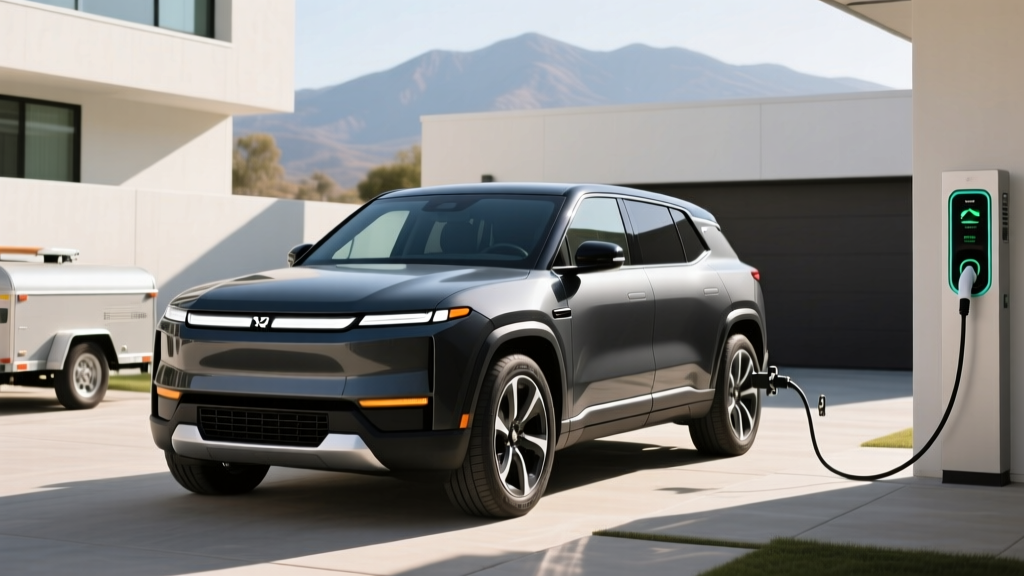
At home on a 48-amp Level 2 wall connector (11.5 kW), overnight charging is painless. A full Standard pack replenishes in about 9 hours; the Max Pack takes closer to 13 hours. Most owners charge from 20-80% daily, which takes 5-7 hours — easily within a single night's window.
Performance, Drivetrain, and What GVWR Means on the Road
Every 2026 R1S ships with dual-motor AWD as standard (a single-motor RWD was never offered on the R1S, unlike the R1T). The performance gap between trims is significant:
- Dual-Motor: ~533 hp, ~610 lb-ft torque, 0-60 mph in ~4.5 sec
- Performance Dual-Motor: ~665 hp, ~820 lb-ft, 0-60 mph in ~3.4 sec
- Tri-Motor (Max Pack option): ~850 hp, ~1,100+ lb-ft, 0-60 mph in ~2.9 sec
GVWR directly affects ride quality under load. The R1S uses an adaptive air suspension that automatically adjusts ride height and damping. Near GVWR (seven passengers plus cargo), the air springs firm up to prevent squat, and the regen braking system compensates for the additional kinetic energy. Owners who frequently tow or haul will notice the Max Pack's extra 300 lbs of battery mass makes the chassis feel more planted — at the cost of ~2 MPGe in everyday driving.
Towing capacity holds at 7,700 lbs across all packs, competitive with the BMW iX (no tow rating in the U.S.) and slightly below the Tesla Model X (5,000 lbs). For boat, horse, or camper trailer duty, the R1S is the strongest three-row electric SUV in its class.
Interior, Cargo, and Three-Row Practicality
The R1S seats up to seven in a 2-3-2 layout, with an optional six-seat captain's-chair configuration. Cargo volume breaks down as follows:
- Behind third row: ~10.5 cu ft (tight for a week's groceries with all seats up)
- Behind second row (third folded): ~46 cu ft
- Behind first row (all rear folded): ~88 cu ft
- Front trunk (frunk): ~11 cu ft (weatherproof, drainable — ideal for muddy gear)
Second-row legroom measures ~38.5 inches, and third-row legroom is ~30.5 inches — best reserved for children or short trips. The R1S is slightly tighter in the third row than the Tesla Model X but offers superior cargo flexibility thanks to the flat load floor and wide hatch opening. The frunk alone solves the "where do we put wet shoes" problem that plagues most family SUVs.
The 15.6-inch center touchscreen runs Rivian's in-house software, which has matured considerably since 2022. Wireless CarPlay and Android Auto are now standard, over-the-air updates arrive monthly, and the built-in Rivian Adventure Network maps integrate charger status in real time. Driver assistance falls under Rivian's Driver+ system — a Level 2 SAE hands-on/highway system with lane centering and adaptive cruise. It is not self-driving and requires continuous driver attention.
Pricing, Trims, and Federal Tax Credit Eligibility
| Configuration | Base MSRP | Typical As-Tested |
|---|---|---|
| Dual-Motor Standard | ~$75,900 | $80,000-$85,000 |
| Dual-Motor (109 kWh) | ~$82,900 | $88,000-$95,000 |
| Performance Dual-Motor | ~$89,900 | $96,000-$105,000 |
| Tri-Motor Max Pack | ~$104,900 | $110,000-$120,000 |
Federal tax credit eligibility under IRS §30D is the most confusing piece of the R1S purchase. Here's the framework:
- MSRP Cap: SUVs must be at or below $80,000 MSRP to qualify. Most Dual-Motor Standard trims fit; Dual-Motor (109 kWh) and above generally exceed the cap.
- Buyer Income Cap: AGI ≤ $300,000 (married joint), $225,000 (head of household), $150,000 (single).
- Battery Sourcing: Critical minerals and battery component requirements phase in annually. As of 2026, nearly all content must be U.S./FTA-sourced. Rivian manufactures in Normal, Illinois, but cell sourcing varies — confirm the specific VIN's eligibility on the IRS qualified vehicles list before purchase.
- Point-of-Sale Transfer: Eligible buyers can apply up to $7,500 as an immediate dealer discount rather than a tax-year credit.
- GVWR Requirement: Vehicle must be under 14,000 lbs GVWR (all R1S trims qualify).
In practice, only the base Dual-Motor Standard R1S reliably clears the $80,000 MSRP threshold. Buyers targeting the Dual-Motor (109 kWh) or Max Pack should budget without the federal credit, though state incentives (Colorado, California, and others) may still apply. Always confirm with a tax professional — rules shift annually.
Battery Warranty, Degradation, and Long-Term Ownership
Rivian covers the R1S battery and drive units with an 8-year / 175,000-mile warranty, with a capacity retention threshold of 70%. This is among the strongest in the segment — Tesla covers 8 years / 150,000 miles on the Model X, and BMW covers 8 years / 100,000 miles on the iX.
The LFP Standard pack has a chemistry advantage for longevity: LFP cells tolerate routine 100% charging and exhibit slower calendar degradation than NMC. Rivian recommends daily charging to 100% on LFP vehicles. The NMC Dual and Max packs benefit from staying between 20-80% for daily use, with 100% reserved for road trips. Real-world degradation data from 2023-2024 R1S owners suggests ~5-7% capacity loss over the first 60,000 miles — well within warranty tolerance and consistent with industry averages.
Insurance costs for the R1S run higher than comparable ICE SUVs. Expect annual premiums of $2,800-$3,800 depending on state and driving record, roughly 20-30% above a similarly priced BMW X5. Get quotes before signing.
Rivian R1S vs. Competitors: Who Wins Where?
| Metric | Rivian R1S Dual | Tesla Model X LR | BMW iX xDrive50 |
|---|---|---|---|
| EPA Range | 340 mi | 335 mi | 324 mi |
| Seating | 7 (or 6) | 5, 6, or 7 | 5 only |
| Tow Rating | 7,700 lbs | 5,000 lbs | 3,500 lbs |
| 0-60 mph | 4.5 sec | 3.8 sec | 4.4 sec |
| Base MSRP | ~$82,900 | ~$81,630 | ~$87,250 |
| Battery Warranty | 8 yr / 175k mi | 8 yr / 150k mi | 8 yr / 100k mi |
| Frunk | Yes (11 cu ft) | Small (3 cu ft) | No |
The R1S wins decisively on towing, cargo flexibility, and third-row usability. The Model X counters with slightly quicker acceleration, broader Supercharger network access (though Rivian's NACS adoption has closed this gap), and lower starting pricing on the Long Range trim. The BMW iX is the refinement and ride-quality leader but seats only five and tows far less — it's a luxury crossover, not a family hauler.
Pros, Cons, and Who Should Buy the R1S
- Class-leading 7,700-lb tow rating
- True 7-seat three-row layout with frunk
- 175,000-mile battery warranty
- NACS native — full Supercharger access
- Strong off-road capability (air suspension + quad-motor option)
- LFP option for buyers who want daily 100% charging
- Most trims exceed the $80,000 §30D MSRP cap
- Third-row legroom tight for adults
- Real-world highway range trails EPA by ~10-15%
- Insurance premiums above segment average
- Tri-Motor Max Pack pushes past $120,000 as-tested
Buy the R1S if: You need three rows, tow regularly, value off-road capability, and want the longest battery warranty in the class. The Dual-Motor Standard is the sweet spot for buyers who can stay under the §30D MSRP cap.
Look elsewhere if: You only need five seats (BMW iX offers better ride refinement), you want the lowest possible cost of entry (Model X LR undercuts on MSRP), or you drive predominantly highway miles in cold climates where the range penalty hits hardest.
Frequently Asked Questions
What is the real-world range of the Rivian R1S?
Expect 290-310 highway miles from the Dual-Motor (EPA 340), 235-250 from the Standard LFP (EPA 270), and 340-365 from the Max Pack (EPA 400). Cold weather, towing, and aggressive driving reduce these figures 15-30%.
How fast does the R1S charge at home and on the road?
On a 250-kW DC fast charger, the Dual-Motor reaches 10-80% in about 21 minutes. At home on an 11.5-kW Level 2 wall connector, expect 20-25 miles of range per hour of charging.
Does the 2026 Rivian R1S qualify for the federal EV tax credit?
Only trims at or below $80,000 MSRP qualify under §30D — generally the Dual-Motor Standard. Higher trims exceed the SUV MSRP cap. Buyer income, battery sourcing, and point-of-sale transfer rules also apply. Confirm on the IRS qualified vehicle list before purchasing.
Is the R1S worth buying over the Tesla Model X or BMW iX?
For families who tow, carry seven passengers, or venture off-pavement, the R1S is the strongest option in the segment. The Model X wins on acceleration and price; the iX wins on ride quality and refinement for five-passenger duty.
How does GVWR affect towing and payload?
The R1S's 8,500-9,100 lb GVWR (depending on pack) leaves roughly 1,700-1,800 lbs of payload capacity after curb weight. That's enough for seven passengers and moderate cargo, but heavy loads will compress the air suspension and reduce range. The 7,700-lb tow rating is separate and governed by GCWR.
What is the battery warranty on the R1S?
Rivian covers the battery and drive units for 8 years or 175,000 miles, whichever comes first, with a minimum 70% capacity retention guarantee.