Can a Rivian Survive the Cannonball Run?
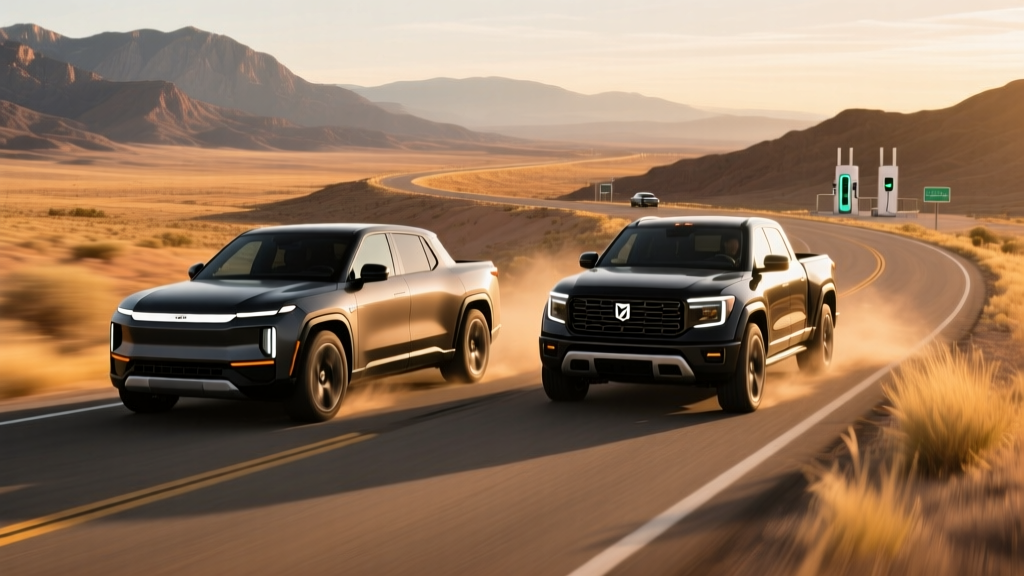
The Cannonball Run — an unsanctioned coast-to-coast speed record attempt from New York to Los Angeles — has historically been a playground for high-displacement internal-combustion machines. But as DC fast-charging infrastructure has expanded along I-80 and I-70, EV owners have started asking: can a Rivian R1S or R1T realistically compete in a Cannonball Run-style cross-country dash in 2026?
This isn't about endorsing illegal speed runs. It's about stress-testing the Rivian platform's ultimate road-trip capability — range, sustained highway efficiency, charging speed, route planning, and comfort over 2,800+ miles. If a Rivian can handle Cannonball-style logistics, it can handle any road trip you'll actually take.
Below, we break down the 2026 Rivian R1S (3-row SUV) and R1T (pickup) through the lens of maximum-distance, minimum-time driving — with hard numbers on range, charging curves, and ownership costs.
Rivian R1S & R1T: 2026 Powertrain and Spec Overview
Rivian offers both the R1S and R1T on the same skateboard platform with shared battery and motor configurations. For the 2026 model year, Rivian's Gen 2 architecture delivers meaningful efficiency and charging improvements over the original 2022-2024 models.
| Spec | Dual-Motor Standard | Dual-Motor Max | Tri-Motor (R1T only) |
|---|---|---|---|
| Drivetrain | AWD (dual-motor) | AWD (dual-motor) | AWD (tri-motor) |
| Horsepower | 533 hp | 533 hp | 850 hp |
| 0-60 mph | 4.5 sec | 4.5 sec | 2.9 sec |
| Battery (usable) | ~92 kWh (Standard) | ~128 kWh (Max) | ~128 kWh (Max) |
| Chemistry | NMC (Gen 2 prismatic) | NMC (Gen 2 prismatic) | NMC (Gen 2 prismatic) |
| EPA Range (R1S) | 270 mi | 410 mi | N/A |
| EPA Range (R1T) | 270 mi | 420 mi | ~370 mi |
| Efficiency (R1S Max) | ~76 MPGe / 44 kWh/100mi | ~68 MPGe / 49 kWh/100mi | |
| Max DC Fast Charge | 200 kW | 220 kW | 220 kW |
| 10-80% DCFC Time | ~27 min | ~30 min | ~30 min |
| Level 2 Home Charging | 11.5 kW (~25 mi/hr on Max pack) | ||
| Cargo (R1S, behind 3rd row) | 20.5 cu ft / 91.6 cu ft max | ||
| Cargo (R1T bed) | 54 cu ft bed + 11 cu ft gear tunnel + 11 cu ft frunk | ||
| Towing Capacity | 7,700 lbs (R1T) / 7,700 lbs (R1S) | ||
| Base MSRP (R1S) | $79,900 | $89,900 | N/A |
| Base MSRP (R1T) | $74,800 | $84,800 | $99,900 |
Source: Rivian R1S specs, fueleconomy.gov. Tri-Motor R1S availability TBD for 2026.
Real-World Range: What the EPA Sticker Doesn't Tell You
EPA (R1S Max Pack): 410 miles
Real-world highway (70-75 mph, moderate temps): ~320-340 miles
Real-world highway (80+ mph, Cannonball pace): ~260-290 miles
Cold-weather highway (below 32°F): ~250-280 miles (Max Pack)
Towing (5,000+ lb trailer): ~180-210 miles
The R1S and R1T are tall, boxy vehicles with the aerodynamic profile of, well, an SUV and a pickup. At sustained speeds above 75 mph, air resistance dominates energy consumption. Rivian's Gen 2 powertrain is more efficient than Gen 1, but physics is physics — pushing a 7,000-lb vehicle through air at 80+ mph burns electrons fast.
For a Cannonball Run scenario, where average speeds might hover around 80-90 mph (with stops), expect the Max Pack's real usable range to drop to roughly 260-290 miles between charging stops. That's still enough to space out DC fast-charging stops at 200-250 mile intervals, which aligns well with Electrify America and Tesla Supercharger spacing along I-80 and I-70.
The Standard Pack (270 EPA) is a non-starter for speed-run logistics. You'd be stopping every 160-180 real-world miles — too frequent to maintain competitive pace.
Charging Speed: The Bottleneck in Any EV Road Race
Charging speed determines your road-trip pace more than range does. Rivian's Gen 2 battery architecture supports faster DC charging than the original Samsung-sourced cylindrical cells, but it still trails the Hyundai/Kia 800V E-GMP platform and Tesla's latest V4 Supercharger vehicles.
| Charging Method | Power (kW) | Rate (mi/hr added) | Notes |
|---|---|---|---|
| Level 1 (120V / 12A) | 1.4 kW | ~3 mi/hr | Emergency/trickle only |
| Level 2 (240V / 48A) | 11.5 kW | ~25 mi/hr | Overnight home charging; 0-100% in ~12 hrs |
| DC Fast Charge (peak) | 220 kW | ~500+ mi/hr (at peak) | Peak rate sustained ~10-40% SoC |
| DC Fast Charge (avg 10-80%) | ~160 kW avg | — | 10-80% in ~30 min (Max Pack) |
| DC Fast Charge (80-100%) | 40-60 kW taper | — | Avoid; adds 25+ min for last 20% |
Charge curve reality check: The 220 kW peak rate on the Max Pack is achieved at low state-of-charge (roughly 10-35% SoC) and tapers significantly above 60%. For Cannonball-style logistics, the optimal strategy is arriving at chargers at ~10-15% SoC and departing at 70-75% — keeping you in the fastest part of the curve. That means ~20-25 minute stops, which is competitive with a bathroom-and-coffee break.
Rivian's NACS (Tesla-style) charge port is now standard on 2026 models, giving direct access to the Tesla Supercharger network — the most reliable and dense DC fast-charging network in the US. Along the Cannonball route (typically I-80 through Pennsylvania, Ohio, Indiana, Illinois, Iowa, Nebraska, and across the West), Supercharger stations are spaced roughly every 150-200 miles, which is ideal for the Max Pack's real-world highway range.
Performance: Tri-Motor Bragging Rights vs. Dual-Motor Practicality
The Tri-Motor R1T's 2.9-second 0-60 time is supercar-quick, but for a cross-country run, launch performance is irrelevant. What matters is sustained high-speed stability, ride comfort, and drivetrain efficiency.
Rivian's dual-motor AWD system uses a permanent-magnet front motor and a rear motor with a disconnect clutch (Gen 2) that can decouple under light-load cruising to reduce drag losses. The air suspension lowers the vehicle at highway speeds, reducing frontal area and improving efficiency by roughly 3-5% compared to the standard ride height.
For a Cannonball scenario, the Dual-Motor Max Pack is the optimal configuration — it offers the best efficiency-to-range ratio. The Tri-Motor's extra weight and power consumption (~49 kWh/100mi vs. ~44 kWh/100mi) cost you range without adding highway-cruise value.
2026 Pricing, Trims, and Federal Tax Credit Eligibility
Rivian's pricing positions the R1S and R1T firmly in the premium segment. Here's the current lineup and how the federal tax credit factors in:
| Model / Trim | MSRP | MSRP Cap (§30D) | Eligible for $7,500 Credit? |
|---|---|---|---|
| R1T Dual-Motor Standard | $74,800 | $80,000 (trucks) | Potentially — if under MSRP cap & buyer meets income limits |
| R1T Dual-Motor Max | $84,800 | $80,000 (trucks) | No — exceeds MSRP cap |
| R1T Tri-Motor Max | $99,900 | $80,000 (trucks) | No — exceeds MSRP cap |
| R1S Dual-Motor Standard | $79,900 | $80,000 (SUVs) | Potentially — just under MSRP cap |
| R1S Dual-Motor Max | $89,900 | $80,000 (SUVs) | No — exceeds MSRP cap |
Under IRS §30D, the $7,500 federal credit requires:
• MSRP cap: $80,000 for SUVs/pickups/vans; $55,000 for sedans
• Buyer income cap: AGI ≤ $300,000 (MFJ), $225,000 (HoH), $150,000 (single)
• Battery sourcing: Critical minerals and battery component requirements phase in annually — verify current-year compliance on the DOE/IRS eligible vehicle list
• Point-of-sale transfer: Eligible buyers can transfer the credit to the dealer for an upfront price reduction
Only the base Dual-Motor Standard configurations come close to MSRP eligibility. Consult a tax professional for your specific situation.
Realistically, most Rivian buyers will not qualify for the full $7,500 credit due to MSRP caps on higher trims. The R1S Dual-Motor Standard at $79,900 squeaks under the $80,000 SUV cap, but adding any options or packages pushes it over. The R1T Standard at $74,800 has more headroom.
Road-Trip Comfort and Tech: 2,800 Miles in a Rivian
The Cannonball Run isn't just about powertrain logistics — it's about human endurance. Here's how the Rivian platform holds up for long-haul comfort:
Seating: The R1S offers three rows with 38.9 inches of second-row legroom and 33.1 inches in the third row. The R1T has a single row with 41.3 inches of front legroom. Seats are well-bolstered and ventilated (available), which matters on 30+ hour drives.
Infotainment: Rivian's 15.6-inch center display runs a custom OS with integrated navigation that factors in real-time charger availability, elevation, temperature, and driving style for range predictions. The system received meaningful OTA updates through 2025, improving route planning accuracy. Wireless Apple CarPlay and Android Auto are standard.
Driver Assistance: Rivian's Driver+ system is a Level 2 (SAE) hands-on-wheel adaptive cruise and lane-centering system. It is not a hands-off or self-driving system. It works well on interstate highways, reducing fatigue over long stretches, but requires continuous driver engagement. This is a critical distinction — no consumer vehicle sold in 2026 offers Level 3+ autonomous driving outside of geofenced robotaxi services.
Notable drawbacks: The R1S/R1T still lacks Apple CarPlay integration in the instrument cluster (navigation shows only on the center screen). Road noise at 80+ mph is noticeable due to the boxy shape and large tire contact patches. The panoramic glass roof, while stunning, increases cabin heat load in desert stretches (Nevada/Utah on I-70), requiring more HVAC energy.
Is the Rivian Worth It vs. Key Competitors?
For cross-country road-trip duty, the Rivian's main EV competitors are the Tesla Model X, BMW iX, Mercedes EQS SUV, and (for the truck segment) the Chevrolet Silverado EV and Ford F-150 Lightning.
- Class-leading Max Pack range (410-420 mi EPA)
- NACS port = direct Tesla Supercharger access
- Air suspension lowers for highway efficiency
- Genuine off-road capability (not just a crossover)
- R1T gear tunnel + frunk = unmatched storage versatility
- Over-the-air updates continuously improve the platform
- Premium build quality and materials
- Boxy aero = steep efficiency loss above 75 mph
- 220 kW peak DCFC trails 800V rivals (Ioniq 9, Lucid)
- Most trims exceed §30D MSRP cap — no federal credit
- Starting near $75K-$80K is premium pricing
- No hands-free driving system (Level 2 only)
- Third-row space in R1S is tight for adults on long trips
- Service center availability still limited in rural areas
- You want a premium adventure SUV/truck with genuine off-road chops AND 400+ mile range
- You value Tesla Supercharger access without an adapter
- You need R1T bed/frunk/gear tunnel versatility for gear-heavy trips
- You're okay paying premium prices without a federal tax credit
- Maximum highway efficiency is your top priority (consider Lucid Gravity or BMW iX)
- You need the fastest DC charging in the business (consider 800V platforms like the Hyundai Ioniq 9)
- Budget is under $60K (consider the Chevy Equinox EV or Hyundai Ioniq 5)
Warranty and Long-Term Ownership
Rivian provides a competitive warranty package for the 2026 model year:
- Battery & Drive Units: 8 years / 175,000 miles (whichever comes first), with a minimum 70% capacity retention guarantee
- Vehicle Limited Warranty: 5 years / 60,000 miles
- Roadside Assistance: 5 years / 60,000 miles
The 175,000-mile battery warranty is generous and reflects confidence in the Gen 2 NMC prismatic cells. For context, a Cannonball Run adds roughly 2,800 miles — a rounding error in the context of long-term ownership. Rivian's battery degradation data from Gen 1 vehicles (2022-2024) shows roughly 5-7% loss over the first 60,000 miles, which is within industry norms for NMC chemistry.
Frequently Asked Questions
What is the real-world highway range of the Rivian R1S and R1T?
The Max Pack R1S achieves 410 miles EPA, but expect roughly 320-340 miles at 70-75 mph in moderate temperatures. At sustained 80+ mph speeds, plan for 260-290 miles. Cold weather (below freezing) reduces range by an additional 15-25%. The Standard Pack (270 EPA) delivers roughly 200-220 real-world highway miles.
How fast does the Rivian charge on DC fast chargers and at home?
The Gen 2 Max Pack peaks at 220 kW on DC fast chargers, completing a 10-80% charge in approximately 30 minutes. The Standard Pack peaks at 200 kW with a 10-80% time of about 27 minutes. At home on a Level 2 (240V/48A) charger, the Max Pack adds roughly 25 miles of range per hour, requiring about 12 hours for a full charge from empty.
Does the Rivian qualify for the $7,500 federal EV tax credit in 2026?
Only the base Dual-Motor Standard configurations come close to eligibility. The R1S Standard at $79,900 is just under the $80,000 SUV MSRP cap, and the R1T Standard at $74,800 is under the truck cap. However, buyer income limits (AGI ≤ $300K joint), battery sourcing requirements, and option packages that push MSRP over the cap can all disqualify you. Verify current eligibility on fueleconomy.gov and consult a tax professional.
Is the Rivian worth buying vs. the Tesla Model X or Ford F-150 Lightning?
The Rivian R1S offers more range (Max Pack), better off-road capability, and more distinctive design than the Model X, but the Tesla charges faster and has a more mature Supercharger-native ecosystem. The R1T outclasses the F-150 Lightning in range, performance, and build quality, but the Lightning is significantly cheaper (starting ~$55K) and may qualify for the full tax credit. Choose Rivian for premium adventure capability; choose Lightning for value and work-truck utility.
Can a Rivian realistically do the Cannonball Run route?
Yes, with the Max Pack. You'd plan stops every 220-250 miles at Tesla Superchargers (now NACS-native), with each stop taking roughly 20-25 minutes (10-70% SoC). Over the ~2,800-mile NYC-to-LA route, that's approximately 12-14 charging stops, adding roughly 5-6 hours of charging time to the drive. It won't set a Cannonball record against optimized ICE vehicles, but it's a fully viable cross-country EV road trip.
What are the biggest drawbacks of the Rivian for road trips?
The boxy shape creates significant aerodynamic drag at highway speeds, which reduces range more than sleeker SUVs. DC fast-charging speed (220 kW peak) is adequate but trails 800V competitors. Service center coverage is still expanding, which could complicate repairs in rural stretches. And most configurations are priced above the §30D MSRP cap, meaning no federal tax credit for most buyers.