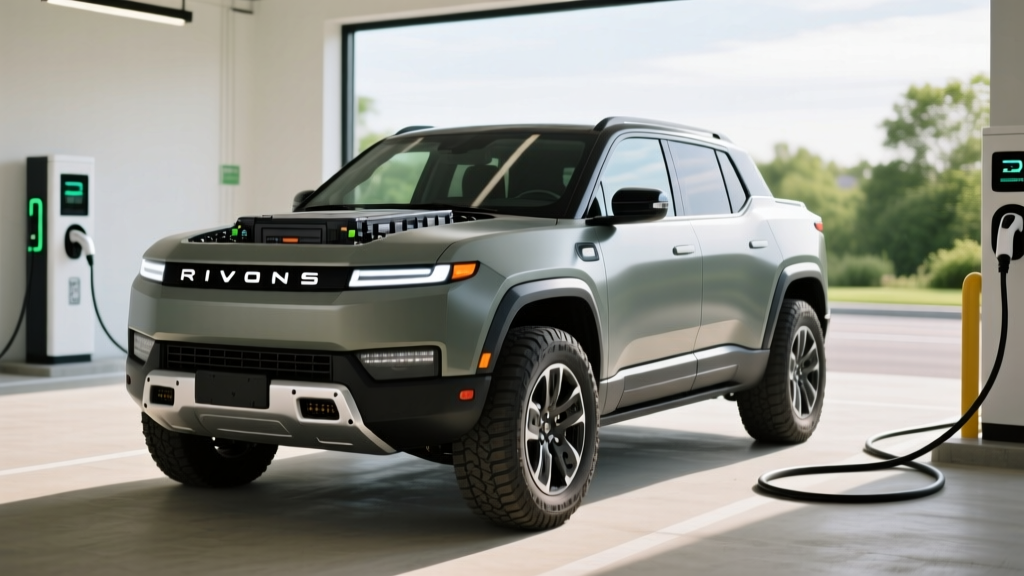
The Rivian R1S has carved out a unique niche as the electric SUV that actually delivers on the "adventure vehicle" promise. But for 2026, it's the lesser-discussed Rivian Gear Guard — the integrated cargo security and bed/cargo management system bundled into Rivian's ecosystem — that has prospective buyers searching for details. This review covers the full R1S (and relevant R1T) platform with a deep focus on the Gear Guard feature set, alongside the hard numbers that matter: real-world range, charging speed, pricing after federal tax credits, and whether this rig earns its premium sticker.
What Is Rivian Gear Guard and Why It Matters
Rivian Gear Guard is not a standalone vehicle — it's the branded cargo security and management system integrated into both the R1S SUV and R1T pickup. On the R1T, it encompasses the lockable gear tunnel (67 cu ft of enclosed, weather-sealed storage between the cab and bed), the powered tonneau cover, integrated tie-downs, and the bed's built-in air compressor and 120V/240V outlets. On the R1S, Gear Guard extends to the rear cargo area's modular tie-down system, the available powered cargo cover, and the vehicle-wide digital monitoring accessible through the Rivian app — which sends alerts if cargo doors, the gear tunnel, or the tailgate are opened unexpectedly.
For overlanders, cyclists, and anyone hauling expensive equipment, Gear Guard solves a genuine pain point: securing gear without resorting to aftermarket lockboxes. The gear tunnel on the R1T locks independently from the cab and bed, meaning you can leave surfboards, camera equipment, or camping gear secured even when the vehicle is parked at a trailhead overnight. The Rivian app provides real-time status on every latch and door, and the available Camp Kitchen slides out from the tunnel on motorized rails — a clever integration that adds utility but also complexity.
Rivian R1S & R1T: 2026 Specs at a Glance
| Spec | Value |
|---|---|
| EPA Range (Max Pack) | 410 miles |
| EPA Range (Standard Pack) | 270 miles |
| Battery Capacity (Max Pack) | 149 kWh usable (NMC) |
| Battery Capacity (Standard) | 106 kWh usable (LFP) |
| Max DC Fast Charge | 220 kW (Max) / 200 kW (Standard) |
| 10–80% DC Charge Time | ~30 min (Max) / ~25 min (Standard) |
| Level 2 Home Charge Rate | 11.5 kW (~25 mi/hr) |
| 0–60 mph (Dual-Motor) | 4.5 seconds |
| 0–60 mph (Tri-Motor) | 2.9 seconds |
| Horsepower (Dual-Motor) | 533 hp |
| Horsepower (Tri-Motor) | 850 hp |
| MPGe (Dual-Motor Max) | 73 MPGe combined |
| Efficiency | 46 kWh/100 mi |
| Towing Capacity | 7,700 lbs |
| Battery Warranty | 8 years / 175,000 miles |
| Base MSRP (R1S Dual-Motor Standard) | $79,900 |
| As-Tested (R1S Tri-Motor Max) | $104,500 |
Range Reality: EPA Sticker vs. What You'll Actually Get
EPA Estimate: 410 miles (R1S Dual-Motor Max Pack)
Real-World Highway (70–75 mph): Expect 310–340 miles
Cold Weather (below 30°F): Expect 260–300 miles
Mixed Commuting (city + suburban): 370–400 miles (regen-heavy driving recovers energy)
The 410-mile EPA figure on the Max Pack is genuinely impressive for a three-row SUV weighing over 7,100 lbs. But physics doesn't bend for anyone. At sustained highway speeds of 70–75 mph, aerodynamic drag on a boxy SUV with a flat roofline and available all-terrain tires shaves 15–20% off the sticker. In winter conditions, battery thermal management draws additional energy, and cabin heating (even with the standard heat pump) compounds the loss. Rivian's heat pump is among the better systems in the segment, limiting cold-weather losses to roughly 25–30% rather than the 40% some competitors experience.
The Standard Pack's 106 kWh LFP (lithium iron phosphate) battery sacrifices range — 270 miles EPA — but gains cycle-life longevity. LFP chemistry tolerates daily 100% charging without the degradation concerns of NMC, making it the pragmatic pick for commuters who charge at home nightly and rarely road-trip beyond 200 miles round-trip. The Max Pack's NMC chemistry delivers higher energy density but benefits from charging to 80–90% for daily use, reserving 100% for long trips.
Charging Speed: Home, Public, and the Charge Curve Truth
| Charging Level | Power | Miles Added per Hour | Notes |
|---|---|---|---|
| Level 1 (120V household) | 1.4 kW | ~3 mi/hr | Emergency/trickle only |
| Level 2 (240V, 48A home) | 11.5 kW | ~25 mi/hr | Full charge in ~13 hrs (Max Pack) |
| DC Fast Charge (peak) | 220 kW | ~400+ mi/hr (at peak) | 10–80% in ~30 min |
| DC Fast Charge (sustained avg) | ~150 kW avg | ~280 mi/hr avg | Curve tapers above 60% SoC |
Rivian's 220 kW peak DC fast-charge rate on the Max Pack is competitive but not class-leading — the Hyundai Ioniq 5 and Kia EV9 hit 240–250 kW peaks on 800V architectures. The critical detail is the charge curve: the R1S sustains close to peak rate from roughly 10–40% state of charge, then progressively tapers. From 60–80%, expect rates closer to 100–120 kW. This means the advertised "10–80% in 30 minutes" is achievable at a well-maintained 350 kW Electrify America or Tesla Supercharger stall (with NACS adapter or built-in NACS port on 2025+ models), but real-world sessions at older 150 kW stations will stretch to 40–45 minutes.
For home charging, Rivian recommends a 60A circuit with a 48A continuous charger (like the Rivian Wall Charger or a ChargePoint Home Flex). A full overnight charge from 20% to 100% on the Max Pack takes roughly 13 hours — plan accordingly. Standard Pack owners will see a full charge in about 9 hours at the same rate. Home installation of a Level 2 charger typically runs $800–$2,200 depending on panel capacity and conduit distance, according to the U.S. Department of Energy.
Performance, Drivetrain, and the Tri-Motor Question
The dual-motor R1S produces 533 horsepower and 610 lb-ft of torque, launching to 60 mph in 4.5 seconds — brisk for a vehicle with genuine off-road capability and three rows. The tri-motor variant (one front, two rear) pushes 850 hp and a 2.9-second 0–60 time, which is supercar territory in a 7,100-lb SUV. Both use Rivian's proprietary single-speed reduction gear, and all variants come standard with all-wheel drive.
Where the Rivian platform earns credibility is off-pavement. The available air suspension provides up to 14.9 inches of ground clearance, and the quad-motor option (on the R1T primarily) enables tank turns. For most buyers, the dual-motor is the value pick — the tri-motor's performance advantage is thrilling but costs roughly $10,000 more and reduces range by approximately 20–30 miles due to the additional motor's weight and parasitic losses.
Pricing, Trim Levels, and Federal Tax Credit Eligibility
| Trim / Config | MSRP | Est. After §30D Credit |
|---|---|---|
| R1S Dual-Motor Standard (106 kWh LFP) | $79,900 | $72,400* |
| R1S Dual-Motor Large (128 kWh NMC) | $87,400 | $79,900* |
| R1S Dual-Motor Max (149 kWh NMC) | $94,900 | $87,400* |
| R1S Tri-Motor Max (149 kWh NMC) | $104,500 | $97,000* |
*Tax credit estimates assume full §30D eligibility. See caveats below.
Rivian's pricing positions the R1S firmly in the premium electric SUV segment, competing with the Tesla Model X, BMW iX, and Mercedes EQS SUV. The base dual-motor Standard at $79,900 is the most accessible entry point, but most buyers opt for the Large or Max pack for the range buffer.
- MSRP Cap: SUVs/vans/pickups must be under $80,000 MSRP. The R1S Dual-Motor Standard ($79,900) qualifies; Large, Max, and Tri-Motor trims exceed the cap and are ineligible.
- Buyer Income Cap: AGI must not exceed $150,000 (single), $225,000 (head of household), or $300,000 (joint filers).
- Battery Sourcing: Critical minerals and battery components must meet phased-in percentage thresholds from U.S. or FTA-partner countries. Rivian has worked to qualify, but verify current-year status at fueleconomy.gov before purchasing.
- Point-of-Sale Transfer: Eligible buyers can transfer the credit to the dealer at purchase, reducing the out-of-pocket price immediately rather than waiting for tax filing.
- Always verify: Rules change annually. Consult IRS.gov §30D guidance and a tax professional.
The critical takeaway: only the base R1S Dual-Motor Standard at $79,900 squeaks under the $80,000 SUV MSRP cap for the $7,500 federal credit. Every other R1S configuration — and all R1T trims above the base — exceed the cap and do not qualify for §30D. This is a significant factor in the total cost calculation. State-level incentives (California's CVRP, Colorado's $5,000 credit, etc.) may partially offset higher trims, but these vary by jurisdiction.
Cargo, Passenger Space, and Gear Guard Utility
The R1S offers 104.8 cu ft of total cargo volume behind the first row (with second and third rows folded), 57.7 cu ft behind the second row, and 20.5 cu ft behind the third row. Third-row legroom measures 30.3 inches — adequate for children on longer trips but tight for adults. Second-row legroom is a generous 38.5 inches, and the front row provides 41.3 inches.
For Gear Guard specifically, the R1S's powered cargo cover and integrated tie-down rails are practical but less transformative than the R1T's gear tunnel. The R1T's tunnel — 67 cu ft of lockable, pass-through storage — is where the Gear Guard concept truly shines. It accommodates skis, snowboards, fishing rods, and the optional Camp Kitchen (a slide-out unit with an induction cooktop, sink, and utensil storage). The tunnel's independent locking means valuables remain secure even when the bed is open or the cab is unlocked for valet.
Notable drawback: the R1S's front trunk (frunk) was eliminated in the second-generation refresh to accommodate additional drivetrain components, reducing total storage versus the first-gen model. Competitors like the Tesla Model X retain a small frunk for charging cables and emergency supplies.
Tech, Driver Assistance, and Ownership Experience
Rivian's software stack is proprietary and among the most polished in the EV space. The 15.6-inch center display runs a responsive, custom OS with native route planning that integrates charging stops, elevation data, and weather. Over-the-air updates are frequent and substantive — Rivian has added features like improved regen profiles, updated driver-assist tuning, and new camping modes post-delivery.
The Driver+ suite is a Level 2 driver-assistance system (per SAE classification) combining adaptive cruise control and lane-centering on divided highways. It is competent and well-calibrated but requires hands-on-wheel engagement at all times. It is not autonomous driving, and Rivian does not market it as such — a refreshing honesty compared to some competitors' naming conventions. Automatic emergency braking, blind-spot monitoring, and a 360-degree camera system are standard across all trims.
Rivian Driver+ is a Level 2 system. The driver must keep hands on the steering wheel and eyes on the road at all times. It does not handle construction zones, unmapped roads, or severe weather autonomously. It is an assist feature, not a replacement for an attentive driver.
Warranty and Long-Term Battery Outlook
Rivian provides an 8-year/175,000-mile battery and powertrain warranty — one of the more generous mileage thresholds in the segment, exceeding the industry-standard 100,000-mile benchmark. The warranty guarantees the battery will retain at least 70% of its original capacity during the coverage period. Rivian's NMC packs in early R1S and R1T deliveries (2022–2023 model years) have shown degradation in line with industry norms: approximately 5–8% loss over the first 40,000–50,000 miles, after which the curve flattens significantly.
The LFP Standard Pack is expected to demonstrate even slower degradation — LFP chemistry routinely exceeds 3,000 charge cycles before reaching 80% capacity, translating to well over 500,000 miles of theoretical use. For second-owner confidence and long-term cost of ownership, the LFP option is arguably the more durable choice despite its range sacrifice.
Pros, Cons, and the Verdict
- 410-mile Max Pack range is top-tier for a three-row SUV
- Gear Guard / gear tunnel is genuinely useful for active lifestyles
- Air suspension delivers 14.9" ground clearance — real off-road capability
- 8-year/175,000-mile battery warranty exceeds most competitors
- LFP Standard Pack option for daily-use longevity
- OTA updates are meaningful and frequent
- Only the $79,900 base trim qualifies for the §30D tax credit
- 220 kW peak charge rate trails 800V competitors (Ioniq 5, EV9)
- Third-row legroom (30.3") is tight for adults
- No frunk on second-generation R1S
- Premium pricing: well-equipped models push past $100,000
- Service center network still expanding in rural areas
- Choose the R1S Standard Pack ($79,900) if you commute under 150 miles daily, charge at home, want the $7,500 tax credit, and value LFP longevity over maximum range.
- Choose the R1S Max Pack ($94,900+) if you regularly road-trip 300+ miles, tow a camper (up to 7,700 lbs), or live in cold climates where range buffer matters — but accept the loss of federal credit eligibility.
- Look elsewhere (Tesla Model X, Kia EV9) if third-row adult comfort is a priority, you need the fastest possible DC charging, or your budget is firmly under $70,000.
Frequently Asked Questions
What is the real-world range of the Rivian R1S?
The EPA rates the R1S Dual-Motor Max Pack at 410 miles. In real-world highway driving at 70–75 mph, expect 310–340 miles. In cold weather below 30°F, plan for 260–300 miles. City and suburban driving with regenerative braking recovers more energy, approaching the EPA figure.
How fast does the Rivian R1S charge at home and on the road?
On a Level 2 home charger (11.5 kW / 48A), the Max Pack gains about 25 miles per hour, with a full charge taking ~13 hours. On a DC fast charger, it peaks at 220 kW, achieving 10–80% in approximately 30 minutes under optimal conditions. Sustained average rate across the full session is closer to 150 kW due to charge-curve tapering above 60% SoC.
Does the Rivian R1S qualify for the federal EV tax credit?
Only the base R1S Dual-Motor Standard at $79,900 qualifies under the §30D MSRP cap of $80,000 for SUVs. Higher trims (Large, Max, Tri-Motor) exceed the cap. Buyer income limits ($150K single / $300K joint) and battery-sourcing requirements also apply. Verify current eligibility at fueleconomy.gov and consult a tax professional.
Is the Rivian R1S worth buying over the Tesla Model X or Kia EV9?
The R1S wins on off-road capability, gear security (Gear Guard / gear tunnel), and adventure-oriented design. The Model X offers faster Supercharger network access and a more spacious third row. The Kia EV9 is significantly cheaper ($55,000–$73,000) and charges faster at 240 kW, but offers less range and no off-road pretensions. Your priority — adventure utility vs. value vs. charging speed — determines the winner.
What is Rivian Gear Guard and is it standard?
Gear Guard is Rivian's integrated cargo security and management system, including lockable compartments (gear tunnel on R1T), tie-down systems, digital monitoring via the app, and powered cargo covers. Core elements are standard across trims; the Camp Kitchen and some modular accessories are optional add-ons.
How does the LFP Standard Pack compare to the NMC Max Pack?
The 106 kWh LFP Standard offers 270 miles of range but supports daily 100% charging with minimal degradation, making it ideal for home-charging commuters. The 149 kWh NMC Max delivers 410 miles but benefits from 80–90% daily charging limits. LFP is heavier per kWh but offers a longer cycle life — often exceeding 3,000 cycles before 80% capacity retention.