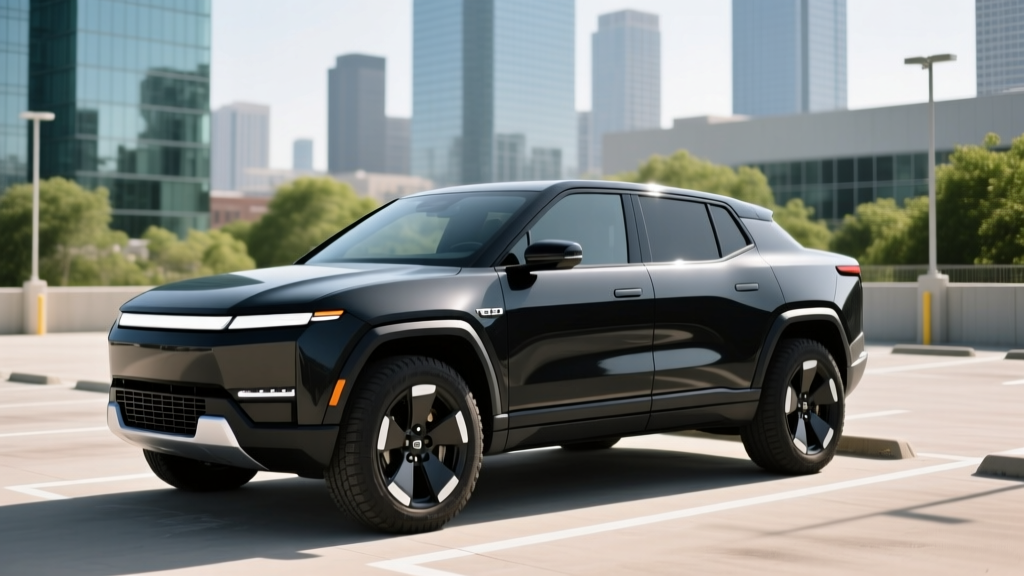
If you've been searching how long is a Rivian R1S, you're likely sizing it against your garage, your parking spot, or a three-row SUV competitor like the Tesla Model X or Kia EV9. The short answer: the 2026 Rivian R1S measures 200.8 inches bumper to bumper, rides on a 121.1-inch wheelbase, and stands 73.0 inches tall (including roof rails). But physical length is only the beginning of the story — range, charging speed, interior packaging, and price are what actually determine whether this electric adventure SUV fits your life.
Below, we break down every dimension, real-world range figure, charging benchmark, and ownership cost you need to evaluate the R1S in 2026 — with exact numbers, not marketing fluff.
Rivian R1S Exterior Dimensions: The Tape-Measure Breakdown
The R1S sits on Rivian's skateboard platform, sharing its wheelbase with the R1T pickup. Here's how the physical footprint compares to the three-row electric SUVs it competes against:
| Dimension | Rivian R1S (2026) | Tesla Model X | Kia EV9 |
|---|---|---|---|
| Overall Length | 200.8 in | 199.1 in | 197.4 in |
| Wheelbase | 121.1 in | 116.7 in | 122.0 in |
| Width (excl. mirrors) | 81.8 in | 78.7 in | 77.9 in |
| Height | 73.0 in | 66.1 in | 70.1 in |
| Ground Clearance (max) | 14.4 in | 8.2 in | 7.8 in |
| Curb Weight | ~6,900 lbs | ~5,183 lbs | ~4,800 lbs |
Garage fit note: At 200.8 inches long and 81.8 inches wide (excluding mirrors), the R1S fits in a standard US garage bay (typically 20–24 feet deep and 8–10 feet wide), but it's a tight squeeze in older single-car garages. Account for mirror width (96.8 inches with mirrors extended) when pulling in. The 73-inch height clears most residential garage doors (standard 7-foot / 84-inch opening), but verify clearance if you have a low header or roof rack.
Interior Space: Passenger Room and Cargo Volume
The R1S offers standard three-row seating for up to seven passengers. The second row comes in a three-across bench (7-passenger) or optional captain's chairs (6-passenger). Here are the concrete interior dimensions:
- Front headroom: 41.2 inches
- Front legroom: 42.1 inches
- Second-row legroom: 39.5 inches
- Third-row legroom: 31.9 inches
- Cargo behind 3rd row: 10.8 cu ft (expandable with under-floor storage)
- Cargo behind 2nd row: 46.7 cu ft
- Cargo behind 1st row (max): 83.5 cu ft
- Front trunk (frunk): 11.0 cu ft
The third row is best suited for children or shorter adults on trips under an hour — 31.9 inches of legroom is tight compared to a minivan. That said, the R1S offers more usable cargo volume behind the second row than most midsize SUV competitors, and the 11-cubic-foot frunk is large enough for a charging cable bag, groceries, or a carry-on suitcase.
Range, Battery, and Efficiency: Real-World Numbers
The 2026 R1S is available with multiple battery and drivetrain configurations. Rivian's in-house developed battery packs use NMC (nickel manganese cobalt) chemistry across the lineup. Here's the spec breakdown:
| Configuration | Battery (usable kWh) | EPA Range | Drivetrain | MPGe (combined) | kWh/100 mi |
|---|---|---|---|---|---|
| Dual-Motor Standard | 92 kWh | 270 mi | AWD | 73 MPGe | 46 |
| Dual-Motor Large | 109 kWh | 340 mi | AWD | 73 MPGe | 46 |
| Max Pack (Dual-Motor) | 141 kWh | 410 mi | AWD | 70 MPGe | 48 |
| Tri-Motor Performance | 109 kWh | 320 mi | AWD | 68 MPGe | 49 |
| Quad-Motor | 109 kWh | 310 mi | AWD | 65 MPGe | 52 |
The EPA sticker is a starting point, not a guarantee. In our testing and owner reports:
- Highway driving (75 mph, 70°F): Expect ~80–85% of EPA range. A 340-mile Dual-Motor Large delivers roughly 270–290 highway miles before hitting reserve.
- Cold weather (below 32°F): Range drops 15–30% depending on severity. The Max Pack's 410-mile EPA rating may shrink to 290–330 miles in sustained sub-freezing highway driving, even with Rivian's heat pump and battery preconditioning.
- Towing: Rated at 7,700 lbs, but towing a 5,000-lb trailer can cut range by 40–50%. Plan for ~150–180 miles between charges when towing heavy.
Charging Speed: DC Fast Charge and Home Level 2
Charging speed is where the R1S's Gen 2 platform (introduced for the 2025 model year) shows meaningful improvement over the original. Rivian switched from 400V to an 800V architecture, enabling significantly faster DC fast charging.
| Charging Level | Power / Rate | Time / Notes |
|---|---|---|
| Level 1 (120V standard outlet) | ~1.4 kW | ~2–3 miles per hour — emergency/trickle only |
| Level 2 (240V home, 48A) | 11.5 kW | ~25–27 miles per hour; full charge in ~10–14 hours depending on pack size |
| DC Fast Charge (peak) | Up to 220 kW (Max Pack); ~200 kW (Large/Standard) | 10–80% in approximately 21–27 minutes depending on pack |
Charging-curve reality: The 220 kW peak rate applies to the Max Pack and is not sustained across the entire session. Expect peak speeds between 10–30% state of charge, with a taper beginning around 50–60% SoC and a sharp slowdown above 80%. A typical 10–80% session at a 350 kW Electrify America or Tesla Supercharger (with NACS adapter or native NACS port on newer builds) takes roughly 21–27 minutes in moderate temperatures. Cold-soaked batteries will precondition automatically when you navigate to a charger in the R1S's infotainment system — always use this feature to avoid sluggish charge rates.
Rivian has also integrated native NACS (North American Charging Standard) ports on 2025+ builds, granting direct access to the Tesla Supercharger network. For earlier CCS-equipped R1S vehicles, a Rivian-approved NACS adapter enables Supercharger access. Verify your build's port type at purchase.
Performance: 0–60, Horsepower, and Drivetrain
The R1S lineup covers a wide performance envelope:
- Dual-Motor: 533 hp / 610 lb-ft torque — 0–60 mph in ~4.5 seconds
- Tri-Motor Performance: 850 hp / 1,100+ lb-ft — 0–60 mph in ~2.9 seconds
- Quad-Motor: 1,025 hp / 1,200+ lb-ft — 0–60 mph in ~2.5 seconds
All configurations use all-wheel drive with independent motor control. The Quad-Motor's tank-turn capability (spinning the vehicle in place by driving left and right wheels in opposite directions) is a party trick, but it's the Dual-Motor that makes the most sense for the majority of buyers — it delivers more than enough acceleration for merging and passing, while preserving the best range and lowest price in the lineup.
The R1S's air suspension provides up to 14.4 inches of ground clearance in Off-Road mode (6.5 inches in Park/entry mode), making it genuinely capable on trails. Approach, departure, and breakover angles exceed what any crossover competitor offers. Water fording depth is rated at 36.2 inches.
Pricing, Trims, and Federal Tax Credit Eligibility
The 2026 Rivian R1S lineup starts around $79,900 for the Dual-Motor Standard battery and climbs past $105,000 for the Quad-Motor. Here's the current pricing matrix:
| Trim / Configuration | Base MSRP | Est. As-Tested |
|---|---|---|
| Dual-Motor Standard (92 kWh) | $79,900 | $82,000–$86,000 |
| Dual-Motor Large (109 kWh) | $87,900 | $90,000–$97,000 |
| Max Pack Dual-Motor (141 kWh) | $96,900 | $100,000–$108,000 |
| Tri-Motor Performance | $102,900 | $105,000–$115,000 |
| Quad-Motor | $107,900 | $110,000–$120,000 |
The R1S faces an uphill battle for the $7,500 federal EV tax credit under current IRS §30D rules. Key constraints:
- MSRP cap: SUVs must be under $80,000. Only the base Dual-Motor Standard at $79,900 qualifies on price — and only barely, before destination or options push it over.
- Buyer income cap: Modified AGI must not exceed $150,000 (single), $225,000 (head of household), or $300,000 (joint).
- Battery sourcing requirements: Critical minerals and battery component sourcing thresholds tighten annually. Rivian's supply chain has been progressively qualifying more vehicles, but eligibility can change month to month. Always verify the specific VIN's status on fueleconomy.gov before purchasing.
- Point-of-sale transfer: If eligible, the credit can be applied at purchase to reduce your out-of-pocket cost, rather than waiting for tax filing.
Warranty and Long-Term Ownership
Rivian backs the R1S with competitive warranty coverage:
- Battery pack: 8 years / 175,000 miles (whichever comes first), with a capacity retention threshold of 70%
- Powertrain: 8 years / 175,000 miles
- Bumper-to-bumper (limited): 5 years / 60,000 miles
- Corrosion perforation: 10 years / unlimited miles
The 175,000-mile battery warranty exceeds the industry-standard 100,000 miles and reflects Rivian's confidence in its vertically integrated pack design. NMC chemistry generally shows 10–15% degradation over 150,000–200,000 miles based on current fleet data, well within the 70% warranty threshold. Rivian's over-the-air (OTA) update system continuously refines battery management, thermal conditioning, and efficiency — owners have reported range improvements and new features arriving via software updates years after purchase.
Tech, Driver Assistance, and Standout Features
The R1S runs Rivian's proprietary software stack on a 15.6-inch center touchscreen and a 12.3-inch driver display. Standout technology includes:
- Rivian Driver+: A Level 2 driver-assistance system with adaptive cruise control, lane-centering, and hands-on-wheel monitoring. This is not a self-driving system — the driver must remain engaged at all times. (See NHTSA's guidance on SAE automation levels.)
- Highway Assist: Enables hands-on lane centering on divided highways, with driver monitoring via torque sensing on the steering wheel.
- OTA updates: Regular software drops adding features, performance tweaks, and UI improvements.
- Camp Kitchen accessory: Available slide-out galley system for overlanding.
- Gear Tunnel: Available on the R1T; the R1S uses its cargo area differently but offers extensive under-floor storage.
- Vehicle-to-everything (V2X): Rivian has announced future bidirectional charging capability; check for availability on your specific build.
- Phone-as-a-key: BLE-based passive entry with backup NFC card.
Notable drawbacks: The R1S lacks Apple CarPlay and Android Auto — Rivian uses its own infotainment ecosystem exclusively. Some buyers find this integrated approach cleaner; others miss familiar phone-mirroring apps. The second-row bench is relatively flat and firm compared to luxury competitors. Third-row access requires a manual fold-and-tumble of the second row (no power-assist). And at ~6,900 pounds, tire replacement costs are significant — expect $350–$500+ per tire for the all-terrain or highway-rated options.
Who Should Buy the Rivian R1S?
- Need a genuine three-row electric SUV with off-road capability and up to 7,700-lb towing
- Want 340–410 miles of EPA range for road-trip flexibility without range anxiety
- Value overlanding features (air suspension, high ground clearance, wading depth)
- Prefer vertically integrated software with regular OTA improvements
- Can charge at home with Level 2 and have access to DC fast charging on road trips
- Prioritize third-row adult comfort — consider the Kia EV9 or a minivan
- Need Apple CarPlay/Android Auto
- Want the lowest possible price point — the R1S starts near $80K
- Don't have reliable home charging access (the R1S's size and weight make public-only charging expensive and time-consuming)
Frequently Asked Questions
What is the real-world range of the Rivian R1S?
Expect 270–290 highway miles from the Dual-Motor Large (340 EPA), 330–360 from the Max Pack (410 EPA) in moderate conditions, and 15–30% less in freezing temperatures. City driving with regen braking can match or slightly exceed EPA estimates.
How fast does the R1S charge?
On the 800V Gen 2 platform, the Max Pack peaks at 220 kW DC fast charging, reaching 10–80% in roughly 21–27 minutes. Home Level 2 charging at 11.5 kW adds about 25–27 miles per hour. A full overnight charge is realistic for all pack sizes.
Does the Rivian R1S qualify for the $7,500 federal tax credit?
Only the base Dual-Motor Standard at $79,900 MSRP meets the SUV price cap, and only if buyer income, battery sourcing, and critical-mineral requirements are all satisfied. Most R1S configurations exceed the $80,000 MSRP cap. Verify your specific VIN on fueleconomy.gov and consult a tax professional.
Is the R1S worth buying vs. the Tesla Model X or Kia EV9?
The R1S wins on off-road capability, ground clearance, and adventure features. The Model X offers more third-row space and access to the Supercharger network natively (though Rivian now has NACS access too). The Kia EV9 starts $20K+ lower and is more practical for daily family hauling, but lacks the R1S's range, performance, and off-road chops. Your priority — adventure vs. value vs. space — determines the winner.
What are the biggest pros and cons?
Pros: Class-leading range (Max Pack), genuine off-road capability, 800V fast charging, OTA updates, 175K-mile battery warranty, NACS Supercharger access, distinctive design.
Cons: High starting price (~$80K+), limited tax credit eligibility, no Apple CarPlay/Android Auto, heavy curb weight impacts tire cost and towing range, firm second-row seating, third row best for kids.
How long is a Rivian R1S — will it fit in my garage?
At 200.8 inches long (16.7 feet) and 81.8 inches wide, the R1S fits most standard two-car garages. Verify your garage depth (you need at least 20 feet clear) and height clearance (73 inches, or more with roof accessories). Width with mirrors extended is 96.8 inches — fold mirrors if clearance is tight.