Rivian R1S at a Glance: Colors, Specs, and Real-World Ownership
The Rivian R1S remains one of the most capable electric SUVs on the market — a three-row family hauler that can tow 7,700 pounds, ford rivers, and still park at a grocery store. For 2026, the R1S continues with its Generation 2 platform introduced for the 2025 model year, featuring Rivian's in-house drive units, a redesigned electrical architecture, and a refreshed palette of exterior and interior options. If you've been searching for Rivian R1S colors and trying to figure out which configuration actually makes sense for your daily driving, this guide breaks down every exterior paint option, interior theme, and the hard numbers behind range, charging, and pricing.
We'll also cover what the EPA sticker doesn't tell you about real-world range, how the R1S charges on the road and at home, whether it qualifies for the federal §30D tax credit under current IRS rules, and how it stacks up against the Tesla Model X, BMW iX, and Mercedes EQS SUV.
2026 Rivian R1S Exterior Colors: The Full Palette
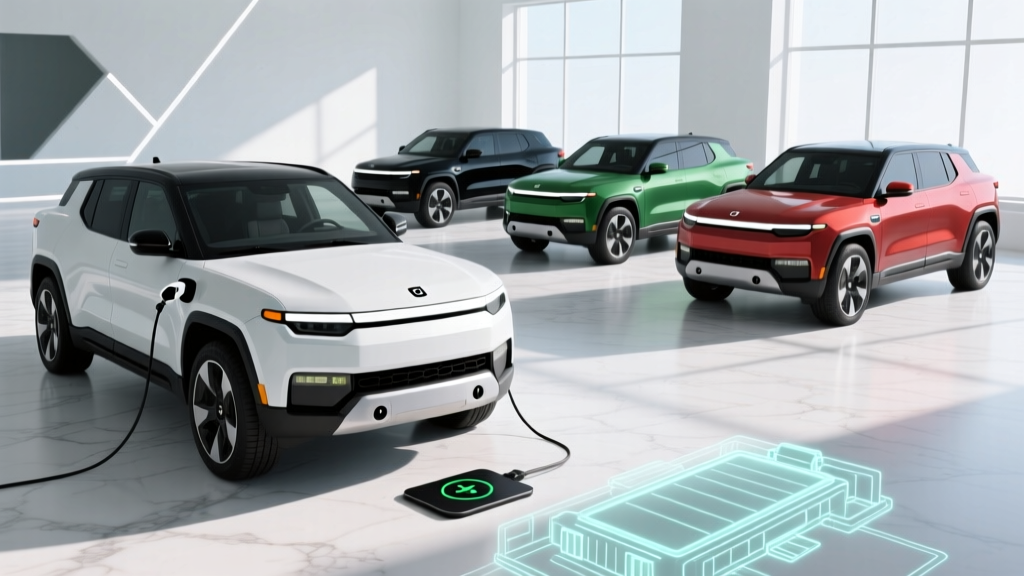
Rivian offers seven exterior colors for the 2026 R1S across its Adventure, Adventure Dual-Motor, and Tri-Motor configurations. The color selection leans earthy and outdoorsy — fitting for a vehicle marketed toward adventure seekers — but there's enough variety to suit urban buyers as well.
| Color Name | Finish | Price Add-On | Notes |
|---|---|---|---|
| Glacier White | Solid | $0 | Standard no-cost option; hides dust well |
| Midnight Black | Metallic | $0 | Standard; shows swirl marks more readily |
| Forest Green | Metallic | $0 | Rivian's signature heritage color |
| Canyon Red | Metallic | $0 | Vibrant; popular on Adventure trims |
| El Cap Granite | Metallic | $0 | Warm gray-stone tone; sophisticated neutral |
| Coastal Blue | Metallic | $2,500 | Premium color; shifts hue in different light |
| Rivian Waymo Edition (limited) | Special | TBD | Limited-run color for select configurations |
Rivian also offers a color-matched gear tunnel (on configurations equipped with the optional gear tunnel accessory) and available black or silver roof options depending on trim. The brand has historically rotated one or two seasonal colors in and out each model year, so availability can shift. Always confirm current options on Rivian's configurator before placing a deposit.
Interior Color Themes
The 2026 R1S interior comes in four primary themes:
- Black Mountain: All-black vegan leather with dark wood trim (standard)
- Ocean Coast: Light gray-blue with ash wood accents (+$1,000)
- Forest Edge: Two-tone green and black with eucalyptus wood (+$1,000)
- Desert Cove: Warm tan with light oak trim (+$1,000)
All interiors use Rivian's proprietary vegan leather material, which has held up well in long-term ownership reports with minimal cracking or wear after 40,000+ miles.
Range, Battery, and Efficiency: What the EPA Doesn't Tell You
The 2026 Rivian R1S is offered with two battery packs and multiple motor configurations, which significantly affect range. Here's the official breakdown:
| Configuration | Battery Pack | Usable Capacity | Chemistry | EPA Range | MPGe (Combined) | kWh/100 mi |
|---|---|---|---|---|---|---|
| Dual-Motor Standard | Standard | ~92 kWh | NMC (Nickel Manganese Cobalt) | 270 mi | 73 MPGe | 46 |
| Dual-Motor Large | Large | ~109 kWh | NMC | 340 mi | 73 MPGe | 46 |
| Dual-Motor Max | Max | ~141 kWh | NMC | 410 mi | 70 MPGe | 48 |
| Tri-Motor Large | Large | ~109 kWh | NMC | 315 mi | 68 MPGe | 49 |
All R1S battery packs use NMC (nickel manganese cobalt) chemistry. Rivian does not currently offer an LFP (lithium iron phosphate) option in the R1S. NMC provides higher energy density — critical for fitting 141 kWh into a pack that still allows for ground clearance and off-road capability — but it requires more careful thermal management and benefits from not being regularly charged to 100% for daily use.
The EPA combined range figure blends city and highway driving. In real-world testing, the R1S Dual-Motor Large (EPA 340 mi) typically delivers:
- Highway (70-75 mph): ~280-300 miles — the tall, boxy SUV shape creates significant aerodynamic drag at speed
- City/Suburban: ~330-350 miles — regenerative braking recovers energy effectively
- Cold weather (below 32°F): ~240-270 miles — expect 20-30% range loss due to battery heating demands and cabin HVAC use
- Towing (5,000+ lb trailer): ~150-180 miles — towing cuts range roughly in half
The Max Pack's 410-mile EPA rating is genuinely useful for road trips, but plan for ~330-350 real-world highway miles in moderate temperatures.
Efficiency of 46-49 kWh/100 miles is typical for a large, heavy electric SUV. For comparison, the Tesla Model X achieves roughly 40-42 kWh/100 miles thanks to its more aerodynamic profile, while the Mercedes EQS SUV sits around 44-46 kWh/100 miles. The R1S trades efficiency for off-road capability, ground clearance (up to 14.9 inches), and a rugged build.
Charging Speed: DC Fast Charge and Home Level 2
Charging speed is where the R1S Generation 2 platform made significant improvements over the original 2022-2024 models. Here's what to expect:
| Charging Level | Power / Rate | Speed (Miles Added) | Time / Notes |
|---|---|---|---|
| Level 1 (120V household) | ~1.4 kW | ~3-4 mi/hr | Emergency/trickle only; full charge takes days |
| Level 2 (240V home, 48A) | 11.5 kW | ~25-27 mi/hr | Full charge overnight (~12-14 hrs for Max Pack) |
| Level 2 (240V home, 60A circuit) | ~11.5 kW (vehicle-limited) | ~25-27 mi/hr | R1S onboard charger caps at 11.5 kW |
| DC Fast Charge (peak) | 220 kW (Max Pack) | ~550 mi/hr (at peak) | 10-80% in ~27-30 min (Large/Max) |
| DC Fast Charge (Standard Pack) | ~190 kW | ~475 mi/hr (at peak) | 10-80% in ~25-28 min |
A few important notes on R1S charging behavior:
- Charge curve taper: The R1S peaks at 220 kW only between roughly 15-40% state of charge. Above 60%, the rate drops significantly — to around 80-100 kW — and above 85% it slows to under 40 kW. This is normal NMC behavior but means the advertised 10-80% time is where the speed lives; 80-100% can add another 25+ minutes.
- Preconditioning: The R1S automatically preconditioning the battery when you navigate to a DC fast charger in the infotainment system. This warms the pack to optimal temperature and is essential for achieving peak charge rates, especially in cold weather. Always route through the nav system when heading to a charger.
- NACS connector: The 2026 R1S comes equipped with the NACS (North American Charging Standard) connector natively, giving it direct access to Tesla Supercharger stalls (now open to non-Tesla EVs via the NACS standard). CCS adapters are available for older Electrify America and other CCS-only stations.
- Home charging reality: The R1S's 11.5 kW onboard charger means that even with a 60-amp circuit and 48-amp charger, you're limited to 11.5 kW. For the Max Pack's 141 kWh battery, a full Level 2 charge from 10% takes roughly 13-14 hours. Most owners charge nightly and rarely need a full 0-100% cycle.
For home Level 2 installation, budget $800-$2,500 for a quality hardwired charger (Rivian sells its own Wall Connector for $650) plus $500-$2,000 for electrician labor depending on your panel capacity and run distance. Homes with 100-amp electrical panels may need a $1,500-$3,000 panel upgrade to support a dedicated 60-amp EV circuit.
Performance: Dual-Motor and Tri-Motor Compared
The R1S Generation 2 uses Rivian's in-house designed and manufactured drive units, replacing the Bosch-sourced motors from the first generation. The result is more power, better efficiency, and reduced weight.
| Configuration | Horsepower | Torque (lb-ft) | 0-60 mph | Drivetrain | Towing Capacity |
|---|---|---|---|---|---|
| Dual-Motor | 533 hp | 610 | 4.5 sec | AWD | 7,700 lb |
| Performance Dual-Motor | 665 hp | 829 | 3.4 sec | AWD | 7,700 lb |
| Tri-Motor | 850 hp | 1,103 | 2.9 sec | AWD | 7,700 lb |
The Tri-Motor R1S is absurdly quick for a 7,000-pound three-row SUV — a 2.9-second 0-60 time rivals sports cars. But the sweet spot for most buyers is the Performance Dual-Motor, which delivers 3.4-second sprints (still faster than nearly every SUV on the road) at a lower price and better efficiency than the Tri-Motor.
All configurations feature adaptive air suspension with adjustable ride height (from 6.4 inches for highway efficiency to 14.9 inches for off-road clearance), a flat floor thanks to the skateboard battery architecture, and Rivian's quad-motor torque vectoring (on Tri-Motor) for precise off-road traction control.
Pricing, Trims, and Federal Tax Credit Eligibility
The 2026 Rivian R1S pricing structure starts at $79,900 for the Dual-Motor Standard Pack and climbs significantly with options and larger batteries.
| Trim / Configuration | Base MSRP | Typical As-Tested | §30D Federal Credit | Effective Price |
|---|---|---|---|---|
| Dual-Motor Standard (270 mi) | $79,900 | $84,000-$88,000 | Up to $7,500* | ~$72,400-$80,500 |
| Dual-Motor Large (340 mi) | $89,900 | $94,000-$100,000 | Up to $7,500* | ~$82,400-$92,500 |
| Dual-Motor Max (410 mi) | $99,900 | $105,000-$112,000 | Up to $7,500* | ~$92,400-$104,500 |
| Tri-Motor Large (315 mi) | $104,900 | $110,000-$118,000 | Up to $7,500* | ~$97,400-$110,500 |
*Federal §30D tax credit eligibility is subject to multiple requirements per current IRS rules:
- MSRP cap: SUVs must have an MSRP of $80,000 or below to qualify. This means the Dual-Motor Standard qualifies at base, but most R1S configurations with options exceed the cap. The Large and Max Pack models generally do NOT qualify for the full credit at their base MSRP.
- Buyer income cap: Adjusted gross income must not exceed $300,000 (married filing jointly), $225,000 (head of household), or $150,000 (single).
- Battery sourcing: Critical minerals and battery component requirements phase in annually. For 2026, a significant percentage of battery components must be manufactured or assembled in North America, and critical minerals must be sourced from the US or FTA partners. Rivian manufactures in Normal, Illinois, which helps, but specific credit amounts depend on the supply chain for each build.
- Point-of-sale transfer: As of 2024, buyers can transfer the credit to the dealer at point of sale, reducing the purchase price directly rather than waiting for a tax refund. This is available for the R1S.
The $80,000 MSRP cap is the biggest hurdle for R1S buyers. Only the base Dual-Motor Standard at $79,900 squeaks under the limit, and adding even one premium option pushes it over. Consult a tax professional to confirm your specific eligibility before relying on the credit in your purchase decision.
Cargo, Passenger Space, and Daily Practicality
The R1S is a genuine three-row SUV with usable space for adults in all seating positions — something many electric SUVs (looking at you, Tesla Model X third row) struggle with.
| Measurement | Specification |
|---|---|
| Cargo (behind 3rd row) | 20.5 cu ft |
| Cargo (3rd row folded) | 57.0 cu ft |
| Cargo (2nd & 3rd rows folded) | 97.0 cu ft |
| Front headroom | 41.2 in |
| 2nd-row legroom | 39.5 in |
| 3rd-row legroom | 32.7 in |
| Ground clearance (max) | 14.9 in |
| Water fording depth | ~36 in (with appropriate mode) |
The R1S does not have a traditional front trunk (frunk) in the same way the R1T pickup does — instead, the space under the hood houses components. However, Rivian offers an optional gear tunnel (a pass-through storage compartment behind the third row) that adds meaningful cargo capacity for long, narrow items like skis or fishing rods.
Tech, Driver Assistance, and Standout Features
The 2026 R1S runs Rivian's latest software stack on a 15.6-inch center touchscreen and a 12.3-inch digital instrument cluster. Key technology highlights include:
- Rivian Driver+: A Level 2 driver-assistance system (per SAE classification) combining adaptive cruise control, lane centering, and automatic lane changes on highways. This is NOT autonomous driving — the driver must remain attentive with hands on the wheel at all times.
- Over-the-air updates: Rivian regularly pushes software updates that add features, improve efficiency, and refine the driving experience. Recent updates have improved regenerative braking behavior and added new camping modes.
- Camp Kitchen integration: An available slide-out camp kitchen accessory integrates with the vehicle's power system.
- Powered tonneau and tailgate: Automated cargo access with programmable settings.
- Vehicle-to-load (V2L): The R1S can power external devices and appliances, useful for camping or emergency backup power.
- Phone-as-a-key: Bluetooth-based keyless entry and start, with backup NFC card.
Rivian Driver+ is a Level 2 SAE system. It does not make the R1S self-driving. You must keep your hands on the steering wheel, monitor the road, and be prepared to take over instantly. The system does not stop at all red lights, handle complex construction zones, or navigate unmapped roads autonomously. Do not confuse Level 2 driver assistance with Level 4 robotaxi services like Waymo.
Notable Drawbacks
- Charging speed vs. competitors: At 220 kW peak, the R1S charges slower than the Hyundai Ioniq 5 (350 kW) or Porsche Macan EV (270 kW). The 10-80% time of ~27-30 minutes is adequate but not class-leading.
- No Apple CarPlay/Android Auto: Rivian uses its proprietary infotainment system. While well-designed, some buyers expect smartphone mirroring at this price point.
- Service center access: Rivian's service network is growing but still limited compared to legacy automakers. Mobile service vans handle many issues, but major repairs may require a trip to a service center.
- Insurance costs: R1S insurance premiums run 15-30% higher than comparable gas SUVs due to repair costs and parts availability.
Warranty Coverage
| Coverage | Term |
|---|---|
| Basic Vehicle | 5 years / 60,000 miles |
| Battery & Drive Units | 8 years / 175,000 miles |
| Battery Capacity Retention | 70% minimum over 8 yr / 175,000 mi |
| Roadside Assistance | 5 years / 60,000 miles |
Rivian's 8-year/175,000-mile battery and drive unit warranty is competitive with the industry standard (most automakers offer 8 years/100,000 miles). The 175,000-mile threshold is notably generous and reflects confidence in the Generation 2 battery and motor design. The 70% capacity retention guarantee means Rivian will repair or replace the battery if it degrades below 70% of original capacity within the warranty period.
R1S vs. the Competition: Is It Worth Buying?
| Spec | Rivian R1S Dual-Motor Large | Tesla Model X Long Range | BMW iX xDrive50 | Mercedes EQS 580 SUV |
|---|---|---|---|---|
| EPA Range | 340 mi | 335 mi | 324 mi | 305 mi |
| 0-60 mph | 4.5 sec | 3.8 sec | 4.4 sec | 4.4 sec |
| DC Fast Charge (peak) | 220 kW | 250 kW | 200 kW | 200 kW |
| 3rd Row | Yes (usable) | Yes (tight) | No | Optional (tight) |
| Off-Road Capability | Excellent | Limited | Limited | Limited |
| Towing | 7,700 lb | 5,000 lb | 3,500 lb | 3,500 lb |
| Base MSRP | $89,900 | $79,990 | $87,250 | $104,400 |
- You need a genuine three-row SUV with adult-usable third-row seating
- Off-road capability or towing is a priority (7,700 lb capacity is class-leading)
- You value build quality, adventure-oriented design, and unique features like V2L
- You want NACS native access to Tesla Superchargers without an adapter
- You want the fastest possible charging speed (Hyundai Ioniq 9 or Porsche Macan EV charge faster)
- You need Apple CarPlay/Android Auto
- Service center proximity is a concern in your area
- Budget is tight — the R1S is a premium-priced vehicle, and most configurations exceed the $80K tax credit MSRP cap
Frequently Asked Questions
What is the real-world range of the Rivian R1S?
The EPA rates the R1S Dual-Motor Large at 340 miles, but real-world highway driving at 70-75 mph yields approximately 280-300 miles. In cold weather (below freezing), expect 240-270 miles. The Max Pack (EPA 410 mi) delivers roughly 330-350 real-world highway miles in moderate conditions. City driving with regenerative braking recovers more energy and can match or slightly exceed EPA estimates.
How fast does the R1S charge at home and on the road?
At home on a Level 2 (240V) charger, the R1S adds about 25-27 miles of range per hour at its 11.5 kW onboard charger maximum. A full overnight charge handles daily needs easily. On DC fast chargers, the R1S peaks at 220 kW (Max Pack) and achieves a 10-80% charge in approximately 27-30 minutes. Charging slows significantly above 80% — plan to unplug at 80% on road trips for the best time efficiency.
Does the Rivian R1S qualify for the $7,500 federal EV tax credit?
It depends on the configuration and your income. Under IRS §30D rules, SUVs must have an MSRP at or below $80,000 to qualify. Only the base Dual-Motor Standard ($79,900) meets this threshold — and adding options pushes it over. Buyer income caps also apply ($300K joint, $150K single). Battery sourcing requirements must also be met. Consult a tax professional for your specific situation.
Is the Rivian R1S worth buying over the Tesla Model X or BMW iX?
The R1S is the best choice if you prioritize off-road capability, towing capacity (7,700 lb), and a genuinely usable third row. The Tesla Model X is faster, has access to the widest charging network (though NACS is closing that gap), and starts at a lower price. The BMW iX is a luxury-focused two-row SUV with a more refined interior but no third row or serious off-road chops. Your priorities determine the winner.
What are the biggest pros and cons of owning an R1S?
Pros: Excellent off-road capability, class-leading towing, spacious three-row interior, strong build quality, regular OTA updates, NACS connector, generous battery warranty (8yr/175K mi), V2L capability, and distinctive design.
Cons: High starting price (most trims exceed the tax credit MSRP cap), DC fast charging slower than some rivals, no Apple CarPlay/Android Auto, limited service center network, higher insurance premiums, and no LFP battery option for buyers who prefer daily 100% charging.
How long will the R1S battery last?
Rivian warranties the battery for 8 years/175,000 miles with a minimum 70% capacity retention guarantee. Based on NMC chemistry degradation data from similar packs in the industry, expect roughly 85-90% capacity after 100,000 miles and 80-85% after 150,000 miles with normal use. Avoiding frequent 100% charges, minimizing DC fast charging when Level 2 is available, and using battery preconditioning will extend long-term health.
Sources: fueleconomy.gov (EPA range and efficiency data), IRS.gov (§30D clean vehicle credit rules), Rivian official specifications.