The Rivian R1S occupies a rare slot in the EV market: a body-on-frame, three-row electric SUV that actually delivers off-road credibility without sacrificing daily-driver comfort. For 2026, Rivian has refined the R1S with its updated Gen 2 architecture, improved thermal management, and a streamlined trim lineup. But for families and adventurers, the make-or-break question often comes down to utility. Here's everything you need to know about the 2026 Rivian R1S cargo space, real-world range, charging, and whether this $80,000+ SUV justifies its premium.
Rivian R1S Cargo Space: Dimensions and Real-World Utility
The R1S is built on the same skateboard platform as the R1T pickup, but the SUV body gives it enclosed cargo volume that competes directly with the Tesla Model X, BMW iX, and Mercedes EQS SUV. Here's how the numbers break down across all three rows:
| Configuration | Cargo Volume (cu ft) |
|---|---|
| Behind 3rd row | 20.2 |
| Behind 2nd row (3rd row folded) | 57.1 |
| Behind 1st row (all rear rows folded) | 104.7 |
| Front trunk (frunk) | 11.0 |
| Gear Tunnel (standard on dual-motor) | 11.0 cu ft / ~300 lbs capacity |
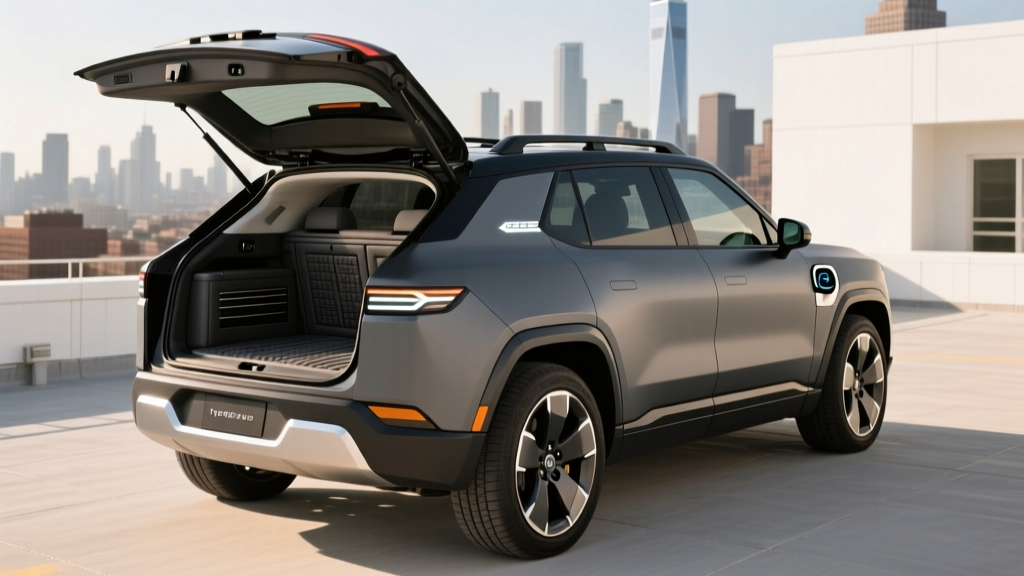
With all three rows in use, the 20.2 cubic feet behind the third row is enough for roughly four carry-on suitcases or a week's groceries for a family of five. That's tighter than a Chevrolet Tahoe (25.5 cu ft) but on par with the BMW X7. The real advantage comes when you fold the second and third rows flat: 104.7 cubic feet opens up a near-van-like floor that swallows mountain bikes, kayak halves, or a full camping setup without a roof box.
The gear tunnel — a pass-through compartment behind the rear axle accessible from both sides — is a Rivian signature. It's ideal for muddy boots, charging cables, or a stroller you don't want inside the cabin. The 11-cubic-foot frunk adds weatherproof storage up front, though it's shallower than the R1T's frunk due to the SUV's HVAC packaging.
Interior passenger space is generous in the first two rows. Front legroom measures 41.3 inches, second-row legroom is 38.2 inches, and the third row offers 30.4 inches — adequate for children or adults on shorter trips. The second row slides fore and aft by several inches, letting you prioritize either passenger legroom or cargo depth depending on the day's needs.
Range, Battery, and Real-World Efficiency
The 2026 R1S continues with Rivian's in-house battery packs, primarily using NMC (nickel manganese cobalt) chemistry for its higher energy density — a necessary trade-off for a 7,000-pound SUV that needs maximum range. The Standard pack uses LFP (lithium iron phosphate) chemistry, offering better cycle life and tolerance for daily 100% charging at the cost of lower total range.
Dual-Motor Standard: EPA 270 mi → Expect ~230-250 mi highway, ~200-220 mi in cold weather (below 32°F).
Dual-Motor Max: EPA 352 mi → Expect ~290-310 mi highway, ~250-270 mi in cold weather.
Tri-Motor Max: EPA 321 mi → Expect ~265-285 mi highway, ~230-250 mi in cold weather.
Highway driving at 75+ mph and winter temperatures consistently reduce range 15-25% vs. EPA combined estimates. Rivian's heat pump (standard on 2026 models) mitigates some cold-weather loss.
| Trim | Battery (usable kWh) | Chemistry | EPA Range | MPGe (combined) | kWh/100 mi |
|---|---|---|---|---|---|
| Dual-Motor Standard | 92 kWh | LFP | 270 mi | 73 MPGe | 46 |
| Dual-Motor Max | 141 kWh | NMC | 352 mi | 73 MPGe | 46 |
| Tri-Motor Max | 141 kWh | NMC | 321 mi | 70 MPGe | 48 |
Efficiency of 46-48 kWh per 100 miles is typical for a large electric SUV. For context, the Tesla Model X Long Range achieves roughly 39 kWh/100 mi thanks to its lower curb weight and more aerodynamic profile. The R1S trades some efficiency for ground clearance (up to 14.9 inches in off-road mode), towing capacity (7,700 lbs), and rugged build quality.
Charging Speed: DC Fast, Level 2, and Home Setup
Rivian upgraded the R1S's DC fast-charging capability with the Gen 2 platform. The Max pack models now peak at 200 kW on a compatible CCS or NACS DC fast charger (Rivian has adopted the NACS connector for 2026 models, with CCS adapters available for legacy stations). The Standard pack peaks at approximately 175 kW.
| Charging Level | Power | Speed / Time |
|---|---|---|
| DC Fast Charge (Max pack) | Peak 200 kW | 10-80% in ~28 minutes |
| DC Fast Charge (Standard pack) | Peak 175 kW | 10-80% in ~30 minutes |
| Level 2 (home, 48A / 11.5 kW) | 11.5 kW | ~25 mi/hr of range added |
| Level 2 (home, 32A / 7.7 kW) | 7.7 kW | ~17 mi/hr of range added |
| Level 1 (120V outlet) | 1.4 kW | ~3 mi/hr of range added |
Charging curve reality check: The 200 kW peak only sustains between roughly 10-40% state of charge. Above 60%, the curve tapers significantly — expect 80-100 kW in the 60-80% band, and speeds drop below 50 kW past 85%. Plan your road-trip stops to charge from 10-80% rather than topping off to 100%, which also preserves long-term battery health.
For home charging, Rivian's Wall Connector delivers up to 11.5 kW (48 amps) on a NEMA 14-50 or hardwired 240V circuit. With the Max pack's 141 kWh battery, a full 10-100% charge at home takes approximately 12-13 hours. Most owners charge nightly from 30-80%, which takes roughly 5-6 hours — well within an overnight window. A licensed electrician should assess your panel capacity; a 200-amp service is typically required for a 48-amp EV circuit.
Performance: Tri-Motor Power and Off-Road Capability
The R1S lineup starts with a dual-motor all-wheel-drive setup producing 533 horsepower and 610 lb-ft of torque, achieving a 0-60 mph time of 4.5 seconds. That's quick for any SUV, let alone one weighing over 6,800 pounds.
The Tri-Motor variant adds a third motor to the rear axle, bumping output to 850 horsepower and 1,103 lb-ft of torque. Rivian claims a 0-60 mph time of 2.9 seconds in launch mode — supercar territory in a vehicle with three rows and a gear tunnel. The tri-motor also enables torque vectoring across the rear wheels, improving both on-road cornering and off-road traction.
| Trim | Drivetrain | Horsepower | Torque (lb-ft) | 0-60 mph | Towing Capacity |
|---|---|---|---|---|---|
| Dual-Motor | AWD (dual-motor) | 533 hp | 610 | 4.5 sec | 7,700 lbs |
| Tri-Motor | AWD (tri-motor) | 850 hp | 1,103 | 2.9 sec | 7,700 lbs |
Off-road, the R1S shines with its quad-corner air suspension offering up to 14.9 inches of ground clearance, a wading depth of over 43 inches, and dedicated drive modes for sand, rock crawling, snow, and all-terrain. Approach, departure, and breakover angles are competitive with a Jeep Grand Cherokee equipped with air suspension.
Pricing, Trims, and Federal Tax Credit Eligibility
The 2026 Rivian R1S starts at $79,900 for the Dual-Motor Standard pack and climbs to approximately $104,000 for a fully optioned Tri-Motor Max. Rivian simplified its trim structure for 2026, offering Dual-Motor and Tri-Motor configurations with Standard (92 kWh) and Max (141 kWh) battery options.
| Configuration | Base MSRP | As-Tested (typical options) |
|---|---|---|
| Dual-Motor Standard (92 kWh) | $79,900 | $83,000-$86,000 |
| Dual-Motor Max (141 kWh) | $89,900 | $93,000-$97,000 |
| Tri-Motor Max (141 kWh) | $99,900 | $100,000-$104,000 |
- MSRP cap: SUVs must be at or below $80,000 to qualify. The Dual-Motor Standard at $79,900 is eligible; Dual-Motor Max and Tri-Motor trims exceed the cap.
- Buyer income cap: Modified AGI must not exceed $150,000 (single), $225,000 (head of household), or $300,000 (joint filers).
- Battery sourcing: A percentage of critical minerals and battery components must be sourced from the U.S. or free-trade-agreement countries. Rivian has worked to increase domestic sourcing, but specific 2026 compliance should be verified at purchase — ask your dealer for the latest IRS sourcing documentation.
- Point-of-sale transfer: Eligible buyers can apply the credit as an upfront discount at the dealership rather than waiting for tax filing.
- Credit amount: Up to $7,500 for fully qualifying vehicles; partial credit ($3,750) may apply if only one sourcing requirement is met.
Source: IRS §30D Clean Vehicle Credit. Eligibility rules are subject to change. Consult a tax professional before purchase.
In practice, only the Dual-Motor Standard configuration at base MSRP falls under the $80,000 SUV cap. Adding options that push the transaction price above $80,000 could disqualify the vehicle. Rivian also offers a lease structure where the $7,500 commercial credit (§45W) may be passed through as a lease incentive — this can make higher trims more affordable, though you don't own the vehicle at the end.
Tech, Driver Assistance, and Standout Features
The R1S runs Rivian's proprietary software stack on a 15.6-inch center touchscreen and a 12.3-inch driver display. The interface is clean, responsive, and receives regular over-the-air updates. Wireless Apple CarPlay and Android Auto are supported, along with native navigation with integrated charging route planning.
Rivian's Driver+ system provides SAE Level 2 driver assistance with adaptive cruise control, lane centering, and automatic lane changes on divided highways. It's competent for long highway stretches, but this is not a self-driving system — your hands must remain on the wheel and your eyes on the road at all times. The system does not currently support hands-free operation like GM's Super Cruise or Ford's BlueCruise on mapped highways.
Rivian Driver+ is an SAE Level 2 driver-assistance system. The driver must remain fully engaged, monitor the road, and be prepared to take over at any moment. No consumer vehicle currently sold in the U.S. offers Level 3 or above for general public use.
Standout features include the gear tunnel with powered tonneau-style doors, a camp kitchen accessory that slides out of the tunnel, built-in air compressor for tire inflation, and a tow mode with integrated trailer brake controller. The panoramic glass roof floods the cabin with light but lacks a retractable shade — cabin heat on sunny days can be an issue in warmer climates.
Pros, Cons, and Who Should Buy the R1S
- Class-leading cargo versatility with gear tunnel + frunk + 104.7 cu ft max
- Up to 352 mi EPA range (Dual-Motor Max) — longest in its segment
- Genuine off-road capability with air suspension and 14.9" ground clearance
- 7,700-lb towing capacity with integrated trailer brake controller
- Tri-motor performance (850 hp, 2.9-sec 0-60) without sacrificing utility
- Regular OTA updates improving software and adding features
- Base price of $79,900+ puts most trims above the §30D MSRP cap
- Efficiency of 46-48 kWh/100 mi trails the Tesla Model X (~39 kWh/100 mi)
- Driver+ lacks hands-free highway capability found in BlueCruise/Super Cruise
- Third-row space (30.4" legroom) is tight for adults on long trips
- No retractable glass roof shade — greenhouse effect in summer
- 200-kW peak DC charging is slower than Hyundai Ioniq 9 or Lucid Gravity
Choose the R1S if: You need three rows, genuine off-road capability, maximum cargo flexibility (gear tunnel is a unique advantage), and you tow a trailer or boat regularly. The Dual-Motor Max is the sweet spot for road-tripping families who want 352 miles of EPA range.
Look elsewhere if: Your priority is efficiency and charging speed (consider the Tesla Model X or upcoming Hyundai Ioniq 9), you need adult-friendly third-row space (BMW iX or Mercedes EQS SUV), or you want hands-free highway driving (Ford Expedition with BlueCruise or GM SUVs with Super Cruise).
Warranty and Long-Term Ownership
Rivian covers the R1S with a 5-year/60,000-mile bumper-to-bumper limited warranty and an 8-year/175,000-mile battery and drive unit warranty. The battery warranty guarantees that the pack will retain at least 70% of its original capacity during the coverage period — a competitive threshold, though some competitors (Hyundai/Kia) offer 10-year/100,000-mile powertrain coverage.
Long-term battery degradation data on Rivian's NMC packs is still maturing, but early 2022-2023 R1T and R1S owners report 3-5% capacity loss over the first 30,000-40,000 miles, which is within expected norms for liquid-cooled NMC packs. The LFP Standard pack should show even less degradation over time and tolerates routine 100% charging — a practical advantage for daily drivers who need every mile of the 270-mile EPA range.
Frequently Asked Questions
What is the real-world range of the 2026 Rivian R1S?
In mixed highway driving at 70-75 mph and moderate temperatures (55-75°F), expect roughly 290-310 miles from the Dual-Motor Max (EPA 352 mi). In cold weather below 32°F, plan for 250-270 miles. The Standard pack delivers around 230-250 miles in real-world highway conditions.
How fast does the R1S charge at home and on the road?
On a DC fast charger, the Max pack peaks at 200 kW and charges from 10-80% in approximately 28 minutes. At home on a 48-amp Level 2 charger (11.5 kW), you'll add about 25 miles of range per hour, or roughly 5-6 hours for a 30-80% charge on the Max pack.
Does the 2026 Rivian R1S qualify for the $7,500 federal tax credit?
Only the Dual-Motor Standard at its $79,900 base MSRP falls at or under the $80,000 SUV cap for the §30D credit. You must also meet income caps ($300,000 joint / $150,000 single) and the vehicle must satisfy battery-sourcing requirements. Verify current eligibility with your dealer and a tax professional at the time of purchase. Lease buyers may benefit from a pass-through of the commercial credit on any trim.
How much total cargo space does the R1S have?
The R1S offers 20.2 cu ft behind the third row, 57.1 cu ft behind the second row, and 104.7 cu ft with both rear rows folded. The 11-cu-ft frunk and 11-cu-ft gear tunnel bring total enclosed storage potential to over 126 cubic feet across all compartments.
Is the Rivian R1S worth buying over the Tesla Model X or BMW iX?
The R1S wins on off-road capability, towing (7,700 lbs), and cargo creativity (gear tunnel). The Model X is more efficient, charges faster, and has access to the Supercharger network natively. The BMW iX is a two-row crossover with a more luxurious interior but no off-road pretensions. If you need three rows, tow capacity, and adventure readiness, the R1S has no direct equal.
What are the biggest drawbacks of the R1S?
The main trade-offs are price (most trims exceed the federal tax credit MSRP cap), efficiency (46-48 kWh/100 mi is thirsty by EV standards), a glass roof without a shade, and a driver-assist system that doesn't yet offer hands-free highway driving. Third-row space is also best suited for children.
Data sources: EPA Fuel Economy, Rivian R1S official specifications, IRS §30D Clean Vehicle Credit. Specs reflect 2026 model year as published. Verify all figures with your dealer before purchase.