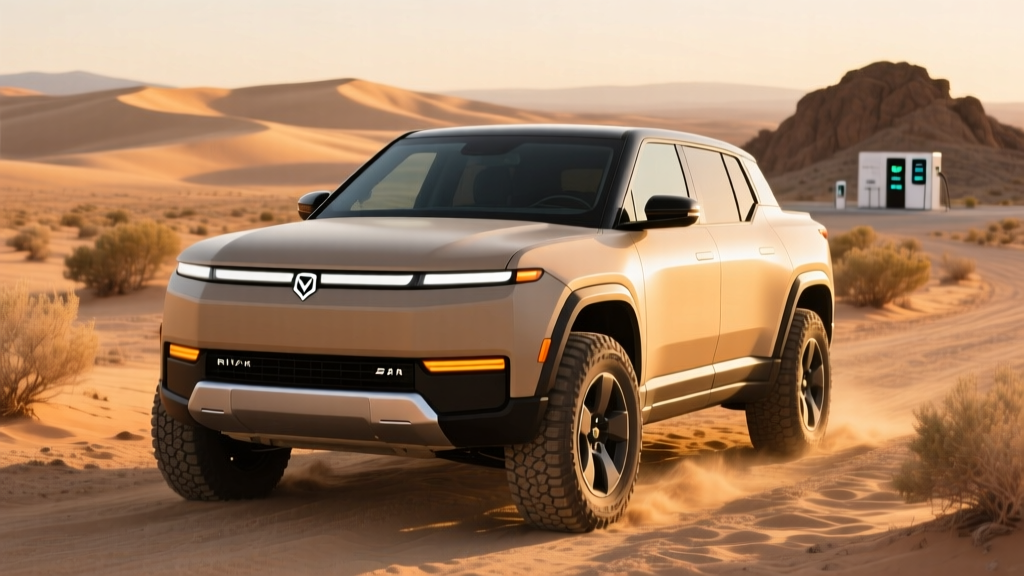
Rivian's California Dune aesthetic has become one of the most recognizable configurations in the electric SUV segment. For 2026, the R1S continues to anchor this warm, sand-tone colorway as a premium tri-motor, all-wheel-drive family hauler that bridges daily school runs with weekend trail access. Below, we break down every spec a buyer needs — from the exact EPA range and real-world highway expectations to the 220 kW DC fast-charging curve and IRS §30D tax credit mechanics.
Spec Sheet at a Glance
| Specification | R1S Dual-Motor Max | R1S Tri-Motor (Ascend) |
|---|---|---|
| EPA Range | 410 miles | ~390 miles |
| Battery Capacity (usable) | ~141 kWh (Max Pack, NMC) | ~141 kWh (NMC) |
| Horsepower | 665 hp | 850 hp |
| 0-60 mph | ~4.5 sec | ~2.9 sec |
| Drivetrain | AWD (Dual-Motor) | AWD (Tri-Motor) |
| Max DC Fast Charge | 220 kW | 220 kW |
| 10-80% DC Time | ~30 min | ~30 min |
| Level 2 Home Charge | 11.5 kW (~25 mi/hr) | 11.5 kW (~25 mi/hr) |
| MPGe (combined) | 73 MPGe | 70 MPGe |
| Towing Capacity | 7,700 lbs | 7,700 lbs |
| Cargo (behind 3rd row) | 10.4 cu ft | 10.4 cu ft |
| Cargo (all rows folded) | 83.5 cu ft | 83.5 cu ft |
Battery Chemistry, Degradation, and Warranty
The 2026 R1S Max Pack uses a high-nickel NMC (nickel-manganese-cobalt) lithium-ion pack with approximately 141 kWh of usable capacity. Rivian has not adopted LFP (lithium iron phosphate) chemistry for the R1 platform — the energy density of NMC remains essential for achieving 390+ mile range targets in a 7,000-pound SUV. The trade-off: NMC cells are more sensitive to prolonged 100% state-of-charge storage and extreme heat. Rivian recommends daily charging to 80-90% and reserving 100% for road trips.
Rivian's battery warranty covers 8 years or 175,000 miles (whichever comes first), with a capacity retention threshold that is industry-standard. The broader powertrain warranty runs 8 years/175,000 miles, and the vehicle body warranty is 5 years/60,000 miles. Owners can monitor State of Health (SoH) through the Rivian mobile app, which tracks long-term degradation curves.
Charging: DC Fast, Level 2, and the Curve Reality
Rivian's Gen 2 architecture supports a peak DC fast-charge rate of 220 kW on Max Pack models. However, as with every EV, peak rate is not sustained rate. The charging curve tapers meaningfully above 60% SoC, and drops sharply past 80%. Here is what that looks like in practice:
| Charge Level | Power | Speed (approx.) | Use Case |
|---|---|---|---|
| Level 1 (120V) | 1.4 kW | ~3 mi/hr | Emergency / overnight trickle |
| Level 2 (240V, 48A) | 11.5 kW | ~25 mi/hr | Home daily charging |
| DC Fast (peak) | 220 kW | ~140 mi in 15 min | Road-trip stops (10-60% SoC) |
| DC Fast (tapered, 80-100%) | ~40-60 kW | ~30 mi/hr | Avoid unless needed |
On a road trip, preconditioning the battery via the navigation system (setting a DC charger as your destination) is essential — it warms the pack to optimal temperature and can shave 5-8 minutes off a 10-80% session. Without preconditioning in cold weather, peak rates may be limited to 150-170 kW initially.
At home, a 48-amp Level 2 wall connector on a 60-amp circuit will fully replenish the Max Pack from 10% to 80% overnight (roughly 8-9 hours). Installation costs vary widely — budget $800-$2,500 for equipment plus electrician labor, and confirm your panel has capacity before committing. Source: Rivian Charging Guide.
Performance and Driving Dynamics
The Tri-Motor R1S — the powertrain most commonly paired with the California Dune exterior on the Ascend trim — delivers 850 horsepower and a 0-60 mph time of approximately 2.9 seconds. That figure places it in supercar territory, though the 6,900-pound curb weight is noticeable through corners and under hard braking. The dual-motor variant (665 hp, ~4.5 sec 0-60) is more than adequate for most buyers and preserves roughly 20 miles of additional EPA range.
Rivian's quad-motor configuration is no longer offered on the 2026 R1S, having been consolidated into the tri-motor layout for the current generation. The air suspension provides 6.5 inches of adjustable ride height — useful for both highway efficiency (lowered) and trail clearance (raised). Approach, departure, and breakover angles remain competitive with body-on-frame SUVs when in Off-Road mode.
Pricing, Trims, and Federal Tax Credit Eligibility
The 2026 R1S lineup starts at approximately $79,900 for the Dual-Motor Standard Pack and climbs to roughly $104,000 for the Tri-Motor Ascend with Max Pack — the configuration most associated with the California Dune colorway. The California Dune exterior is a premium paint option ($0 on Ascend, $2,500 on lower trims where available).
| Trim | Base MSRP | §30D Credit (max) | Effective Price |
|---|---|---|---|
| Dual-Motor Standard | $79,900 | $0 (over MSRP cap) | $79,900 |
| Dual-Motor Max | $89,900 | $0 (over MSRP cap) | $89,900 |
| Tri-Motor Ascend Max | $104,000 | $0 (over MSRP cap) | $104,000 |
Critical tax credit note: Under IRS §30D rules, the federal EV tax credit is capped at $80,000 MSRP for SUVs. Every 2026 R1S trim exceeds this threshold, meaning no R1S currently qualifies for the $7,500 federal credit. Buyers should investigate state-level incentives (California's CVRP, for example, has its own income and MSRP rules) and consult a tax professional. See IRS §30D guidelines for current-year eligibility details including income caps ($300,000 joint / $150,000 single) and battery-sourcing requirements.
Interior, Tech, and Driver Assistance
The R1S cabin seats up to seven across three rows. Third-row legroom is 30.4 inches — usable for children on short trips but tight for adults beyond 30 minutes. The 15.6-inch center touchscreen runs Rivian's proprietary OS, which has matured significantly since launch with over-the-air updates adding improved route planning, camp mode refinements, and enhanced battery preconditioning logic.
Rivian's Driver+ system is a Level 2 (SAE) hands-on-wheel driver-assistance suite featuring adaptive cruise, lane-centering, and automatic lane changes on divided highways. It is not a self-driving system — the driver must remain engaged at all times. The system competes favorably with GM's Super Cruise in smoothness but lacks the hands-off capability of mapped-highway systems. A 21-speaker Meridian audio system, glass roof with electrochromic dimming, and a front trunk (frunk) with 11 cu ft of lockable storage round out the feature list.
Who Should Buy the California Dune R1S?
This SUV is ideal for: active families who need three rows and 7,700-pound towing for a boat or camper; buyers who prioritize off-road capability without sacrificing daily-driver refinement; and those with reliable home Level 2 charging access who road-trip 2-4 times per year. It is less ideal for: budget-conscious buyers (no federal credit, high insurance premiums), urban apartment dwellers without charging access, or those who rarely use the third row (the R1T pickup or a two-row competitor may be more efficient).
Pros and Cons
- Class-leading 410-mile EPA range (Dual-Motor Max)
- 850 hp tri-motor with sub-3-sec 0-60
- Genuine off-road capability with air suspension
- 220 kW DC charging with effective preconditioning
- Premium interior with OTA improvements
- 7,700-lb towing capacity
- No federal §30D credit (all trims exceed $80K MSRP cap)
- Third row tight for adults on long drives
- Real-world highway range drops to ~330-360 mi
- Insurance premiums 20-35% above segment average
- NACS adapter required for Tesla Supercharger access (included, but native port is CCS through 2025 models)
- Service center network still expanding in rural regions
Competitor Context
Against the Tesla Model X, the R1S offers superior interior material quality and off-road hardware but trails on DC charging infrastructure convenience (Tesla's native Supercharger network). The Kia EV9 (starting ~$55,000) undercuts on price and qualifies for partial credits on certain trims but offers only 304 miles EPA and 236 kW peak charging. The Cadillac Escalade IQ competes on luxury and size but starts above $130,000. For buyers specifically drawn to the California Dune aesthetic and the adventure-lifestyle positioning, the R1S has no direct equivalent.
Frequently Asked Questions
What is the real-world range of the 2026 Rivian R1S?
EPA-estimated at 410 miles (Dual-Motor Max) or ~390 miles (Tri-Motor). Expect 330-360 miles in real-world highway driving, and 280-310 miles in sustained sub-30°F cold weather without preconditioning.
How fast does the R1S charge at home and on the road?
DC fast charging peaks at 220 kW, delivering 10-80% in approximately 30 minutes with preconditioning. Home Level 2 charging at 11.5 kW adds about 25 miles per hour, fully replenishing overnight.
Does the Rivian R1S qualify for the federal EV tax credit?
No. Under current IRS §30D rules, the credit is unavailable for SUVs with MSRP above $80,000. All 2026 R1S trims exceed this cap. State incentives may apply — check local programs.
Is the California Dune color available on all trims?
California Dune is standard on the Ascend trim and available as a premium option on select lower trims. Availability varies by configuration and model year ordering.
Can the R1S tow a travel trailer?
Yes — maximum towing capacity is 7,700 pounds. Expect a 30-50% range reduction while towing at highway speeds depending on trailer weight and aerodynamics.
What is the battery warranty?
8 years or 175,000 miles for the battery pack and powertrain, with a guaranteed minimum capacity retention percentage defined in the owner agreement.