Quick Verdict: The Family EV That Does It All
If you've been researching three-row electric SUVs, you've likely seen the Rivian R1S surface again and again. Shoppers evaluating the Tesla Model X, Kia EV9, or Cadillac Escalade IQ often find that the Rivian R1S also lands on their shortlist — and for good reason. With up to 410 miles of EPA-estimated range on the Max Pack, a genuinely usable third row, and legitimate off-road capability, the R1S occupies a niche that few competitors can match: a premium adventure-family hauler that doesn't force compromise on range or utility.
For 2026, Rivian has refined the R1S with updated software, improved heat-pump efficiency, and continued production scaling at its Normal, Illinois facility. But at a base price hovering near $80,000 (before credits), the R1S demands scrutiny. This review covers every number that matters — real-world range, charging curves, tax-credit eligibility, and ownership costs — so you can decide whether it earns a spot in your garage.
Rivian R1S Spec Sheet at a Glance
| Specification | Dual-Motor (Standard) | Dual-Motor (Large) | Quad-Motor (Max) |
|---|---|---|---|
| EPA Range | 270 mi | 352 mi | 410 mi |
| Battery (usable, est.) | 92 kWh (LFP) | 128 kWh (NMC) | 141 kWh (NMC) |
| Horsepower | 533 hp | 533 hp | 850 hp |
| 0-60 mph | 4.5 sec | 4.5 sec | 2.9 sec |
| Max DC Fast Charge | 200 kW | 220 kW | 220 kW |
| 10-80% DC Time | ~30 min | ~28 min | ~34 min |
| Level 2 Home Rate | 11.5 kW (~31 mi/hr) | 11.5 kW (~31 mi/hr) | 11.5 kW (~31 mi/hr) |
| Towing Capacity | 7,700 lbs | 7,700 lbs | 7,700 lbs |
| Base MSRP (2026) | $79,900 | $87,900 | $104,900 |
Source: Rivian official specs and fueleconomy.gov. Specs reflect 2026 model-year configurations.
Real-World Range: What the EPA Sticker Doesn't Tell You
EPA Estimate: Up to 410 miles (Max Pack, Dual-Motor)
Real-World Highway (70 mph, 72°F): ~330-350 miles
Real-World Highway (32°F, no heat pump assist): ~260-290 miles
Mixed Commute (city + suburban): ~370-395 miles (regen-heavy routes recover more energy)
The Rivian R1S Max Pack's 410-mile EPA rating is among the highest of any three-row SUV sold in the U.S. However, as with every EV, that sticker number assumes an optimal blend of city and highway driving. In sustained highway use at 70 mph — where aerodynamic drag dominates — expect to consume roughly 38-42 kWh per 100 miles, translating to 330-350 usable miles from the 141 kWh pack before you'd want to find a charger.
Cold weather compounds this. The R1S now uses an improved heat pump for cabin and battery thermal management, which mitigates some loss, but winter highway driving at freezing temperatures will still reduce range by roughly 20-30%. If you live in the Upper Midwest or Northeast and plan winter road trips, budget for 260-290 miles between stops. For daily commuting with regenerative braking recapturing energy in stop-and-go traffic, the R1S easily approaches its EPA figure.
The Standard Pack's LFP (lithium iron phosphate) battery sacrifices range (270 miles EPA) but gains cycle-life longevity and can be charged to 100% daily without degradation concerns — an ideal trade-off for city-dwelling families with home charging.
Charging Speed: DC Fast, Level 2, and the Curve That Matters
| Charging Method | Power / Rate | Miles Added per Hour | Notes |
|---|---|---|---|
| Level 1 (120V outlet) | 1.4 kW | ~3-4 mi/hr | Emergency / trickle only |
| Level 2 (240V, 48A home) | 11.5 kW | ~31 mi/hr | Full charge overnight (~13 hrs for Max Pack) |
| DC Fast (peak) | 220 kW | ~550 mi/hr (at peak) | 10-80% in ~28-34 min depending on pack |
| DC Fast (sustained avg.) | ~140-160 kW | — | Real-world average across 10-80% session |
| Tesla Supercharger (NACS) | Up to 250 kW (V4 stalls) | Varies | R1S now ships with native NACS port |
The R1S peaks at 220 kW on DC fast chargers (Large and Max packs), which is competitive but not class-leading — the Hyundai Ioniq 9 and Lucid Gravity push higher. The critical detail is the charge curve: the R1S holds strong above 150 kW through roughly 55% state of charge, then tapers progressively. A 10-80% session on a 350 kW Electrify America or Tesla Supercharger V4 stall takes approximately 28 minutes for the Large Pack and 34 minutes for the Max Pack, because the larger battery absorbs energy longer at moderate rates but takes more total time to reach 80%.
For home charging, a 48-amp Level 2 wall connector on a 60-amp circuit delivers 11.5 kW, adding roughly 31 miles of range per hour. Most owners report a full overnight charge from 20% to 100% in 10-13 hours depending on pack size. Installation typically runs $800-$2,000 depending on panel capacity and conduit distance — budget for a potential panel upgrade to 200A if your home has an older 100A service.
Preconditioning matters. The R1S navigation system will automatically warm or cool the battery when you route to a DC fast charger, ensuring you hit peak charge rates on arrival. Skipping this (e.g., driving to a charger without navigation routing) can add 5-10 minutes to your session in cold weather.
Performance, Efficiency, and Drivetrain
The Dual-Motor R1S produces 533 horsepower and rockets to 60 mph in 4.5 seconds — quick for a 7,000-pound SUV. The Quad-Motor variant (one independent motor per wheel) delivers 850 hp and a 2.9-second 0-60 time, making it one of the fastest SUVs ever sold, electric or otherwise. Both configurations use a single-speed reduction gear with no traditional transmission.
Efficiency varies by pack and configuration:
- Dual-Motor Standard Pack: 76 MPGe combined / 44 kWh/100mi
- Dual-Motor Large Pack: 73 MPGe combined / 46 kWh/100mi
- Dual-Motor Max Pack: 70 MPGe combined / 48 kWh/100mi
- Quad-Motor Max Pack: 65 MPGe combined / 52 kWh/100mi
The MPGe drop with larger packs reflects added weight (the Max Pack adds roughly 400 lbs over the Standard). For perspective, charging at the U.S. average electricity rate of $0.17/kWh, the Dual-Motor Large Pack costs approximately $7.82 per 100 miles — roughly one-third the cost of a comparable gas SUV getting 18 mpg at $3.50/gallon.
Interior, Cargo, and Technology
The R1S seats up to seven passengers across three rows. Second-row captain's chairs are standard, with an optional bench for six-passenger configuration. Key interior dimensions:
- Cargo (behind 3rd row): 10.4 cu ft
- Cargo (3rd row folded): 46.7 cu ft
- Cargo (all rear rows folded): 88.2 cu ft
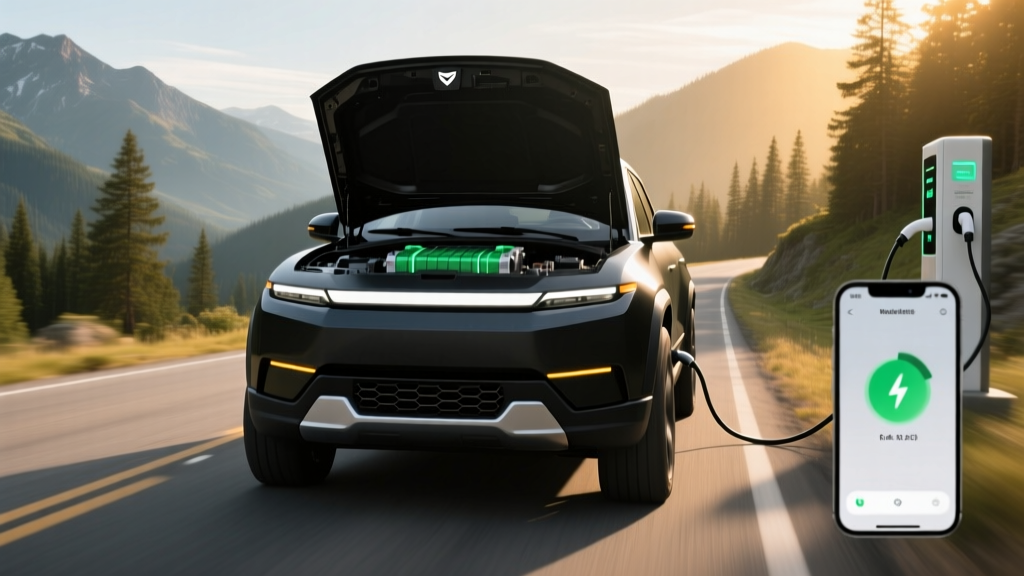
- Front trunk (frunk): 11.0 cu ft — fits a full carry-on or charging cables and groceries
- 3rd-row legroom: 30.4 inches (usable for children and short-trip adults)
The 15.6-inch center touchscreen runs Rivian's in-house infotainment OS, which has matured considerably through OTA updates. Wireless Apple CarPlay and Android Auto are supported. The digital driver display is a clean 12.3-inch panel. A standout feature is the built-in air compressor with a configurable outlet (useful for inflating tires or sports equipment on the trail).
On the driver-assistance front, Rivian Driver+ provides adaptive cruise control with lane centering on divided highways. This is an SAE Level 2 system — you must keep your hands on the wheel and eyes on the road at all times. It is not self-driving. The system performs competently but trails GM's Super Cruise and Ford's BlueCruise in hands-free highway capability. Rivian has indicated hands-free functionality is in development via future OTA updates, but as of 2026, it requires active supervision.
Pricing, Trim Levels, and Federal Tax Credit Eligibility
| Trim / Configuration | 2026 MSRP | Est. After §30D Credit | Destination |
|---|---|---|---|
| Dual-Motor Standard Pack (Adventure) | $79,900 | $72,400* | $1,800 |
| Dual-Motor Large Pack (Adventure) | $87,900 | $80,400* | $1,800 |
| Dual-Motor Max Pack (Adventure) | $94,900 | $87,400* | $1,800 |
| Quad-Motor Max Pack (Ascend) | $104,900 | $97,400* | $1,800 |
*Tax credit estimates assume buyer eligibility. See below.
- Maximum credit: $7,500 (if both battery-component and critical-minerals requirements are met; $3,750 if only one is met)
- MSRP cap for SUVs: $80,000 — vehicles above this threshold are ineligible
- Buyer income caps: $300,000 joint / $225,000 head of household / $150,000 single (modified AGI)
- Battery sourcing: Battery components must be manufactured or assembled in North America; critical minerals must be sourced from the U.S. or FTA partners
- Point-of-sale transfer: Eligible buyers can apply the credit as a down-payment reduction at purchase rather than waiting for tax filing
Critical caveat for the R1S: The Dual-Motor Standard Pack at $79,900 MSRP clears the $80,000 SUV cap — but only barely, and only before adding destination or dealer-installed accessories that push the effective price above the limit. All other R1S trims exceed $80,000 and do NOT qualify for the new-vehicle §30D credit. Always verify current eligibility at IRS.gov before purchasing. Tax rules change, and battery-sourcing compliance can shift with supply-chain updates.
For buyers priced out of the new-vehicle credit, the used EV credit (up to $4,000 under §25E) may apply to pre-owned R1S models priced at or below $25,000 — though as of 2026, most used R1S vehicles still command well above that threshold. Consult a tax professional for your specific situation.
Warranty, Ownership Costs, and Long-Term Outlook
Rivian covers the R1S with:
- Vehicle limited warranty: 5 years / 60,000 miles
- Battery & drive unit warranty: 8 years / 175,000 miles (retains ≥70% capacity)
- Roadside assistance: 5 years / 60,000 miles
The 175,000-mile battery warranty is generous — exceeding the industry-standard 100,000-mile threshold. Rivian's 70% capacity retention guarantee means that if your Max Pack degrades below roughly 99 kWh within 8 years, they'll repair or replace it at no cost. Real-world degradation data from early R1T/R1S owners (2022-2024 models) suggests approximately 4-6% loss over the first 50,000 miles, which is within expected norms for NMC chemistry.
Insurance costs run higher than average for the R1S — expect $2,400-$3,600 annually depending on your state, driving record, and coverage level. Rivian has launched its own insurance product in select states, which can be competitive. Maintenance is minimal (no oil changes, cabin air filter every 15,000-20,000 miles, tire rotations), but tire replacement costs are significant given the R1S's weight and 275/50R21 or 275/65R20 tire sizes — budget $1,200-$1,800 for a set of four.
Pros, Cons, and Who Should Buy the R1S
- Best-in-class range (410 mi Max Pack)
- Genuine off-road capability (14.9" ground clearance, wading mode)
- 11.0 cu ft frunk — largest in the three-row EV SUV segment
- OTA updates continuously add features
- Native NACS port — full Supercharger network access
- 7,700-lb towing with integrated trailer brake controller option
- Only the base trim qualifies for the §30D tax credit
- Third row is tight for adults on long trips
- Driver+ is Level 2 and not hands-free
- 220 kW peak charge rate trails some competitors
- Service center network still expanding — wait times in some regions
- High insurance premiums relative to ICE SUVs
Who the R1S is for: Active families who need three rows, want maximum range for road trips, and value off-road or towing capability. If you regularly drive 300+ miles between charging stops, haul kids and gear to campsites, or tow a boat or small trailer, the R1S Max Pack is purpose-built for you.
Who should look elsewhere: Urban commuters who don't need three rows (the Rivian R1T, Tesla Model Y, or Hyundai Ioniq 5 offer better value). Budget-conscious buyers who need the $7,500 credit — most R1S trims don't qualify. Buyers who prioritize hands-free highway driving — GM's Super Cruise on the Cadillac Escalade IQ offers a more advanced Level 2 experience today.
Frequently Asked Questions
What is the real-world range of the Rivian R1S?
The EPA rates the R1S Max Pack at 410 miles, but sustained highway driving at 70 mph yields approximately 330-350 miles in mild weather and 260-290 miles in freezing conditions. The Standard Pack (LFP) delivers roughly 220-250 real-world highway miles. City commuting with regenerative braking pushes range closer to EPA estimates.
How fast does the Rivian R1S charge?
On a DC fast charger, the R1S peaks at 220 kW and charges from 10-80% in approximately 28-34 minutes depending on battery pack size. At home on a Level 2 (240V, 48A) charger, it adds roughly 31 miles of range per hour, fully replenishing overnight. The native NACS port provides access to Tesla Superchargers at up to 250 kW on compatible stalls.
Does the Rivian R1S qualify for the federal EV tax credit?
Only the Dual-Motor Standard Pack at $79,900 MSRP meets the $80,000 SUV cap for the §30D new-vehicle credit — and even then, eligibility depends on buyer income limits, battery-sourcing compliance, and point-of-sale requirements. All higher trims exceed the MSRP cap and are ineligible. Always confirm at IRS.gov before purchase.
Is the Rivian R1S worth buying vs. the Kia EV9 or Tesla Model X?
The R1S wins on range (410 vs. 379 mi for the EV9 GT-Line and 348 mi for the Model X), off-road capability, and frunk space. The Kia EV9 starts significantly lower (~$55,000) and is better for budget-focused buyers. The Tesla Model X offers faster Supercharger access (though the R1S now has native NACS) and more advanced driver-assist software, but at a higher starting price and with gullwing doors that some find impractical. For adventure-oriented families, the R1S remains the strongest all-around pick.
How long will the Rivian R1S battery last?
Rivian warranties the battery for 8 years or 175,000 miles with a 70% capacity retention threshold. Early owner data suggests approximately 4-6% degradation over the first 50,000 miles for NMC packs. LFP packs (Standard) historically show even slower degradation. With proper care — avoiding prolonged 100% SoC storage on NMC, using preconditioning — most owners can expect well over 200,000 miles before significant capacity loss.
Can the Rivian R1S tow, and how does towing affect range?
The R1S is rated to tow 7,700 lbs with the available tow package. Expect range to drop by 40-55% when towing a loaded trailer at highway speeds — a 410-mile Max Pack may deliver 185-245 miles while towing. Plan charging stops accordingly and use Rivian's built-in trailer light check and integrated brake controller for safety.