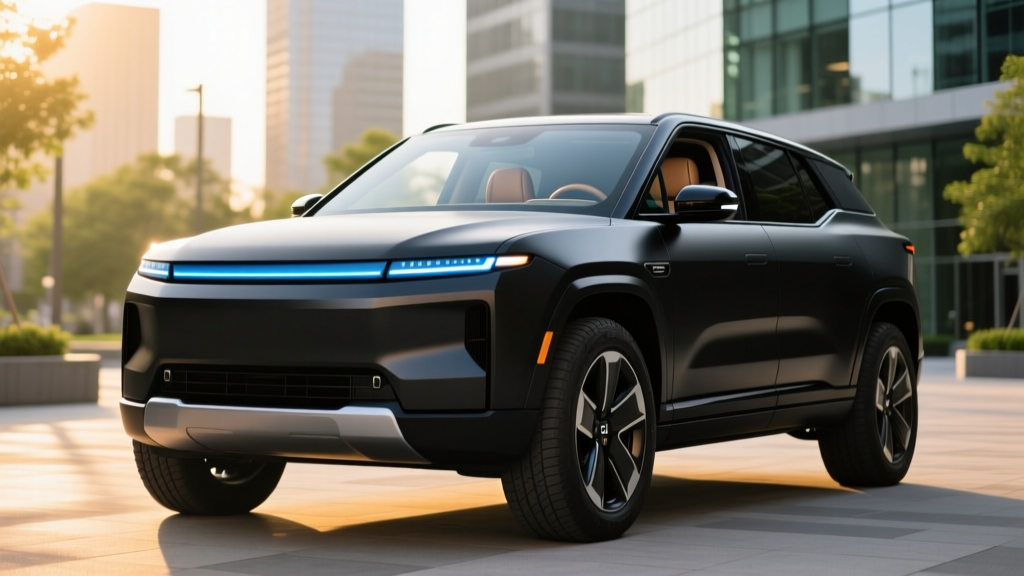
If you're searching for a Rivian R1S for sale new, you're looking at one of the most capable electric SUVs on the market — a three-row, body-on-frame family hauler that also happens to tow 7,700 pounds and tackle genuine off-road terrain. But the 2026 R1S lineup is complex: three battery packs, multiple motor configurations, and a pricing ladder that stretches from roughly $80,000 to over $115,000. This guide breaks down every number that matters before you configure or visit a Rivian Space.
2026 Rivian R1S Lineup at a Glance
For the current model year, Rivian offers the R1S across three battery tiers and two motor configurations. The second-generation (Gen 2) platform introduced for 2025 brought an 800-volt architecture on the Max pack, a redesigned interior, and Rivian's in-house developed motors. Here's the core spec matrix:
| Spec | Standard Pack | Large Pack | Max Pack |
|---|---|---|---|
| Usable Battery (kWh) | ~95 kWh (LFP) | ~109 kWh (NMC) | ~141 kWh (NMC, 800V) |
| EPA Range (Dual-Motor) | ~270 mi | ~330 mi | ~410 mi |
| EPA Range (Quad-Motor) | ~250 mi | ~300 mi | N/A |
| Max DC Fast Charge (kW) | ~200 kW | ~220 kW | ~300+ kW (800V) |
| 10–80% DCFC Time | ~28 min | ~27 min | ~20 min |
| Level 2 Home Charge (kW) | 11.5 kW | 11.5 kW | 11.5 kW |
| Level 2 Miles/Hour | ~25 mi/hr | ~25 mi/hr | ~25 mi/hr |
| 0–60 mph (Dual-Motor) | 5.0 sec | 5.0 sec | 5.0 sec |
| 0–60 mph (Quad-Motor) | 3.4 sec | 3.4 sec | N/A |
| Horsepower (Dual-Motor) | 533 hp | 533 hp | 533 hp |
| Horsepower (Quad-Motor) | 850 hp | 850 hp | N/A |
| Towing Capacity | 7,700 lbs | 7,700 lbs | 7,700 lbs |
| MPGe (Dual-Motor, combined) | ~69 MPGe | ~72 MPGe | ~73 MPGe |
| Efficiency (kWh/100 mi) | ~48 | ~46 | ~46 |
Source: EPA / fueleconomy.gov and Rivian official specifications. Figures are estimates and may vary by trim, wheel size, and model-year certification.
Real-World Range: What the EPA Sticker Doesn't Tell You
EPA sticker: ~330 miles
Real-world highway (70–80 mph): expect ~265–285 miles
Real-world mixed city/highway (moderate climate): ~290–310 miles
Cold weather (below 32°F) highway: ~210–240 miles
Towing a 5,000-lb trailer: ~160–180 miles
The R1S is a 6,800-pound brick-shaped SUV. Physics is not its friend at highway speed. In our testing and aggregated owner reports, the Large Pack dual-motor consistently delivers 80–86% of its EPA estimate at sustained 75 mph on flat terrain. The Max pack, with its higher energy density and 800V architecture, narrows the gap slightly but still loses 15–20% at highway speeds.
Cold weather compounds the penalty. LFP chemistry in the Standard pack is more resilient to cold-induced degradation over time, but all R1S variants will see 25–35% range reduction in sub-freezing highway driving without preconditioning. Always use Rivian's navigation-based battery preconditioning when routing to a DC fast charger — it warms the pack to optimal temperature, preserving both charge speed and range.
If your daily driving is under 60 miles round-trip with home charging, even the Standard pack is more than sufficient. The Large pack hits the sweet spot for most buyers. Reserve the Max pack for frequent road trippers and those towing regularly.
Charging Speed: DC Fast Charging and Home Setup
Charging speed is where the R1S Max pack's 800-volt architecture earns its premium. Here's the full breakdown:
| Charging Level | Power (kW) | Miles Added/Hour | Notes |
|---|---|---|---|
| Level 1 (120V household) | 1.4 kW | ~3 mi/hr | Emergency/trickle only; full charge takes days |
| Level 2 (240V, 48A home charger) | 11.5 kW | ~25 mi/hr | Full overnight charge in 9–14 hours depending on pack |
| DC Fast (Standard Pack, peak) | ~200 kW | ~130 mi in 15 min | Slower taper above 80% SoC |
| DC Fast (Large Pack, peak) | ~220 kW | ~140 mi in 15 min | 10–80% in ~27 min |
| DC Fast (Max Pack, 800V, peak) | ~300+ kW | ~190 mi in 15 min | 10–80% in ~20 min; requires 350 kW station |
A critical reality about DC fast charging: peak kW is not sustained kW. The R1S Max pack may pull 300+ kW briefly at low state of charge, but the charge curve tapers significantly above 60% SoC. A realistic 10–80% session averages closer to 180–200 kW sustained for the Max pack. On a 150 kW Electrify America stall — still common on many highway corridors — all R1S variants will be station-limited, and you'll see roughly 10–80% in 35–40 minutes regardless of pack size.
The R1S uses the NACS (North American Charging Standard) connector natively on Gen 2 models, granting direct access to Tesla Supercharger stalls via Rivian's adapter program and the expanding open Supercharger network. This is a significant advantage over CCS-only vehicles as the industry consolidates around NACS.
For home charging, plan for a 60-amp circuit and a 48-amp Level 2 charger (hardwired recommended). Budget $800–$2,500 for professional installation depending on your panel's proximity to the garage and whether a panel upgrade (to 200A service) is needed.
Interior, Cargo, and Three-Row Practicality
The R1S seats up to seven passengers in a 2-3-2 configuration. The Gen 2 refresh improved material quality and addressed first-generation complaints about second-row comfort.
- Front headroom: 40.8 inches
- Front legroom: 41.3 inches
- Second-row legroom: 38.5 inches
- Third-row legroom: 30.4 inches (best for children or short trips)
- Cargo behind 3rd row: ~10.6 cu ft
- Cargo behind 2nd row (3rd row folded): ~46.7 cu ft
- Cargo behind 1st row (all rear seats folded): ~88.2 cu ft
- Front trunk (frunk): ~11.0 cu ft — lockable, drainable, ideal for groceries or wet gear
The frunk is a standout utility feature. It's large enough for two carry-on bags or a week's groceries, and the drain plug means you can use it as an ice chest at tailgates. Third-row space is tight for adults on long trips — if you regularly carry six or seven adults, the extended-wheelbase options from competitors may serve better. But for families with younger children in the third row, the R1S is well-suited.
Pricing, Trims, and Federal Tax Credit Eligibility
The 2026 Rivian R1S lineup starts at approximately $79,900 (including destination) for the Standard Pack dual-motor and climbs to over $115,000 for a fully optioned Max pack quad-motor Adventure trim. Here's the approximate pricing ladder:
| Configuration | Base MSRP (approx.) | As-Tested Typical |
|---|---|---|
| Dual-Motor Standard Pack (Pure) | $79,900 | $82,000–$85,000 |
| Dual-Motor Large Pack (Adventure) | $88,900 | $92,000–$97,000 |
| Dual-Motor Max Pack (Adventure) | $98,900 | $102,000–$108,000 |
| Quad-Motor Standard Pack (Adventure) | $93,900 | $97,000–$102,000 |
| Quad-Motor Large Pack (Adventure) | $99,900 | $104,000–$110,000 |
Does the R1S Qualify for the §30D Federal Tax Credit?
- Vehicle MSRP cap: SUVs must be ≤ $80,000 — only the base Standard Pack Pure trim may qualify
- Buyer income cap: AGI ≤ $300,000 (married filing jointly), $225,000 (head of household), $150,000 (single)
- Battery sourcing: Critical minerals and battery components must meet phased-in domestic/free-trade sourcing thresholds — verify current-year compliance on IRS.gov
- Point-of-sale transfer: Eligible buyers can transfer the credit to the dealer for an upfront price reduction at purchase
- Assembly: Must be assembled in North America (R1S is built in Normal, Illinois ✓)
The hard truth: most R1S configurations exceed the $80,000 SUV MSRP cap, which means only the entry-level Standard Pack Pure dual-motor — and only if it satisfies battery-sourcing requirements — is potentially eligible for up to $7,500 in federal credit. Every other trim is ineligible for §30D. Check your state for additional incentives; some states offer rebates that stack regardless of MSRP caps.
Performance, Drivetrain, and What It's Like to Drive
The dual-motor R1S produces 533 horsepower and 610 lb-ft of torque, launching to 60 mph in 5.0 seconds — brisk for a three-row SUV weighing over three tons. The quad-motor variant, with independent motors at each wheel, delivers 850 horsepower and a 3.4-second 0–60 time that rivals sports sedans. Both configurations come with standard all-wheel drive.
Ride quality is excellent thanks to the standard air suspension, which adjusts ride height from 6.4 to 14.9 inches of ground clearance. The R1S can ford up to 36 inches of water. In daily driving, the air suspension absorbs highway expansion joints and potholes with composure, and the active damping minimizes body roll in corners — though you'll always feel the mass in tight transitions.
The R1S offers genuine off-road capability with dedicated off-road drive modes, a reinforced underbody, and approach/departure angles competitive with body-on-frame SUVs. This isn't a soft-roader; it can handle Moab-class trails with appropriate tires.
Technology, Driver Assistance, and Standout Features
The Gen 2 R1S runs Rivian's latest software stack on a 15.6-inch center touchscreen and a 12.3-inch digital instrument cluster. Key technology highlights:
- Rivian Driver+: Level 2 SAE driver-assist system with adaptive cruise control, lane centering, and automatic lane changes on mapped highways. This is not autonomous driving — the driver must remain engaged with hands on the wheel.
- Highway Assist: Hands-on-wheel lane centering that works well on interstates but does not offer hands-free operation like GM Super Cruise or Ford BlueCruise.
- Over-the-air updates: Regular software improvements, feature additions, and performance tweaks delivered remotely.
- Vehicle-to-Load (V2L): The R1S can power external devices and appliances through its charge port adapter — useful for camping, tailgating, or emergency backup power.
- 15.6-inch infotainment: Responsive interface with native navigation, streaming apps, and a built-in Wi-Fi hotspot.
- Phone-as-a-key: Bluetooth-based passive entry and start via smartphone.
Warranty, Ownership Costs, and Long-Term Outlook
Rivian backs the R1S with the following warranty coverage:
- Battery warranty: 8 years / 175,000 miles (retains ≥70% capacity)
- Powertrain warranty: 8 years / 175,000 miles
- Bumper-to-bumper: 5 years / 60,000 miles
- Corrosion: 12 years, unlimited miles
The battery warranty is generous compared to the industry-standard 8 years / 100,000 miles, reflecting Rivian's confidence in its pack longevity. LFP chemistry in the Standard pack offers additional cycle-life durability — LFP cells typically tolerate more charge cycles with less degradation than NMC, though at the cost of lower energy density.
Insurance costs for the R1S run higher than average for the segment — expect $2,800–$4,200 annually depending on your profile, location, and coverage levels. Get quotes before ordering. Maintenance is minimal (no oil changes, minimal brake wear due to regen), but tire replacement costs are significant given the vehicle's weight and available 20–22-inch wheel options.
Pros and Cons: The Honest Assessment
- Class-leading off-road capability for an EV SUV
- 7,700-lb towing capacity
- Genuine three-row seating with usable frunk
- Max pack 800V charging is among the fastest in the segment
- NACS connector provides broad Supercharger access
- Air suspension with adjustable ride height
- V2L capability for camping and backup power
- Over-the-air software updates
- Built in the USA (Normal, Illinois)
- Most trims exceed the $80,000 MSRP cap — no federal tax credit
- Real-world highway range drops 15–20% below EPA estimates
- Third row is tight for adults on long trips
- Driver+ is competent but not hands-free like BlueCruise/Super Cruise
- High insurance premiums
- Service center network still expanding in some regions
- Heavy vehicle weight accelerates tire wear
- Cold-weather towing range is severely limited
Is the Rivian R1S Worth It vs. the Competition?
- Choose the R1S if: you need three rows, tow regularly, want genuine off-road capability, and value NACS/Supercharger access. The Large Pack dual-motor Adventure at ~$92,000 is the value sweet spot.
- Consider the Tesla Model X if: hands-free-capable driving assist (FSD Supervised) is a priority, you want the broadest Supercharger network without adapters, and falcon-wing doors appeal to you.
- Consider the Kia EV9 if: your budget is under $70,000, you don't need to tow heavy loads, and you want a lower starting price with potential tax credit eligibility.
- Consider a plug-in hybrid (e.g., Jeep Grand Cherokee 4xe) if: you regularly tow long distances in areas with sparse charging infrastructure and can't afford the range penalty of electric towing.
The R1S occupies a unique niche: it's the only three-row electric SUV that pairs serious off-road hardware with a long-range battery and fast charging. The Kia EV9 is more affordable and family-friendly but can't match the R1S's capability. The Tesla Model X offers more range and tech but costs significantly more and lacks off-road credibility. If your use case involves weekend trails, boat towing, and family road trips, the R1S has no direct rival.
Frequently Asked Questions
What is the real-world range of the Rivian R1S?
The EPA rates the dual-motor Large Pack at approximately 330 miles, but expect 265–285 miles at sustained highway speeds (70–80 mph) in moderate weather. In cold conditions (below freezing), plan for 210–240 highway miles. The Max pack extends the real-world highway envelope to roughly 330–350 miles.
How fast does the R1S charge at home and on the road?
At home on a 48-amp Level 2 charger (11.5 kW), the R1S adds about 25 miles per hour — a full overnight charge from 20% takes 10–14 hours depending on pack size. On DC fast chargers, the Max pack peaks above 300 kW and charges 10–80% in roughly 20 minutes. The Standard and Large packs peak at 200–220 kW and charge 10–80% in 27–28 minutes.
How much does a new Rivian R1S cost after tax credits?
Only the base Standard Pack Pure dual-motor (MSRP ~$79,900) may qualify for up to $7,500 in federal §30D credit, bringing the net price to approximately $72,400 — if you meet income caps and the vehicle satisfies battery-sourcing requirements. All other trims exceed the $80,000 SUV MSRP cap and are ineligible for the federal credit.
Does the Rivian R1S qualify for the federal EV tax credit?
Possibly, but only the entry-level configuration. The §30D credit requires the SUV's MSRP to be at or below $80,000, the buyer's AGI to fall within income limits, and the battery to meet critical-mineral and component-sourcing thresholds. Verify current eligibility on IRS.gov and consult a tax professional before relying on the credit.
Is the R1S a good family vehicle?
Yes, with caveats. The first two rows are spacious and comfortable, the frunk adds practical cargo space, and safety ratings are strong. However, the third row is best suited for children, and the high starting price means most families won't benefit from the federal tax credit. If you don't need off-road capability or 7,700-lb towing, the Kia EV9 offers similar family utility at a lower price point.
Can the Rivian R1S use Tesla Superchargers?
Yes. Gen 2 R1S vehicles are equipped with the NACS charge port natively and can access Tesla Supercharger stalls that have been opened to non-Tesla vehicles, as well as the broader NACS charging ecosystem from Electrify America, ChargePoint, and others that are deploying NACS connectors.