The 2018 Tesla Model X P100D remains one of the most audacious electric vehicles ever built — a three-row, falcon-wing-door SUV that could outrun most supercars while hauling six passengers and their cargo. Now firmly a used-EV proposition, the P100D represents a high-value, high-risk entry into Tesla ownership. This review breaks down exactly what you get, what to watch for, and whether this flagship SUV still holds up in 2026.
Quick Verdict: Still Thrilling, But Know the Risks
The P100D pairs a massive 100 kWh battery with Tesla's Performance dual-motor drivetrain to deliver 295 miles of EPA-rated range and a 2.7-second 0-60 mph time in Ludicrous mode. As a used purchase in 2026, expect to pay between $32,000 and $48,000 depending on mileage, condition, and Autopilot hardware. It's a compelling family hauler for buyers who can accept higher maintenance risk on an out-of-warranty vehicle with complex mechanical features (falcon-wing doors, air suspension, MCU1 infotainment).
EPA Estimated Range: 295 miles (100D variant) / 289 miles (P100D variant)
Real-World Expectation: Expect 240–265 miles in mixed driving. Highway cruising at 75 mph drops this to roughly 220–240 miles. In freezing temperatures (below 32°F), range can fall 25–35%, yielding as little as 185–210 miles on a full charge. The P100D's performance tuning and heavier curb weight (5,440 lbs) contribute to slightly lower efficiency than the 100D.
Spec Sheet: 2018 Tesla Model X P100D at a Glance
| Specification | Value |
|---|---|
| EPA Range (P100D) | 289 miles |
| EPA Range (100D) | 295 miles |
| Battery Capacity | 100 kWh (usable ~98 kWh), NMC chemistry |
| Drivetrain | Dual-motor AWD |
| Horsepower | ~603 hp (P100D with Ludicrous) |
| 0–60 mph | 2.7 seconds (P100D Ludicrous) |
| EPA Efficiency | 86 MPGe combined (P100D) / 92 MPGe (100D) |
| Energy Consumption | 39 kWh/100 mi (P100D) |
| Max DC Fast Charge | ~120 kW (Supercharger V2) |
| 10–80% DC Charge Time | ~45–50 minutes |
| Level 2 Home Charging | 48A / 11.5 kW onboard charger (Gen 2) |
| Level 2 Miles per Hour | ~34 mi/hr at 48A |
| Cargo Volume (behind 3rd row) | 12.6 cu ft |
| Cargo Volume (behind 2nd row) | 62.2 cu ft |
| Cargo Volume (max, seats folded) | 88.1 cu ft |
| Front Trunk (Frunk) | 6.6 cu ft |
| Seating | 5, 6, or 7 passengers |
| Original Base MSRP (P100D) | ~$140,000 (2018) |
| Used Price Range (2026) | $32,000–$48,000 |
| Battery Warranty (original) | 8 years / unlimited miles (80% retention) |
| Drivetrain Warranty (original) | 8 years / unlimited miles |
Battery, Range, and Efficiency: What the Numbers Mean
The P100D uses a 100 kWh lithium-ion pack built with NMC (nickel manganese cobalt) chemistry — the standard for Tesla's long-range and performance models of this era. NMC delivers higher energy density than LFP (lithium iron phosphate), enabling the Model X's impressive range in a large, heavy vehicle, but it's more sensitive to sustained high states of charge. Tesla recommends daily charging to 80–90% and reserving 100% charges for road trips.
At 39 kWh per 100 miles, the P100D is not the most efficient EV on the road — the lighter Model S 100D achieves roughly 33 kWh/100 mi, and modern competitors like the Hyundai Ioniq 5 use as little as 28 kWh/100 mi. The Model X's weight, aerodynamic drag (despite a 0.25 Cd), and performance-oriented motor tuning all contribute to higher consumption.
Battery degradation considerations: By 2026, an 8-year-old 100 kWh pack will have experienced some capacity loss. Tesla's NMC packs from this era typically show 8–15% degradation at 80,000–120,000 miles, depending on charging habits and climate. Always request a battery health reading (accessible via the service menu or third-party tools like TeslaFi) before purchasing. A pack retaining below 80% of original capacity may trigger warranty coverage if still within the 8-year/unlimited-mile window — but most 2018 models are now past or nearing the warranty expiration date.
Charging Speeds: DC Fast Charging and Home Level 2
The 2018 Model X P100D supports Tesla's proprietary connector (now being adopted industry-wide as NACS) and charges on Tesla Superchargers natively. Here's what to expect:
| Charging Level | Power (kW) | Speed | Notes |
|---|---|---|---|
| Level 1 (120V household) | ~1.4 kW | ~4 mi/hr | Emergency/trickle only |
| Level 2 (240V, 48A) | 11.5 kW | ~34 mi/hr | Full charge in ~9 hours |
| Level 2 (240V, 32A Mobile Connector) | 7.7 kW | ~23 mi/hr | Standard Tesla Mobile Connector |
| DC Fast (Supercharger V2) | Up to ~120 kW | ~170 mi in 30 min | 10–80% in ~45–50 min |
| DC Fast (Supercharger V3) | ~120 kW (limited) | Similar to V2 | 2018 Model X cannot reach V3's 250 kW peak |
Charging curve reality: The P100D peaks at approximately 120 kW on V2 Superchargers, but this peak is only sustained between roughly 10–30% state of charge. Above 50%, charging tapers significantly — dropping below 60 kW by 70% SoC and below 30 kW above 85%. This is typical for NMC packs of this generation. Plan road-trip stops around 10–80% to avoid the slow upper charging curve.
CCS adapter note: Tesla now sells a CCS Combo 1 adapter (~$250) that allows the Model X to charge on non-Tesla DC fast-charging networks like Electrify America and EVgo. This expands your charging options significantly, though peak speeds on CCS stations will still be limited by the car's onboard charge acceptance (~120 kW).
Performance and Driving Dynamics
The P100D's dual-motor all-wheel-drive system produces approximately 603 horsepower and delivers a 2.7-second 0–60 mph time in Ludicrous mode — making it one of the quickest production SUVs ever sold. Even in standard mode, acceleration is effortlessly quick, and the instant torque delivery makes highway merging and passing feel trivial.
The adaptive air suspension provides adjustable ride height (useful for rough driveways and speed bumps) and automatically lowers at highway speeds for improved aerodynamics. However, air suspension is a known failure point on 2016–2020 Model X vehicles. Replacement struts cost $1,500–$2,500 per corner if out of warranty. Budget for this possibility.
Driving experience: The Model X rides firmly for a luxury SUV — you'll feel road imperfections more than in a BMW X5 or Mercedes GLE. Steering is precise but light, and the regenerative braking (single-mode, strong) enables one-pedal driving in most situations. The large 22-foot footprint makes parking challenging, though the 360-degree cameras and ultrasonic sensors help.
Interior, Tech, and the Falcon Wing Doors
The 2018 Model X interior is minimalist and tech-forward, centered on a 17-inch touchscreen running Tesla's software. The 2018 model year shipped with MCU1 (Media Control Unit 1) — an NVIDIA Tegra-based system that is noticeably slower than the MCU2 (Intel Atom) introduced in March 2018. Some late-2018 builds received MCU2; check the specific vehicle. Tesla offered an MCU upgrade program for $1,500–$2,000, which dramatically improves responsiveness and enables newer features like theater mode and Sentry Mode visualization.
Autopilot hardware: All 2018 Model X vehicles shipped with HW2.5 (Hardware 2.5), which supports Enhanced Autopilot and Full Self-Driving (Supervised). Note that FSD remains a SAE Level 2 driver-assistance system — it requires active driver supervision at all times and does not make the vehicle autonomous. HW2.5 is capable of running current FSD (Supervised) software, though Tesla's latest HW4.0 hardware (in 2023+ models) offers superior camera resolution and processing.
Tesla Autopilot and Full Self-Driving (Supervised) are SAE Level 2 driver-assist systems. The driver must remain fully engaged, keep hands on the wheel, and monitor the road at all times. These systems do NOT make the vehicle self-driving. Misuse has resulted in NHTSA investigations and crashes. Always stay alert.
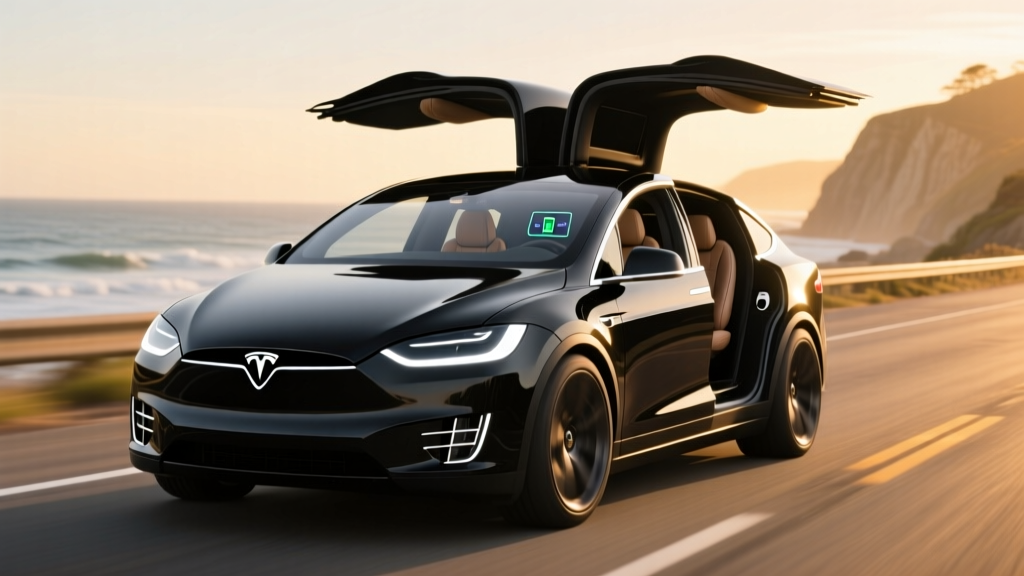
Falcon wing doors: The signature rear doors are the Model X's most polarizing feature. They provide excellent access to the second and third rows in tight parking spaces (they require only ~12 inches of side clearance). However, they're mechanically complex, with multiple sensors, hydraulic actuators, and seals that are prone to water leaks and alignment issues. Repair costs for door mechanisms run $800–$3,000 per incident. Many owners apply dielectric grease to connectors and keep drain channels clear as preventative maintenance.
Pricing, Tax Credits, and Used-EV Economics
When new, the 2018 Model X P100D carried a base MSRP of approximately $140,000 before options. Well-equipped examples reached $155,000–$165,000 with premium interior, FSD capability, and 22-inch wheels. Depreciation has been steep — as is typical for luxury EVs — and used examples in 2026 trade between $32,000 and $48,000 depending on mileage, condition, battery health, and hardware configuration.
Buying a used 2018 Model X P100D from a dealer may qualify you for the federal used-EV tax credit of up to $4,000 (30% of the sale price, capped at $4,000). Eligibility requires:
- Vehicle price: Must be $25,000 or less (sale price, not original MSRP)
- Vehicle age: Model year at least 2 years older than current year (2018 qualifies in 2026)
- Buyer income cap: AGI ≤ $75,000 (single) / ≤ $112,500 (head of household) / ≤ $150,000 (joint)
- Dealer requirement: Must purchase from a licensed dealer (private-party sales excluded)
- First transfer: Must be the first qualifying sale of this specific vehicle since August 16, 2022
- Battery capacity: At least 7 kWh (100 kWh pack easily qualifies)
Source: IRS Used Clean Vehicle Credit. Rules subject to change. Consult a tax professional for your specific situation. Note: At $32,000+, most P100D examples exceed the $25,000 price cap, making the used-EV credit unavailable for typical market purchases.
New-vehicle §30D credit: The 2018 Model X is no longer eligible for the new-vehicle $7,500 credit, which applies only to new purchases. Additionally, the original MSRP cap for SUVs ($80,000) would have disqualified the P100D even when new.
Warranty Coverage and Out-of-Pocket Risk
Tesla's original battery and drivetrain warranty for the 2018 Model X covers 8 years with unlimited miles, with a minimum 70% capacity retention threshold. For a 2018 model, this warranty window closes in 2026 — meaning most examples are at or past the expiration date. Some low-mileage examples registered late may still have a few months of coverage remaining.
The basic vehicle limited warranty was 4 years / 50,000 miles, which has long expired for all 2018 examples. This means virtually all repairs — including air suspension, falcon-wing doors, MCU, drive units, and HVAC — will be out of pocket unless you purchase an extended warranty from Tesla (if still available for the model year) or a third-party EV warranty provider.
Common repair costs to budget for:
- Air suspension strut replacement: $1,500–$2,500 per corner
- Falcon-wing door mechanism repair: $800–$3,000
- MCU1 to MCU2 upgrade: ~$1,500–$2,000 (if not already done)
- Drive unit replacement: $5,000–$8,000
- 12V battery replacement: $300–$500 (the 12V auxiliary battery, not the traction pack)
- Windshield replacement: $1,200–$1,800 (panoramic glass is expensive)
How Does It Compare to Alternatives?
In the $35,000–$45,000 used-EV SUV market, the Model X P100D competes with several strong alternatives:
| Attribute | 2018 Tesla Model X P100D | 2020–2021 Tesla Model Y LR | 2022 Hyundai Ioniq 5 AWD |
|---|---|---|---|
| EPA Range | 289 mi | 326 mi | 256 mi |
| Battery | 100 kWh NMC | 75 kWh NMC | 77.4 kWh NMC |
| 0–60 mph | 2.7 sec | 4.8 sec | 5.0 sec |
| Seating | 5/6/7 | 5 | 5 |
| Max DC Charge | ~120 kW | ~250 kW | ~240 kW |
| 10–80% Time | ~45–50 min | ~25 min | ~18 min |
| Warranty Remaining | Expired or expiring | Partial remaining | Mostly remaining |
| Used Price (2026) | $32K–$48K | $28K–$38K | $27K–$35K |
The P100D wins on raw performance, three-row seating, and cargo capacity. But it loses decisively on charging speed, warranty coverage, and maintenance risk. If you need seven seats and thrilling acceleration and are comfortable with repair budgets, the P100D is unique. If reliability and low running costs are priorities, a newer Model Y or Ioniq 5 is a smarter financial play.
- You need three-row seating in an EV and can't stretch to a new Model X or Rivian R1S
- Performance matters — 2.7-second 0–60 in a family SUV never gets old
- You have access to affordable Tesla service or are mechanically inclined
- You can budget $2,000–$5,000 annually for potential repairs
- You want warranty peace of mind
- Faster DC charging (sub-25-minute stops) matters for road trips
- You only need two rows of seating
- Lower total cost of ownership is the priority
Pros and Cons
- Supercar-rivaling 2.7s 0–60 mph acceleration
- 289-mile EPA range still competitive for a large SUV
- Three-row seating with falcon-wing door access
- 88.1 cu ft max cargo volume
- Over-the-air software updates keep the car current
- Access to Tesla Supercharger network (best-in-class reliability)
- Standard AWD with excellent traction in all conditions
- Warranty expired or expiring — high repair risk
- Slow DC charging (~120 kW) vs modern 250+ kW EVs
- Falcon-wing doors are expensive to repair and prone to leaks
- Air suspension failures are common and costly
- MCU1 infotainment is sluggish (unless upgraded to MCU2)
- 39 kWh/100 mi efficiency is poor by 2026 standards
- No longer eligible for most federal tax credits at typical used prices
- Insurance premiums are above average for the segment
Frequently Asked Questions
What is the real-world range of the 2018 Tesla Model X P100D?
The EPA rates the P100D at 289 miles. In real-world mixed driving, expect 240–265 miles. Highway driving at 75+ mph yields roughly 220–240 miles. In freezing weather, range can drop to 185–210 miles. Battery degradation (typically 8–15% at this age) further reduces usable range on a full charge.
How fast does the 2018 Model X P100D charge?
On Tesla Superchargers (V2), the P100D peaks at approximately 120 kW and charges from 10–80% in about 45–50 minutes. On a 48A Level 2 home charger, it adds roughly 34 miles per hour and fully charges in about 9 hours. The car cannot take advantage of V3 Supercharger speeds (250 kW) due to its older charge architecture.
Does the 2018 Model X P100D qualify for the federal EV tax credit?
As a used purchase, the §30D Used Clean Vehicle Credit offers up to $4,000 — but only if the sale price is $25,000 or less, buyer income is under the cap ($75K single / $150K joint), and the purchase is from a licensed dealer. Since most P100D examples sell for $32,000–$48,000, the credit is generally unavailable at current market prices. The new-vehicle $7,500 credit does not apply. Always verify current rules at IRS.gov.
Is the 2018 Model X P100D worth buying in 2026?
It depends on your priorities. If you need three-row EV seating, want supercar acceleration, and can budget for potential repairs ($2,000–$5,000/year), it offers extraordinary value at $35,000–$45,000 — a fraction of its $140,000+ original price. If reliability, warranty coverage, and fast charging are more important, a newer Model Y, Ioniq 5, or Kia EV6 is a safer choice.
What are the biggest problems with the 2018 Model X P100D?
The most common and costly issues are air suspension failure ($1,500–$2,500 per strut), falcon-wing door mechanism problems ($800–$3,000), MCU1 sluggishness, and windshield cracks (expensive panoramic glass replacement). Battery and drive unit failures are less common but extremely costly if out of warranty. Always get a pre-purchase inspection from a Tesla-certified technician.
How long will the battery last?
Tesla's 100 kWh NMC packs from this era typically retain 85–92% of original capacity at 100,000 miles, based on fleet data. At 150,000+ miles, expect 78–88% retention. A full battery replacement (if needed) costs approximately $18,000–$22,000 as of 2026, though refurbished packs are sometimes available for $12,000–$15,000. Minimizing DC fast charging and avoiding sustained 100% charges will maximize pack longevity.
Sources: EPA Fuel Economy Guide — 2018 Tesla Model X, IRS Used Clean Vehicle Credit, NHTSA — 2018 Tesla Model X