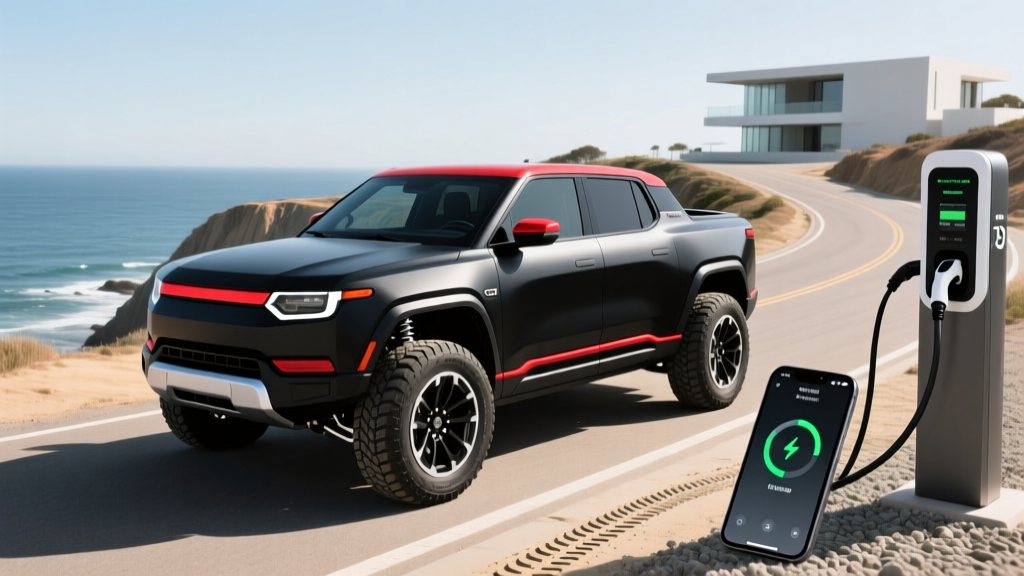
The Rivian R1 Quad Launch Edition sits at the apex of the second-generation R1 lineup — a four-motor electric SUV and truck platform pushing 1,025 horsepower through an available 149 kWh Max battery pack. For buyers evaluating the Rivian R1 Quad Launch Edition, the appeal is clear: supercar acceleration in a vehicle that can still tow 11,000 pounds and ford 3 feet of water. But flagship performance comes with flagship compromises — weight, efficiency, and a price that clears six figures before options. This review breaks down the exact numbers you need to decide whether the Quad motor configuration justifies its premium over the Dual-Motor R1.
Rivian R1 Quad Launch Edition: Core Specifications
| Specification | R1S (SUV) | R1T (Truck) |
|---|---|---|
| Powertrain | Quad-Motor AWD | Quad-Motor AWD |
| Horsepower | 1,025 hp | 1,025 hp |
| Torque | 1,198 lb-ft | 1,198 lb-ft |
| 0-60 mph | ~2.5 seconds | ~2.5 seconds |
| Battery (Max Pack) | 149 kWh (NMC) | 149 kWh (NMC) |
| EPA Range (Max Pack) | ~420 mi (est.) | ~405 mi (est.) |
| Max DC Fast Charge | ~220 kW | ~220 kW |
| 10-80% DCFC Time | ~42 minutes | ~42 minutes |
| Level 2 Home Charging | 11.5 kW (~16 mi/hr) | 11.5 kW (~16 mi/hr) |
| Towing Capacity | 7,700 lbs | 11,000 lbs |
| Ground Clearance (max) | 14.9 in | 14.9 in |
| Base MSRP (Launch Ed.) | $114,900 | $111,900 |
| Battery/Powertrain Warranty | 8 yr / 175,000 mi | 8 yr / 175,000 mi |
Note: Quad Launch Edition specs reflect Rivian's published Gen 2 platform data. EPA range figures are estimated based on Rivian projections and fueleconomy.gov listings for comparable R1 configurations. Final certified numbers may vary by model year.
Real-World Range: What the EPA Sticker Doesn't Tell You
Real-World Expectation: 320-360 miles highway; 280-310 miles in cold weather (below 32°F); 200-250 miles while towing at highway speeds.
The 149 kWh Max Pack is one of the largest battery modules available in any production consumer vehicle. That capacity gives the Quad Launch Edition a substantial range buffer — but physics still applies. The four-motor drivetrain, combined with the R1's boxy aerodynamics and 7,000+ pound curb weight, means efficiency suffers at sustained highway speeds.
In real-world driving, expect roughly 2.0-2.2 kWh/mile on the highway at 70-75 mph, which translates to 320-360 usable miles before you need to find a charger. In cold weather, lithium-ion chemistry and cabin heating demands can reduce range by 20-30%, bringing that figure down to 280-310 miles. Rivian's heat pump helps mitigate this compared to resistive heating systems, but the loss is still significant.
The most dramatic range hit comes from towing. If you're pulling a 5,000-pound trailer at highway speeds, expect consumption to roughly double — meaning your 420-mile EPA range effectively becomes 200-250 miles. This is consistent across all electric trucks and SUVs, not unique to Rivian, but it's a reality every R1 Quad buyer planning road trips with a trailer must plan around.
The R1's NMC (nickel manganese cobalt) battery chemistry offers higher energy density than LFP alternatives, which is how Rivian packs 149 kWh into the platform. The trade-off is that NMC cells benefit more from staying between 20-80% state of charge for daily driving, reserving 100% charges for road trips. Rivian's battery management system includes a substantial buffer to protect long-term cell health.
Charging Speed: DC Fast Charging and Home Setup
| Charging Level | Power | Speed (miles/hr) | Notes |
|---|---|---|---|
| Level 1 (120V) | ~1.4 kW | ~2-3 mi/hr | Emergency/trickle only |
| Level 2 (240V, 48A) | 11.5 kW | ~16 mi/hr | Full overnight charge in ~13 hrs |
| DC Fast Charge | ~220 kW peak | ~140 mi/15 min (peak) | 10-80% in ~42 min; tapers above 80% |
The Gen 2 R1 platform supports DC fast charging at up to approximately 220 kW via its NACS (North American Charging Standard) port, which provides native access to Tesla's Supercharger network — a significant advantage for road-trip planning. On a 250 kW or 350 kW charger, the R1 Quad will peak near 220 kW in the low state-of-charge window (roughly 10-30% SoC), then progressively taper.
The charge curve matters here. That 10-80% time of approximately 42 minutes accounts for the taper that begins around 50-60% SoC, where charge rates drop to roughly 150 kW, and further above 80% where they fall below 80 kW. Charging from 80-100% can add another 30+ minutes — so unless you absolutely need the full battery, stopping at 80% saves substantial time on road trips.
For home charging, the onboard 11.5 kW Level 2 charger means a full 0-100% charge takes roughly 13 hours on a 48-amp hardwired Level 2 station. Most owners will plug in overnight and rarely need a full charge from empty. A typical daily top-up of 100-150 miles requires only 6-9 hours on Level 2. Installation of a 240V/60A circuit for Level 2 home charging typically costs $800-$2,500 depending on panel proximity and local permit requirements — consult a licensed electrician for your specific setup.
Performance: Four Motors, 1,025 Horsepower, and What It Feels Like
The Quad-Motor configuration assigns one dedicated motor to each wheel, enabling true torque vectoring — the ability to independently vary power delivery to each corner of the vehicle. The result is a 0-60 mph time of approximately 2.5 seconds, placing the R1 Quad Launch Edition in hypercar acceleration territory despite weighing over three tons.
Beyond the headline 0-60 figure, the quad-motor setup delivers tangible capability benefits:
- Tank turns: The R1 can rotate in place by spinning left and right wheels in opposite directions — useful for tight off-road situations.
- Off-road precision: Individual wheel torque control provides traction management that mechanical differentials can't match, with instantaneous response to slip detection.
- Launch mode: The Launch Edition includes a dedicated drive mode that pre-conditions the battery and powertrain for maximum acceleration.
The trade-off for four motors is efficiency. The Quad-Motor configuration consumes more energy per mile than the Dual-Motor variants, which is reflected in the slightly lower EPA range estimates compared to Dual-Motor Max Pack models. For buyers who prioritize maximum range over maximum performance, the Dual-Motor with Max Pack offers a compelling alternative at a lower price point.
Pricing, Trim Levels, and Federal Tax Credit Eligibility
| Configuration | Base MSRP | §30D Tax Credit | Effective Price |
|---|---|---|---|
| R1T Quad Launch Edition | $111,900 | $0 (exceeds MSRP cap) | $111,900 |
| R1S Quad Launch Edition | $114,900 | $0 (exceeds MSRP cap) | $114,900 |
| R1T Dual-Motor (Standard) | $69,900 | Up to $7,500* | ~$62,400* |
| R1S Dual-Motor (Standard) | $74,900 | Up to $7,500* | ~$67,400* |
*§30D credit eligibility subject to IRS income caps ($300K MFJ / $150K single), MSRP caps ($80K trucks / $80K SUVs), and battery critical-mineral and component sourcing requirements. Rules change frequently — verify current eligibility at irs.gov or with a tax professional. Point-of-sale transfer available for eligible buyers.
The Quad Launch Edition's MSRP places it well above the IRS §30D price cap, which currently limits eligible trucks to $80,000 and SUVs to $80,000. This means the Quad Launch Edition does not qualify for the $7,500 federal EV tax credit. Buyers at this price point are paying full MSRP — though many states offer additional incentives that may partially offset the cost.
The Launch Edition includes premium equipment as standard: the 149 kWh Max Pack, quad-motor drivetrain, premium interior materials, advanced driver assistance features, and exclusive Launch Edition badging and color options. As of this writing, the Launch Edition is a limited-production model — availability depends on Rivian's production allocation.
Cargo, Passenger Space, and Daily Practicality
The R1S (SUV) and R1T (truck) share the same core platform but differ meaningfully in cargo configuration:
R1S SUV:
- Behind third row: ~10 cu ft
- Behind second row (third row folded): ~47 cu ft
- Max cargo (all rear seats folded): ~105 cu ft
- Front trunk (frunk): ~11 cu ft
- Seating: up to 7 passengers
R1T Truck:
- Bed length: 4.5 ft (standard) / extendable with tailgate down
- Gear Tunnel: ~11 cu ft (pass-through storage behind cab) — exclusive to R1T
- Front trunk (frunk): ~11 cu ft
- Seating: 5 passengers
The R1T's Gear Tunnel is a standout feature — a lockable, weather-sealed pass-through compartment accessible from both sides of the vehicle, ideal for storing long items like skis, fishing rods, or camping gear. Combined with the frunk, the R1T offers more secure enclosed storage than most conventional trucks.
Passenger space is generous in both variants. Front and second-row legroom exceed 38 inches, with comfortable seating for adults in all positions. The R1S third row is best suited for children or short trips — a common compromise in three-row SUVs of this size.
Technology, Driver Assistance, and Notable Drawbacks
Rivian's software platform is one of the strongest in the EV space, with an intuitive 15.6-inch center touchscreen, over-the-air updates, and a digital driver display. Key tech features on the Quad Launch Edition include:
- Rivian Driver+: A Level 2 driver-assistance system combining adaptive cruise control and lane centering on supported highways. Like all Level 2 systems (per SAE classification), this requires continuous driver supervision — it is not autonomous driving.
- Highway Assist: Hands-on-wheel lane centering with automatic lane changes on select divided highways.
- 360-degree camera system: Critical for a vehicle of this size, with trailer-reverse assist on the R1T.
- Over-the-air updates: Rivian regularly pushes feature additions and performance improvements remotely.
- NACS native charging: Direct Tesla Supercharger access without adapters.
Notable drawbacks:
- Efficiency penalty: The Quad-Motor drivetrain consumes more kWh per mile than Dual-Motor variants, meaning higher charging costs and more frequent stops on road trips.
- Ride firmness: The air suspension is competent, but the R1's weight and performance tuning can transmit road imperfections more than luxury-focused competitors.
- No Apple CarPlay / Android Auto: Rivian uses its proprietary infotainment system. While well-designed, some buyers expect smartphone mirroring at this price point.
- Service center access: Rivian's service network is growing but still limited in rural areas compared to legacy automakers.
- Towing range reduction: As noted, towing cuts effective range roughly in half — a physics limitation shared with all electric trucks.
Who the R1 Quad Launch Edition Suits Best
- You want the fastest-accelerating production SUV/truck available and value exclusivity.
- You need serious off-road capability with torque vectoring precision.
- You tow occasionally but prioritize performance over maximum towing efficiency.
- Budget is not a primary constraint and you accept the efficiency trade-off for four motors.
- Maximum range and efficiency are higher priorities than 0-60 times.
- You want to stay under the $80,000 MSRP cap for potential §30D tax credit eligibility.
- You don't need tank turns or individual wheel torque vectoring for off-road use.
- You're a daily commuter who values lower per-mile charging costs.
The Quad Launch Edition is a halo product — it showcases what the R1 platform can do at its engineering ceiling. For adventure-oriented buyers who want uncompromising performance and can accommodate the price and efficiency trade-offs, it delivers an experience no competitor matches. For the majority of EV truck and SUV shoppers, the Dual-Motor variants offer 80% of the capability at a significantly lower cost with better range and tax-credit potential.
Pros and Cons at a Glance
- 2.5-second 0-60 mph — among the fastest production vehicles ever made
- True torque vectoring with individual wheel motors
- Up to ~420 miles EPA range (Max Pack)
- Native NACS charging with Tesla Supercharger access
- Class-leading off-road capability and 14.9" ground clearance
- 11,000-lb towing capacity (R1T)
- Gear Tunnel (R1T) and 11 cu ft frunk
- 8-year/175,000-mile battery warranty
- Strong OTA update track record
- MSRP exceeds §30D tax credit cap — no $7,500 federal credit
- Quad-motor efficiency penalty vs Dual-Motor (~2.0+ kWh/mi highway)
- Towing cuts effective range by ~50%
- No Apple CarPlay or Android Auto
- Service network still expanding in rural regions
- Limited Launch Edition production allocation
- Premium price ($111,900-$114,900) with few rivals at this tier
Frequently Asked Questions
What is the real-world range of the Rivian R1 Quad Launch Edition?
The EPA estimates approximately 420 miles for the R1S and 405 miles for the R1T with the 149 kWh Max Pack. Real-world highway driving at 70-75 mph typically yields 320-360 miles. Cold weather (below 32°F) reduces that to roughly 280-310 miles. Towing at highway speeds can drop effective range to 200-250 miles.
How fast does the R1 Quad charge on DC fast chargers and at home?
On a DC fast charger, the R1 Quad peaks at approximately 220 kW and charges from 10-80% in roughly 42 minutes. The charge rate tapers significantly above 80%. At home on a 240V Level 2 charger (11.5 kW), expect about 16 miles of range per hour, with a full 0-100% charge taking approximately 13 hours.
Does the Rivian R1 Quad Launch Edition qualify for the federal EV tax credit?
No. The Quad Launch Edition's MSRP ($111,900-$114,900) exceeds the IRS §30D cap of $80,000 for both trucks and SUVs. Buyers will not receive the $7,500 federal credit on this trim. Lower-priced Dual-Motor configurations under $80,000 may qualify, subject to income limits and battery sourcing requirements — verify at irs.gov.
Is the R1 Quad Launch Edition worth buying over competitors?
It depends on your priorities. The R1 Quad has no direct rival combining 1,025 hp, genuine off-road capability, and 400+ mile range. The Tesla Model X Plaid is faster but lacks off-road credibility and towing capacity. The GMC Hummer EV is similarly powerful but heavier and less efficient. The Lucid Gravity (when available) targets luxury efficiency, not off-road performance. If you need a do-everything performance EV truck or SUV, the R1 Quad is currently the only option that checks every box.
What is the battery warranty on the R1 Quad?
Rivian covers the battery pack and powertrain for 8 years or 175,000 miles, whichever comes first. The warranty covers defects and capacity loss below a specified threshold (typically 70% state of health). This is among the more generous battery warranties in the EV truck segment.
Can the R1 Quad use Tesla Superchargers?
Yes. The Gen 2 R1 platform uses a native NACS (North American Charging Standard) port, providing direct access to Tesla's Supercharger network without the need for an adapter. This is a significant advantage for road-trip charging infrastructure.