The Tesla Model Y in 2026: Still the EV to Beat, Even With the Controversy
The 2026 Tesla Model Y remains the best-selling electric vehicle in the United States for good reason: it offers a compelling blend of range, charging speed, cargo space, and software integration that competitors still struggle to match across all dimensions simultaneously. But a growing cultural phenomenon — the anti Elon Tesla Club bumper sticker — reflects a real tension many buyers feel. They want the car's objectively strong engineering while distancing themselves from the polarizing public statements of Tesla's CEO.
This review covers the 2026 Model Y purely on its merits as an electric vehicle: range, charging, performance, pricing, tax-credit eligibility, and daily ownership reality. Whether you slap a bumper sticker on the back or not, these are the numbers that matter.
| Spec | Long Range RWD | Long Range AWD | Performance |
|---|---|---|---|
| EPA Range | 320 mi | 308 mi | 285 mi |
| Battery (usable) | 75 kWh (est.) NMC | 75 kWh (est.) NMC | 75 kWh (est.) NMC |
| Max DC Fast Charge | 250 kW | 250 kW | 250 kW |
| 10–80% DC Time | ~27 min | ~27 min | ~27 min |
| Level 2 Home Charge | 11.5 kW (~44 mi/hr) | 11.5 kW (~44 mi/hr) | 11.5 kW (~44 mi/hr) |
| 0–60 mph | 6.5 sec | 4.8 sec | 3.5 sec |
| Horsepower | 346 hp | 384 hp | 456 hp |
| Drivetrain | RWD (single motor) | AWD (dual motor) | AWD (dual motor) |
| MPGe (combined) | 123 MPGe | 117 MPGe | 111 MPGe |
| Efficiency | 27 kWh/100mi | 29 kWh/100mi | 30 kWh/100mi |
| Base MSRP | $44,990 | $47,990 | $52,490 |
Range and Efficiency: EPA Numbers vs. Real-World Reality
The 2026 Model Y Long Range RWD carries an EPA-estimated 320 miles of range, placing it among the top-tier mainstream EVs. The dual-motor AWD drops to 308 miles, and the Performance trim sits at 285 miles — still highly competitive for a vehicle with its acceleration figures.
Real-World Range Expectations:
- Mixed driving (city/suburban): Expect 290–310 miles on the Long Range RWD — close to EPA thanks to strong regenerative braking in stop-and-go traffic.
- Sustained highway (70–75 mph): Plan for 250–275 miles. Aerodynamic drag at speed consumes energy faster than the EPA combined cycle suggests.
- Cold weather (below 32°F): Range can drop 20–30%, putting realistic winter range at 220–255 miles for the Long Range AWD. The Model Y uses a heat pump (standard), which mitigates cabin-heating losses compared to resistive heaters, but battery chemistry still suffers in deep cold.
- Towing: Rated for 3,500 lbs, but towing cuts range roughly in half — expect 140–160 miles on the AWD trim with a loaded trailer.
Efficiency is where Tesla's engineering shows. At 27 kWh/100 miles (Long Range RWD), the Model Y converts battery energy to motion with minimal waste. That translates to roughly 123 MPGe combined, per fueleconomy.gov. For context, the Hyundai Ioniq 5 AWD sits at 110 MPGe combined, and the Ford Mustang Mach-E Extended Range AWD at 101 MPGe. Tesla's thermal management system — which conditions the battery proactively based on navigation routing — is a meaningful contributor here.
Charging Speed: 250 kW Peak, but the Curve Tells the Full Story
The 2026 Model Y supports up to 250 kW DC fast charging on Tesla's V3 Supercharger network and compatible CCS/NACS stations (Tesla transitioned to NACS as its native port, and adapters are available for CCS networks like Electrify America).
| Charging Level | Power | Speed (miles added) | Notes |
|---|---|---|---|
| Level 1 (120V household) | ~1.4 kW | ~3–4 mi/hr | Emergency/trickle only; not practical for daily use |
| Level 2 (240V, 48A home) | 11.5 kW | ~44 mi/hr | Full charge in ~7–8 hours; ideal overnight setup |
| DC Fast (V3 Supercharger) | Peak 250 kW | ~162 mi in 15 min | Peak only below ~50% SoC; tapers significantly above 80% |
| DC Fast (V4 Supercharger) | Up to 250 kW | Similar to V3 | Newer stations with cable management improvements |
The critical detail many spec sheets bury: the charge curve. The Model Y hits its 250 kW peak only at low state-of-charge (roughly 10–30% SoC) and when the battery is preconditioned — which happens automatically when you navigate to a Supercharger. Above 50% SoC, the rate drops to roughly 150 kW, and above 80% it falls below 50 kW. The 10–80% time of approximately 27 minutes is realistic only with preconditioning. Without it (say, at a non-Tesla DC station without nav routing), add 5–10 minutes.
For home charging, a Level 2 wall connector on a 60A circuit (48A continuous) delivers 11.5 kW — enough to replenish a full day's driving in 1–2 hours. Most owners wake up to a full battery every morning, which is the single biggest quality-of-life advantage of EV ownership. Installation typically runs $800–$2,000 depending on panel proximity and local permitting, on top of the ~$400 Wall Connector hardware cost.
Performance and Driving Dynamics
The Model Y Performance does 0–60 mph in 3.5 seconds — sports-car territory in a 4,400-pound crossover. The Long Range AWD manages 4.8 seconds, and even the base RWD at 6.5 seconds is quicker than most gas-powered compact SUVs. Instant electric torque makes all trims feel responsive in daily driving, particularly in merging and passing situations.
The dual-motor AWD system provides confident traction in rain and light snow, with independent torque vectoring between front and rear axles. However, the Model Y's ride quality remains firm — Tesla prioritizes handling precision over plushness. Road noise at highway speeds is noticeable compared to the Hyundai Ioniq 5 or Kia EV6, which benefit from additional sound deadening.
Regenerative braking is strong enough for one-pedal driving in most conditions. Tesla removed the user-adjustable regen setting several model years ago, so the intensity is fixed — most owners adapt quickly, but it's a consideration if you prefer a coasting feel.
Interior, Tech, and Cargo: Minimalist by Design
The Model Y interior is defined by its 15.4-inch center touchscreen that handles virtually all vehicle functions — climate, mirrors, glovebox, navigation, and media. There is no instrument cluster; speed and range information appears in the upper-left corner of the main display. The 2025 refresh (carried into 2026) added ambient lighting, ventilated front seats, a rear-seat touchscreen, and improved materials, addressing long-standing criticism of the cabin's spartan feel.
Cargo and passenger dimensions:
- Cargo (behind 2nd row): 30.2 cu ft
- Cargo (2nd row folded): 72.1 cu ft
- Front trunk (frunk): 4.1 cu ft
- Rear legroom: 41.6 inches
- Front headroom: 41.0 inches
- Seating: 5 standard (optional 7-seat layout available with tiny third row, best for small children only)
The cargo area is genuinely practical — the hatchback design swallows luggage, strollers, and Costco runs with ease. The frunk adds useful space for charging cables or a small bag. Compared to the Ford Mustang Mach-E (29.0 cu ft behind the rear seats, 59.7 cu ft folded), the Model Y holds a slight edge.
Standout tech: Tesla's software remains the industry benchmark for over-the-air updates, trip planning with automatic battery preconditioning, and the Supercharger network's plug-and-charge simplicity. The optional Full Self-Driving (Supervised) package ($8,000) provides advanced lane changes, traffic-light recognition, and city-street navigation — but this is SAE Level 2 driver assistance, not autonomous driving. You must remain attentive with hands on the wheel at all times.
Notable drawbacks: The lack of Apple CarPlay/Android Auto frustrates many buyers. Turn-signal stalks were removed in favor of steering-wheel buttons — a divisive design choice. Panel-gap quality, while improved, still lags behind legacy automakers at this price point.
Pricing, Trims, and Federal Tax Credit Eligibility
| Trim | Base MSRP | Est. Federal Credit (§30D) | Effective Price |
|---|---|---|---|
| Long Range RWD | $44,990 | Up to $7,500* | ~$37,490* |
| Long Range AWD | $47,990 | Up to $7,500* | ~$40,490* |
| Performance | $52,490 | Up to $7,500* | ~$44,990* |
*Eligibility for the full $7,500 federal tax credit under IRS §30D depends on buyer income, battery critical-mineral sourcing, and MSRP caps. The Model Y qualifies as an SUV under the $80,000 MSRP cap. Income limits: $300,000 joint / $225,000 head of household / $150,000 individual modified AGI. Credit can be transferred at point of sale as a purchase-price reduction. Verify current eligibility at irs.gov before purchasing, as battery-sourcing rules tighten annually.
Destination charges add approximately $1,390. Popular options include FSD (Supervised) at $8,000, premium paint colors ($1,000–$2,500), and 20-inch wheels ($2,000, which reduces range by roughly 10–15 miles). A well-equipped Long Range AWD with FSD and premium paint can reach $60,000+ before credits.
Warranty and Long-Term Battery Outlook
Tesla covers the Model Y with:
- Basic vehicle warranty: 4 years / 50,000 miles
- Battery and drive unit: 8 years / 120,000 miles (Long Range AWD, Performance)
- Battery and drive unit: 8 years / 100,000 miles (Long Range RWD)
- Capacity retention threshold: Tesla warrants that the battery will retain at least 70% of original capacity during the warranty period
The Model Y uses NMC (nickel manganese cobalt) chemistry, which offers higher energy density than LFP (lithium iron phosphate) but is more sensitive to sustained high state-of-charge. Tesla recommends daily charging to 80% for NMC batteries and reserving 100% charges for road trips. Real-world degradation data from Tesla's own fleet reports show approximately 12% range loss at 150,000 miles — meaning a 320-mile new battery might deliver ~282 miles after significant use. Battery replacement, should it be needed out of warranty, runs approximately $12,000–$16,000 at current service pricing.
The Anti-Elon Tesla Club Bumper Sticker Phenomenon
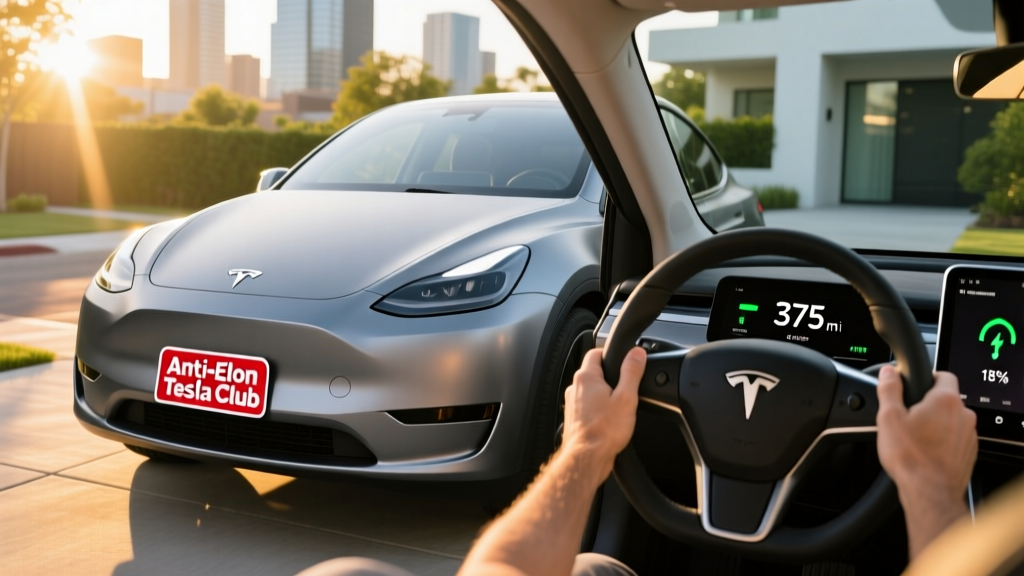
Search "anti Elon Tesla Club bumper sticker" on any marketplace and you'll find dozens of listings — "I Bought This Before the Elon Stuff," "Anti-Elon Tesla Owners Club," and variations that let drivers signal their purchase was pragmatic, not political. This cultural artifact reveals something real about the 2026 EV market.
Tesla's brand perception has fractured. IIHS safety ratings for the Model Y remain excellent (Top Safety Pick+ in prior model years), and the Supercharger network is still the most reliable DC fast-charging infrastructure in North America. But for a segment of buyers, the CEO's public activities have created enough discomfort that a bumper sticker serves as a social permission slip.
From a pure ownership standpoint, the sticker doesn't change the car. The Model Y's engineering, range, and charging ecosystem remain strong regardless of corporate leadership. But it's worth noting that Tesla's resale values have softened partly due to brand-sentiment shifts, and some buyers who would have defaulted to Tesla in 2021 now cross-shop the Hyundai Ioniq 5, Kia EV6, Ford Mustang Mach-E, and BMW iX more seriously.
If you're considering the bumper sticker, you're not alone — and you're also not wrong to evaluate the Model Y on its specs. The car and the controversy are separable, at least mechanically.
Model Y vs. Key Competitors: Is It Still Worth Buying?
Here's how the 2026 Model Y Long Range AWD stacks up against its closest rivals:
| Attribute | Tesla Model Y LR AWD | Hyundai Ioniq 5 Limited AWD | Ford Mach-E Ext. Range AWD | Kia EV6 GT-Line AWD |
|---|---|---|---|---|
| EPA Range | 308 mi | 290 mi | 290 mi | 282 mi |
| Max DC Charge | 250 kW | 350 kW (peak) | 150 kW | 350 kW (peak) |
| 10–80% Time | ~27 min | ~18 min | ~45 min | ~18 min |
| 0–60 mph | 4.8 sec | 5.1 sec | 5.1 sec | 5.2 sec |
| Cargo (rear seats up) | 30.2 cu ft | 27.2 cu ft | 29.7 cu ft | 24.4 cu ft |
| Apple CarPlay | No | Yes (wireless) | Yes (wireless) | Yes (wireless) |
| Base MSRP (AWD) | $47,990 | $53,600 | $48,995 | $52,900 |
Choose the Model Y if: You prioritize maximum cargo space, the best software/trip-planning ecosystem, access to the Supercharger network without adapters, and proven long-term efficiency.
Choose the Ioniq 5 or EV6 if: You want faster peak charging (350 kW on compatible stations), Apple CarPlay, a more conventional interior with physical controls, and don't mind slightly less cargo room.
Choose the Mach-E if: You want a Ford dealer network for service, CarPlay support, and a more traditional crossover driving feel — but accept slower DC charging as a trade-off.
Pros
- Class-leading cargo volume (30.2 cu ft + 4.1 cu ft frunk)
- Excellent efficiency (27–30 kWh/100mi depending on trim)
- Supercharger network: most reliable DC charging in the US
- Strong OTA updates continuously add features
- Competitive pricing, especially after §30D credit
- Heat pump standard for better cold-weather efficiency
Cons
- No Apple CarPlay or Android Auto
- Firm ride quality; road noise at highway speed
- Turn signals on steering wheel (no stalks) — polarizing
- FSD (Supervised) is expensive and remains Level 2
- Brand sentiment concerns affecting potential resale value
- Panel-gap quality still inconsistent vs. legacy brands
Who the 2026 Model Y Suits Best
Commuters and daily drivers: The Long Range RWD at $44,990 (potentially ~$37,490 after credit) is one of the best value-per-mile-of-range propositions in the market. If you can charge at home, the Model Y transforms daily driving into a fuel-cost-minimized, low-maintenance routine.
Families: The cargo space, optional 7-seat layout, strong safety ratings, and over-the-air feature improvements make it a practical family hauler. Rear-seat entertainment via the back-screen is a welcome 2025+ addition.
Road trippers: The Supercharger network remains the gold standard for long-distance EV travel. Trip planning with automatic battery preconditioning means you spend less time figuring out logistics and more time driving. Just budget for the real-world range reduction at sustained highway speeds.
Towing: The 3,500-lb rating handles a small boat or light camper, but range drops dramatically. If regular towing is a priority, consider the Ford F-150 Lightning or Rivian R1S instead.
Frequently Asked Questions
What is the real-world range of the 2026 Tesla Model Y?
The EPA estimates 320 miles for the Long Range RWD, 308 for the Long Range AWD, and 285 for the Performance. In real-world mixed driving, expect 290–310 miles (RWD). Sustained highway driving at 70+ mph drops this to 250–275 miles. Cold weather (below freezing) can reduce range by 20–30%, yielding roughly 220–255 miles for the AWD model in winter conditions.
How fast does the Model Y charge at home and on DC fast chargers?
On a Level 2 home charger (11.5 kW / 48A), the Model Y adds approximately 44 miles of range per hour, fully recharging overnight in 7–8 hours. On a DC fast charger (V3 Supercharger), it peaks at 250 kW and charges from 10–80% in roughly 27 minutes with battery preconditioning. Without preconditioning, add 5–10 minutes. Charging slows significantly above 80% SoC — plan your stops around 10–80% cycles for efficiency.
How much does the 2026 Model Y cost after federal tax credits?
The Long Range RWD starts at $44,990, and if you qualify for the full $7,500 §30D credit (transferred at point of sale), the effective price drops to approximately $37,490. Eligibility requires: buyer income below $150,000 individual / $300,000 joint modified AGI; MSRP under the $80,000 SUV cap (the Model Y qualifies); and the vehicle must meet critical-mineral and battery-component sourcing requirements that tighten each year. Always verify at irs.gov before purchase.
Is the Tesla Model Y still worth buying versus competitors in 2026?
Yes, if your priorities are cargo space, charging-network reliability, software integration, and efficiency. The Ioniq 5 and EV6 charge faster on 350 kW stations and offer Apple CarPlay. The Mach-E provides a more conventional dealership experience. But no single competitor beats the Model Y across every category simultaneously — its overall package remains the most well-rounded in the segment.
What are the biggest pros and cons of the 2026 Model Y?
Top pros: class-leading cargo room, excellent energy efficiency, reliable Supercharger access, strong OTA updates, competitive post-credit pricing, standard heat pump. Top cons: no CarPlay/Android Auto, firm ride and road noise, steering-wheel turn signals, expensive FSD package that remains Level 2 only, brand-sentiment headwinds affecting resale, and inconsistent panel gaps.
Does the 2026 Model Y qualify for the federal EV tax credit?
As of the 2026 tax year, the Model Y qualifies for up to $7,500 under IRS §30D, provided the buyer meets income thresholds ($150K single / $300K joint MAGI), the vehicle MSRP is under the $80,000 SUV cap, and the battery meets critical-mineral and component-sourcing requirements. The credit can be applied as a point-of-sale reduction. Rules change annually — confirm current eligibility with your tax professional or at irs.gov before finalizing a purchase.