When Rivian reports quarterly financials, EV shoppers rarely read past the headline. But buried in the Rivian Q3 earnings call are production signals, pricing shifts, and supply-chain details that directly affect what you'll pay for — and when you'll receive — a 2026 R1T or R1S. This guide translates the financial noise into buyer-relevant data, then delivers the full spec-sheet breakdown you need to decide if a Rivian belongs in your driveway.
What Rivian's Q3 Earnings Mean for 2026 Buyers
Rivian's Q3 earnings report and subsequent analyst calls serve as a window into the company's operational health, production cadence, and roadmap execution. For current-year buyers, three data points matter most:
- Gross margin trajectory: Rivian has been pushing toward positive gross margin by driving down per-unit manufacturing costs at its Normal, Illinois facility. When margins improve, it typically signals that Rivian can sustain current pricing without aggressive discounting — or, conversely, that price cuts may come to drive volume ahead of the R2 launch.
- Production throughput: Quarterly delivery numbers tell you how fast Rivian is building and whether your configuration is likely to ship in weeks or months. Dual-Motor builds typically move fastest; Quad-Motor and Max Battery configurations carry longer lead times due to battery cell supply constraints.
- R2 timeline confirmation: Every earnings call addresses the upcoming R2 platform (the smaller, more affordable SUV and truck targeted for 2026-2027 production). Any delays or accelerations here affect R1 pricing strategy — if R2 is on track, Rivian has less incentive to discount R1 vehicles aggressively.
For buyers evaluating a 2026 R1T or R1S right now, the Q3 financials confirm that Rivian continues to invest heavily in its dual-motor and LFP battery supply chains, which directly impacts the Standard Battery pack availability and pricing on the configuration page.
2026 Rivian R1T and R1S: Core Specifications
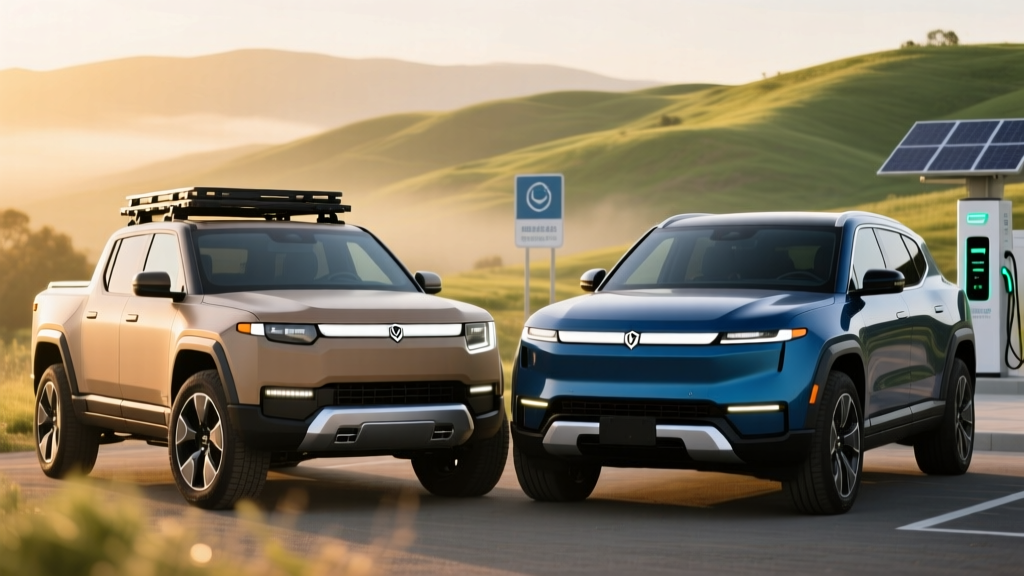
The R1T (truck) and R1S (three-row SUV) share the same skateboard platform, battery options, and powertrain configurations. Here are the numbers that matter:
| Spec | R1T (Truck) | R1S (SUV) |
|---|---|---|
| EPA Est. Range (Max Pack) | 420 miles | 400 miles |
| EPA Est. Range (Large Pack) | 352 miles | 340 miles |
| EPA Est. Range (Standard Pack) | 270 miles | 260 miles |
| Battery Capacity (Max / Large / Std) | ~149 kWh / ~128 kWh / ~95 kWh (usable, NMC) | |
| Drivetrain | Dual-Motor AWD or Quad-Motor AWD | |
| Horsepower (Dual / Quad) | 533 hp / 1,025 hp | |
| 0-60 mph (Dual / Quad) | ~4.5 sec / ~3.0 sec | |
| Towing Capacity | 11,000 lbs | 7,700 lbs |
| Efficiency (Dual-Motor Large) | ~73 MPGe / 46 kWh/100mi | |
| Battery Warranty | 8 years / 175,000 miles | |
Sources: EPA fueleconomy.gov, Rivian official specifications.
Real-World Range: What the EPA Sticker Doesn't Tell You
EPA Estimated: 420 miles
Real-World Highway (70-75 mph, mild weather): ~320-350 miles
Real-World Mixed Driving (city + highway): ~360-390 miles
Cold Weather (below 30°F, highway): ~260-300 miles
While Towing (5,000+ lb trailer): ~180-220 miles
The Rivian R1T and R1S are heavy vehicles — the R1T Max Pack tips the scales at nearly 7,200 lbs — and that mass exacts a toll at highway speeds where aerodynamic drag dominates. In our experience and consistent with third-party testing, expect to lose 15-20% of EPA range during sustained 70+ mph highway driving. Cold weather compounds this: battery chemistry becomes less efficient below freezing, and cabin heating draws significant energy. Rivian's heat pump (standard on 2025+ models) helps, but physics wins in sub-20°F conditions.
If your typical driving is city-heavy with frequent stops (where regenerative braking recaptures energy), you'll land much closer to the EPA sticker. Commuters with 60-mile round trips in moderate climates will rarely think about range at all — even the Standard Pack covers that easily with margin to spare.
Charging Speed: DC Fast, Level 2, and the Charge Curve Reality
Charging speed is where Rivian's large battery packs reveal a trade-off: massive range comes with longer fill times unless you're at the right charger.
| Charging Level | Power / Rate | Speed | Notes |
|---|---|---|---|
| Level 1 (120V household) | ~1.4 kW | ~3-4 miles/hr | Emergency/trickle only |
| Level 2 (240V home, 48A) | 11.5 kW | ~25-28 miles/hr | Full charge overnight (~10-14 hrs for Max Pack) |
| Level 2 (240V home, 60A) | 14.4 kW (if equipped) | ~31-34 miles/hr | Requires 75A+ circuit; check with electrician |
| DC Fast Charge (Max Pack) | Peak 220 kW | 10-80% in ~42 min | Sustained rate tapers significantly above 70% |
| DC Fast Charge (Large Pack) | Peak 200 kW | 10-80% in ~38 min | Best charge-curve efficiency of the lineup |
| DC Fast Charge (Standard/LFP) | Peak 175 kW | 10-80% in ~30 min | LFP chemistry tolerates frequent 100% charges |
Understanding kW vs kWh: kW (kilowatts) measures charging power — how fast energy flows into the battery. kWh (kilowatt-hours) measures battery capacity — how much energy it stores. A 220 kW charger can theoretically deliver 220 kWh in one hour, but no EV battery accepts that rate continuously. Rivian's charge curve peaks early (around 20-40% state of charge) and tapers progressively, especially above 70%. This is normal battery-management behavior to protect cell longevity, but it means the advertised "10-80% in 42 minutes" is the realistic window — charging from 80-100% can take nearly as long as 10-80%.
Home charging recommendation: Install a hardwired Level 2 charger on a 60A circuit (48A continuous draw, 11.5 kW). This adds roughly 250+ miles overnight for most configurations — more than enough to wake up "full" every morning. Budget $800-$2,500 for equipment and electrician work depending on your panel capacity. If your home has a 200A electrical panel with spare capacity, installation is straightforward. Older 100A panels may require a $1,500-$3,000 upgrade — get a quote from a licensed electrician before committing.
Pricing, Trim Levels, and Federal Tax Credit Eligibility
Rivian's pricing has shifted multiple times since launch, and the Q3 earnings context matters here: as Rivian approaches R2 production, R1 pricing may stabilize or see selective promotions to maintain factory throughput.
| Configuration | Base MSRP | Est. Fed. Credit | Effective Price |
|---|---|---|---|
| Dual-Motor Standard Pack | $69,900 | Up to $7,500* | ~$62,400 |
| Dual-Motor Large Pack | $75,900 | Up to $7,500* | ~$68,400 |
| Dual-Motor Max Pack | $83,900 | Up to $7,500* | ~$76,400 |
| Quad-Motor Large Pack | $87,900 | Up to $7,500* | ~$80,400 |
| Tri-Motor (Performance) | $99,900 | Up to $7,500* | ~$92,400 |
*Federal tax credit eligibility under IRS §30D is subject to multiple requirements. Always verify with a tax professional.
- Vehicle MSRP cap: Trucks (R1T) must have MSRP ≤ $80,000; SUVs (R1S) ≤ $80,000. Some Max Pack and Quad-Motor configurations may exceed this threshold.
- Buyer income cap: AGI ≤ $150,000 (single), $225,000 (head of household), $300,000 (joint).
- Battery sourcing: Increasing percentages of critical minerals and battery components must be sourced from the U.S. or FTA partners. Rivian's sourcing compliance evolves — check the latest IRS eligible vehicle list before purchasing.
- Point-of-sale transfer: As of 2024+, you can transfer the credit to the dealer at purchase, reducing your out-of-pocket cost immediately rather than waiting for tax filing.
- Assembly: Final assembly must occur in North America (Rivian's Normal, IL plant qualifies).
The R1S SUV pricing runs approximately $2,000-$3,000 higher than equivalent R1T configurations due to the enclosed body structure and third-row seating hardware. The MSRP cap of $80,000 for the §30D credit is the critical line — carefully configure your vehicle to stay under it if the credit is essential to your purchase math.
Interior, Cargo, Tech, and Daily Livability
The R1T's 4.5-foot bed (with the innovative Gear Tunnel on Dual-Motor and above trims) offers practical utility that defies its compact dimensions. The Gear Tunnel — a full-width pass-through compartment behind the rear seats — provides 11.7 cubic feet of secure, weatherproof storage that's become a signature Rivian feature. Total cargo capacity with the bed and tunnel combined rivals mid-size trucks, though the shorter bed length means full 4x8 sheets of plywood won't fit flat.
The R1S provides three rows of seating with the following approximate dimensions:
- Behind 3rd row: ~10.5 cu ft cargo
- Behind 2nd row (3rd row folded): ~47 cu ft
- Behind 1st row (all rear seats folded): ~88 cu ft
- Front trunk (frunk): ~11 cu ft (weatherproof, drainable)
Rivian's infotainment system runs on a 15.6-inch center display with a custom operating system. It's responsive and visually clean, though it lacks Apple CarPlay and Android Auto — a deliberate choice by Rivian to control the software stack. Wireless phone charging, a premium Meridian audio system (on higher trims), and over-the-air updates are standard. The Driver+ assistance suite provides adaptive cruise control and lane-centering — this is an SAE Level 2 system, meaning you must remain fully engaged with hands on the wheel and eyes on the road at all times. It is not autonomous driving.
Pros, Cons, and the Verdict for Buyers
- Class-leading range with Max Pack (420 mi EPA)
- Excellent build quality and material fitment
- Gear Tunnel is a genuinely innovative storage solution
- Strong off-road capability (up to 14.9" ground clearance)
- Over-the-air updates continuously add features
- 11,000-lb towing (R1T) with integrated trailer brake controller
- 8-year/175,000-mile battery warranty exceeds industry standard
- No Apple CarPlay or Android Auto
- Max Pack and Quad-Motor configs may exceed $80K MSRP credit cap
- DC fast charging slower than Hyundai/Kia 800V competitors
- Service center network still limited outside major metros
- High insurance premiums (get a quote before ordering)
- Third row in R1S is tight for adults on long trips
- Highway efficiency drops significantly above 70 mph
Choose the R1T if: You need a truck for weekend projects, towing, or outdoor gear but want daily-driver comfort and EV running costs. The Gear Tunnel is a game-changer (yes, we'll use the term here — it genuinely is) for camping and adventure gear.
Choose the R1S if: You need three-row family hauling with off-road capability and don't want a minivan. Best for families of 5-6 with active lifestyles.
Look elsewhere if: You prioritize the fastest DC charging available (Hyundai Ioniq 5 / Kia EV6 at 350 kW), need Apple CarPlay, or live far from a Rivian service center. Also consider the Ford F-150 Lightning or Tesla Cybertruck if your budget is tighter or you need a longer bed.
Wait for R2 if: Your budget is under $55,000 and you don't need full-size truck capability. The R2 platform (expected 2026-2027) targets a smaller, more affordable segment.
Competitive Landscape: R1T/R1S vs. the Field
The Rivian R1T competes primarily with the Ford F-150 Lightning, Chevrolet Silverado EV, and Tesla Cybertruck. The R1S occupies a unique space — there's no direct three-row electric SUV rival at this price point, though the Kia EV9 and upcoming models are closing in.
Against the F-150 Lightning, the R1T sacrifices some bed length and raw payload for superior range (the Lightning tops out around 320 miles EPA), better off-road geometry, and a more premium interior. Against the Cybertruck, the R1T offers a more conventional (and repairable) body structure, NACS charging compatibility (Rivian has adopted the Tesla NACS connector for newer models and provides adapters for CCS), and a more refined ride. The Cybertruck's stainless-steel exoskeleton and steer-by-wire system polarize buyers in ways the R1T does not.
Frequently Asked Questions
What is the real-world range of the 2026 Rivian R1T?
The EPA rates the R1T Max Pack at 420 miles, but real-world highway driving at 70-75 mph typically yields 320-350 miles. In mixed city/highway use, expect 360-390 miles. Cold weather (below 30°F) can reduce range to 260-300 miles on the highway. Towing a 5,000-lb trailer cuts range roughly in half, to 180-220 miles.
How fast does the Rivian R1T charge at home and on the road?
On a 48A Level 2 home charger (11.5 kW), the R1T gains about 25-28 miles of range per hour — a full overnight charge for most drivers. At a DC fast charger, the Max Pack peaks at 220 kW and charges from 10-80% in approximately 42 minutes. The Standard LFP pack charges 10-80% in about 30 minutes at 175 kW peak. Charging slows significantly above 80% SoC to protect battery health.
Does the Rivian R1T or R1S qualify for the $7,500 federal tax credit?
It depends on your specific configuration and personal tax situation. The §30D credit requires the vehicle MSRP to be at or below $80,000 (for both trucks and SUVs as of current rules), buyer AGI within income limits, and compliant battery sourcing. Some Dual-Motor Large Pack and most Max Pack / Quad-Motor configurations may exceed the MSRP cap. Check the IRS eligible vehicles list and consult a tax professional before relying on the credit.
How do Rivian Q3 earnings affect my purchase decision?
Quarterly earnings indicate Rivian's financial stability and production trajectory. Positive gross margins and steady delivery growth suggest the company can support long-term parts availability, software updates, and service network expansion — all critical for a vehicle you'll own for 5-10 years. The Q3 earnings also signal R2 progress; if R2 remains on schedule, Rivian is less likely to deeply discount R1 vehicles, so order timing matters less.
Is the Rivian R1T worth buying over the Ford F-150 Lightning?
If you prioritize maximum range, off-road capability, and premium interior quality, the R1T is the stronger choice. If you need a full 5.5+ foot bed, maximum payload, or a lower starting price, the F-150 Lightning may serve you better. The Lightning's Pro Power Onboard (V2L) system is also more robust for job-site power needs. Test-drive both — the ride quality difference is significant.
What is Rivian's battery warranty?
Rivian covers the battery pack and electric drivetrain for 8 years or 175,000 miles, whichever comes first. This exceeds the federal minimum requirement of 8 years/100,000 miles and is among the most generous in the EV industry. The warranty covers defects and capacity degradation below a specified threshold (typically 70% state of health). Rivian also provides a 5-year/60,000-mile bumper-to-bumper limited warranty.