Tesla Cybertruck Spotted on Road: What Buyers Actually Need to Know
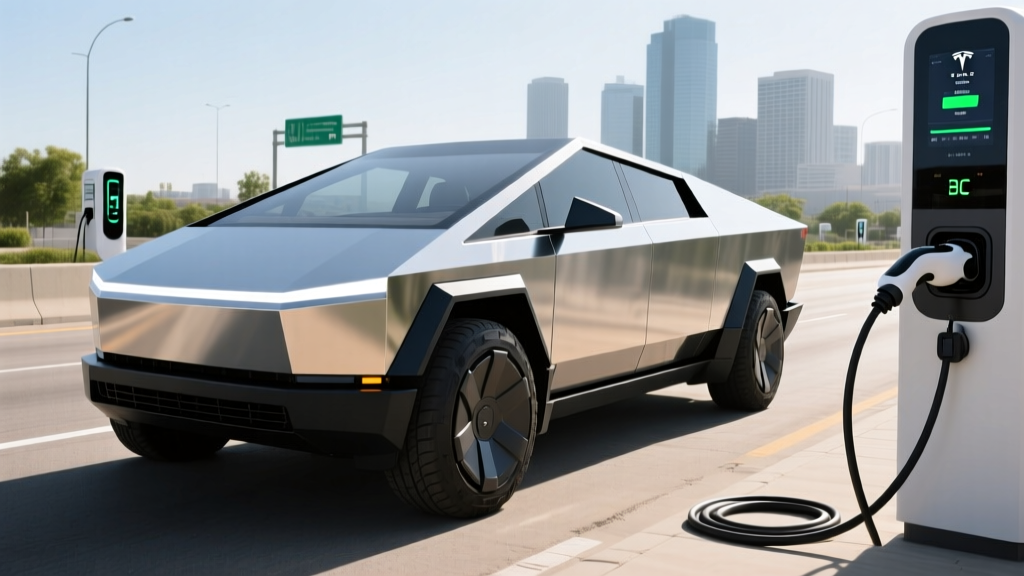
The Tesla Cybertruck is no longer a concept-car curiosity — it's rolling off the Austin Gigafactory line and appearing in driveways, grocery-store parking lots, and highway fast-charging stalls across the country. If you've seen a Cybertruck spotted on road near you and wondered whether the angular stainless-steel pickup actually delivers as a daily driver, this review breaks down every number that matters: real-world range versus the EPA sticker, DC fast-charge curves, home charging realities, tax-credit eligibility, and how it stacks up against the Ford F-150 Lightning and Rivian R1T.
We'll cut through the social-media hype and focus on the data points that determine whether the Cybertruck is a practical purchase or an expensive conversation piece.
Range, Efficiency, and the Real-World Reality Check
Real-World Expectation: 270–300 miles highway at 70 mph; 220–250 miles in freezing temperatures with cabin heat; 310+ miles in moderate city driving with regen.
The Cybertruck AWD carries a usable battery capacity of approximately 123 kWh using a 4680-cell NMC (nickel-manganese-cobalt) architecture. That's one of the largest packs in any production consumer EV, and it's needed — the truck's brick-like aerodynamics (drag coefficient around 0.34, high for an EV though improved over conventional pickups) and 6,600+ lb curb weight demand serious energy.
EPA efficiency lands at roughly 2.0 kWh/mile (50 MPGe combined) for the AWD trim. To put that in perspective, the Ford F-150 Lightning Extended Range achieves about 2.0 kWh/mile as well, while the Rivian R1T Dual-Motor Max sits closer to 2.2 kWh/mile. The Cybertruck is not an efficiency leader, but its massive battery compensates.
The real-world range story is where buyers need honesty. On a 75°F day with mixed city/highway driving, hitting 300–320 miles before the buffer warning is achievable. But load the 6-foot bed with 1,500 lbs of cargo, drive 75 mph into a headwind, and watch that number drop to 240–260 miles. Cold-weather testing in sub-30°F conditions consistently shows a 20–30% range reduction — a physics reality for all EVs, but amplified by the Cybertruck's high energy consumption per mile. The heat pump helps, but it can't fully offset cabin heating demands at highway speeds in deep cold.
Charging Speed: DC Fast Charge and Home Level 2
Charging speed is where the Cybertruck's 800-volt-class architecture shows its advantage. On a V4 Tesla Supercharger or compatible high-power DC station, the truck can accept peak rates up to 350 kW, though sustained rates taper significantly as state of charge climbs.
| Charging Level | Power / Rate | Speed / Time |
|---|---|---|
| DC Fast Charge (peak) | Up to 350 kW | 10–80% in ~25–30 minutes |
| DC Fast Charge (sustained avg) | ~175–200 kW avg | ~200 miles added in 20 min |
| Level 2 Home (Wall Connector) | 11.5 kW (48A) | ~37 miles of range per hour |
| Level 2 Home (NEMA 14-50) | 7.7 kW (32A) | ~25 miles of range per hour |
| Level 1 (120V outlet) | 1.4 kW (12A) | ~4–5 miles of range per hour |
The 10–80% DC fast-charge time of approximately 25–30 minutes is competitive but not class-leading — the Hyundai Ioniq 5 can do 10–80% in about 18 minutes thanks to its smaller, more charge-optimized pack. The Cybertruck's enormous 123 kWh battery means even at 350 kW peak, there's simply more energy to push. The charge curve tapers noticeably above 60% SoC, and above 80%, speeds drop to under 50 kW as the battery management system protects cell longevity.
For home charging, Tesla's Wall Connector at 48 amps (11.5 kW) adds roughly 37 miles per hour — enough to fully replenish overnight from a typical daily drive. A full 0–100% charge on Level 2 takes approximately 11–13 hours. Buyers should budget for a 60-amp dedicated circuit installation; older homes may need a panel upgrade to 200A service, which can add $1,500–$3,000 to installation costs.
Performance and Drivetrain Specs
| Spec | AWD | Cyberbeast |
|---|---|---|
| Drivetrain | Dual-Motor AWD | Tri-Motor AWD |
| Horsepower | 600 hp | 845 hp |
| 0–60 mph | 4.1 seconds | 2.6 seconds |
| Top Speed | 130 mph | 130 mph |
| Max Towing | 11,000 lbs | 11,000 lbs |
| Payload Capacity | 2,500 lbs | 2,500 lbs |
| Bed Length | 6 ft (lockable vault) | 6 ft (lockable vault) |
The dual-motor AWD delivers 600 horsepower and a 4.1-second 0–60 time — genuinely quick for a vehicle weighing over three tons. The tri-motor Cyberbeast is a different animal entirely: 845 hp and a 2.6-second sprint that embarrasses most sports cars, let alone full-size pickups. Torque-vectoring on the rear axle (Cyberbeast) provides noticeably sharper cornering for a truck this size.
Towing capacity maxes out at 11,000 lbs, which beats the F-150 Lightning (10,000 lbs) and matches the upper range of the Rivian R1T. However, towing at max capacity will slash range roughly in half — expect 150–170 miles before needing to charge. Tesla's integrated trailer brake controller and tow-assist camera views are well-implemented, though the camera-based side mirrors (replacing traditional mirrors on early builds) drew mixed reviews from owners hauling trailers in rain and glare.
Pricing, Tax Credits, and Total Cost
| Trim | Base MSRP | Est. Federal Credit | Effective Price |
|---|---|---|---|
| RWD (announced, limited availability) | $60,990 | Up to $7,500* | ~$53,490* |
| AWD | $79,990 | Up to $7,500* | ~$72,490* |
| Cyberbeast | $99,990 | Up to $7,500* | ~$92,490* |
*Federal tax credit eligibility under IRS §30D depends on multiple factors: buyer income caps ($150K single / $300K joint AGI), vehicle MSRP caps ($80,000 for trucks/vans/SUVs — meaning the Cyberbeast at $99,990 exceeds the cap and does NOT qualify), battery critical-mineral and component sourcing requirements, and point-of-sale transfer election. Always confirm eligibility with a tax professional before purchase.
The AWD trim at $79,990 sits just under the $80,000 MSRP cap for trucks, making it potentially eligible for the full $7,500 credit — provided the buyer meets income limits and the vehicle's battery sourcing satisfies current-year critical-mineral thresholds. The Cyberbeast, at $99,990, exceeds the cap and is ineligible for the federal credit regardless of buyer income.
The base RWD trim was announced at $60,990 but has seen extremely limited production and availability as of 2026, with most deliveries focused on AWD and Cyberbeast trims. Buyers should treat RWD availability as preliminary and check Tesla's configurator for current ordering status.
Destination fees, optional paint colors (the bare stainless steel is standard; Satin Black wraps and other colors run $2,000–$3,000), and Full Self-Driving (Supervised) at $8,000 can push as-tested prices well above base MSRP. A fully loaded AWD with FSD and accessories can land in the $90,000–$95,000 range before any credit.
Cargo, Interior Space, and Daily Livability
The Cybertruck is a crew-cab pickup with seating for five, though the rear seat is tighter than an F-150 SuperCrew. Front legroom measures approximately 41.5 inches, while rear legroom comes in around 38.2 inches — adequate for adults on shorter trips but snug for tall passengers on long highway drives.
The 6-foot bed (Tesla calls it "the vault") offers 67 cubic feet of lockable, weather-sealed cargo volume with the motorized tonneau cover deployed. That's a genuine advantage over open-bed competitors for securing gear. The bed includes a built-in ramp (deployable from the tailgate), 120V and 240V power outlets for job-site or camping use, and integrated LED lighting.
The front trunk (frunk) provides approximately 7.1 cubic feet of additional storage — useful for groceries or charging cables but smaller than the F-150 Lightning's 14.1 cu-ft Mega Power Frunk. Interior cabin storage includes a large center console bin and door pockets, though the minimalist dash design means no traditional glovebox (it's app-locked and hidden).
The 18.5-inch front touchscreen handles infotainment, climate, and vehicle controls. The rear passengers get their own 9.4-inch touchscreen. Audio is a 15-speaker premium system. Build quality on 2025–2026 production units has improved significantly over the early 2024 deliveries that drew panel-gap criticism, though some owners still report minor trim-alignment issues.
Driver Assistance and Standout Tech
The Cybertruck ships with Tesla's latest HW4 (Hardware 4) Autopilot computer and a camera-only sensor suite (no radar, no ultrasonic sensors — Tesla relies on its Tesla Vision neural-net processing for parking and proximity detection). Autopilot includes adaptive cruise control and lane-centering on highways. The optional Full Self-Driving (Supervised) package adds automated lane changes, intersection navigation, and parking assist, though real-world performance remains inconsistent in construction zones, unmapped roads, and heavy rain.
Standout tech features include:
- Steer-by-wire: No mechanical connection between the yoke and wheels — enables the variable-ratio steering (less than one full turn lock-to-lock) that eliminates hand-over-hand maneuvers
- 48-volt electrical architecture: A first for a production vehicle at this scale, reducing wiring harness weight and enabling more powerful accessories
- Armor glass: Laminated stainless-steel exterior panels with ultra-hard glass (though early "unbreakable" window demos infamously cracked)
- Bioweapon Defense Mode: HEPA air filtration system
- Powershare: Vehicle-to-load (V2L) capability with up to 11.5 kW of exportable power for job-site tools or emergency home backup
Warranty, Battery Longevity, and Ownership Costs
Tesla covers the Cybertruck with the following warranty structure:
- Basic Vehicle: 4 years / 50,000 miles
- Battery & Drive Units: 8 years / 120,000 miles (whichever comes first), with a minimum 70% capacity retention guarantee
- Restraint System: 5 years / 60,000 miles
The 8-year/120,000-mile battery warranty is slightly more generous in mileage than the industry-standard 8/100,000 (used by Ford, Hyundai, and others), reflecting Tesla's confidence in the 4680 NMC cell chemistry. Based on data from Tesla's higher-volume Model Y and Model 3 packs, owners can expect approximately 8–12% degradation over the first 100,000 miles, with the curve flattening significantly after the initial break-in period.
Insurance costs are a real consideration: the Cybertruck's high repair costs (stainless-steel body panels require specialized equipment, and the steer-by-wire system is expensive to replace) push premiums above comparable pickups. Expect annual insurance costs of $3,000–$4,500 depending on location, driving record, and coverage level — roughly 20–40% higher than an F-150 Lightning.
Maintenance is minimal compared to gas trucks: no oil changes, no transmission fluid, no spark plugs. Tire wear is the primary consumable expense, and the Cybertruck's weight and torque are hard on rubber — budget for a set of replacement all-terrains every 25,000–35,000 miles at approximately $1,200–$1,800 per set.
Competitive Comparison: Cybertruck vs. F-150 Lightning vs. Rivian R1T
| Spec | Tesla Cybertruck AWD | Ford F-150 Lightning Ext. Range | Rivian R1T Dual-Motor Max |
|---|---|---|---|
| EPA Range | 340 mi | 320 mi | 352 mi |
| Battery (usable) | ~123 kWh (NMC) | ~131 kWh (NMC) | ~141 kWh (NMC) |
| Peak DC Charge | 350 kW | 150 kW | 220 kW |
| 10–80% Time | ~25–30 min | ~41 min | ~30 min |
| 0–60 mph | 4.1 sec | 5.0 sec | 4.5 sec |
| Max Towing | 11,000 lbs | 10,000 lbs | 11,000 lbs |
| Base MSRP | $79,990 | $69,990 | $87,000 |
| Federal Credit Eligible | Yes (AWD)* | Yes* | Yes* |
*Credit eligibility subject to IRS §30D income, sourcing, and MSRP requirements. Confirm with a tax professional.
Choose the F-150 Lightning if: You want a more traditional truck experience, need a massive frunk, prefer a proven dealer service network, and want the lowest entry price in the segment.
Choose the Rivian R1T if: You prioritize off-road capability (quad-motor available), want the longest EPA range, prefer a more conventional steering setup, and value Rivian's adventure-focused accessory ecosystem.
Pros, Cons, and the Verdict
- Class-leading DC fast-charge speed (350 kW peak)
- Lockable, weather-sealed vault bed with integrated ramp
- Tri-motor Cyberbeast performance is extraordinary (2.6s 0–60)
- 11,000-lb towing with integrated trailer tech
- 48V architecture and V2L powershare capability
- 120,000-mile battery warranty
- Steer-by-wire eliminates hand-over-hand turning
- Cyberbeast exceeds $80K MSRP cap — no federal tax credit
- High insurance premiums due to repair costs
- Real-world highway/cold-weather range drops significantly
- Camera-only parking can struggle in adverse conditions
- Yoke steering and steer-by-wire require adaptation
- Rear seat legroom is tighter than F-150 Lightning
- RWD base trim availability remains uncertain
- Efficiency is poor at ~2.0 kWh/mile (heavy, boxy design)
Who Should Buy the Cybertruck?
The Cybertruck AWD is best suited for tech-forward truck buyers who want electric-pickup utility with the fastest possible DC charging for road trips, need a secure lockable bed for gear or job-site tools, and are drawn to the vehicle's engineering ambition (steer-by-wire, 48V architecture, armor glass). It works as a daily commuter if you have reliable home Level 2 charging, and it can handle weekend towing and camping duties competently.
It is not the best choice for buyers who prioritize traditional truck ergonomics, want the lowest purchase price (the F-150 Lightning undercuts it by ~$10,000), need maximum rear-seat space for family use, or want guaranteed access to a widespread dealer service network. The Cybertruck's service model still relies heavily on Tesla mobile service and a limited number of specialized service centers.
Frequently Asked Questions
What is the real-world range of the Tesla Cybertruck?
The EPA rates the Cybertruck AWD at 340 miles and the Cyberbeast at 320 miles. In real-world highway driving at 70 mph, expect 270–300 miles. In freezing weather, plan for 220–250 miles. Heavy towing can cut range to 150–170 miles. According to fueleconomy.gov, the AWD achieves approximately 50 MPGe combined.
How fast does the Cybertruck charge at home and on the road?
On a 350 kW DC fast charger, the Cybertruck can add 10–80% in approximately 25–30 minutes. At home on a Tesla Wall Connector (11.5 kW / 48A), it adds about 37 miles of range per hour, with a full charge taking 11–13 hours. On a standard NEMA 14-50 outlet (7.7 kW), expect about 25 miles per hour.
Does the Tesla Cybertruck qualify for the $7,500 federal EV tax credit?
The AWD trim at $79,990 MSRP is potentially eligible for up to $7,500 under IRS §30D, since it sits under the $80,000 MSRP cap for trucks. The Cyberbeast at $99,990 exceeds the cap and does not qualify. Eligibility also depends on buyer income limits ($150K single / $300K joint), battery critical-mineral sourcing requirements, and point-of-sale transfer rules. Consult a tax professional and review current IRS guidance before purchasing.
Is the Cybertruck worth buying over the F-150 Lightning or Rivian R1T?
The Cybertruck wins on DC charging speed (350 kW vs. 150–220 kW for competitors), lockable vault-style bed, and raw performance. The F-150 Lightning wins on price, dealer service access, frunk size, and traditional truck familiarity. The Rivian R1T wins on EPA range (352 mi with Max pack), off-road capability, and interior refinement. Your priority — charging speed vs. cost vs. off-road — should drive the decision.
How reliable is the Cybertruck's steer-by-wire system?
Steer-by-wire has been used in aviation and some production vehicles (Lexus RZ, Toyota bZ4X in certain markets) for years, but the Cybertruck is the highest-profile American implementation. Early owner reports from 2024–2025 builds show no systemic failures, though the system requires an adaptation period — the variable ratio (fewer than 360 degrees lock-to-lock) feels unnatural at first. Tesla provides redundancy with backup power and communication pathways. Long-term reliability data across 100,000+ mile samples is still accumulating.
What does it cost to insure a Cybertruck?
Insurance premiums for the Cybertruck run approximately $3,000–$4,500 per year depending on your location, driving history, and coverage level. This is 20–40% higher than the F-150 Lightning, driven by the Cybertruck's higher repair costs (stainless-steel panels, specialized glass, steer-by-wire components) and higher base price. Tesla Insurance is available in some states and may offer competitive rates based on real-time driving data.