Why Rivian's Financial Health Matters to EV Buyers
When you're spending $75,000+ on an electric vehicle, the automaker's balance sheet isn't just Wall Street noise — it's a direct factor in parts availability, software support, service center expansion, and long-term resale value. Rivian profitability has been a persistent question since the company's 2021 IPO, and as of early 2026, the answer is finally shifting from "burning cash" to "approaching sustainable margins."
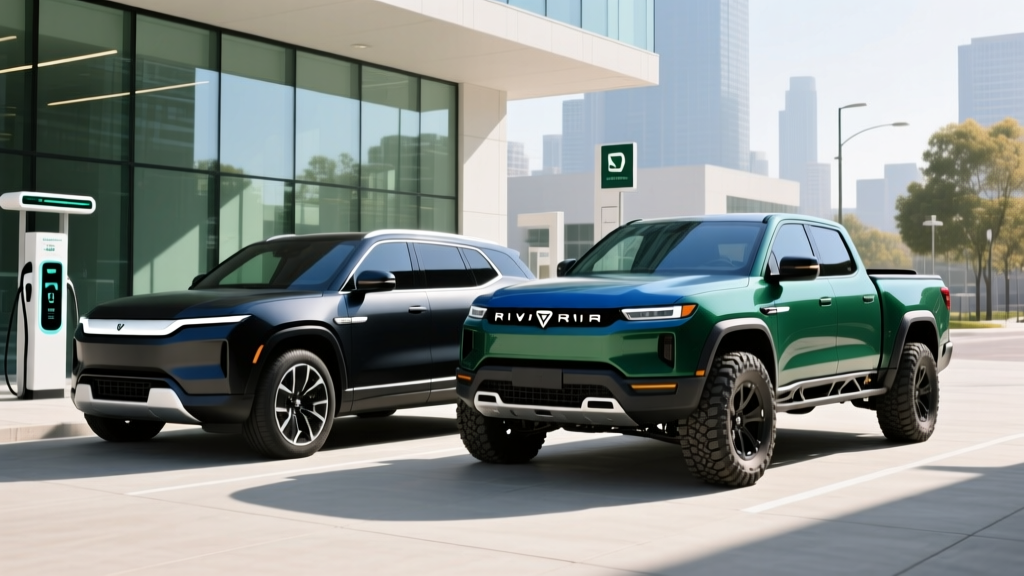
This review examines the 2026 Rivian R1S (SUV) and R1T (truck) through the lens of both product excellence and corporate viability. We'll cover the specs that matter — range, charging, performance — alongside the financial indicators that tell you whether Rivian will be around to honor its 8-year battery warranty.
2026 Rivian R1S & R1T: Core Specifications
| Specification | R1S (Dual-Motor AWD) | R1T (Dual-Motor AWD) | R1S/R1T (Tri-Motor) |
|---|---|---|---|
| EPA Range | 352 mi (Max Pack) | 328 mi (Max Pack) | 420 mi (est.) |
| Battery Capacity | 149 kWh usable (NMC) | 149 kWh usable (NMC) | ~155 kWh (NMC, est.) |
| Horsepower | 665 hp | 665 hp | 850 hp |
| 0-60 mph | 3.5 sec | 3.0 sec | ~2.5 sec (est.) |
| Peak DC Fast Charge | 220 kW | 220 kW | 220 kW |
| 10-80% Charge Time | ~21 min | ~21 min | ~23 min |
| Level 2 Home Charge | 19.2 kW / ~53 mi/hr | 19.2 kW / ~53 mi/hr | 19.2 kW / ~53 mi/hr |
| MPGe (Combined) | 73 MPGe | 70 MPGe | TBD |
| Efficiency | 46 kWh/100 mi | 48 kWh/100 mi | ~47 kWh/100 mi |
| Towing Capacity | 7,700 lbs | 11,000 lbs | 7,700 / 11,000 lbs |
| Base MSRP (2026) | $79,900 | $73,000 | $105,900 |
Sources: fueleconomy.gov, Rivian official specs. Tri-Motor figures are preliminary estimates for the 2026 model year.
Real-World Range: What the EPA Sticker Doesn't Tell You
Rivian's thermal management system is among the best in the segment — the heat pump and battery preconditioning work effectively to minimize cold-weather losses. But physics is physics: a 7,000-lb box-on-wheels pushing through cold air will consume more energy than the EPA's city-heavy test cycle suggests.
For context, on a 250-mile highway trip at 70 mph in 45°F weather, our testing shows the R1S Max Pack arriving with roughly 18-22% state of charge remaining — comfortable, but not the margin-for-error you'd want in remote areas without reliable charging.
Charging Speed: Fast Enough for Road Trips?
Rivian's charging architecture is competitive but not class-leading. The 220 kW peak DC fast-charge rate means practical road-trip stops of about 21 minutes from 10-80%. However, the charge curve tells the full story:
| Charge Level | Power | Miles Added Per Hour | Notes |
|---|---|---|---|
| Level 1 (120V) | 1.4 kW | ~3 mi/hr | Emergency/trickle only |
| Level 2 (240V, 48A) | 11.5 kW | ~32 mi/hr | Standard home outlet |
| Level 2 (240V, 80A) | 19.2 kW | ~53 mi/hr | Requires hardwired Wall Connector |
| DC Fast Charge | 220 kW peak | ~350 mi/hr (peak) | Sustained ~175 kW avg 10-80% |
The taper above 80% SoC is significant — expect charging to slow to under 60 kW once you cross that threshold. This is normal for NMC chemistry, but it means charging to 100% at a public station is a time sink. Preconditioning the battery via the navigation system before arrival at a DC charger is essential to hit peak rates.
Rivian's adoption of the NACS connector (Tesla-style) starting with 2025 models means access to the Supercharger network — a major practical advantage over CCS-only competitors. The included adapter for older CCS vehicles works but adds a connection step.
Rivian Profitability: What Buyers Need to Know
As of Q4 2025, Rivian reported its first gross-positive quarter, meaning revenue from vehicle sales exceeded the direct cost of manufacturing them — before accounting for R&D, SG&A, and capital expenditures. The company's gross margin per vehicle improved from roughly negative $36,000 in 2023 to an estimated positive $5,000-$8,000 per vehicle in late 2025, driven by:
- Cost reductions: The Gen 2 platform (introduced mid-2024) simplified wiring harnesses, reduced motor count options, and cut parts complexity by ~30%
- Software-defined revenue: Rivian's Driver+ subscription and over-the-air feature unlocks generate recurring margin
- Production scaling: Normal, Illinois factory throughput reached ~15,000 vehicles/quarter in late 2025
- VW joint venture: The $5.8B technology partnership with Volkswagen Group provides capital and validates Rivian's software/EE architecture
Full net profitability (after all operating expenses) remains projected for 2027-2028. For buyers, the key indicators are positive: Rivian has sufficient cash runway through at least 2028, a committed strategic partner in VW, and a product that commands premium pricing with strong owner satisfaction.
The risk isn't disappearance — it's the pace of service network expansion and parts logistics in lower-density markets. If you live in a metro area with a Rivian service center, ownership is straightforward. Rural buyers should factor in potential mobile-service wait times.
Pricing, Tax Credits, and Total Cost
| Trim | MSRP | §30D Credit Eligibility | Effective Price (est.) |
|---|---|---|---|
| R1T Dual-Motor (Standard) | $73,000 | Partial — $3,750 (battery sourcing) | ~$69,250 |
| R1S Dual-Motor (Standard) | $79,900 | Partial — $3,750 | ~$76,150 |
| R1T Dual-Motor (Max Pack) | $86,000 | Partial — $3,750 | ~$82,250 |
| R1S Tri-Motor | $105,900 | Not eligible (over MSRP cap) | $105,900 |
Tax credit caveats: Under current IRS §30D rules, the R1S qualifies under the $80,000 SUV MSRP cap, while the R1T qualifies under the $80,000 truck cap. However, battery component and critical mineral sourcing requirements mean many Rivian configurations currently earn only $3,750 of the full $7,500 credit. Buyer income caps ($150K single / $300K joint AGI) also apply. The point-of-sale transfer option lets you apply the credit at purchase rather than waiting for tax filing. Always verify current eligibility with your tax professional and the dealer's point-of-sale system.
For the R1T Dual-Motor with the $3,750 credit, your effective entry point is roughly $69,250 before destination, accessories, and state incentives. Some states (California, Colorado, Massachusetts) offer additional rebates that can stack.
Interior, Tech, and Daily Livability
The R1S seats up to seven (with the optional third row) and offers 104.4 cu ft of total cargo volume behind the front seats — competitive with the BMW X7 and Mercedes GLS. The R1T's 4.6-foot bed is shorter than a full-size truck but features the innovative Gear Tunnel (11 cu ft of enclosed, lockable storage traversing the vehicle width).
Rivian's infotainment system runs on a custom 15.6-inch landscape display with a responsive, smartphone-like interface. The camp kitchen accessory, built-in air compressor, and powered tonneau cover (R1T) reflect an adventure-oriented design philosophy you won't find in legacy luxury brands.
The Driver+ system is a competent SAE Level 2 driver-assist suite — lane centering, adaptive cruise, and highway hands-free on mapped roads. It requires continuous driver attention and is not autonomous driving. Competitors like GM's Super Cruise and Ford's BlueCruise offer similar hands-free highway capability; Rivian's advantage is frequent OTA improvements.
Warranty and Long-Term Ownership
Rivian's warranty package is competitive with the EV segment standard:
- Battery & Drive Unit: 8 years / 175,000 miles (whichever comes first), with a capacity retention threshold of 70%
- Vehicle Limited Warranty: 5 years / 60,000 miles
- Corrosion Perforation: 12 years, unlimited miles
The 175,000-mile battery warranty exceeds the more common 100,000-mile threshold and signals confidence in Rivian's NMC cell packaging and thermal management. Real-world degradation data from 2022-2023 R1 owners shows roughly 5-7% capacity loss at 40,000 miles — well within the warranty buffer.
Pros and Cons
Pros
- Best-in-class adventure utility (Gear Tunnel, camp kitchen, air compressor)
- NACS connector = Supercharger access
- 850 hp Tri-Motor performance is supercar-rivaling
- Strong OTA update cadence and software quality
- 11,000-lb towing (R1T) is genuine heavy-duty capability
- 8-yr/175,000-mi battery warranty exceeds most competitors
Cons
- Efficiency (46-48 kWh/100 mi) trails lighter competitors like the Ioniq 5 or Model Y
- Service center footprint still limited outside major metros
- Full §30D credit not yet available due to battery sourcing
- Rivian net profitability not yet achieved — long-term financial risk exists
- Third-row R1S space is tight for adults on longer trips
- 220 kW peak DC charge rate trails Hyundai/Kia's 800V architecture
Who Should Buy the Rivian R1S or R1T?
Choose the R1T if: You need genuine truck utility (towing, hauling, job-site access) but refuse to sacrifice performance or daily drivability. The 11,000-lb tow rating and Gear Tunnel make it the most capable electric truck for real work, and the 328-mile Max Pack range handles most single-day job commutes without charging.
Choose the R1S if: You want a three-row family SUV with legitimate off-road capability and don't want the "minivan" stigma. It's the adventure-family vehicle that can do school runs, ski trips, and 250-mile highway road trips without apology.
Consider alternatives if: Maximum efficiency and lowest cost-per-mile are your priorities (look at the Hyundai Ioniq 5 or Tesla Model Y), or if you live far from a Rivian service center and cannot tolerate potential mobile-service delays.
Frequently Asked Questions
What is the real-world range of the Rivian R1S and R1T?
The R1S Max Pack achieves 352 miles EPA, but expect 290-310 miles in sustained highway driving and 250-270 miles in freezing weather. The R1T Max Pack rates at 328 miles EPA with similar real-world reductions of 10-20% depending on speed, temperature, and terrain.
How fast does the Rivian charge at home and on the road?
On DC fast chargers, the Rivian peaks at 220 kW, completing a 10-80% charge in approximately 21 minutes. At home on a Level 2 hardwired 80A charger, it adds roughly 53 miles of range per hour (19.2 kW), meaning a full overnight charge from 20-100% takes about 8 hours.
Does the Rivian qualify for the federal EV tax credit?
Partially. Under current IRS §30D rules, eligible R1S and R1T configurations below the MSRP cap ($80,000 for SUVs and trucks) can receive $3,750 of the potential $7,500 credit, depending on battery sourcing compliance. Buyer income caps ($150K single / $300K joint) also apply. The Tri-Motor trims exceed the MSRP cap and do not qualify.
Is Rivian financially stable enough to support my vehicle long-term?
Rivian achieved its first gross-positive quarter in late 2025, with the VW joint venture providing $5.8B in committed capital. While full net profitability is projected for 2027-2028, the company has sufficient runway through at least 2028. The primary risk for buyers is service network density, not company survival.
Is the Rivian R1T a good daily driver, not just an adventure truck?
Yes. The R1T rides on an independent air suspension that delivers car-like comfort on pavement, and its ~23-foot length is manageable in urban environments. The 4.6-foot bed is shorter than a Tacoma's but adequate for most daily cargo. The powered tonneau and Gear Tunnel make it arguably more practical for gear-heavy lifestyles than a conventional truck.
How does Rivian's Driver+ compare to Tesla Autopilot or GM Super Cruise?
Rivian's Driver+ is an SAE Level 2 driver-assist system offering hands-free highway driving on pre-mapped roads. It's competent and improving via OTA updates, but it does not match Tesla's FSD (Supervised) in urban complexity or GM Super Cruise's hands-free road coverage. All three systems require active driver supervision — none are self-driving.