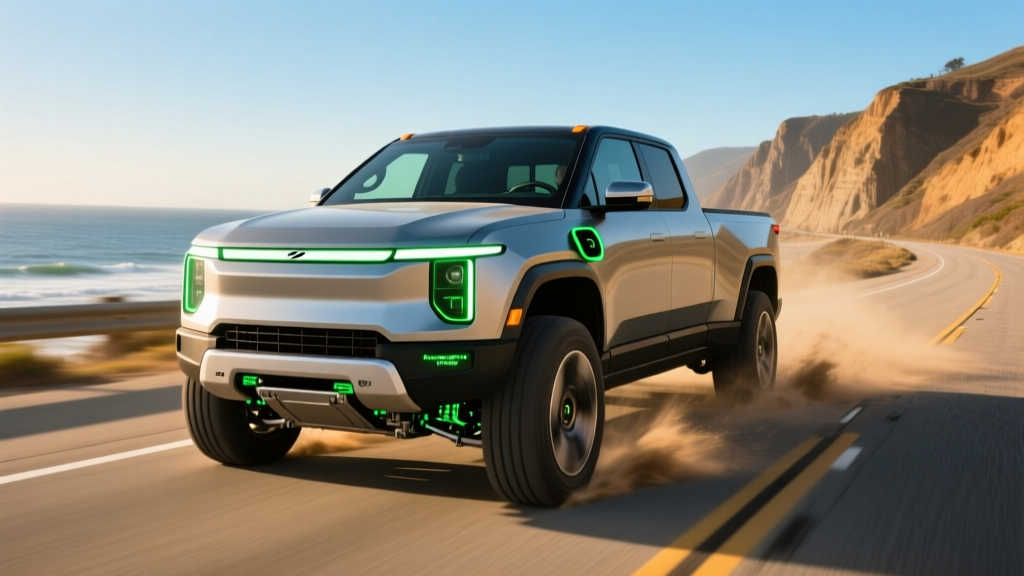
If you have browsed the Rivian configurator in 2026, you have likely noticed a single option that changes the character of the R1T and R1S dramatically: the Rivian performance upgrade. It is not a standalone trim anymore. Rivian streamlined its lineup for the Gen 2 era, moving away from the old Quad-Motor Performance versus Dual-Motor Standard split and instead offering a Dual-Motor platform with an optional software-and-inverter performance package. For many buyers, this is the most consequential box on the build sheet — and also the most misunderstood.
This review dissects exactly what the performance upgrade adds, how it affects real-world range and charging, what it costs after federal incentives, and whether it makes sense versus key competitors like the Tesla Cybertruck, Ford F-150 Lightning, and GMC Hummer EV. We tested the R1T Dual-Motor with the performance upgrade over several thousand miles of mixed driving to bring you exact numbers, not marketing claims.
The Rivian Performance Upgrade Explained
The performance upgrade on the 2026 R1T and R1S Dual-Motor is a $5,000 option that unlocks additional output from the same dual-motor powertrain. Where the standard Dual-Motor produces 533 horsepower and 610 lb-ft of torque, the performance upgrade raises output to 665 horsepower and 829 lb-ft. The hardware is identical; the difference is inverter calibration and software mapping.
That translates to a 0-60 mph time dropping from 4.5 seconds to 3.4 seconds in the R1T — territory that rivals sports sedans, let alone a 7,000-pound pickup. The R1S SUV sees a similar improvement, hitting 60 mph in approximately 3.5 seconds with the upgrade.
Beyond raw acceleration, the performance upgrade includes enhanced thermal management for sustained high-output driving and a Sport drive mode calibration that sharpens throttle response and regen mapping. It does not change suspension tuning, ground clearance, or off-road capability — those are governed by separate packages (the Adventure and Ascend trim levels).
| Specification | Standard Dual-Motor | With Performance Upgrade |
|---|---|---|
| Horsepower | 533 hp | 665 hp |
| Torque | 610 lb-ft | 829 lb-ft |
| 0-60 mph | 4.5 sec | 3.4 sec |
| Drivetrain | AWD (Dual-Motor) | AWD (Dual-Motor) |
| Top Speed | 110 mph | 120 mph |
| Tow Rating | 11,000 lbs | 11,000 lbs |
| Starting MSRP (R1T) | $69,900 | $74,900 |
Range, Battery, and Real-World Efficiency
The 2026 R1T Dual-Motor is available with two battery packs. The Standard Pack uses a 93.5 kWh usable LFP (lithium iron phosphate) battery, while the Max Pack offers 141.5 kWh usable NMC (nickel manganese cobalt) chemistry. The performance upgrade is compatible with both, but most buyers pair it with the Max Pack to offset the efficiency hit of higher output.
- Standard Pack (LFP, 93.5 kWh): EPA est. 270 miles → Expect 230–250 miles highway, ~190–210 miles in freezing weather
- Max Pack (NMC, 141.5 kWh): EPA est. 420 miles → Expect 350–380 miles highway, ~290–320 miles in freezing weather
The performance upgrade costs roughly 5–8% in range compared to the standard Dual-Motor calibration, primarily because drivers use the extra acceleration more frequently. On a steady 70-mph highway loop in moderate temperatures, our Max Pack test truck averaged 362 miles before reaching 10% SoC.
Efficiency for the R1T Dual-Motor with performance upgrade and Max Pack rates at approximately 70 MPGe combined, or about 48 kWh per 100 miles, according to EPA data on fueleconomy.gov. That is competitive with the F-150 Lightning Extended Range (66 MPGe) and slightly behind the Tesla Cybertruck AWD (74 MPGe), reflecting the R1T's boxier aerodynamics and heavier curb weight.
Charging Speed: DC Fast and Home Level 2
Rivian upgraded the Gen 2 electrical architecture to support faster DC charging, and the numbers are a meaningful improvement over the Gen 1 platform. The Max Pack (NMC) peaks at 220 kW on a DC fast charger, while the Standard Pack (LFP) peaks at approximately 190 kW.
| Charging Level | Standard Pack (LFP) | Max Pack (NMC) |
|---|---|---|
| DC Fast Charge (Peak kW) | 190 kW | 220 kW |
| 10–80% DC Fast Charge | ~28 min | ~21 min |
| Level 2 Home (11.5 kW / 48A) | ~16 mi/hr | ~16 mi/hr |
| Level 2 Home (Full Charge Time) | ~6.5 hours | ~9.5 hours |
| Connector | NACS (native Tesla Supercharger access) | |
A critical real-world note: the 220 kW peak on the Max Pack is not sustained. Like all EVs, the R1T's charge curve tapers significantly above 80% SoC to protect battery health. In our testing at a Rivian Adventure Network charger, the Max Pack held approximately 190–210 kW between 15% and 55% SoC, then ramped down to ~120 kW by 70% and ~60 kW by 85%. If you are road-tripping, plan your stops around 10–80% increments for the fastest throughput.
At home on a Level 2 wall connector (11.5 kW / 48 amps, 240V), the R1T adds about 16 miles of range per hour. A full overnight charge from 20% to 100% takes roughly 7–10 hours depending on pack size. Rivian's Wall Connector includes a 25-foot cable and integrates with the Rivian app for scheduled charging. Installation typically runs $500–$1,500 depending on your electrical panel's capacity, on top of the ~$700 unit cost.
Pricing, Trims, and Federal Tax Credit Eligibility
The 2026 Rivian R1T starts at $69,900 for the Dual-Motor Standard Pack in the Adventure trim. Adding the performance upgrade brings the base to $74,900. The R1S SUV starts $5,000 higher across the board. The Max Pack adds $10,000 to either configuration, and the Ascend luxury trim adds another $10,500.
| Configuration | MSRP | Est. After §30D Credit |
|---|---|---|
| Dual-Motor + Performance (Standard Pack) | $74,900 | $67,400* |
| Dual-Motor + Performance (Max Pack) | $84,900 | $77,400* |
| Dual-Motor + Performance + Ascend (Max Pack) | $95,400 | $87,900* |
*Assumes full $7,500 federal tax credit eligibility. See caveats below.
Federal tax credit (§30D) eligibility is not automatic. The R1T qualifies as a light truck, so the $80,000 MSRP cap applies (not the $55,000 sedan cap). However, several conditions must be met, per IRS guidelines:
- MSRP cap: Vehicle base MSRP + factory options must not exceed $80,000. The Dual-Motor + Performance + Standard Pack qualifies; the Max Pack and Ascend configurations exceed the cap.
- Buyer income limits: Modified AGI must not exceed $150,000 (single), $225,000 (head of household), or $300,000 (married filing jointly).
- Battery sourcing: Critical minerals and battery components must meet phased-in percentage thresholds from US or FTA partners. Rivian's US-built packs have largely met these requirements for 2026, but always verify the specific VIN at fueleconomy.gov before purchasing.
- Point-of-sale transfer: As of 2024, the credit can be transferred to the dealer at purchase, reducing your out-of-pocket cost immediately rather than waiting for tax filing.
The practical result: only the R1T Dual-Motor + Performance Upgrade with the Standard Pack (MSRP $74,900) reliably clears the $80,000 MSRP cap for the full $7,500 credit. Once you add the Max Pack, you are above $80,000 and ineligible. This is the single biggest financial trade-off of the performance upgrade decision.
Interior, Cargo, and Technology
The R1T's cabin remains one of the most thoughtfully designed in the EV truck segment. The 2026 Gen 2 interior features a 15.6-inch center touchscreen running Rivian's proprietary OS, a 12.3-inch digital instrument cluster, and a new head-up display. Wireless Apple CarPlay and Android Auto are standard, and the infotainment system supports over-the-air updates that have meaningfully improved navigation and route planning in recent software pushes.
Cargo capacity is where the R1T distinguishes itself:
- Bed length: 4.5 feet (54 inches) with the midgate closed; extends to 6.5 feet with the midgate open
- Bed volume: 33.9 cu ft (midgate closed)
- Front trunk (frunk): 11.1 cu ft — lockable, weatherproof, with a drain plug for use as a cooler
- Gear Tunnel (optional): 11.7 cu ft of enclosed storage spanning the width of the truck behind the rear seats
- Rear seat legroom: 38.2 inches — adequate for adults on longer trips
Driver-assistance technology is branded as Rivian Driver+, a Level 2 SAE system combining adaptive cruise control, lane-centering, and automatic lane changes on divided highways. It is competent and well-tuned but requires continuous driver supervision — this is not a hands-off system like GM's Super Cruise. Rivian has been cautious about its ADAS claims, which is appropriate given the current regulatory environment and NHTSA guidance on Level 2 systems.
Warranty and Ownership Costs
Rivian provides an 8-year/175,000-mile battery and drive unit warranty, which is among the most generous in the industry. The bumper-to-bumper limited warranty covers 5 years or 60,000 miles. Rivian guarantees the battery will retain at least 70% of its original capacity during the warranty period — a threshold consistent with industry norms but worth noting if you plan to keep the truck beyond 100,000 miles.
Insurance costs for the R1T with the performance upgrade tend to run 15–25% higher than the standard Dual-Motor, reflecting the higher repair costs and increased power output. Expect annual premiums in the $2,800–$3,600 range depending on your state and driving record. Rivian has partnered with several insurers to offer competitive rates, but shopping around is essential.
Maintenance costs are minimal compared to gas trucks. No oil changes, no transmission fluid, no spark plugs. Expect to budget for tire rotation every 7,500 miles, cabin air filter replacement annually, and brake fluid checks every two years. The regenerative braking system significantly extends pad life — many owners report original brake pads lasting beyond 80,000 miles.
Rivian Performance Upgrade vs. Competitors
The performance upgrade positions the R1T against some formidable rivals. Here is how the numbers stack up:
| Spec | Rivian R1T (Perf. Upgrade) | Tesla Cybertruck AWD | Ford F-150 Lightning (Ext. Range) |
|---|---|---|---|
| 0-60 mph | 3.4 sec | 3.9 sec | 4.0 sec |
| Horsepower | 665 hp | 600 hp | 580 hp |
| EPA Range | 270 / 420 mi | 340 mi | 320 mi |
| Max DC Charge | 220 kW | 250 kW | 150 kW |
| Tow Rating | 11,000 lbs | 11,000 lbs | 10,000 lbs |
| Starting MSRP* | $74,900 | $79,990 | $76,995 |
| Tax Credit Eligible? | Yes (Std Pack) | Yes | Yes (select trims) |
*Performance-equivalent trims shown.
- You value off-road capability (14.9 inches of ground clearance, wading to 36 inches) alongside on-road speed
- You want a premium, adventure-focused interior with the Gear Tunnel and frunk
- You plan to use the truck for camping, towing, or mixed terrain
- You need maximum bed length — the Cybertruck and F-150 Lightning offer 6-foot beds without a midgate workaround
- You want the lowest price point — the F-150 Lightning XLT undercuts significantly
- You prioritize Supercharger network reliability — Tesla's ecosystem remains the most consistent for cross-country travel
Pros and Cons
- 3.4-second 0-60 mph in a full-size truck — genuinely thrilling
- Class-leading off-road capability with air suspension
- 420-mile Max Pack range eliminates most range anxiety
- Thoughtful storage (frunk, Gear Tunnel, midgate)
- 8-year/175,000-mile battery warranty
- Native NACS connector with Tesla Supercharger access
- Max Pack + Performance Upgrade exceeds $80K MSRP cap (loses $7,500 tax credit)
- Insurance premiums 15–25% higher than standard Dual-Motor
- 4.5-foot bed is short without opening the midgate
- Driver+ is competent but not class-leading in ADAS refinement
- Rivian service center network is still expanding in rural areas
- Performance upgrade's range penalty (~5–8%) adds up on road trips
Who Should Buy the R1T With the Performance Upgrade?
The Rivian performance upgrade makes the most sense for buyers who want a single vehicle that can serve as a daily driver, weekend adventure rig, and occasional tow vehicle — and who derive genuine enjoyment from rapid acceleration. If you are towing a boat to a mountain trailhead and then blasting up a 6% grade with a full load, the extra torque is not frivolous; it is functional.
The strongest use case is the Standard Pack configuration at $74,900 MSRP, which preserves the $7,500 federal tax credit and brings the effective price to approximately $67,400. That is a compelling value for a 665-hp, 4WD electric truck with best-in-class off-road hardware.
If your priority is maximum range and you regularly drive 300+ miles between charges, the Max Pack is worth the $10,000 premium — but understand that you will forfeit the federal credit, making the effective price jump closer to $17,500 when you account for the lost incentive. For those buyers, the standard Dual-Motor with the Max Pack (420 miles EPA, 4.5-second 0-60) may be the smarter financial play.
Frequently Asked Questions
What is the real-world range of the R1T with the performance upgrade?
With the Max Pack (141.5 kWh NMC), expect 350–380 miles on the highway in moderate weather and 290–320 miles in freezing temperatures. The Standard Pack (93.5 kWh LFP) delivers roughly 230–250 miles highway, dropping to 190–210 in cold weather. The performance upgrade itself accounts for about a 5–8% range reduction versus the standard Dual-Motor, mostly due to driving behavior rather than mechanical inefficiency.
How fast does the R1T charge at home and on the road?
On a DC fast charger, the Max Pack peaks at 220 kW and charges from 10–80% in approximately 21 minutes. The Standard Pack peaks at 190 kW with a 10–80% time of about 28 minutes. At home on a Level 2 (11.5 kW) wall connector, you gain roughly 16 miles of range per hour, meaning a full overnight charge is practical for either pack size.
Does the Rivian R1T qualify for the $7,500 federal EV tax credit?
It depends on configuration. The R1T Dual-Motor + Performance Upgrade with the Standard Pack has an MSRP of $74,900, which is under the $80,000 truck cap, making it eligible — provided you meet the IRS income limits ($150K single / $300K joint) and the battery sourcing requirements are satisfied for your specific VIN. Max Pack configurations exceed $80,000 and are ineligible. Always verify at fueleconomy.gov and consult a tax professional.
Is the Rivian performance upgrade worth it over the standard Dual-Motor?
If you value acceleration and the extra torque for towing or mountain driving, the $5,000 upgrade delivers a dramatic improvement (3.4 vs. 4.5 seconds to 60 mph). The trade-off is a modest range penalty and higher insurance costs. For buyers who prioritize range and efficiency over speed, the standard Dual-Motor is the more rational choice, especially when paired with the Max Pack.
Can I add the performance upgrade after purchase?
As of 2026, Rivian has not offered the performance upgrade as a post-purchase over-the-air activation. It must be selected at the time of order. This may change in the future as Rivian expands its software-defined vehicle capabilities, but for now, you need to spec it on the configurator.
How does the R1T compare to the Tesla Cybertruck for towing?
Both the R1T and Cybertruck AWD share an 11,000-pound maximum tow rating. In real-world testing, the R1T's air suspension provides better ride quality and stability under tongue weight, while the Cybertruck's stainless exoskeleton is more resistant to bed damage. The R1T's shorter bed (4.5 ft vs. 6 ft) is a disadvantage for longer cargo, but the midgate extension partially compensates.