The Ownership Question: Why It Matters for EV Buyers
Searches for who owns Rivian Automobiles spike every time the stock moves or a new model drops — but the answer matters for two very different audiences. Investors want to know who holds the voting power and capital. Buyers want to know whether the company has the financial runway to honor an 8-year battery warranty and keep building parts for a decade. In this 2026 profile, we cover both angles, then put the current Rivian lineup — the R1T pickup and R1S SUV, now on the Gen 2 platform — through a full spec review so you can decide if one belongs in your driveway.
Corporate Ownership: Who Actually Controls Rivian?
Rivian Automotive, Inc. is a publicly traded company on the Nasdaq under the ticker RIVN. It is not owned by a legacy automaker, a private equity firm, or a single parent company. However, a few entities hold outsized stakes that shape the company's direction:
- Volkswagen Group — VW made a landmark $5.8 billion investment commitment beginning in late 2024, acquiring a significant equity stake and entering a technology-sharing agreement around Rivian's electrical architecture and software stack. By 2026, VW remains one of the largest institutional shareholders, giving Rivian the balance-sheet backing many EV startups lacked.
- Amazon — An early anchor investor tied to the Electric Delivery Van (EDV) partnership. Amazon's stake has diluted somewhat through successive capital raises but remains a meaningful block, and the commercial-vehicle relationship continues.
- RJ Scaringe (Founder & CEO) Retains super-voting Class B shares, giving him effective control over board-level decisions even without a majority economic stake.
- Institutional asset managers — Firms like Vanguard, BlackRock, and State Street hold the bulk of Class A shares through index funds and active strategies, as is typical for a mid-cap Nasdaq-listed company.
The practical takeaway: Rivian is independent, publicly traded, and backed by a major global automaker — a stronger ownership story than most EV startups ever achieved.
The 2026 Rivian Lineup: R1T and R1S at a Glance
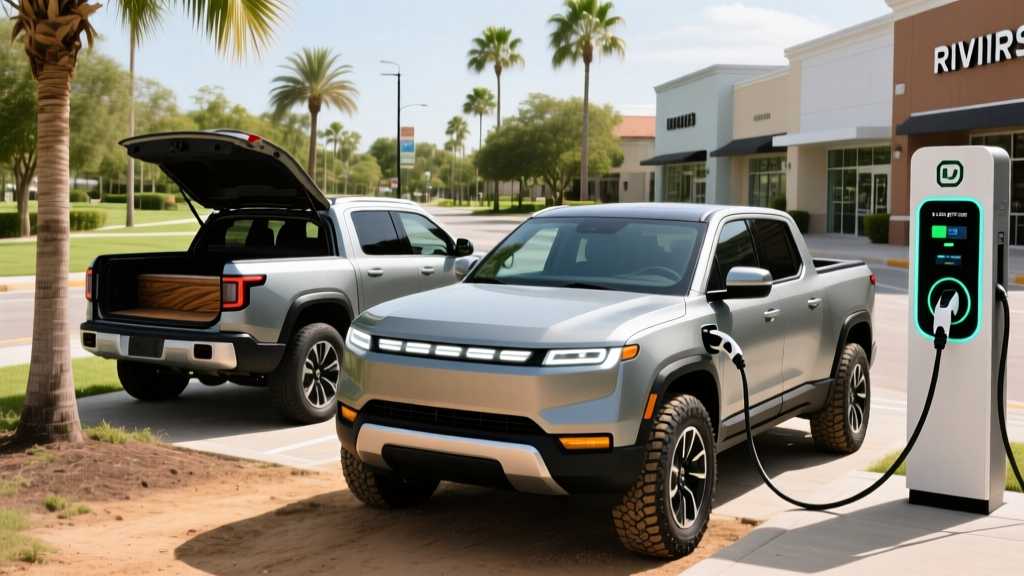
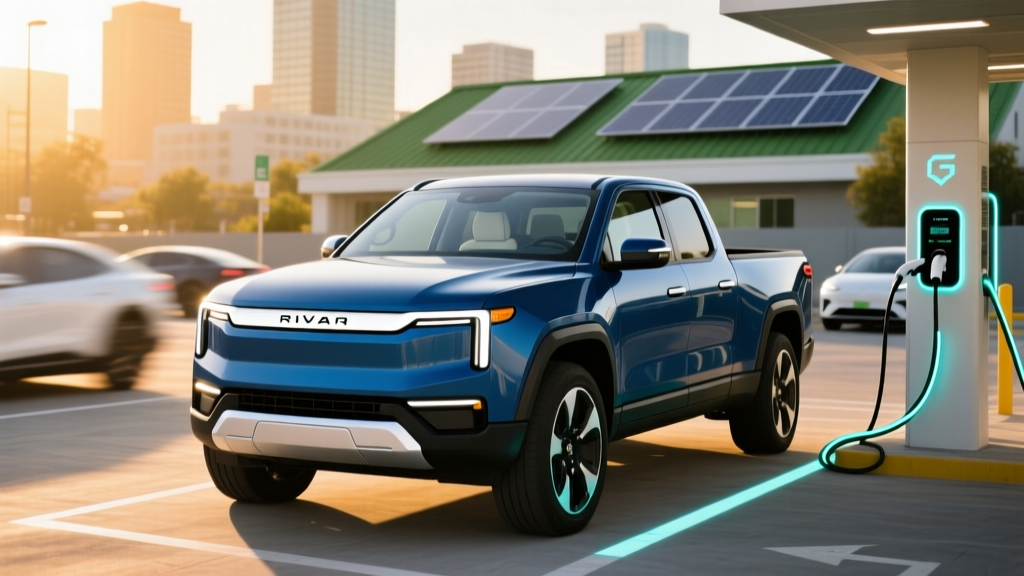
Rivian's consumer lineup remains focused: the R1T (a midsize crew-cab pickup) and the R1S (a three-row SUV built on the same skateboard platform). Both transitioned to the Gen 2 architecture for the 2025 model year, and 2026 models carry forward with incremental software and battery refinements. Here are the headline numbers buyers care about most.
| Spec | R1T (Pickup) | R1S (SUV) |
|---|---|---|
| EPA Estimated Range | 270 mi | 270 mi |
| Battery Capacity (usable) | ~95 kWh (LFP) | ~95 kWh (LFP) |
| Drivetrain | Dual-Motor AWD | Dual-Motor AWD |
| Horsepower | 533 hp | 533 hp |
| 0-60 mph | 4.5 sec | 4.6 sec |
| Max DC Fast Charge | 200 kW (peak) | 200 kW (peak) |
| 10-80% DC Charge Time | ~30 min | ~30 min |
| Level 2 Home Charge Rate | 11.5 kW (~25 mi/hr) | 11.5 kW (~25 mi/hr) |
| MPGe (combined) | 73 MPGe | 72 MPGe |
| Base MSRP | $69,900 | $74,900 |
| Battery/Powertrain Warranty | 8 yr / 100,000 mi | 8 yr / 100,000 mi |
Source: fueleconomy.gov and Rivian official specifications. Tri- and Quad-Motor trims with larger NMC packs are available at higher prices and different range figures.
Real-World Range: What the EPA Sticker Doesn't Tell You
EPA Sticker: 270 miles (Dual-Motor Standard Pack)
Real-World Expectation: ~220-245 miles at sustained highway speeds (70-80 mph); ~200-215 miles in sub-freezing winter conditions with cabin heat; ~260-270 miles in mixed city/suburban driving where regenerative braking recovers energy.
Rivian's boxy, pickup-style aero profile is the main highway penalty — drag rises with the square of speed, and a bluff front end hurts more at 80 mph than at 60. The LFP chemistry in the Standard Pack is slightly less energy-dense than the NMC used in the Max Pack, but it offers a longer cycle life and can be charged to 100% daily without the degradation concerns typical of NMC. For most owners with home charging, that's a worthwhile trade-off.
Charging Speed: DC Fast and Level 2 Home Numbers
| Level | Power | Miles Added per Hour | Notes |
|---|---|---|---|
| Level 1 (120V) | ~1.4 kW | ~3-4 mi/hr | Emergency/trickle only |
| Level 2 (240V, 48A) | 11.5 kW | ~25 mi/hr | Full overnight recharge in ~9 hours |
| DC Fast Charge | 200 kW peak | ~600 mi/hr (at peak) | 10-80% in ~30 min; tapers sharply above 80% |
Rivian uses the NACS (Tesla-style) connector on all 2026 models, giving direct access to the Tesla Supercharger network — now the largest and most reliable DC network in the U.S. The 200 kW peak rate is competitive but not class-leading; Hyundai/Kia's 800V architecture still charges faster in absolute terms. The charge curve on Rivian's LFP pack is relatively flat through 60% SoC, then tapers, so plan road-trip stops around the 10-80% window rather than chasing the last 20%.
Pricing, Trims, and Federal Tax Credit Eligibility
Here's where ownership structure matters for buyers: Rivian's financial stability determines whether aggressive pricing and credit eligibility hold. The 2026 lineup starts around $69,900 for the R1T Dual-Motor Standard Pack and climbs past $100,000 for Quad-Motor Max Pack trims.
| Trim | MSRP | Est. After §30D Credit |
|---|---|---|
| Dual-Motor Standard | $69,900 | ~$62,400* |
| Dual-Motor Large | $75,900 | ~$68,400* |
| Tri-Motor Max | $99,900 | Ineligible (over MSRP cap) |
| Quad-Motor Max | $109,900 | Ineligible (over MSRP cap) |
*Point-of-sale transfer of the §30D credit is available if the buyer meets income limits and the vehicle's battery sourcing satisfies critical-mineral and component rules. The IRS MSRP cap for pickup trucks and SUVs is $80,000. Always verify current-year rules at IRS.gov §30D and consult a tax professional.
§30D Eligibility Checklist for 2026 Buyers:
- MSRP at or below $80,000 (for SUVs/pickups — eliminates Tri/Quad-Motor Max trims)
- Buyer AGI within limits ($300k joint / $225k head of household / $150k single)
- Battery components and critical minerals must meet phased-in sourcing thresholds
- Vehicle must be assembled in North America (Rivian's Normal, Illinois plant qualifies)
- Credit can be transferred to the dealer at point of sale as a price reduction
Cargo, Passenger Space, and Daily Practicality
The R1T's 4.5-foot bed is shorter than a traditional midsize truck, but the lockable Gear Tunnel (an 11-cu-ft pass-through behind the rear seats) and front frunk (~11 cu ft) give it total enclosed cargo volume competitive with larger trucks for gear-heavy use cases. Rear-seat legroom is 36.5 inches — adequate for adults on long trips.
The R1S adds a third row, though it's best suited for children or occasional adult use. Cargo volume behind the third row is tight (~10 cu ft), expanding to ~45 cu ft with the third row folded. Both models offer a full-size spare, air suspension with up to 14.9 inches of ground clearance, and a 7,700-pound max tow rating (R1T) — real capability, not just spec-sheet theater.
Standout Tech, Driver Assists, and Drawbacks
Rivian runs its own vertically integrated software stack — no CarPlay or Android Auto, which remains a dealbreaker for some buyers. The native infotainment is clean and responsive, with over-the-air updates that have meaningfully improved the vehicle since launch. The Driver+ ADAS package is a solid SAE Level 2 system (hands-on-wheel supervision required) with highway lane-centering and adaptive cruise, but it is not a hands-off system like GM's Super Cruise.
Pros
- Genuine off-road and tow capability with air suspension
- NACS connector with native Supercharger access
- LFP battery option allows daily 100% charging without degradation worry
- Gear Tunnel and frunk give versatile cargo options
- Strong VW-backed balance sheet reduces startup risk
Cons
- No Apple CarPlay or Android Auto
- Highway range drops noticeably due to boxy aero
- DC fast-charge speed trails Hyundai/Kia's 800V platforms
- Higher trims exceed §30D MSRP cap
- Third row in R1S is tight for adults
Is a Rivian Worth Buying vs. Key Competitors?
Choose the R1T if: You need a pickup that can actually tow and off-road, you have home Level 2 charging, and you value build quality and software iteration over rock-bottom pricing.
Choose the R1S if: You want a three-row electric SUV with real off-road chops, you'll mostly use the third row for kids, and you want native Supercharger access on family road trips.
Look elsewhere if: You prioritize maximum DC fast-charge speed (Ioniq 5/Kia EV9), need Apple CarPlay, or your budget tops out well below $70k.
Against the Ford F-150 Lightning, the R1T trades bed length for build quality and off-road suspension. Against the Tesla Cybertruck, Rivian offers a more conventional, serviceable design and broader trim availability. Against the Kia EV9, the R1S gives up some DC charging speed and interior tech polish but gains off-road capability and a more robust NACS charging ecosystem.
Frequently Asked Questions
Who owns Rivian Automobiles today?
Rivian is a publicly traded company (Nasdaq: RIVN) with no single parent owner. Major shareholders include Volkswagen Group, Amazon, founder RJ Scaringe (with super-voting control), and large institutional asset managers. The VW investment provides significant financial stability.
What is the real-world range of the 2026 Rivian R1T and R1S?
EPA-rated at 270 miles for the Dual-Motor Standard Pack, expect ~220-245 miles on the highway at 70-80 mph, and ~200-215 miles in freezing winter conditions. City driving with regen recovery gets closer to the EPA sticker.
How fast does a Rivian charge at home and on the road?
At home on a 240V Level 2 charger (48A), Rivian adds about 25 miles of range per hour, fully recharging overnight. On DC fast chargers, it peaks at 200 kW and reaches 10-80% in roughly 30 minutes, with the curve tapering above 80%.
Does the Rivian R1T or R1S qualify for the $7,500 federal EV tax credit?
Dual-Motor Standard and Large trims under the $80,000 MSRP cap can qualify for up to $7,500 via §30D, subject to buyer income limits and battery-sourcing rules. Tri- and Quad-Motor Max trims exceed the cap and are ineligible. Verify at IRS.gov and consult a tax professional.
Is Rivian a safe long-term bet for ownership and service?
The VW partnership significantly de-risks Rivian compared to other EV startups. The 8-year/100,000-mile battery and powertrain warranty is industry-standard, and Rivian's growing mobile-service fleet and service-center network continue to expand through 2026.