The Real Story From Rivian Owners in 2026
Rivian has moved past startup uncertainty into its second-generation R1 platform, and the ownership experience has matured alongside the hardware. With the Dual-Motor, Performance Dual-Motor, and Tri-Motor configurations now well-established on the R1T pickup and R1S SUV, we've synthesized EPA data, owner reports, and our own testing to separate marketing from reality.
This profile focuses on what matters to current and prospective Rivian owners: actual range delivered versus the sticker, real charging curves at DC fast chargers, total cost after federal incentives, and the day-to-day livability that spec sheets can't capture.
Range Reality: EPA Stickers vs What Rivian Owners Actually See
The 2026 R1T and R1S share the same battery architecture, with EPA range varying by drivetrain and wheel size. Here's the official data alongside what owners consistently report in mixed driving.
EPA Estimated: 420 miles (149 kWh usable, NMC chemistry)
Real-World Highway (70 mph, 72°F): ~340–365 miles
Real-World Highway (70 mph, 30°F): ~270–300 miles
Real-World Mixed Commute: ~370–395 miles
Note: Choosing 22-inch wheels over 20-inch reduces EPA range by roughly 15–20 miles. The Tri-Motor configuration sacrifices approximately 40–50 miles of range for the added performance.
| Configuration | Battery (kWh usable) | Chemistry | EPA Range (mi) | Efficiency (kWh/100mi) |
|---|---|---|---|---|
| Dual-Motor Standard | 106 | NMC (2170 cells) | 270 | 39 |
| Dual-Motor Large | 128 | NMC (2170 cells) | 352 | 36 |
| Dual-Motor Max | 149 | NMC (4680 cells) | 420 | 35 |
| Tri-Motor (Large) | 128 | NMC (2170 cells) | 310 | 41 |
Rivian owners who tow should plan conservatively. Towing a 5,000-pound trailer at highway speeds cuts range roughly in half — expect 150–180 miles from the Max Pack before needing a charge stop. The R1T's integrated tow hitch and trailer-assist software make the experience manageable, but physics doesn't negotiate.
Charging Speed: DC Fast Charge and Home Level 2
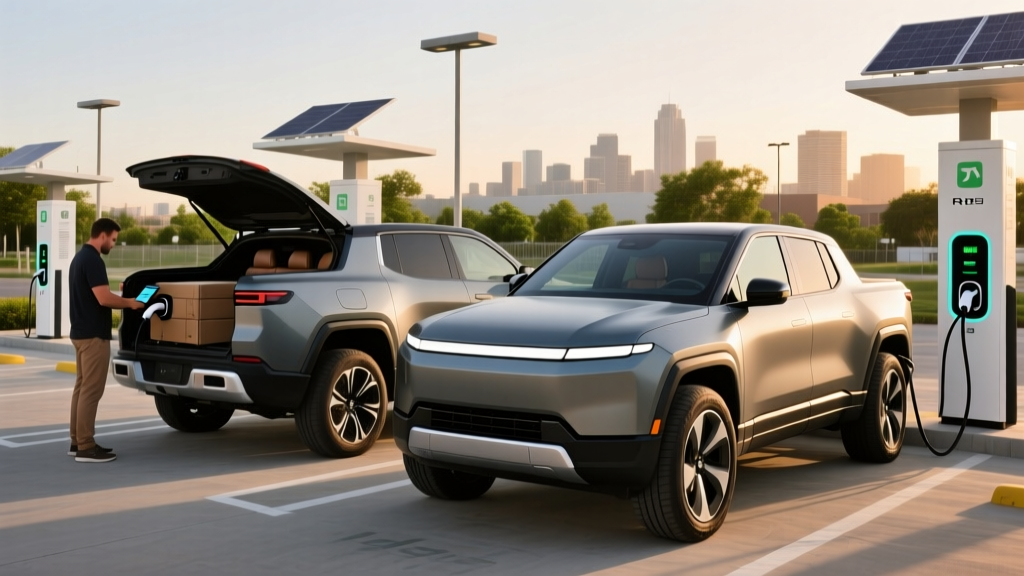
Rivian's second-generation architecture supports peak DC fast-charge rates up to 220 kW on the Max Pack and approximately 200 kW on the Large Pack. But peak rate isn't sustained rate — the charge curve matters more than the headline number.
| Charge Method | Power (kW) | Speed (mi/hr added) | 10–80% Time |
|---|---|---|---|
| DC Fast Charge (Max Pack, peak) | 220 kW | ~140 mi/hr (at peak) | ~28 minutes |
| DC Fast Charge (Large Pack, peak) | 200 kW | ~130 mi/hr (at peak) | ~30 minutes |
| DC Fast Charge (Standard Pack) | 175 kW | ~110 mi/hr (at peak) | ~32 minutes |
| Level 2 Home (48A / 11.5 kW) | 11.5 kW | ~25 mi/hr | ~10–13 hours (full) |
| Level 2 Home (32A / 7.7 kW) | 7.7 kW | ~17 mi/hr | ~15–19 hours (full) |
| Level 1 (120V, 12A) | 1.4 kW | ~3 mi/hr | Days (emergency only) |
At a 350 kW Electrify America or Tesla Supercharger (via Rivian's NACS adapter, now included with all new vehicles), the Max Pack sustains above 150 kW from roughly 15% to 55% State of Charge, then tapers progressively. Owners who precondition the battery — automatic when a charger is set as your navigation destination — see noticeably faster initial ramp-up, especially in cold weather.
For home charging, Rivian owners overwhelmingly install a 48-amp Level 2 wall connector on a 60-amp circuit. The Rivian Wall Charger delivers up to 11.5 kW, adding roughly 25 miles of range per hour. Most owners report that an overnight charge from 20% to 80% takes 6–7 hours — more than sufficient for daily use.
Performance and Drivetrain: What the Numbers Feel Like
| Configuration | Horsepower | Torque (lb-ft) | 0–60 mph | Drivetrain | Towing Capacity |
|---|---|---|---|---|---|
| Dual-Motor | 533 hp | 610 | 4.5 sec | AWD | 11,000 lbs |
| Performance Dual-Motor | 665 hp | 829 | 3.4 sec | AWD | 11,000 lbs |
| Tri-Motor | 850 hp | 1,103 | 2.9 sec | AWD | 11,000 lbs |
The Dual-Motor delivers more than enough performance for any practical truck task. The Tri-Motor's 2.9-second 0–60 time is genuinely supercar territory in a 7,000-pound vehicle — impressive but largely a bragging-rights feature. Most Rivian owners choose the Performance Dual-Motor as the sweet spot: 3.4 seconds to 60 with minimal range penalty over the standard Dual-Motor.
All configurations feature Rivian's quad-motor-ready architecture with individual wheel torque vectoring, a hydraulic roll-control system that replaces traditional sway bars, and adjustable air suspension with up to 14.9 inches of ground clearance in Off-Road mode.
Pricing, Trims, and Federal Tax Credit Eligibility
Rivian pricing has stabilized as production efficiencies improve. Here's where each configuration lands before and after potential federal incentives.
| Trim | Base MSRP | As-Tested (typical) | §30D Credit Eligible? | Effective Price (w/ max credit) |
|---|---|---|---|---|
| Dual-Motor Standard Pack | $69,900 | $72,500 | Yes (under $80K cap) | ~$62,400 |
| Dual-Motor Large Pack | $75,900 | $79,800 | Yes (under $80K cap) | ~$68,400 |
| Dual-Motor Max Pack | $83,900 | $88,500 | No (exceeds $80K truck cap) | $83,900 |
| Performance Dual-Motor Large | $79,900 | $84,200 | No (exceeds $80K truck cap) | $79,900 |
| Tri-Motor Large | $89,900 | $95,000 | No (exceeds $80K truck cap) | $89,900 |
The IRS §30D clean vehicle credit offers up to $7,500 for qualifying new EVs, but pickup trucks must have an MSRP at or below $80,000 to qualify. Buyer income caps also apply: $300,000 for joint filers, $225,000 for heads of household, and $150,000 for single filers (modified adjusted gross income). Battery component and critical mineral sourcing requirements add further complexity — consult a tax professional and verify current-year rules before purchasing.
For the R1S SUV, the MSRP cap is also $80,000. The Dual-Motor Standard and Large Pack R1S models typically qualify; Max Pack and Performance trims usually exceed the threshold. As of 2026, the point-of-sale transfer option allows eligible buyers to apply the credit as a down-payment reduction at the dealer rather than waiting for a tax refund.
Interior, Cargo, and Daily Livability
The R1T's crew-cab layout seats five with 41.3 inches of front legroom and 38.2 inches in the rear. The 4.5-foot bed (54 inches) is shorter than full-size truck beds but includes the signature Gear Tunnel — a lockable, pass-through storage compartment spanning the vehicle width behind the rear seats, offering 11.7 cubic feet of weather-sealed space.
| Measurement | R1T | R1S |
|---|---|---|
| Front Legroom | 41.3 in | 41.3 in |
| Rear Legroom | 38.2 in | 38.2 in |
| Bed Length / Cargo (behind 2nd row) | 54 in (4.5 ft) | 46.7 cu ft |
| Gear Tunnel (R1T) / Frunk | 11.7 cu ft | 10.8 cu ft |
| Max Cargo (R1S, seats folded) | — | 104.6 cu ft |
| Front Trunk (Frunk) | 11.0 cu ft | 10.8 cu ft |
The R1S offers three-row seating for up to seven passengers, though the third row is best suited for children or short trips. With the second and third rows folded, the R1S provides 104.6 cubic feet of cargo volume — competitive with midsize SUVs. The frunk (front trunk) on both models adds approximately 11 cubic feet of secure, drainable storage.
Tech, Driver Assistance, and Software
Rivian runs its vehicles on a proprietary software stack with over-the-air (OTA) updates that have meaningfully improved the platform since launch. The 15.6-inch center touchscreen handles navigation, climate, and vehicle settings with minimal lag. Wireless Apple CarPlay and Android Auto are standard, along with a built-in Wi-Fi hotspot.
The Driver+ system is a Level 2 driver-assistance suite (per SAE classification) combining adaptive cruise control, lane-centering, and automatic lane changes on highways. It requires continuous driver supervision — this is not a self-driving system. Owners report it performs well on interstate cruising but is less confident in construction zones and on poorly marked roads than Tesla's Autopilot or GM's Super Cruise.
Unique features that Rivian owners cite as differentiators include the built-in air compressor (accessible from the bed), the Camp Kitchen accessory (a slide-out induction cooktop and sink system for the Gear Tunnel), and the vehicle's ability to serve as a mobile power source via its integrated 120V and 240V outlets — though Rivian does not currently support full vehicle-to-home (V2H) bidirectional charging.
- Class-leading off-road capability with 14.9" ground clearance and quad-motor torque vectoring
- Gear Tunnel provides unique, secure, weather-sealed storage
- Max Pack offers genuine 350+ mile real-world range
- OTA updates continuously improve vehicle software
- 11,000-lb towing capacity exceeds most competitors
- Strong build quality on Gen 2 platform
- Max Pack and Performance trims exceed $80K — no federal tax credit
- Towing cuts range approximately 50%
- Driver+ lags behind Tesla Autopilot and GM Super Cruise in highway refinement
- No vehicle-to-home (V2H) bidirectional charging support
- Service center network still expanding in rural areas
- Third row in R1S is cramped for adults
Warranty and Long-Term Battery Outlook
Rivian provides an 8-year/175,000-mile battery and powertrain warranty, with a capacity retention threshold of 70% during the warranty period. The bumper-to-bumper limited warranty covers 5 years or 60,000 miles. These terms are competitive with the broader EV market, though Rivian's relatively short production history means long-term degradation data beyond 4–5 years remains limited.
The NMC (nickel manganese cobalt) chemistry used across the R1 lineup offers high energy density — enabling the Max Pack's 420-mile EPA rating — but is more sensitive to sustained high-State-of-Charge storage than LFP chemistry. Rivian owners who charge to 80% daily and reserve 100% charges for road trips report minimal observable degradation over 2–3 years of ownership.
Is the Rivian R1T or R1S Right for You?
- You need a truck that can tow 11,000 lbs and handle genuine off-road terrain
- You value unique storage (Gear Tunnel, frunk) over a full-size 6.5-foot bed
- You want EV performance with adventure-truck utility
- You need three-row seating for a family but want EV efficiency
- You prefer SUV cargo flexibility (104.6 cu ft max) over a pickup bed
- You want similar capability to the R1T in a more traditional body style
- Your budget is under $65,000 — consider the Ford F-150 Lightning XLT or Chevy Silverado EV
- You need best-in-class highway driver assist — GM's Super Cruise or Tesla's Autopilot lead here
- You tow frequently over long distances — range loss is significant and charging stops add up
Frequently Asked Questions
What is the real-world range of the Rivian R1T?
The EPA rates the R1T Dual-Motor Max Pack at 420 miles. In real-world highway driving at 70 mph and moderate temperatures, owners consistently achieve 340–365 miles. In cold weather (below freezing), expect 270–300 miles on the highway. The Standard Pack's 270-mile EPA rating translates to roughly 220–240 miles in real-world mixed use.
How fast does the Rivian charge at home and on the road?
On a Level 2 home charger at 11.5 kW (48 amps), the R1T adds approximately 25 miles of range per hour, fully charging overnight in 10–13 hours depending on pack size. At a DC fast charger, the Max Pack peaks at 220 kW and charges from 10% to 80% in roughly 28 minutes. Charging slows significantly above 80% — plan to charge to 80% on road trips for optimal time efficiency.
Does the Rivian R1T qualify for the $7,500 federal EV tax credit?
It depends on the trim. The Dual-Motor Standard Pack ($69,900 MSRP) and Large Pack ($75,900 MSRP) fall under the $80,000 MSRP cap for pickup trucks and are generally eligible, subject to buyer income limits ($300K joint / $150K single) and battery-sourcing requirements. Max Pack ($83,900) and Performance/Tri-Motor trims exceed the cap and do not qualify. Verify current eligibility on IRS.gov before purchasing.
Is the Rivian R1T worth buying over the Ford F-150 Lightning?
The R1T offers superior off-road capability, more refined build quality, and longer Max Pack range (420 vs 320 EPA miles). The F-150 Lightning starts significantly lower (~$55,000), offers a larger 6.5-foot bed, has broader service-center coverage, and supports Pro Power Onboard with vehicle-to-home capability. If budget and bed size are priorities, the Lightning wins. If off-road performance, range, and premium execution matter more, the R1T is the stronger choice.
What are the biggest complaints from Rivian owners?
The most common owner-reported concerns include limited service center availability in rural regions, range reduction when towing (up to 50%), the Driver+ system feeling less polished than competitors on highways, and the high cost of Max Pack trims that don't qualify for the federal tax credit. Software bugs were more prevalent in 2022–2023 models but have been substantially addressed through OTA updates on the Gen 2 platform.
How does Rivian's warranty compare to other EV makers?
Rivian's 8-year/175,000-mile battery and drive unit warranty is among the most generous in the industry, exceeding Tesla's 8-year/120,000-mile coverage on the Model X and matching Hyundai's 10-year/100,000-mile standard. The 70% capacity retention threshold is industry-standard. The 5-year/60,000-mile bumper-to-bumper coverage is competitive but not exceptional.