Why Rivian's Net Worth Matters to EV Buyers
When you're spending $75,000+ on an electric vehicle, the financial health of the automaker isn't just Wall Street trivia — it directly affects long-term parts availability, software updates, service center expansion, and resale value. Searches for Rivian net worth have climbed as buyers weigh whether this American EV startup has the staying power to support its vehicles for a decade or more.
As of early 2026, Rivian's market capitalization hovers around $12–15 billion, a significant recovery from its 2022 lows but still well below its 2021 IPO peak of over $100 billion. The company holds roughly $6–7 billion in cash and equivalents, bolstered by its joint venture with Volkswagen (a $5.8 billion investment finalized in late 2024). Revenue has climbed past $5 billion annually, driven by R1S/R1T sales and the commercial EDV delivery van fleet for Amazon.
But what does this mean for you, the buyer? Let's break down the vehicles Rivian actually sells — the 2026 R1S SUV and R1T pickup — and evaluate whether the company's trajectory supports a confident purchase.
2026 Rivian R1S and R1T: Core Specs at a Glance
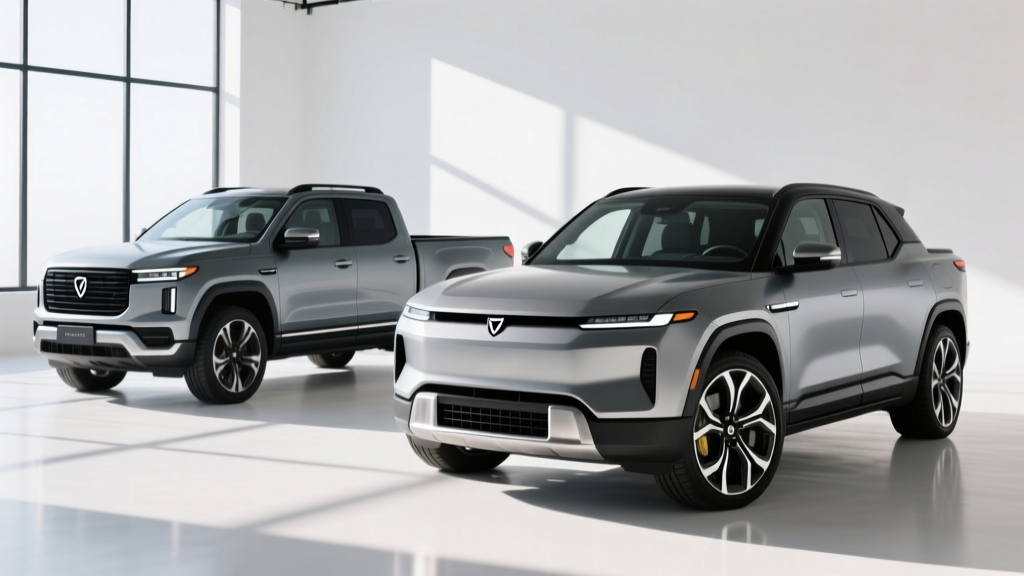
Both the R1S (three-row SUV) and R1T (crew-cab pickup) share Rivian's updated Gen 2 platform for 2026, which introduced a more efficient drive unit and updated battery options. Here's the consolidated spec sheet:
| Spec | Standard Battery (AWD) | Large Battery (AWD) | Max Battery (Tri-Motor) |
|---|---|---|---|
| Usable Battery Capacity | ~92 kWh (LFP) | ~109 kWh (NMC) | ~141 kWh (NMC) |
| EPA Est. Range (R1S) | 270 mi | 352 mi | 410 mi |
| EPA Est. Range (R1T) | 258 mi | 342 mi | 390 mi |
| Horsepower | 533 hp | 533 hp | 850 hp |
| 0–60 mph | 4.5 sec | 4.5 sec | 2.9 sec |
| Max DC Fast Charge | 200 kW | 220 kW | 220 kW |
| 10–80% DC Charge Time | ~28 min | ~25 min | ~38 min |
| Level 2 Home Charging | 11.5 kW (~25 mi/hr) | 11.5 kW (~25 mi/hr) | 11.5 kW (~25 mi/hr) |
| Efficiency (R1S, Large) | ~73 MPGe / 46 kWh per 100 mi | ||
| Towing Capacity (R1T) | 11,000 lbs (max) | ||
Real-World Range Reality Check
EPA Sticker: Up to 410 miles (R1S Max Battery).
Expect in the Real World: On a 75-mph highway run in moderate temperatures, plan for roughly 80–85% of EPA — so around 280–290 miles from the Large Battery pack and 340–350 miles from the Max. In cold weather (below 30°F), knock off another 15–25%, especially on short trips where the cabin and battery must heat from cold. LFP-equipped Standard Battery models handle cold somewhat better due to chemistry resilience, but energy consumption still rises. The R1T, with its open bed creating more aerodynamic drag, typically loses 5–10 more miles than the R1S in equivalent conditions.
Charging Speed: Home, Public, and the NACS Advantage
Rivian transitioned to the NACS (Tesla-style) charge port starting with the 2025 model year, and all 2026 R1 vehicles ship natively with NACS. This grants access to Tesla's Supercharger network — over 25,000 stalls in North America — without an adapter, a significant practical advantage over CCS-equipped competitors.
| Charging Level | Power | Miles Added per Hour | Notes |
|---|---|---|---|
| Level 1 (120V) | ~1.4 kW | ~3 mi/hr | Emergency/trickle only |
| Level 2 (240V, 48A) | 11.5 kW | ~25 mi/hr | Full charge overnight (~10–14 hrs for Max pack) |
| DC Fast (Large/Max) | Up to 220 kW | ~140 mi in 15 min (peak) | Peak rate sustained to ~60% SoC, then tapers |
| DC Fast (Standard LFP) | Up to 200 kW | ~130 mi in 15 min (peak) | LFP accepts charge well at high SoC |
Charging curve reality: Rivian's 220 kW peak applies only to the Large and Max NMC packs, and only between roughly 15–60% State of Charge. Above 80%, charging slows dramatically to protect battery health — expect 80–100% to take nearly as long as 10–80%. For road trips, the practical rhythm is 20–25 minute stops every 250 miles or so, which aligns well with rest and food breaks.
For home charging, Rivian sells the Rivian Wall Connector ($500) rated at 11.5 kW on a 60-amp circuit. A licensed electrician will typically charge $800–$2,000 for installation, depending on panel proximity and whether a 200-amp panel upgrade is needed. Total home setup budget: $1,300–$2,500.
Pricing, Trims, and Federal Tax Credit Eligibility
Rivian simplified its trim structure for 2026. Here's where pricing lands:
| Model / Config | Base MSRP | As-Tested Typical | §30D Federal Credit |
|---|---|---|---|
| R1T AWD Standard Battery | $69,900 | $74,000 | Eligible — $3,750–$7,500* |
| R1T AWD Large Battery | $75,900 | $82,000 | Eligible — $3,750–$7,500* |
| R1T Tri-Motor Max | $99,900 | $108,000 | Eligible — $3,750–$7,500* |
| R1S AWD Standard Battery | $74,900 | $80,000 | Eligible — $3,750–$7,500* |
| R1S AWD Large Battery | $79,900 | $87,000 | Eligible — $3,750–$7,500* |
| R1S Tri-Motor Max | $104,900 | $113,000 | Eligible — $3,750–$7,500* |
*Federal tax credit amounts and eligibility depend on multiple factors. Always verify current rules at IRS.gov.
§30D Federal Tax Credit — Do You Qualify?
- Vehicle MSRP cap: Trucks/SUVs must be ≤ $80,000 MSRP. This disqualifies most Tri-Motor Max configurations from the full credit. Dual-Motor Large Battery models priced under $80K remain eligible.
- Buyer income cap: Modified AGI must not exceed $150,000 (single), $225,000 (head of household), or $300,000 (joint filers).
- Battery sourcing: A percentage of critical minerals and battery components must be sourced from the US or free-trade-agreement partners. Rivian has progressively improved sourcing compliance, but the credit may split into $3,750 (minerals only) or $7,500 (both minerals + components met). Check the latest fueleconomy.gov listings for per-model eligibility.
- Point-of-sale transfer: Since 2024, you can transfer the credit to the dealer at purchase, reducing your out-of-pocket cost immediately rather than waiting for tax filing.
- Assembled in USA: All Rivians are built in Normal, Illinois — this requirement is met.
Performance, Space, and Daily Livability
Even the base dual-motor R1T and R1S produce 533 horsepower and sprint to 60 mph in 4.5 seconds — performance that embarrasses most gas-powered trucks and large SUVs. The Tri-Motor variant is supercar-quick at 2.9 seconds, though at that price point you're paying for bragging rights more than practicality.
R1T cargo and bed: The 4.5-foot bed is shorter than a full-size truck's, but the lockable gear tunnel (11 cu ft, running through the vehicle between cab and bed) is a genuinely innovative storage solution. Total cargo with bed and tunnel: roughly 54 cu ft. The front trunk (frunk) adds 11 cu ft of lockable, drainable storage — perfect for muddy gear or groceries.
R1S passenger space: The three-row SUV seats up to seven. Front-row legroom is generous at 41.3 inches, second row at 38.4 inches, but the third row is tight at 30.1 inches — best suited for children or short trips. Cargo behind the third row is 10.4 cu ft, expanding to 57.7 cu ft with the third row folded and 91.6 cu ft max.
Towing: The R1T maxes out at 11,000 lbs (properly equipped), and the R1S at 7,700 lbs. However, towing a heavy trailer will cut range by 40–50% — a reality for all EVs, but especially impactful for the R1T on long hauls. Plan charging stops accordingly.
Warranty, Reliability, and Ownership Costs
Rivian's warranty package is competitive with the EV segment:
- Battery & Drive Units: 8 years / 175,000 miles (whichever comes first), with a minimum 70% capacity retention threshold
- Limited Vehicle Warranty: 5 years / 60,000 miles bumper-to-bumper
- Roadside Assistance: 5 years / unlimited miles
The 175,000-mile battery warranty is notably longer than many competitors' 100,000-mile thresholds, reflecting Rivian's confidence in its pack engineering. Real-world degradation data is still maturing — the oldest R1 vehicles on the road are 2022 models with roughly 3–4 years of data — but early reports from high-mileage owners and Amazon's EDV fleet suggest degradation in line with industry norms (roughly 5–8% loss over the first 100,000 miles).
Insurance: Expect premiums in the $2,400–$3,600/year range depending on trim, location, and driving record. Rivians carry higher-than-average insurance costs due to repair complexity and parts pricing.
Maintenance: Like all EVs, there are no oil changes, spark plugs, or transmission fluid services. Expect to budget for tire rotation/replacement (EVs wear tires faster due to weight and instant torque — plan on new tires every 25,000–35,000 miles at $300–$450 per tire), cabin air filter replacement, and brake fluid checks. Rivian offers mobile service for many routine items, reducing dealer-visit friction.
Tech, Driver Assists, and Standout Features
Rivian's infotainment runs on a proprietary system displayed on a 15.6-inch center touchscreen with a 12.3-inch driver cluster. The interface is clean and responsive, with integrated navigation that factors in charging stops and elevation changes for range estimation. Wireless Apple CarPlay and Android Auto are standard.
Rivian Driver Assist: This is a Level 2 SAE driver-assistance system — it provides adaptive cruise control, lane centering, and automatic emergency braking, but requires the driver to remain fully engaged at all times. It is not self-driving. Rivian has been gradually rolling out enhanced features via over-the-air updates, including hands-free highway driving on select mapped roads, but it still trails GM's Super Cruise and Ford's BlueCruise in hands-free route coverage.
Unique features that set Rivian apart:
- Gear Tunnel (R1T): A full-width, lockable pass-through storage compartment unique in the truck segment
- Camp Kitchen (option): A slide-out kitchen module that integrates with the gear tunnel — $5,000 option, niche but beloved by overlanders
- Rivian Waypoints: Curated adventure routes with embedded charging and camping waypoints in the navigation system
- Drive Modes: Including a dedicated Off-Road mode with adjustable air suspension (up to 14.4 inches of ground clearance)
- Vehicle-to-Load (V2L): The R1T can power external devices and appliances via its bed outlets, useful for camping and job-site power
Is Rivian Worth Buying vs. the Competition?
The R1T competes primarily with the Ford F-150 Lightning and the Chevrolet Silverado EV, while the R1S slots against the Tesla Model X, Kia EV9, and luxury SUVs like the BMW iX.
Choose the Rivian R1T if:
- You want a premium electric truck with genuine off-road capability (air suspension, quad-motor torque vectoring on Tri-Motor)
- The gear tunnel and frunk storage solutions match your gear-hauling needs
- NACS Supercharger access matters for your road-trip routes
- You value build quality and materials a step above the F-150 Lightning
Choose the Rivian R1S if:
- You need three rows but want something more adventure-oriented than a Tesla Model X
- You prioritize off-road capability in a family SUV
- You're willing to accept a tight third row in exchange for design and performance
Look elsewhere if:
- Budget is paramount — the Kia EV9 starts ~$20K lower and offers more third-row space
- You need maximum towing range — consider a diesel or PHEV for frequent heavy-trailer hauling
- You want the most mature hands-free driving system — GM's Super Cruise has broader coverage
Pros
- Class-leading off-road capability with air suspension and 14.4" ground clearance
- NACS native — full Supercharger network access without adapters
- Innovative storage (gear tunnel, frunk, drainable compartments)
- 175,000-mile battery warranty exceeds most competitors
- Strong build quality and premium interior materials
- OTA updates continuously add features
Cons
- High starting price — most trims exceed $80K MSRP cap for full tax credit
- Third-row space in R1S is cramped for adults
- Towing drastically reduces range (40–50% loss)
- Insurance premiums run higher than segment average
- Driver assist system still maturing vs. Super Cruise/BlueCruise
- Service center network still expanding — rural owners may face longer wait times
Frequently Asked Questions
What is Rivian's net worth in 2026, and is the company financially stable?
Rivian's market capitalization is approximately $12–15 billion as of early 2026, with $6–7 billion in cash reserves bolstered by the Volkswagen partnership. The company is still operating at a net loss as it scales production, but its cash runway extends several years, and the Amazon van contract provides a stable revenue floor. For buyers, the VW investment is a strong vote of confidence — it signals that a major legacy automaker believes in Rivian's technology platform and long-term viability.
What is the real-world range of the 2026 Rivian R1S and R1T?
Expect roughly 80–85% of the EPA estimate during highway driving at 70–75 mph in moderate weather. The Large Battery R1S delivers around 280–290 real-world highway miles; the Max Battery pushes 340–350. Cold weather (below 30°F) can reduce range an additional 15–25%. The R1T loses a few extra miles to aerodynamic drag from the open bed.
How fast does a Rivian charge at home and on the road?
At home on a 240V Level 2 charger (11.5 kW), expect roughly 25 miles of range per hour — a full overnight charge handles even the Max Battery pack. On DC fast chargers, the Large and Max NMC packs peak at 220 kW, delivering a 10–80% charge in 25–38 minutes depending on pack size. The LFP Standard Battery peaks at 200 kW with a ~28-minute 10–80% time. With NACS, you get seamless access to Tesla Superchargers nationwide.
Does the 2026 Rivian qualify for the $7,500 federal EV tax credit?
It depends on the configuration and your income. Dual-Motor models with MSRP at or below $80,000 can qualify for the full or partial §30D credit ($3,750–$7,500), subject to buyer income caps ($150K single / $300K joint) and battery-sourcing requirements. Tri-Motor Max configurations exceed the $80K MSRP cap and are not eligible. Always verify current eligibility at IRS.gov and check fueleconomy.gov for the latest sourcing compliance status before purchasing.
How does Rivian's warranty compare to Tesla and Ford?
Rivian's 8-year/175,000-mile battery warranty is among the best in the industry — Tesla offers 8 years/120,000–150,000 miles (depending on model), and Ford offers 8 years/100,000 miles on the F-150 Lightning. The bumper-to-bumper coverage at 5 years/60,000 miles is standard for the segment.
Is buying from Rivian a risk given the company's financials?
All startups carry more risk than century-old automakers, but Rivian's position in 2026 is meaningfully stronger than it was in 2022–2023. The VW investment, growing production volumes, and Amazon fleet contract provide multiple revenue pillars. The bigger practical risk for buyers is service-center density — if you live far from a Rivian service hub, routine warranty work may require mobile service or longer wait times compared to a Ford or Toyota dealer network.