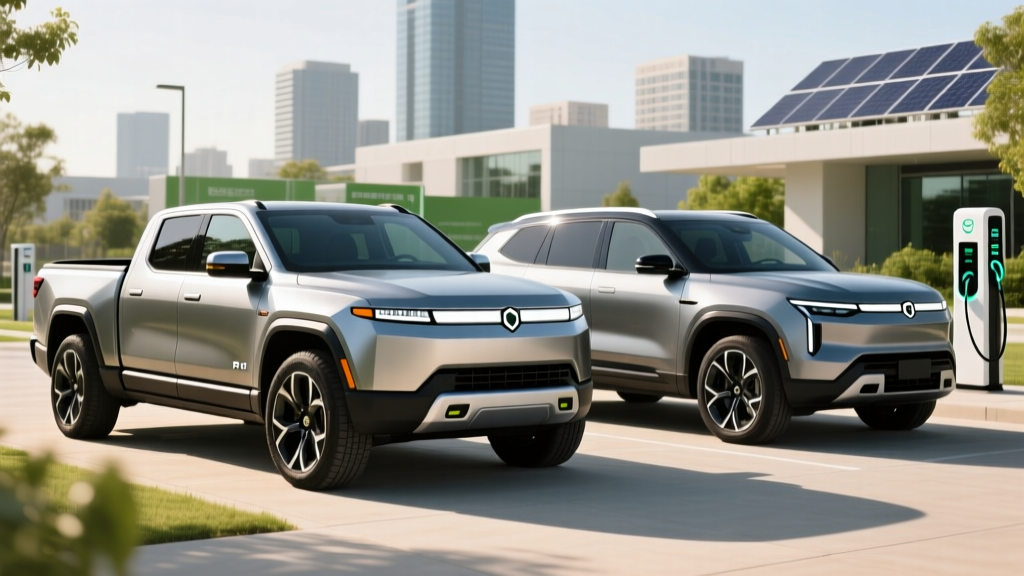
If you've ever typed "Rivian made by who" into a search bar, you're not alone. Rivian Automotive isn't a subsidiary of a legacy automaker — it's an independent American EV company founded in 2009 by RJ Scaringe, headquartered in Irvine, California, with manufacturing in Normal, Illinois. Unlike brands that badge-engineer shared platforms, Rivian designs its own skateboard chassis, battery packs, and software stack in-house. For 2026, that independence shows in the second-generation R1T pickup and R1S SUV, which feature a redesigned tri-motor powertrain, NACS charging ports, and a new LFP battery option.
This profile covers both the R1T and R1S across their current trims so you can decide whether a Rivian fits your garage, your budget, and your road-trip habits.
Rivian at a Glance: Company & Lineup Overview
Rivian went public in November 2021 and has since scaled its Normal, Illinois assembly plant to produce both consumer vehicles and its Amazon EDV commercial delivery van. The company controls its own direct-to-consumer sales model (no franchised dealers), operates a growing Adventure Network of DC fast chargers, and handles all service through company-owned centers plus mobile ranger vans. For buyers, this means a Tesla-like ownership experience with some growing-pains typical of a startup — service center wait times in certain metro areas remain a real consideration.
| Spec | R1T Dual-Motor | R1T Tri-Motor | R1S Dual-Motor | R1S Tri-Motor |
|---|---|---|---|---|
| EPA Range | 352 mi | 420 mi (Max Pack) | 352 mi | 410 mi (Max Pack) |
| Battery (usable) | 106 kWh (NMC) | 141 kWh (NMC) | 106 kWh (NMC) | 141 kWh (NMC) |
| Horsepower | 533 hp | 850 hp | 533 hp | 850 hp |
| 0–60 mph | 4.5 sec | 2.9 sec | 4.6 sec | 3.0 sec |
| Drivetrain | AWD (dual-motor) | AWD (tri-motor) | AWD (dual-motor) | AWD (tri-motor) |
| Max DC Charge Rate | 200 kW | 220 kW | 200 kW | 220 kW |
| 10–80% DCFC Time | ~28 min | ~35 min | ~28 min | ~35 min |
| Base MSRP | $69,900 | $99,900 | $74,900 | $104,900 |
Real-World Range: What the EPA Sticker Doesn't Tell You
Rivian's thermal management system includes a heat pump, which helps mitigate cold-weather losses compared to resistive heating. Still, the R1T's boxy aerodynamics and 5,900+ lb curb weight mean highway efficiency suffers more than sleeker sedans. Around town with regenerative braking engaged, you'll often exceed the EPA combined number — the R1T Dual-Motor achieves roughly 2.0–2.2 kWh/mi in mixed suburban driving.
For context, the R1S shares the same battery options but posts slightly lower range figures due to a marginally taller profile and additional third-row weight. The EPA's fueleconomy.gov database confirms the combined MPGe ratings at approximately 73 MPGe for Dual-Motor variants and 70 MPGe for Tri-Motor trims.
Charging Speed: DC Fast Charging and Home Level 2
Rivian switched to the NACS (Tesla-style) charge port starting with the 2025 refresh, meaning native access to the Tesla Supercharger network without an adapter — a major practical advantage for road-trip charging. Here's the charging breakdown:
| Charging Level | Power / Rate | Miles of Range Added | Notes |
|---|---|---|---|
| Level 1 (120V household) | ~1.4 kW | ~3–4 mi/hr | Emergency/trickle only |
| Level 2 (240V, 48A home charger) | 11.5 kW | ~28–32 mi/hr | Full charge overnight (~10 hrs for Standard) |
| Level 2 (240V, 32A mobile) | 7.7 kW | ~19–22 mi/hr | Portable cord included |
| DC Fast Charge (Dual-Motor) | Peak 200 kW | ~140 mi in 15 min | Tapers above 80% SoC |
| DC Fast Charge (Tri-Motor Max) | Peak 220 kW | ~160 mi in 15 min | Longer sustained curve |
The charge curve matters: the Dual-Motor peaks at 200 kW but typically sustains that rate only between 15–55% State of Charge (SoC), then tapers to ~120 kW through 80%. The Tri-Motor Max Pack sustains higher power longer because its larger battery absorbs energy at a lower C-rate for the same kW input — a physics advantage of bigger packs. If you regularly road-trip, preconditioning the battery via the navigation system (which activates when a charger is set as your destination) shaves 3–5 minutes off your 10–80% session.
At home, Rivian's Wall Charger delivers up to 11.5 kW on a 60A circuit. Expect a full installation to cost $800–$2,000 depending on panel proximity and whether your home needs a 200A service upgrade. A licensed electrician should confirm your panel capacity before purchase.
Performance, Drivetrain, and Efficiency
Every R1T and R1S uses an all-wheel-drive layout with individual motors per axle (Dual-Motor) or a front motor plus dual rear motors (Tri-Motor). The Tri-Motor's torque-vectoring rear axle gives it sports-car-level launch grip — the R1T Tri-Motor hits 0–60 mph in 2.9 seconds, making it one of the quickest pickups ever sold. The Dual-Motor at 4.5 seconds is hardly slow for a 6,000-lb truck.
Towing capacity maxes out at 11,000 lbs for the R1T (all trims) and 7,700 lbs for the R1S. Real-world towing at highway speeds will cut range by 40–55%, so a 352-mile truck becomes a ~175-mile truck when pulling a 7,000-lb trailer. Plan charging stops accordingly.
Efficiency in mixed driving settles around 48–50 kWh/100 mi for the Dual-Motor and 51–53 kWh/100 mi for the Tri-Motor. These are truck numbers — for comparison, a Tesla Model Y runs roughly 27 kWh/100 mi. You're trading efficiency for capability, ground clearance (up to 14.9 inches with air suspension), and water fording depth (3+ feet).
Pricing, Trims, and Federal Tax Credit Eligibility
Rivian's pricing spans from the $69,900 R1T Dual-Motor Standard to the $104,900+ R1S Tri-Motor Max. The as-tested price on a well-equipped R1T Dual-Motor with the Adventure package, premium interior, and air suspension typically lands around $79,000–$83,000 before incentives.
| Trim | Base MSRP | Federal §30D Credit | Effective Price |
|---|---|---|---|
| R1T Dual-Motor Standard | $69,900 | Up to $7,500* | ~$62,400 |
| R1T Dual-Motor Large | $75,900 | Up to $7,500* | ~$68,400 |
| R1T Tri-Motor Max | $99,900 | Up to $7,500* | ~$92,400 |
| R1S Dual-Motor Standard | $74,900 | Up to $7,500* | ~$67,400 |
| R1S Tri-Motor Max | $104,900 | Up to $7,500* | ~$97,400 |
*Federal EV tax credit eligibility under IRS §30D depends on multiple factors that change frequently. Key 2026 requirements include:
- MSRP Cap: Pickup trucks (R1T) must be under $80,000 MSRP; SUVs (R1S) under $80,000. This means the Tri-Motor Max trims exceed the cap and do not qualify.
- Buyer Income Limits: Modified AGI must not exceed $300,000 (joint), $225,000 (head of household), or $150,000 (single).
- Battery Sourcing: Critical minerals and battery components must meet escalating domestic-content thresholds. Verify current-year compliance on Rivian's configurator or the IRS §30D guidance page.
- Point-of-Sale Transfer: Eligible buyers can transfer the credit to the dealer at purchase, reducing the out-of-pocket cost immediately rather than waiting for tax filing.
- US Assembly: Both R1T and R1S are assembled in Normal, Illinois — this requirement is satisfied.
Always confirm eligibility with a tax professional and the IRS source-of-manufacturer letter before committing to a purchase. Rules can shift between model years.
Cargo, Passenger Space, and Everyday Practicality
The R1T is a midsize pickup with a 4.5-foot bed, which is shorter than a Tacoma or Ranger. However, Rivian's Gear Tunnel — a pass-through storage compartment spanning the width of the truck between the cab and bed — adds roughly 11 cu ft of lockable, weatherproof storage. Combined with a 10 cu ft frunk (front trunk), total enclosed cargo space rivals many midsize SUVs despite the short bed.
Interior passenger volume accommodates five adults comfortably. Rear-seat legroom measures approximately 38.2 inches, and the flat floor (thanks to the skateboard platform) makes the middle seat usable for adults on shorter trips. The R1S adds a third row, though it's best suited for children or occasional adult use — expect ~28 inches of third-row legroom.
R1T bed payload is rated at 1,760 lbs, and the bed features integrated tie-downs, a powered tonneau cover option, and a built-in air compressor. The R1S offers 104.7 cu ft of total cargo volume with both rear rows folded.
Tech, Driver Assistance, and Standout Features
Rivian runs its own proprietary software stack on a 15.6-inch center touchscreen and a 12.3-inch driver display. The system supports over-the-air updates, and Rivian has steadily improved route planning, charge-stop integration, and voice commands since launch. Apple CarPlay and Android Auto remain unavailable — a deliberate choice by Rivian that frustrates some buyers who prefer phone projection.
The Rivian Driver+ suite includes adaptive cruise control, lane-centering assist, automatic emergency braking, and blind-spot monitoring. This is an SAE Level 2 driver-assistance system — the driver must keep hands on the wheel and eyes on the road at all times. It does not offer hands-free driving like GM's Super Cruise or Ford's BlueCruise on mapped highways. Rivian has announced a hands-free highway assist feature, but as of 2026 it remains in limited testing and is not yet available to customers.
Standout features unique to Rivian include the built-in camp kitchen (available as a Gear Tunnel accessory with induction cooktop and sink), quad-motor tank turns (on Quad-Motor trims only), a gear guard cable lock system for bed cargo, and integrated V2L (vehicle-to-load) capability that can power tools, campsite equipment, or home essentials during outages via bed-mounted outlets.
Warranty and Long-Term Ownership
Rivian provides an 8-year / 175,000-mile battery and driveunit warranty, which exceeds the industry-standard 8-year/100,000-mile coverage. The bumper-to-bumper limited warranty covers 5 years / 60,000 miles. Rivian's battery packs use NMC (nickel manganese cobalt) chemistry, which offers higher energy density than LFP but requires more careful charge management for longevity. Rivian recommends daily charging to 85–90% and reserving 100% charges for road trips.
Battery degradation data on Rivian's second-gen packs is still accumulating, but early first-generation R1T owners (2022–2023 models) report 3–6% capacity loss over 40,000–60,000 miles, which is consistent with industry averages for NMC packs. Replacement cost for a full battery pack is not publicly listed but industry estimates for a 141 kWh pack place it in the $18,000–$25,000 range out of warranty — a figure to keep in mind for long-term ownership planning.
Insurance costs run 15–30% higher than comparable gas trucks according to industry data, driven by repair complexity and parts pricing. Get a quote before ordering.
Rivian vs. the Competition: Is It Worth Buying?
- Class-leading off-road capability with up to 14.9" ground clearance
- NACS port = native Supercharger network access
- Gear Tunnel + frunk give unmatched enclosed storage for a pickup
- 8-yr/175,000-mi battery warranty exceeds competitors
- Tri-Motor performance (2.9 sec 0–60) is extraordinary for a truck
- US-built in Illinois with strong §30D credit eligibility on Standard/Large trims
- No Apple CarPlay or Android Auto
- Driver+ is capable but not hands-free (unlike Super Cruise/BlueCruise)
- Short 4.5-ft bed limits traditional truck utility
- Service center availability still limited in rural/secondary markets
- Tri-Motor trims exceed the $80K MSRP cap for the federal tax credit
- Real-world highway range falls 15–20% below EPA estimates
The R1T's closest competitor is the Tesla Cybertruck, which offers a longer bed and stainless-steel exoskeleton but polarizing styling and a less proven service network. The Ford F-150 Lightning undercuts the R1T on price (starting ~$55,000) and offers a conventional 5.5-ft bed, but trails in range, off-road capability, and charging speed. The Chevrolet Silverado EV provides a longer bed and competitive range but lacks the R1T's off-road hardware and adventure-focused design. The R1S competes most directly with the Tesla Model X and upcoming three-row electric SUVs, winning on ruggedness but losing on third-row space and efficiency.
Choose the Rivian R1S if: You want three-row seating with off-road credibility and don't mind the efficiency trade-off vs. a car-based electric SUV.
Look elsewhere if: You prioritize maximum bed length (F-150 Lightning), hands-free highway driving (GM Super Cruise), or the lowest possible price in an electric truck.
Frequently Asked Questions
Who actually manufactures Rivian vehicles?
Rivian designs, engineers, and manufactures its vehicles independently at its own assembly plant in Normal, Illinois. It is not owned by or partnered with any legacy automaker for vehicle production. Amazon holds a minority stake and purchases Rivian's commercial delivery vans, but the consumer R1T and R1S are entirely Rivian's own products.
What is the real-world range of the Rivian R1T?
The Dual-Motor R1T with the Standard pack (106 kWh) is EPA-rated at 352 miles. In real-world highway driving at 70–75 mph in moderate temperatures, expect 280–310 miles. In sub-freezing conditions, plan for 240–270 miles. The Tri-Motor Max Pack (141 kWh, 420 mi EPA) delivers roughly 340–370 highway miles in mild weather.
How fast does the Rivian R1T charge at home and on the road?
At home on a 240V / 48A Level 2 charger, the R1T adds approximately 28–32 miles of range per hour (11.5 kW), fully charging overnight in about 10 hours for the Standard pack. On DC fast chargers, the Dual-Motor peaks at 200 kW (10–80% in ~28 minutes) and the Tri-Motor peaks at 220 kW (10–80% in ~35 minutes).
Does the 2026 Rivian R1T qualify for the federal EV tax credit?
The R1T Dual-Motor Standard ($69,900) and Large ($75,900) trims fall under the $80,000 MSRP cap for pickup trucks and are potentially eligible for up to $7,500 under IRS §30D, provided the buyer meets income limits and the battery meets current-year critical-mineral and component sourcing requirements. Tri-Motor trims ($99,900+) exceed the MSRP cap and do not qualify. Always verify on the IRS clean vehicle credits page and with a tax professional.
Is the Rivian R1T worth buying over the F-150 Lightning or Cybertruck?
The R1T wins on off-road capability, enclosed storage versatility (Gear Tunnel + frunk), and NACS Supercharger access. The F-150 Lightning wins on price, conventional bed length, and dealer service network breadth. The Cybertruck offers a larger bed and distinctive styling but has a less mature service infrastructure. If adventure-oriented truck use is your priority, the R1T is the strongest pick in the segment.
What battery chemistry does Rivian use?
Rivian's current R1T and R1S packs use NMC (nickel manganese cobalt) lithium-ion chemistry, which prioritizes energy density for maximum range in a large, heavy vehicle. Rivian recommends charging to 85–90% for daily use and reserving 100% charges for long trips to optimize long-term battery health.