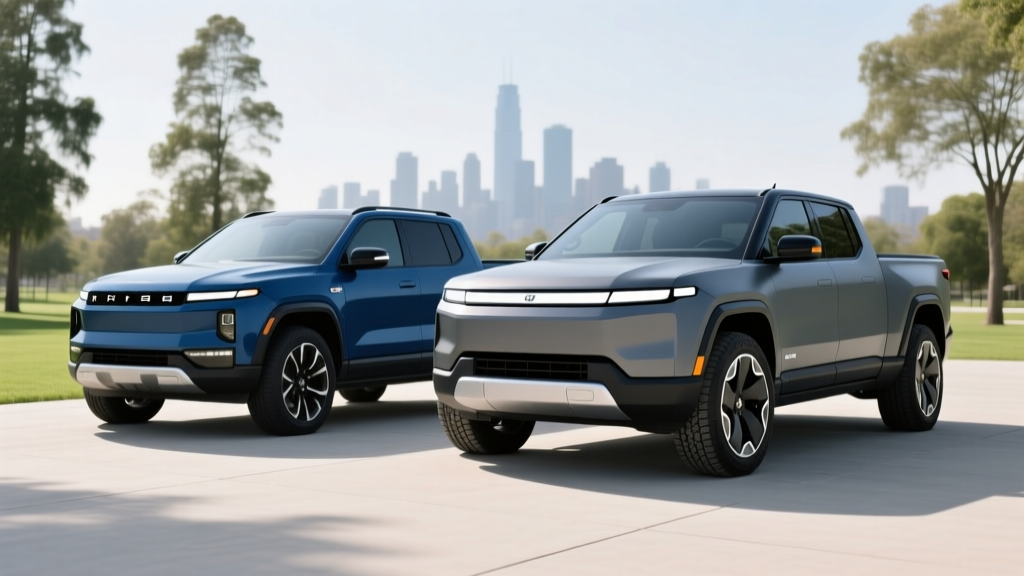
If you are measuring your garage, sizing up a parking space, or comparing the Rivian platform against full-size trucks and three-row SUVs, the Rivian length is one of the most searched—and most misunderstood—specifications in the EV truck and SUV segment. Both the R1S (SUV) and R1T (truck) ride on Rivian's skateboard platform, but their overall lengths, bed configurations, and interior volumes diverge in ways that matter for daily driving, trail use, and cargo hauling.
This guide breaks down every exterior and interior dimension you need, then layers in the data that actually decides a purchase: EPA range, charging speed, battery chemistry, pricing after federal tax credits, and how the R1S and R1T stack up against the Ford F-150 Lightning, Tesla Cybertruck, and Chevrolet Silverado EV.
Rivian R1S and R1T: Exterior Dimensions at a Glance
Before we get into range and pricing, let's answer the core question: how long is a Rivian? The R1S three-row SUV measures 200.8 inches bumper to bumper, while the R1T crew-cab pickup stretches to 217.1 inches with the standard 4.5-foot bed. That puts the R1S in the same footprint territory as a BMW X7 or Mercedes GLS, and the R1T closer to mid-size trucks like the Toyota Tacoma or Ford Ranger rather than full-size half-tons.
| Dimension | R1S (SUV) | R1T (Truck) |
|---|---|---|
| Overall Length | 200.8 in | 217.1 in |
| Wheelbase | 121.1 in | 135.9 in |
| Width (w/o mirrors) | 81.8 in | 81.8 in |
| Width (mirrors out) | 94.5 in | 94.5 in |
| Height (max) | 73.0 in | 73.0 in |
| Ground Clearance (max) | 14.9 in | 14.9 in |
| Curb Weight (approx.) | 6,880 lbs | 7,148 lbs |
Interior Space: Passenger Volume and Cargo Capacity
The Rivian length translates into genuinely usable interior space, though with some caveats depending on the model.
R1S Three-Row SUV
The R1S offers seating for up to seven passengers across three rows. Front-row legroom is generous at 41.5 inches, second-row legroom sits at 38.2 inches, and the third row provides 30.4 inches—adequate for children or short trips but tight for adults on longer drives. Cargo volume behind the third row is 10.8 cubic feet, expanding to 46.7 cu ft with the third row folded and up to 91.6 cu ft with both rear rows down. The front trunk (frunk) adds another 11.1 cu ft of enclosed, weather-sealed storage.
R1T Crew-Cab Pickup
The R1T seats five with 41.5 inches of front legroom and 38.2 inches in the rear. The 4.5-foot bed (54 inches long) is shorter than most mid-size trucks, but Rivian's Gear Tunnel—a 11.7 cu ft pass-through compartment between the cab and bed—adds secure, enclosed storage that competitors don't offer. The frunk contributes an additional 11.1 cu ft. Total enclosed cargo capacity (frunk + Gear Tunnel) reaches 22.8 cu ft, which rivals many compact SUVs.
Range, Battery, and Efficiency: What the EPA Says vs. Reality
Rivian offers multiple battery pack sizes for the 2025–2026 model year, built around its in-house-developed Gen 2 drive unit architecture. Chemistry varies by pack: the Standard battery uses lithium iron phosphate (LFP) cells for durability and lower cost, while the Large and Max packs use nickel-manganese-cobalt (NMC) chemistry for higher energy density and maximum range.
| Pack | Usable Capacity | Chemistry | EPA Range (R1S) | EPA Range (R1T) |
|---|---|---|---|---|
| Standard | ~92 kWh | LFP | ~270 mi | ~270 mi |
| Large | ~109 kWh | NMC | ~330 mi | ~328 mi |
| Max | ~141 kWh | NMC | ~400 mi | ~390 mi |
Highway driving (70–80 mph): Subtract 10–15% from EPA figures. A Max-pack R1T rated at 390 miles will deliver roughly 330–350 miles at sustained highway speeds.
Cold weather (below 32°F): Range drops 20–30% depending on cabin heating demand and whether you precondition. A Large-pack R1S at 330 EPA miles may see 230–265 miles in sub-freezing winter conditions.
Towing: The R1T is rated to tow 11,000 lbs and the R1S up to 7,700 lbs. When towing near max capacity, expect range to drop 40–50%. Plan charging stops accordingly.
Efficiency for the R1S Dual-Motor Large pack is rated by the EPA at approximately 73 MPGe combined, translating to roughly 46 kWh per 100 miles. That is competitive with the Ford F-150 Lightning but below the efficiency of lighter EVs like the Tesla Model Y. The R1T's boxier shape and slightly higher weight push its consumption a few points higher.
Charging Speed: DC Fast Charging and Home Level 2
Charging speed is where Rivian has made significant gains with its Gen 2 platform. The R1S and R1T both support NACS (North American Charging Standard) natively on newer models, granting access to Tesla's Supercharger network alongside Rivian's own Adventure Network and third-party CCS stations via adapter.
| Charging Level | Power / Rate | Time / Miles Added |
|---|---|---|
| Level 1 (120V household) | ~1.4 kW | ~3–4 miles per hour |
| Level 2 (240V home, 48A) | 11.5 kW | ~25–28 miles per hour |
| DC Fast Charge (peak) | Up to 220 kW (Max pack) | 10–80% in ~30 min (Large), ~42 min (Max) |
A few practical notes on Rivian's charge curve: peak rates of 200–220 kW are achieved only between roughly 10–40% state of charge on the Max pack. Above 60%, the curve tapers significantly, and charging above 80% slows to under 50 kW. This is typical of NMC packs and is managed by the battery thermal system to protect long-term cell health. On a road trip, plan your stops around the 10–80% window for the fastest turnaround.
For home charging, Rivian's Wall Charger delivers up to 11.5 kW (48 amps) on a 240V/60A circuit. A full overnight charge from 20% to 80% on a Large pack takes roughly 6–7 hours. Installation costs for a dedicated 60A circuit typically range from $800 to $2,500 depending on your electrical panel capacity and run distance—hire a licensed electrician for a site assessment.
Performance and Drivetrain
Rivian's Gen 2 drive units offer dual-motor (AWD) and quad-motor (one motor per wheel) configurations. The performance spread is substantial:
| Configuration | Horsepower | Torque (lb-ft) | 0–60 mph | Drivetrain |
|---|---|---|---|---|
| Dual-Motor AWD | 533 hp | 610 | ~4.5 sec | AWD |
| Performance Dual-Motor | 665 hp | 829 | ~3.4 sec | AWD |
| Quad-Motor AWD | 1,025 hp | 1,198 | ~2.6 sec | AWD (torque vectoring) |
The Quad-Motor's 0–60 time of approximately 2.6 seconds puts the R1T in supercar territory, though the real advantage of four independent motors is off-road traction control and torque vectoring. Each wheel can be driven, braked, and modulated independently—useful on rock crawls, sand, and snow. Rivian's air suspension adjusts ride height across six settings, from a low "Park" mode for easy entry to 14.9 inches of ground clearance in "Off-Road" mode.
Pricing, Trim Levels, and Federal Tax Credit Eligibility
Rivian pricing has shifted with the introduction of the Standard battery and streamlined trim structure. Here is where the R1S and R1T land for the 2025–2026 model year:
| Model / Config | Base MSRP | As-Tested (typical) |
|---|---|---|
| R1S Dual-Motor Standard | $75,900 | $78,000–$82,000 |
| R1S Dual-Motor Large | $81,900 | $86,000–$92,000 |
| R1S Quad-Motor Max | $99,900 | $105,000+ |
| R1T Dual-Motor Standard | $69,900 | $73,000–$78,000 |
| R1T Dual-Motor Large | $75,900 | $80,000–$87,000 |
| R1T Quad-Motor Max | $94,900 | $100,000+ |
Under current IRS §30D rules, the federal tax credit for new clean vehicles offers up to $7,500, but eligibility is constrained by several factors:
- MSRP Cap: SUVs (R1S) must have an MSRP at or below $80,000. Pickup trucks (R1T) must be at or below $80,000. This means only the Standard and some Large-pack configurations qualify—the Max pack and Quad-Motor trims exceed the cap.
- Buyer Income Limits: Modified adjusted gross income must not exceed $300,000 (married filing jointly), $225,000 (head of household), or $150,000 (single).
- Battery Sourcing: Critical minerals and battery components must meet phased-in domestic-sourcing thresholds. Rivian's US-assembled vehicles with increasing domestic battery content may qualify for the full or partial credit, but this changes annually.
- Point-of-Sale Transfer: Eligible buyers can transfer the credit to the dealer at purchase, reducing the upfront price rather than waiting for a tax refund.
Driver Assistance, Tech, and Notable Drawbacks
Rivian Driver+ and Infotainment
Rivian's Driver+ system is a Level 2 driver-assistance suite combining adaptive cruise control and lane-centering on highways. It requires continuous driver supervision—hands on or near the wheel and eyes on the road. This is not a hands-free system like GM's Super Cruise or Ford's BlueCruise, though Rivian has been developing enhanced highway assist features via over-the-air updates. The 15.6-inch center touchscreen runs Rivian's proprietary OS, which is responsive and well-organized, with native route planning that integrates charging stops. Wireless Apple CarPlay and Android Auto are supported.
Standout Features
- Gear Tunnel (R1T): A lockable, illuminated pass-through storage compartment unique to the R1T—ideal for skis, camping gear, or groceries.
- Camp Kitchen (R1T option): A slide-out kitchen module that integrates into the Gear Tunnel with an induction cooktop, sink, and utensil storage.
- Air Suspension: Six ride-height settings with automatic load-leveling when towing.
- Over-the-Air Updates: Continuous feature additions and performance improvements delivered wirelessly.
- Vehicle-to-Load (V2L): Power devices and tools from the vehicle's battery via built-in outlets in the bed and Gear Tunnel.
Notable Drawbacks
- Short bed (R1T): At 4.5 feet, the R1T bed is shorter than most mid-size trucks. Standard 4×8 plywood sheets require the tailgate down.
- Third-row space (R1S): The third row is best suited for children. Adults will find it cramped on trips over 30 minutes.
- No hands-free highway driving: Unlike BlueCruise or Super Cruise, Rivian's Driver+ does not yet support hands-off operation on approved highways.
- Charging curve taper: The Max pack's large capacity means longer 10–80% charge times (~42 minutes) compared to smaller-battery EVs.
- Service center availability: Rivian's service network is growing but remains sparse in rural areas compared to legacy automakers.
Warranty Coverage
Rivian backs both the R1S and R1T with competitive warranty terms:
| Coverage | Term |
|---|---|
| Limited Vehicle Warranty | 5 years / 60,000 miles |
| Battery & Drive Unit (Powertrain) | 8 years / 175,000 miles |
| Battery Capacity Retention | 70% minimum over 8 years / 175,000 miles |
| Roadside Assistance | 5 years / 60,000 miles |
The 8-year/175,000-mile battery warranty exceeds the federal minimum of 8 years/100,000 miles and is one of the more generous terms in the EV truck segment. The 70% capacity retention threshold is industry-standard—if your Max pack degrades below 98.7 kWh usable within the warranty period, Rivian will repair or replace it.
Rivian vs. Competitors: How Do Dimensions and Specs Compare?
| Spec | Rivian R1T | Ford F-150 Lightning | Tesla Cybertruck | Chevy Silverado EV |
|---|---|---|---|---|
| Length | 217.1 in | 232.7 in | 231.7 in | 233.1 in |
| EPA Range (max) | ~390 mi | ~320 mi | ~340 mi | ~440 mi |
| Bed Length | 4.5 ft | 5.5 ft | 6.0 ft | 5.11 ft |
| Towing Capacity | 11,000 lbs | 10,000 lbs | 11,000 lbs | 10,000 lbs |
| 0–60 (fastest) | ~2.6 sec | ~3.8 sec | ~2.6 sec | ~4.5 sec |
| Starting MSRP | $69,900 | $54,995 | $79,990 | $57,900 |
The Rivian R1T's shorter overall Rivian length (217.1 in vs. 230+ inches for full-size competitors) is a deliberate trade-off: you sacrifice bed length and full-size presence but gain maneuverability on trails, easier garage parking, and a tighter turning circle. The R1S has no direct EV rival—the closest comparison is the Tesla Model X or the upcoming electric Grand Cherokee, but neither matches the R1S's off-road capability.
Who Should Buy a Rivian?
Choose the Rivian R1S if:
- You need a three-row electric SUV with genuine off-road capability
- You want a vehicle that fits a standard garage while offering 400+ mile range (Max pack)
- You prioritize build quality, design, and over-the-air updates over the lowest price
- You want an electric pickup for outdoor recreation, not commercial work or full-size hauling
- The Gear Tunnel and frunk appeal to your storage needs (camping, sports gear)
- You value trail capability and air suspension over maximum bed length
- You need a full-size truck bed for construction or commercial use (consider the F-150 Lightning or Silverado EV)
- Your budget is under $60,000 (Rivian does not compete in this price range)
- You require hands-free highway driving today (consider GM Super Cruise or Ford BlueCruise vehicles)
Frequently Asked Questions
What is the exact Rivian length for the R1S and R1T?
The Rivian R1S SUV is 200.8 inches long, and the R1T pickup is 217.1 inches long. Both are shorter than full-size trucks and large SUVs, making them more manageable in parking structures and on narrow trails.
What is the real-world range of a Rivian?
EPA estimates range from ~270 miles (Standard pack) to ~400 miles (Max pack, R1S). Real-world highway driving at 70–80 mph typically reduces range by 10–15%. In cold weather below freezing, expect a 20–30% reduction. Towing near max capacity can cut range by 40–50%.
How fast does a Rivian charge?
On a DC fast charger, the Large pack charges from 10–80% in approximately 30 minutes at peak rates up to 200 kW. The Max pack takes roughly 42 minutes at up to 220 kW. Home Level 2 charging at 11.5 kW adds about 25–28 miles per hour, fully replenishing overnight.
Does the Rivian qualify for the $7,500 federal EV tax credit?
Potentially. Under IRS §30D rules, the R1S and R1T must have an MSRP at or below $80,000 to qualify. This limits eligibility to Standard and some Large-pack configurations. Buyer income caps ($150K single / $300K joint) and battery-sourcing requirements also apply. Verify on IRS.gov before purchasing.
Is the Rivian worth buying over the Ford F-150 Lightning or Tesla Cybertruck?
It depends on your use case. The R1T excels at off-road recreation, garage-friendly sizing, and premium build quality. The F-150 Lightning offers a larger bed, lower starting price, and broader service network. The Cybertruck provides comparable performance and a longer bed but polarizing design. For a three-row EV SUV with off-road chops, the R1S has no direct rival.
What are the biggest pros and cons of owning a Rivian?
- Class-leading off-road capability with air suspension and up to 14.9" ground clearance
- Unique Gear Tunnel storage (R1T) and large frunk
- Up to 400 miles EPA range (Max pack)
- Quad-Motor performance: 1,025 hp, ~2.6 sec 0–60
- Strong OTA update track record adding features post-purchase
- 8-year/175,000-mile battery warranty
- High starting price ($69,900+) limits tax credit eligibility
- Short 4.5-ft bed on R1T vs. mid-size and full-size trucks
- Third row in R1S is tight for adults
- No hands-free highway driving (Level 2 only)
- Service centers still limited in rural regions
- Max pack charge time (~42 min 10–80%) is lengthy for road trips
Sources: EPA Fuel Economy (fueleconomy.gov), IRS New Clean Vehicle Tax Credit (irs.gov), Rivian official specifications (rivian.com). All specs reflect 2025–2026 model year data as of publication. Verify final pricing and tax credit eligibility before purchase.