The Mercedes-Benz EQE sedan occupies a peculiar space in the luxury EV market: it's the executive cruiser that prioritizes whisper-quiet refinement over 0-60 bragging rights, wrapped in a polarizing cab-forward silhouette that trades rear headroom for aerodynamic efficiency. For 2026, Mercedes has streamlined the EQE lineup and introduced new interior packages — including the sought-after Marana leather appointment option — while the underlying 90.6 kWh battery and 328-hp single-motor powertrain carry forward largely unchanged. If you're researching the new Mercedes-Benz EQE Marana edition, this review covers every number that matters, from real-world highway range to IRS §30D tax credit eligibility.
Quick Verdict: Who the EQE Is Actually For
The EQE 350+ sedan is a luxury commuter and interstate cruiser, not a performance EV. Its strongest attributes — cabin silence, ride quality, MBUX Hyperscreen, and genuine 250+ mile real-world range — shine on daily drives and long highway stretches. Its weaknesses — modest cargo space, rear-seat headroom compromised by the teardrop roofline, and DC fast charging that trails Hyundai/Kia's 800V architecture — matter if you prioritize utility or road-trip charging speed. The Marana interior package elevates the cabin to S-Class-adjacent territory, but pushes the as-tested price well past $85,000.
Range, Efficiency & Real-World Expectations
The 2026 EQE 350+ carries a 90.6 kWh usable lithium-ion NMC (nickel-manganese-cobalt) battery pack. The EPA rates the rear-wheel-drive EQE 350+ at 308 miles of combined range, with an efficiency rating of 94 MPGe combined (roughly 34 kWh per 100 miles). That's competitive with the BMW i5 eDrive40 and slightly ahead of the base Tesla Model S.
EPA Sticker: 308 miles combined
Real-world highway (70-75 mph, 65°F): ~255–275 miles
Cold weather (30°F, highway): ~210–235 miles (expect 20–30% reduction due to cabin heating and battery resistance)
City/regenerative driving: Can meet or slightly exceed EPA — one-pedal regen recaptures energy effectively in stop-and-go traffic.
The EQE's 0.22 Cd drag coefficient helps highway efficiency, but its ~5,400-lb curb weight works against it in mixed driving. On a 250-mile road trip at 75 mph in moderate weather, expect to arrive with roughly 10–15% state of charge remaining — plan one DC fast-charge stop for trips beyond 240 miles.
Charging Speed: DC Fast, Level 2 & Home Setup
The EQE uses a CCS1 connector (Mercedes has not yet adopted NACS on the EQE as of the 2026 model year, though a NACS adapter is available for Tesla Supercharger access). Peak DC fast-charge rate is 170 kW, which is respectable but trails the 800V architectures in the Hyundai Ioniq 6 (peak 240+ kW) and Porsche Taycan (peak 270 kW).
| Charging Level | Power (kW) | Time / Rate | Connector |
|---|---|---|---|
| Level 1 (120V household) | ~1.4 kW | ~4 mi/hr added | J1772 |
| Level 2 (240V home/public) | Up to 9.6 kW | ~28 mi/hr; 10–100% in ~9.5 hrs | J1772 |
| DC Fast Charge | Peak 170 kW | 10–80% in ~32 min | CCS1 (NACS adapter avail.) |
Charging-curve reality check: The EQE sustains its peak 170 kW rate only between roughly 10–40% state of charge. Above 60% SoC, the rate tapers to ~100 kW, and above 80% it drops further to protect battery longevity. This is normal for NMC chemistry but means a 10–90% stop takes closer to 45 minutes — plan accordingly on road trips.
For home charging, Mercedes includes a portable Level 2 charge cord. A dedicated 48-amp wallbox (like the ChargePoint Home Flex or Emporia V2) on a 60-amp circuit delivers the full 9.6 kW, replenishing the 90.6 kWh pack overnight in about 9.5 hours. Expect $800–$1,500 for a professional Level 2 home installation depending on panel proximity — a 200-amp electrical panel is typically sufficient, but older homes may need a panel upgrade ($1,500–$3,000 additional). Consult a licensed electrician for final specifications.
Performance & Drivetrain
The EQE 350+ uses a single rear-mounted permanent-magnet synchronous motor producing 288 hp (Mercedes revised the output figure for 2025-2026; earlier models were rated at 288 hp SAE net). That's good for a 0–60 mph time of 6.2 seconds. The dual-motor EQE 350 4MATIC bumps output to 288 hp with all-wheel grip and a 5.8-second 0-60, while the AMG EQE 43 jumps to 469 hp and 4.0 seconds — but at a significant price and efficiency penalty.
| Trim | Drivetrain | Horsepower | 0–60 mph | EPA Range |
|---|---|---|---|---|
| EQE 350+ | RWD | 288 hp | 6.2 sec | 308 mi |
| EQE 350 4MATIC | AWD | 288 hp | 5.8 sec | 277 mi |
| AMG EQE 43 | AWD | 469 hp | 4.0 sec | 230 mi |
Ride quality is where the EQE earns its Mercedes badge. The standard steel-spring suspension with adaptive dampers delivers a compliant, isolated ride. Optional AIRMATIC air suspension ($1,900) adds rear-axle leveling and a comfort-oriented float that rivals the S-Class. Rear-axle steering (up to 10 degrees, part of the Premium Package) shrinks the turning circle to a remarkably tight 32.8 feet — a genuine advantage in urban parking.
Interior, Cargo & the Marana Package
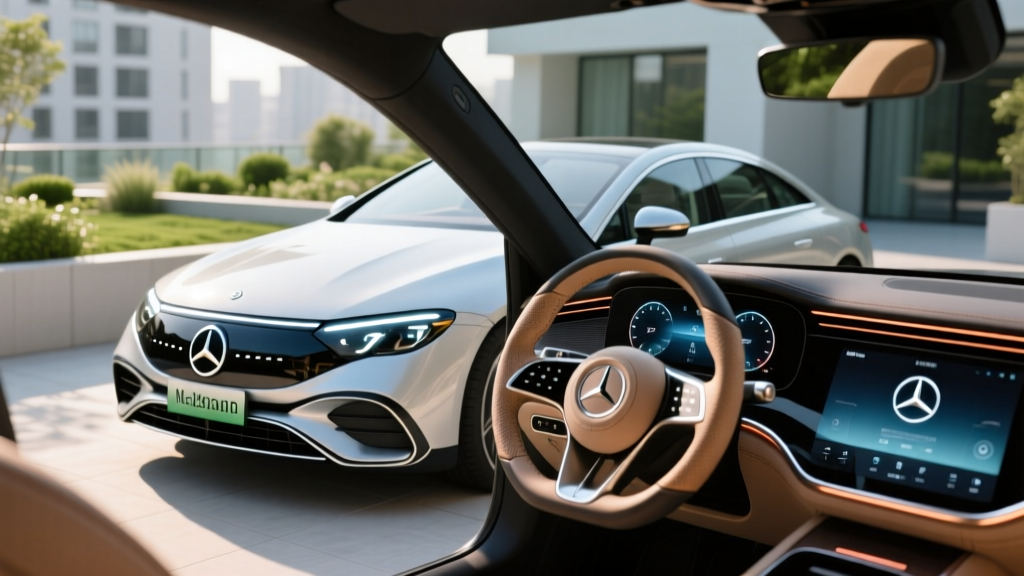
The EQE's cabin is a showcase for Mercedes' latest design language: a sweeping MBUX Hyperscreen (12.3-inch cluster + 17.7-inch center OLED + 12.3-inch passenger display) dominates the dash. Build quality is excellent — soft-touch materials, real wood or aluminum trim, and available Nappa leather throughout.
The Marana interior appointment is a premium leather package offered on Exclusive and Pinnacle trim levels. It includes Marana-branded Nappa leather upholstery (available in Black, Macchiato Beige/Tonka Brown, or Neva Grey/Sable Brown), diamond-stitched seat inserts, heated and ventilated front seats with multicontour massage, and a heated steering wheel. It's a $3,200–$3,800 option depending on trim, and it transforms the cabin into something that genuinely competes with the S-Class in perceived luxury.
Dimensions and practicality:
- Front legroom: 42.5 inches
- Rear legroom: 36.9 inches
- Rear headroom: 37.1 inches (compromised by the fastback roof — taller passengers will notice)
- Trunk volume: 15.0 cu ft (no frunk — the EQE's under-hood space houses HVAC and electronics)
- Towing capacity: Not rated for towing
The 15-cubic-foot trunk is modest for a midsize luxury sedan. The BMW i5 offers 17.3 cu ft and the Tesla Model S provides 28 cu ft (including its front trunk). If cargo versatility matters, the EQE SUV variant offers 52 cu ft with seats folded.
Tech, Driver Assistance & SAE Level 2 Limits
The EQE comes equipped with Mercedes-Benz Driver Assistance Package Plus, which includes:
- Active Distance Assist DISTRONIC: Adaptive cruise with stop-and-go and route-based speed adaptation
- Active Steering Assist: Lane-centering on highways (hands-on-wheel required)
- Active Lane Change Assist: Semi-automatic lane changes when turn signal is engaged
- PRE-SAFE Plus: Rear-collision preparation and automatic braking
All EQE driver-assist features are SAE Level 2: the driver must remain fully engaged, monitor the road, and keep hands on the steering wheel. Mercedes does not currently offer a hands-free Level 3 system on the US-market EQE (Drive Pilot, its Level 3 system, is available in Germany on the S-Class and EQS under limited conditions). Do not confuse Active Steering Assist with autonomous driving — per SAE International definitions, the human driver is responsible at all times.
The MBUX infotainment system is responsive and feature-rich, with wireless Apple CarPlay and Android Auto, over-the-air updates, and the "Hey Mercedes" voice assistant. However, the Hyperscreen's reliance on touch controls for climate and seat functions (buried in submenus) draws legitimate criticism — physical knobs would improve usability at speed.
Pricing, Tax Credit & Ownership Costs
For 2026, the EQE sedan lineup starts at $76,050 (including destination) for the EQE 350+ with the Premium trim. Adding the Exclusive trim ($3,000) or Pinnacle trim ($5,800) unlocks the Marana interior option and additional luxury features.
| Trim | MSRP | With Marana Pkg (est.) | §30D Credit Eligible? |
|---|---|---|---|
| EQE 350+ Premium | $76,050 | — | No (MSRP cap $55k for sedans) |
| EQE 350+ Exclusive | $79,050 | ~$82,850 | No |
| EQE 350+ Pinnacle | $81,850 | ~$85,650 | No |
| EQE 350 4MATIC Pinnacle | $85,350 | ~$89,150 | No |
The EQE sedan does not qualify for the IRS §30D federal EV tax credit. Under current rules, the credit's MSRP cap for sedans is $55,000 (SUVs/wagons/vans have an $80,000 cap). Every EQE sedan trim exceeds $55,000. Additionally, buyer income caps apply ($150k single / $300k joint AGI), and battery critical-mineral and component sourcing requirements must be met. Even if the EQE met the MSRP threshold, its battery sourcing would likely disqualify it under current IRS guidance. Always consult a tax professional for your specific situation.
Lease loophole: Under the commercial clean vehicle credit (§45W), lessors may claim a $7,500 credit on leased EVs regardless of MSRP caps or sourcing rules. Some Mercedes dealers pass this savings through as a lease incentive. Ask your dealer whether a lease deal reflects this credit.
Warranty coverage:
- New vehicle: 4 years / 50,000 miles
- Battery (high-voltage): 8 years / 100,000 miles (capacity retention guaranteed above 70%)
- Powertrain: 4 years / 50,000 miles
- Complimentary maintenance: None (unlike BMW and Hyundai)
EQE vs. Competitors: BMW i5, Tesla Model S, Lucid Air
The EQE's competitive set depends on what you value:
- BMW i5 eDrive40 ($71,175): More cargo space (17.3 cu ft), slightly quicker DC charging (peak 205 kW), similar range (295 mi EPA). Less opulent interior, sharper driving dynamics. Better if you want a sportier sedan with more trunk room.
- Tesla Model S Long Range ($79,990): 402 miles EPA range, 250 kW Supercharging, massive frunk+trunk. Interior quality and ride comfort don't match Mercedes. Better if range and charging speed are top priorities.
- Lucid Air Pure ($71,490): 419 miles EPA, 300+ kW DC charging capability, spacious interior. Newer brand with fewer service centers. Better if you want maximum range and efficiency in a luxury package.
- Cabin silence and ride comfort are your top priorities
- You value Mercedes build quality, dealer network, and brand cachet
- Your daily commute is under 200 miles with home charging
- You want the Marana luxury interior appointment
- You need maximum range (Lucid Air, Tesla Model S)
- Cargo versatility matters (BMW i5, EQE SUV)
- Fastest DC charging is critical for frequent road trips (Hyundai Ioniq 6, Lucid Air)
- Federal tax credit eligibility is a dealbreaker (most luxury sedans above $55k don't qualify)
Pros and Cons
Pros
- Exceptionally quiet, comfortable cabin — best-in-class NVH
- Genuine 250+ mile real-world highway range
- MBUX Hyperscreen is visually stunning and feature-rich
- Rear-axle steering dramatically improves maneuverability
- AIRMATIC suspension delivers S-Class-level ride quality
- Strong dealer/service network vs. newer EV brands
Cons
- No federal tax credit (MSRP exceeds $55k sedan cap)
- 170 kW peak DC charging lags 800V competitors
- 15 cu ft trunk and no frunk — limited cargo versatility
- Fastback roofline compromises rear headroom for tall passengers
- Touch-heavy climate/seat controls buried in MBUX menus
- No complimentary scheduled maintenance program
Frequently Asked Questions
What is the real-world range of the Mercedes-Benz EQE 350+?
The EPA rates the EQE 350+ at 308 miles combined. In real-world highway driving at 70–75 mph in moderate temperatures, expect 255–275 miles. In cold weather (below freezing), plan for 210–235 miles due to battery resistance and cabin heating demands. City driving with regenerative braking can approach or match the EPA figure.
How fast does the EQE charge at home and on DC fast chargers?
On a Level 2 home charger at 9.6 kW, the EQE adds roughly 28 miles per hour and fully charges in about 9.5 hours. On a DC fast charger, it peaks at 170 kW, reaching 10–80% in approximately 32 minutes. Above 80% SoC, charging slows significantly — a 10–90% session takes closer to 45 minutes.
Does the Mercedes-Benz EQE qualify for the $7,500 federal EV tax credit?
No. Under IRS §30D rules, the federal EV tax credit for new sedans is capped at vehicles with an MSRP of $55,000 or less. Every EQE sedan trim starts above $76,000, making it ineligible. However, leasing through a Mercedes dealer may allow the lessor to claim the commercial credit and pass savings through as a lease incentive.
Is the EQE worth buying over the BMW i5 or Tesla Model S?
If cabin luxury, ride comfort, and brand prestige are your top priorities, the EQE is the strongest choice in this segment. If you prioritize range (Tesla Model S: 402 mi EPA), charging speed (Lucid Air: 300+ kW), or cargo space (BMW i5: 17.3 cu ft), competitors offer tangible advantages. Test-drive all three before deciding.
What is the Marana interior package on the EQE?
The Marana appointment is a premium Nappa leather interior package available on Exclusive and Pinnacle trims. It includes diamond-stitched leather seats, multicontour heated/ventilated front seats with massage, and a heated steering wheel. It adds approximately $3,200–$3,800 to the vehicle price and significantly elevates the cabin's luxury feel.
How long will the EQE battery last, and what does replacement cost?
Mercedes warranties the high-voltage battery for 8 years / 100,000 miles, guaranteeing it retains at least 70% of original capacity. Based on NMC degradation data from similar Mercedes packs (EQS, EQC), expect roughly 8–12% degradation over 100,000 miles with normal use. A full battery replacement, if needed out of warranty, is estimated at $18,000–$25,000 based on current Mercedes parts pricing — though individual module replacement may be possible at lower cost.