Why Rivian Lease Costs Are the Top Question for 2026 EV Buyers
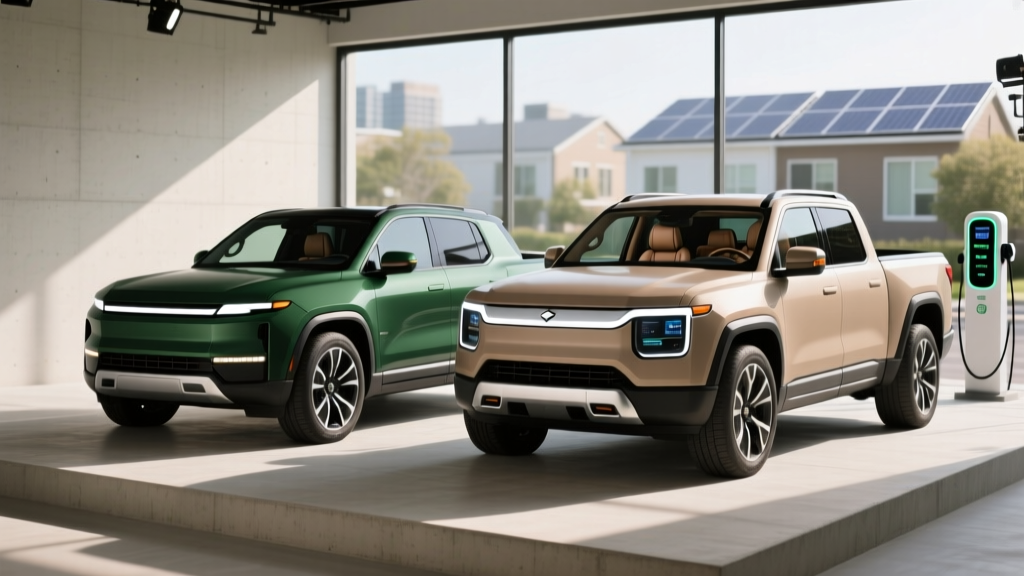
Rivian's second-generation R1S SUV and R1T pickup entered 2026 with a refreshed Tri-Motor powertrain, a new Standard battery option, and pricing that pushes the brand further downmarket. But for most shoppers, the sticker price is only half the equation. The real question is: what does a Rivian lease actually cost per month, and how do federal tax credits, residual values, and trim selection change that number?
This review breaks down the 2026 Rivian R1S and R1T lineup — range, charging, performance, cargo, warranty, and most importantly, lease economics — so you can decide whether leasing or buying makes more financial sense in the current incentive landscape.
2026 Rivian R1S & R1T: Spec Table at a Glance
| Spec | R1 Dual-Motor (Standard Battery) | R1 Dual-Motor (Max Battery) | R1 Tri-Motor (Max Battery) |
|---|---|---|---|
| EPA Range (R1S) | 270 mi | 410 mi | 390 mi |
| EPA Range (R1T) | 270 mi | 420 mi | 390 mi |
| Battery (usable) | 92 kWh (LFP) | 141 kWh (NMC) | 141 kWh (NMC) |
| Horsepower | 533 hp | 533 hp | 850 hp |
| 0–60 mph | 4.5 sec | 4.5 sec | 2.9 sec |
| Drivetrain | AWD (dual-motor) | AWD (dual-motor) | AWD (tri-motor) |
| Max DC Fast Charge | 200 kW | 220 kW | 220 kW |
| 10–80% DC Time | ~28 min | ~42 min | ~42 min |
| Level 2 Home Charge | 11.5 kW (~25 mi/hr) | 11.5 kW (~25 mi/hr) | 11.5 kW (~25 mi/hr) |
| Efficiency (R1S) | 73 MPGe / 46 kWh/100mi | 69 MPGe / 49 kWh/100mi | 63 MPGe / 53 kWh/100mi |
| Towing Capacity | 7,700 lb (R1T) | 7,700 lb (R1T) | 7,700 lb (R1T) |
| Base MSRP (R1S) | $75,900 | $85,900 | $99,900 |
| Base MSRP (R1T) | $69,900 | $79,900 | $93,900 |
| Battery/Powertrain Warranty | 8 yr / 100,000 mi | 8 yr / 100,000 mi | 8 yr / 100,000 mi |
Source: Rivian R1S and Rivian R1T official spec pages, 2026 model year.
Rivian Lease Cost: What You'll Actually Pay Monthly
Rivian offers leasing through its captive finance arm, and monthly payments in 2026 vary dramatically depending on trim, battery pack, and whether you apply the federal EV tax credit at the point of sale. Here's a representative breakdown based on current advertised lease structures for a 36-month / 10,000-mile-per-year term with $7,500 due at signing (which can include the §30D point-of-sale credit transfer):
| Model & Trim | MSRP | After $7,500 Credit | Est. Monthly Payment |
|---|---|---|---|
| R1T Dual-Motor Standard | $69,900 | $62,400 | $749–$829 |
| R1S Dual-Motor Standard | $75,900 | $68,400 | $819–$899 |
| R1T Dual-Motor Max | $79,900 | $72,400 | $899–$979 |
| R1S Tri-Motor Max | $99,900 | $92,400 | $1,149–$1,279 |
Key variables that shift these numbers:
- Residual value: Rivian residuals have improved as the brand matures, but EV depreciation remains steeper than Toyota or Honda benchmarks. Expect 48–54% residuals at 36 months for Dual-Motor trims.
- Money factor: Rivian's captive lease rates hover around 0.00210–0.00250 (equivalent to roughly 5.0–6.0% APR), which is competitive but not subsidized like some legacy automaker deals.
- Point-of-sale credit transfer: Under current IRS §30D rules, you can transfer the $7,500 federal credit to the dealer at signing, reducing your capitalized cost directly — this is the most impactful lever on your monthly payment.
- State incentives: States like California, Colorado, and Massachusetts offer additional rebates ($1,000–$7,500) that further reduce the cap cost if applied at signing.
- ✅ Vehicle MSRP must not exceed $80,000 for SUVs/pickups (R1S Standard and R1T Standard qualify; Max Battery and Tri-Motor trims exceed the cap)
- ✅ Buyer AGI must not exceed $150,000 (single) / $300,000 (joint)
- ✅ Battery must meet critical-mineral and component sourcing thresholds (Rivian confirms 2026 Standard Battery qualifies; Max Battery eligibility varies by build month — verify at fueleconomy.gov)
- ✅ Credit can be transferred to dealer at point of sale to reduce purchase/lease cap cost
- ⚠️ Consult a tax professional — eligibility depends on your individual tax situation
Real-World Range: EPA Sticker vs. What You'll Actually Get
EPA (R1T Dual-Motor Max): 420 miles
Real-world highway (70 mph, 75°F): ~340–360 miles
Real-world highway (30°F, winter): ~280–310 miles
Real-world towing (5,000 lb trailer): ~190–220 miles
The 420-mile EPA figure on the R1T Dual-Motor Max is genuinely impressive — it's among the longest EPA-rated ranges of any production EV sold in the U.S. But the physics of a 7,100-pound aerodynamic brick mean real-world efficiency drops sharply at highway speeds and in cold weather.
In our experience and consistent with third-party testing data, expect to lose roughly 15–18% on sustained highway driving at 70–75 mph compared to the EPA combined cycle. In freezing temperatures, that loss extends to 25–33% due to cabin heating demands and reduced battery chemistry efficiency — even with Rivian's standard heat pump, which helps but doesn't eliminate the cold-weather penalty.
The Standard Battery (92 kWh LFP) delivers an EPA-estimated 270 miles. Real-world highway driving nets roughly 220–235 miles in mild weather, dropping to ~185–200 miles in deep winter. For daily commuting under 80 miles round-trip, this is more than adequate and charges faster due to the smaller pack.
Charging Speed: DC Fast Charge and Home Level 2
| Charging Method | Power / Rate | Time or Miles Added |
|---|---|---|
| Level 1 (120V household) | ~1.4 kW | ~3–4 mi/hr |
| Level 2 (240V, 48A home) | 11.5 kW | ~25 mi/hr (full charge in ~12–13 hr for Max) |
| DC Fast Charge (Standard Battery) | 200 kW peak | 10–80% in ~28 min |
| DC Fast Charge (Max Battery) | 220 kW peak | 10–80% in ~42 min |
| NACS / Tesla Supercharger | Native NACS port (2026 models) | Full Supercharger network access |
For 2026, Rivian equips all R1 vehicles with a native NACS (North American Charging Standard) port, granting direct access to Tesla's Supercharger network — currently the most reliable DC fast-charging infrastructure in the country. No adapter required.
The charging curve matters more than the peak number. The Max Battery pack peaks at 220 kW but sustains roughly 180–190 kW up to about 40% State of Charge (SoC), then tapers progressively. From 80–100%, charging slows dramatically to protect battery health — expect the final 20% to take as long as the 10–80% session. For road trips, the practical strategy is to charge from 10–80% and move on.
At home, a 48-amp Level 2 wall connector on a 60-amp circuit delivers 11.5 kW — enough to fully replenish the Standard Battery overnight (~8 hours) and add roughly 200+ miles to the Max Battery in a typical 8-hour overnight session. Installation costs for a home Level 2 setup typically run $800–$2,200 depending on panel capacity and conduit distance. If your home has a 200-amp electrical panel, you're likely set; older 100-amp panels may require a $1,500–$3,000 upgrade.
Performance, Cargo, and Tech: What You Get for the Money
The Dual-Motor powertrain delivers 533 hp and a 4.5-second 0–60 time — brisk for a vehicle this size. The Tri-Motor's 850 hp and 2.9-second sprint are supercar territory in a three-row SUV or pickup. All trims feature Rivian's quad-motor-ready architecture, with torque vectoring that makes the R1 feel planted on twisty roads despite its mass.
Cargo and passenger space (R1S):
- Behind 3rd row: 10.6 cu ft
- Behind 2nd row (3rd folded): 46.7 cu ft
- Max (all rear seats folded): 104.7 cu ft
- Front trunk (frunk): 11.0 cu ft
- 2nd-row legroom: 38.5 in
- 3rd-row legroom: 30.2 in (best for children on longer trips)
Cargo (R1T):
- Bed length: 4.5 ft (standard) with Gear Tunnel offering 11.7 cu ft of lockable, pass-through storage unique to Rivian
- Frunk: 11.0 cu ft
- Bed payload: ~1,760 lb
Tech and driver assists: The R1 runs Rivian's in-house software on a 15.6-inch center touchscreen with over-the-air updates. The Driver+ package includes adaptive cruise control with lane centering — this is a SAE Level 2 driver-assistance system, meaning the driver must remain fully engaged with hands on the wheel and eyes on the road. It is not autonomous driving. Features include:
- Highway assist (lane centering + adaptive cruise)
- Automatic emergency braking with pedestrian detection
- 360-degree camera system
- Automatic high beams and blind-spot monitoring
- Phone-as-a-key with NFC backup card
Notable drawbacks: The R1S third row is tight for adults on trips over 30 minutes. The R1T bed is shorter than full-size pickups (4.5 ft vs. the Ford F-150 Lightning's 5.5 ft). Rivian's service center network, while expanding, still has gaps in the Mountain West and rural Southeast — plan accordingly if you live outside a major metro.
Pros and Cons: The Honest Assessment
- Class-leading EPA range on Max Battery (420 mi R1T)
- Native NACS port — no adapter for Superchargers
- Gear Tunnel (R1T) is a genuinely unique utility feature
- Strong off-road capability with 14.9 in ground clearance
- 8-year/100,000-mile battery warranty
- Tri-Motor performance is staggering
- Max Battery and Tri-Motor trims exceed the $80K §30D MSRP cap
- Real-world range drops 25–33% in freezing weather
- R1S third row is cramped for adults
- R1T bed is shorter than competitors
- Service center coverage still limited in some regions
- Lease money factors not subsidized — no cheap "loss-leader" deals
Rivian vs. Competitors: Is Leasing an R1 Worth It?
The Rivian R1S competes most directly with the Kia EV9 (lower price, shorter range, 3-row), Tesla Model X (similar price, Supercharger native, aging platform), and the Cadillac Escalade IQ (luxury pricing, massive battery). The R1T's only true electric pickup rival remains the Ford F-150 Lightning, which trades range and tech for a lower entry price and a full-size bed.
Lease the R1T or R1S if:
- You want the longest-range electric pickup/SUV available and value NACS Supercharger access
- You plan to keep the vehicle 2–3 years and want to avoid long-term depreciation risk
- You qualify for the §30D credit and can apply it at signing to reduce monthly payments
- You need genuine off-road capability with ground clearance and wading depth no crossover can match
Look elsewhere if:
- Your budget caps below $65,000 — consider the F-150 Lightning Pro or Kia EV9 instead
- You need a full-size truck bed for work — the R1T's 4.5-foot bed is a lifestyle feature, not a work-site solution
- You live in a region with no Rivian service center within 100 miles
Frequently Asked Questions
What is the cheapest way to lease a Rivian in 2026?
The R1T Dual-Motor with Standard Battery at $69,900 MSRP is the entry point. If you qualify for the full $7,500 §30D credit (income under $150K single / $300K joint, and the vehicle meets battery-sourcing requirements), applying it at point of sale reduces the cap cost to ~$62,400, bringing monthly payments to roughly $749–$829 on a 36-month lease.
Does the Rivian R1 Tri-Motor qualify for the federal EV tax credit?
No. The Tri-Motor R1S at $99,900 and R1T at $93,900 both exceed the IRS §30D MSRP cap of $80,000 for SUVs, vans, and pickups. The Dual-Motor Standard Battery trims fall under the cap and are eligible, provided the buyer meets income requirements and the battery meets sourcing thresholds. Always verify current eligibility at fueleconomy.gov before signing.
How much does it cost to charge a Rivian at home per month?
Assuming 1,000 miles/month driven and the national average electricity rate of ~$0.16/kWh, the Dual-Motor Max (49 kWh/100mi) costs roughly $78/month to charge at home. The Standard Battery (46 kWh/100mi) is about $74/month. Compare that to a gas truck averaging 18 MPG at $3.40/gallon — roughly $189/month in fuel.
Is Rivian's battery warranty competitive?
Rivian covers the battery and drivetrain for 8 years or 100,000 miles, whichever comes first, with a capacity retention threshold of 70%. This matches the industry standard set by Tesla, Hyundai, and Ford. Rivian's LFP Standard Battery chemistry is expected to degrade more slowly than NMC over the same cycle count, which is an advantage for long-term ownership.
Can I take a Rivian on a road trip?
Yes — the 420-mile Max Battery range and native NACS Supercharger access make the R1 one of the most road-trip-capable EVs available. Plan charging stops around the 10–80% sweet spot (~42 minutes on a 220 kW DC charger), and precondition the battery via the navigation system for optimal charge speeds.