Quick Verdict: The Default EV for a Reason — but Insurance and Tariffs Change the Math
The 2026 Tesla Model Y (Juniper refresh) remains the best-selling electric vehicle in the United States for good reason: a usable 320+ mile EPA range, access to the largest DC fast-charging network, OTA updates that keep adding features, and a cabin that finally feels finished. But the buying calculus in 2026 is different than it was in 2023. Tariff-driven price increases, the phase-down of the §30D federal credit, and persistently high insurance premiums — particularly with carriers like Lemonade that have pulled back from certain Tesla-heavy ZIP codes — mean the sticker price is only the opening move. This review runs the full ownership equation: range, charging curve, real-world efficiency, and the insurance-and-credit math buyers actually need.
Range, Battery, and Real-World Efficiency
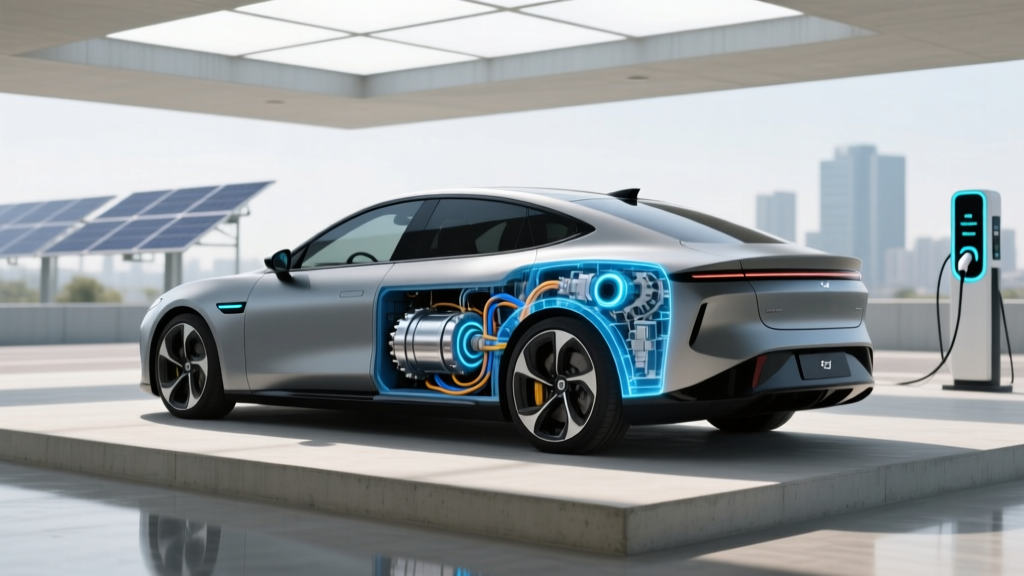
The 2026 Model Y Long Range AWD pairs a ~78 kWh usable NMC (nickel-manganese-cobalt) pack with a permanent-magnet rear motor and induction front motor. The base Rear-Wheel-Drive trim uses a smaller ~60 kWh LFP (lithium iron phosphate) pack from CATL — heavier, slightly lower energy density, but rated for more charge cycles and tolerant of daily 100% charging.
- Long Range AWD: EPA 320 mi — expect ~275-290 mi highway at 70 mph; ~220-240 mi in sub-30°F weather with cabin heat.
- Rear-Wheel-Drive (LFP): EPA 260 mi — expect ~225-240 mi highway; ~180-200 mi cold-weather.
- Performance AWD: EPA 295 mi — expect ~250-265 mi highway.
Cold-weather range loss is real but manageable with preconditioning and the standard heat pump.
Efficiency on the Long Range is rated at 117 MPGe combined, or roughly 29 kWh/100 mi — competitive with the Hyundai Ioniq 5 and slightly better than the Ford Mustang Mach-E Extended Range. LFP RWD runs closer to 31 kWh/100 mi due to pack weight.
Charging: DC Fast, Level 2, and the Supercharger Advantage
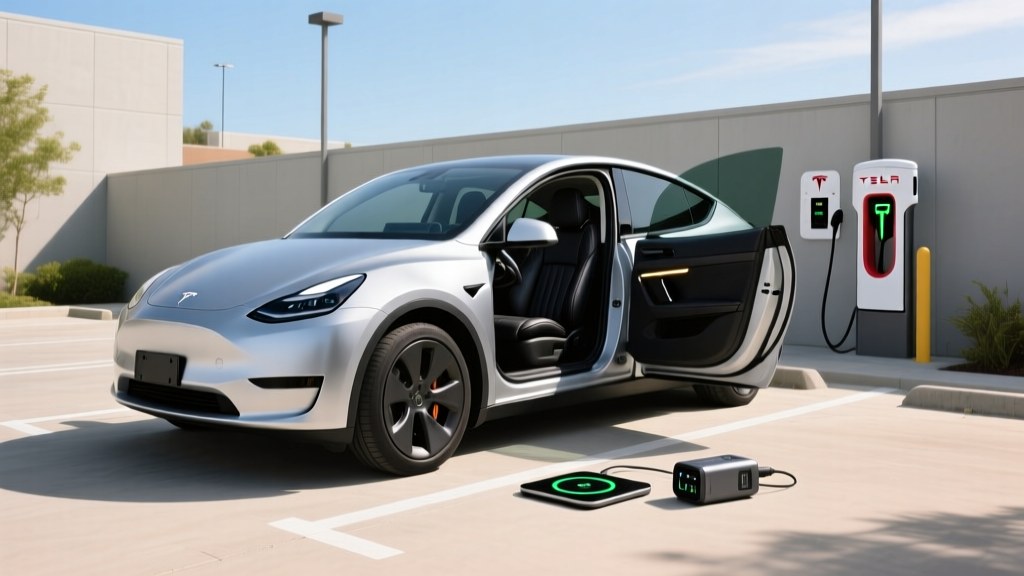
The Juniper Model Y uses the native NACS connector (no adapter needed at Tesla Superchargers) and ships with a CCS adapter for Electrify America, EVgo, and other networks. Peak DC charge rate on the Long Range is 250 kW; the LFP RWD peaks around 170 kW.
| Charging Level | Power | Speed | Notes |
|---|---|---|---|
| Level 1 (120V) | 1.4 kW | ~4 mi/hr | Emergency/trickle only |
| Level 2 (240V / 48A) | 11.5 kW | ~37 mi/hr | Home Wall Connector, ~8.5 hr 10-100% LR |
| DC Fast (V3 Supercharger) | 250 kW peak | 10-80% in ~25 min | Tapers hard above 80% SoC |
| DC Fast (CCS adapter) | ~150-200 kW typical | 10-80% in ~30-35 min | Depends on EA/Ionity station |
Important caveat on the charge curve: the 250 kW peak is sustained only between roughly 10-40% SoC. From 60-80%, the Long Rate drops to ~80-100 kW, which is why 10-80% takes 25 minutes while 10-90% takes closer to 40. Plan road-trip stops around 80% and move on.
Performance and Drivetrain
The Long Range AWD puts down 384 hp and 360 lb-ft of torque, running 0-60 mph in 4.8 seconds. The RWD is a more sedate 295 hp and 6.5 seconds. The Performance variant (when available) bumps output to ~455 hp and 3.5 seconds, with adaptive dampers and a track-oriented drive mode. All trims have a governed top speed between 125-135 mph and use Tesla's regenerative braking system with one-pedal driving — though the stop-hold behavior requires a brief adaptation period for drivers coming from blended-regen EVs.
Pricing, Trim Levels, and the §30D Tax Credit Math
2026 MSRP has climbed due to tariff pressure on imported battery cells and Chinese-sourced components. Pricing below reflects early-2026 configurator figures; always confirm at purchase.
| Trim | MSRP (incl. destination) | §30D Credit Eligibility | Effective Price |
|---|---|---|---|
| Rear-Wheel-Drive (LFP) | $44,990 | Partial — $3,750 (critical minerals only) | ~$41,240 |
| Long Range AWD | $49,990 | Partial — $3,750 | ~$46,240 |
| Long Range AWD (loaded) | $56,490 | Partial — $3,750 | ~$52,740 |
| Performance | $55,490 | Partial — $3,750 | ~$51,740 |
Critical credit caveats (IRS §30D, 2026 rules):
- Tesla's LFP cells are CATL-sourced (China), so most trims qualify for only the $3,750 critical-minerals half of the credit; the battery-component half is blocked by FEOC rules.
- Buyer AGI caps apply: $150k single / $225k HOH / $300k MFJ.
- MSRP cap: $55,000 for SUVs (Model Y qualifies as an SUV per IRS VIN classification).
- Point-of-sale transfer is available — the dealer applies the credit at purchase rather than on your tax return.
- Always confirm current rules at IRS.gov clean vehicle credits.
Insurance Reality: Why "Lemonade Car Insurance Tesla" Searches Are Spiking
Insurance is the hidden ownership cost Tesla buyers underestimate. According to 2025-2026 industry data, the average annual premium for a Model Y Long Range is $2,800-$3,600 nationally — roughly 60-80% higher than a comparable RAV4 Hybrid. Three structural reasons explain the gap:
- Repair cost: Tesla's unibody casting ("gigacast" rear structure) means minor rear collisions often total the vehicle rather than allow panel replacement.
- Parts monopoly: OEM body panels and ADAS sensor recalibration flow through Tesla's closed network.
- High-performance driver profile: Instant torque and low 0-60 times correlate with higher severity claims in actuarial models.
The search trend around Lemonade car insurance for Tesla reflects a specific market shift: Lemonade, which markets heavily to tech-forward EV owners, has been adjusting its Tesla underwriting by state. In California, Florida, and Texas, policyholders have reported non-renewals or steep premium hikes at renewal in 2025-2026, pushing those drivers to shop Tesla-specific carriers (Tesla's own insurance product, where available, plus Root, Progressive, and GEICO's EV tiers). If you're budgeting for a Model Y, run three quotes before signing the purchase agreement — the spread between cheapest and most expensive carrier is routinely $1,500+/year for the same driver.
Tesla's own insurance product (real-time driving-score based) remains competitive in AZ, CA, CO, IL, MD, MN, NV, OH, OR, TX, UT, VA, and WI — typically 10-25% below the market average for drivers with Safety Scores above 90. Below 80, it can be more expensive than Lemonade or Progressive.
Interior, Cargo, and Tech
The Juniper refresh finally addressed the two loudest complaints about the pre-2025 Model Y: cabin noise and rear-seat comfort. Acoustic glass is now standard across all trims, and the rear seat gains ventilation, a small touchscreen for climate/media, and a slightly reclined backrest angle. Cargo volume remains class-leading for the segment: 30.2 cu ft behind the second row, 72.1 cu ft folded, plus a 4.1 cu ft front trunk (frunk).
Tech highlights:
- 15.4-inch center touchscreen running the latest Tesla OS with native Apple CarPlay-style phone integration (still no wireless CarPlay/Android Auto).
- Autopilot standard (SAE Level 2 — driver supervision required); FSD (Supervised) is a $99/mo subscription or $8,000 one-time purchase.
- Ambient lighting, ventilated front seats, and a panoramic glass roof with improved IR-rejection coating.
Notable drawbacks: no physical buttons for wipers or glovebox (all screen-mediated), turn-signal stalks have been replaced by steering-wheel buttons (polarizing), and the rear touchscreen is small and laggy compared to the main display.
Warranty and Long-Term Ownership
Tesla's warranty is segment-typical:
- Basic vehicle: 4 years / 50,000 miles
- Battery & drive unit (Long Range/Performance): 8 years / 120,000 miles, with a 70% capacity retention threshold
- Battery & drive unit (RWD LFP): 8 years / 100,000 miles, 70% retention
The LFP pack's higher cycle-life tolerance means most RWD owners will see 8-12% degradation over 100k miles versus 10-15% on NMC — a meaningful difference for second-owner resale value. Out-of-warranty pack replacement runs $13,000-$18,000 at Tesla Service Centers, though third-party refurbishers are increasingly offering $8,000-$11,000 swaps.
Who the 2026 Model Y Suits Best
Buy the Model Y Long Range if: you need a two-row family hauler with road-trip charging infrastructure, value OTA feature updates, and live in a state where Tesla Insurance or a competitive carrier keeps premiums under $3,000/yr.
Buy the RWD (LFP) if: your commute is under 60 miles round-trip, you charge at home nightly, and you want lower entry price plus a battery chemistry that tolerates daily 100% charging.
Look elsewhere (Ioniq 5, Mach-E, EV6) if: you need physical buttons, want a dealer service network within 20 miles, or live in a state with limited Tesla Insurance availability and high Lemonade/Progressive premiums for Teslas.
Frequently Asked Questions
What is the real-world range of the 2026 Tesla Model Y?
Long Range AWD delivers roughly 275-290 highway miles in mild weather and 220-240 in sub-freezing conditions. RWD LFP runs 225-240 highway, 180-200 cold. Preconditioning to a Supercharger recovers 10-15 miles of that loss.
How fast does the Model Y charge on DC and at home?
Long Range peaks at 250 kW DC (10-80% in ~25 minutes on a V3 Supercharger). Home Level 2 at 11.5 kW adds ~37 miles per hour — enough to refill overnight. RWD LFP peaks at ~170 kW DC.
Does the 2026 Model Y qualify for the full $7,500 federal tax credit?
No. Under current §30D rules, most trims qualify for $3,750 (critical-minerals half only) because CATL-sourced LFP cells and some NMC supply chain components trigger the FEOC battery-component exclusion. Buyer income and MSRP caps also apply — confirm at IRS.gov.
Is Lemonade car insurance good for a Tesla Model Y?
It depends heavily on your state and driving profile. Lemonade has pulled back from Tesla underwriting in some high-loss states (CA, FL, TX) as of 2025-2026, leading to non-renewals or steep hikes. Always run three quotes — including Tesla's own insurance product where available — before committing.
Is the Model Y still worth buying versus the Ioniq 5 or Mach-E?
For Supercharger access, cargo volume, and OTA updates, yes. For physical controls, dealer service proximity, and potentially lower insurance, the Ioniq 5 and Mach-E are strong alternatives. Test-drive all three with your specific insurance quote in hand.
What are the biggest pros and cons?
- Supercharger network access (native NACS)
- Class-leading cargo volume (30.2 / 72.1 cu ft)
- Improved cabin quietness (Juniper refresh)
- Strong OTA feature pipeline
- LFP option for daily 100% charging
- High insurance premiums ($2,800-$3,600/yr avg)
- Only partial §30D credit ($3,750)
- No physical buttons / stalks
- Tariff-driven MSRP increases
- Service center wait times in some metros
Sources: fueleconomy.gov, IRS §30D clean vehicle credits, Tesla Model Y configurator.