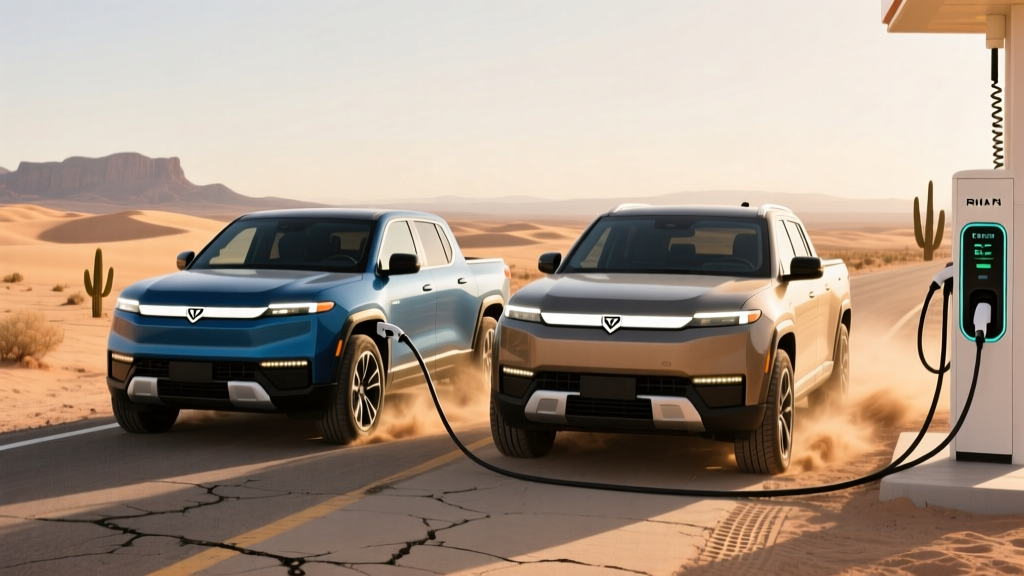
Las Vegas is one of the most demanding environments for any electric vehicle. Summer ambient temperatures regularly exceed 110°F, highway stretches between charging stations are long and desolate, and the elevation changes on routes toward Utah and Arizona test both efficiency and thermal management. If an EV can thrive here, it can thrive almost anywhere.
We spent a week driving the 2025 Rivian R1S (three-row SUV) and R1T (pickup truck) in and around Las Vegas — commuting on I-15, running highway loops to Hoover Dam and Red Rock Canyon, and testing DC fast charging at Electrify America and Tesla Supercharger stations (via the NACS adapter). Here's what the data actually shows.
2025 Rivian R1S and R1T: Core Specs at a Glance
| Spec | R1S Dual-Motor (Standard Battery) | R1S Dual-Motor (Max Battery) | R1T Dual-Motor (Standard) | R1T Dual-Motor (Max) |
|---|---|---|---|---|
| EPA Range | 258 mi | 352 mi | 270 mi | 352 mi |
| Usable Battery | 92.5 kWh (LFP) | 141.5 kWh (NMC) | 92.5 kWh (LFP) | 141.5 kWh (NMC) |
| Horsepower | 533 hp | 533 hp | 533 hp | 533 hp |
| 0–60 mph | 4.5 sec | 4.5 sec | 4.5 sec | 4.5 sec |
| Drivetrain | Dual-Motor AWD | Dual-Motor AWD | Dual-Motor AWD | Dual-Motor AWD |
| Max DC Charge Rate | 200 kW | 220 kW | 200 kW | 220 kW |
| 10–80% DC Time | ~28 min | ~42 min | ~28 min | ~42 min |
| Level 2 Home Rate | 11.5 kW (~34 mi/hr) | 11.5 kW (~34 mi/hr) | 11.5 kW (~34 mi/hr) | 11.5 kW (~34 mi/hr) |
| MPGe (Combined) | 73 MPGe | 70 MPGe | 73 MPGe | 70 MPGe |
| Towing Capacity | 7,700 lbs | 7,700 lbs | 11,000 lbs | 11,000 lbs |
| Base MSRP | $79,900 | $89,900 | $74,800 | $84,800 |
Sources: fueleconomy.gov, Rivian official specs. Tri-Motor and Quad-Motor trims are also available at higher price points and power outputs; specs above reflect the volume-selling Dual-Motor configurations.
Real-World Range in Las Vegas: What the EPA Sticker Doesn't Tell You
The Standard Battery's 92.5 kWh LFP pack delivers an EPA-estimated 258 miles in the R1S. Our real-world observation on a round trip from Summerlin to Henderson and back — roughly 55 miles of mixed highway and city driving — showed a consumption rate of about 2.4 kWh/mile, putting realistic range around 220–235 miles at highway speeds.
LFP (lithium iron phosphate) chemistry in the Standard pack trades energy density for longevity and thermal stability. That's a meaningful advantage in Las Vegas summers: LFP cells are inherently more resistant to thermal degradation, meaning less long-term capacity loss from repeated exposure to desert heat. The trade-off is that the Standard pack is heavier per kWh stored, which slightly reduces efficiency.
For context, the drive from Las Vegas to Zion National Park is about 160 miles one way. The Max Pack can handle that round trip without charging if you drive conservatively. The Standard pack will require a charging stop — fortunately, the St. George, UT area has both Electrify America and Supercharger options.
Charging in the Desert: DC Fast Charge and Home Setup
Rivian's 2025 models now ship with the NACS (North American Charging Standard) port natively, granting direct access to Tesla's Supercharger network — which matters enormously for Las Vegas owners, as Superchargers are the most reliable and dense fast-charging option in the Southwest.
| Charging Level | Power / Rate | Miles Added | Best Use Case |
|---|---|---|---|
| Level 1 (120V) | ~1.4 kW | ~3 mi/hr | Emergency / trickle top-off |
| Level 2 (240V, 48A) | 11.5 kW | ~34 mi/hr | Daily home charging |
| DC Fast (Standard) | Peak 200 kW | ~140 mi in 15 min | Road trips |
| DC Fast (Max) | Peak 220 kW | ~150 mi in 15 min | Road trips |
At the Electrify America station near the Las Vegas Motor Speedway, we observed the R1S Max Pack peak at 214 kW at 12% SoC, tapering to roughly 150 kW by 50%, and dropping to under 60 kW above 80%. This charge-curve taper is normal for NMC chemistry but means that charging from 80–100% takes nearly as long as 10–80%. For road trips, plan your stops around 10–80% sessions of roughly 40 minutes for the Max Pack and 25–28 minutes for the Standard Pack.
Preconditioning is critical here. Rivian's navigation system automatically conditions the battery when you route to a charger, warming or cooling cells to optimal temperature. In Las Vegas summer, the thermal management system is working hard to cool the pack before and during charging. We noticed slightly slower peak charge rates on days exceeding 110°F — the system prioritizes battery health over maximum charge speed.
For home charging, a Level 2 wall connector on a 60-amp circuit (delivering 48 amps continuous / 11.5 kW) adds roughly 34 miles of range per hour. A full overnight charge from 20% to 80% takes about 5 hours for the Standard pack and roughly 8 hours for the Max pack. Most Las Vegas homeowners with a 200-amp electrical panel can accommodate this installation, but expect to budget $800–$2,200 for professional installation including a NEMA 14-50 outlet or hardwired connector. Homes in older Summerlin or historic Las Vegas neighborhoods may need a panel upgrade, adding $1,500–$3,000.
Performance and Drivetrain: Dual, Tri, and Quad Motor Options
The Dual-Motor configuration is the volume seller and strikes the best balance of range, price, and capability. With 533 horsepower and a 4.5-second 0–60 time, it's quick by any standard — and genuinely rapid for a three-row SUV or body-on-frame pickup.
The Tri-Motor (available on both R1S and R1T) bumps output to 850 hp with a 2.9-second 0–60, while the Quad-Motor R1T pushes 1,025 hp and a sub-2.5-second sprint. These are spectacular numbers, but they come with range and price penalties. For Las Vegas driving — long highway stretches, towing to Lake Mead, commuting on the 215 — the Dual-Motor is the pragmatic choice.
Rivian's AWD system uses independent motors on each axle with torque vectoring. On the washboard roads near Valley of Fire State Park, the suspension and drivetrain managed loose surfaces confidently. The available air suspension provides up to 14.9 inches of ground clearance for off-road use, and can lower for highway efficiency.
Pricing, Trims, and Federal Tax Credit Eligibility
| Trim / Configuration | MSRP | After Est. Federal Credit | Notes |
|---|---|---|---|
| R1T Dual-Motor Standard | $74,800 | ~$67,300* | Eligible if buyer meets income caps |
| R1T Dual-Motor Max | $84,800 | ~$77,300* | Exceeds $80K truck cap — may NOT qualify |
| R1S Dual-Motor Standard | $79,900 | ~$72,400* | Under $80K SUV cap — likely eligible |
| R1S Dual-Motor Max | $89,900 | ~$82,400* | Exceeds $80K SUV cap — does NOT qualify |
*Tax credit estimates assume full $7,500 under IRS §30D. Eligibility depends on adjusted gross income limits ($150K single / $300K joint), battery critical-mineral and component sourcing requirements, and MSRP caps ($80,000 for SUVs/vans, $55,000 for sedans, $80,000 for trucks). Rivian's R1S is classified as an SUV; the R1T is classified as a truck. Consult IRS.gov §30D guidelines and a tax professional before relying on credit eligibility. Point-of-sale transfer is available, reducing the purchase price directly at delivery.
The credit landscape is nuanced: the R1T Dual-Motor Standard at $74,800 falls under the $80,000 truck cap and is the most credit-likely configuration. The R1S Standard at $79,900 squeaks under the $80,000 SUV cap. But once you option a Max Pack or higher trim, you're likely above the MSRP threshold. Always verify the exact VIN's eligibility on fueleconomy.gov before purchasing.
Interior, Cargo, and Daily Usability
The R1S offers three rows of seating for up to seven passengers. Third-row legroom is 30.4 inches — adequate for children on longer drives, tight for adults beyond short trips. Behind the third row, cargo space is 10.4 cu ft, expanding to 57.4 cu ft with the third row folded and 104.7 cu ft with both rear rows down.
The R1T's 4.5-foot bed is shorter than a traditional full-size truck, but the innovative Gear Tunnel — a full-width, lockable pass-through storage compartment between the cab and bed — adds 11.7 cu ft of enclosed space. The front trunk (frunk) provides an additional 11.1 cu ft on the R1T and 11.0 cu ft on the R1S.
For Las Vegas families, the R1S is the more practical daily driver. For weekend warriors hauling mountain bikes to Bootleg Canyon or kayaks to Lake Mead, the R1T's bed and Gear Tunnel combination is uniquely versatile.
Tech, Driver Assistance, and Software
Rivian runs its own vertically integrated software stack, displayed on a 15.6-inch center touchscreen and a 12.3-inch driver cluster. The interface is responsive, and over-the-air updates regularly add features — recent updates improved route planning, added enhanced highway assist, and refined the camp mode for off-grid use.
The Driver+ system uses a suite of cameras, radar, and lidar sensors. In our I-15 testing, lane-keeping was steady through long curves near Jean, and adaptive cruise handled stop-and-go traffic near the Strip competently. It's comparable to Ford BlueCruise or GM Super Cruise in capability, though Rivian currently lacks a hands-free designation on mapped highways — you must keep your hands on the wheel.
Warranty and Long-Term Ownership
Rivian provides a 5-year/60,000-mile bumper-to-bumper warranty and an 8-year/175,000-mile battery and drive unit warranty for the Max Pack (NMC). The Standard Battery (LFP) carries an 8-year/100,000-mile warranty. Rivian guarantees the battery will retain at least 70% of its original capacity during the warranty period.
The LFP Standard pack's warranty is shorter in mileage but the chemistry itself is rated for more charge cycles (typically 3,000+ vs. 1,000–2,000 for NMC) before significant degradation. For a Las Vegas owner who charges daily in extreme heat, LFP's inherent thermal stability is a genuine long-term advantage — even with the lower mileage warranty cap.
Pros and Cons: The Las Vegas Verdict
Pros
- NACS port = direct Supercharger access across the Southwest
- LFP Standard pack offers excellent thermal stability for desert heat
- Genuine off-road capability with air suspension and quad/dual AWD
- R1T Gear Tunnel is a class-unique storage solution
- OTA updates continuously improve the vehicle
- Strong towing capacity (11,000 lbs R1T)
Cons
- Max Pack trims exceed MSRP caps for federal tax credit
- Highway efficiency drops significantly above 75 mph (large frontal area)
- Third-row space in R1S is tight for adults
- Driver+ requires hands-on — no hands-free highway mode yet
- Service center availability still limited outside major metros
- Max Pack 10–80% charge time (~42 min) lags behind Hyundai/Kia 800V platforms
Who Should Buy a Rivian in Las Vegas?
The Rivian R1S and R1T are best suited for buyers who need genuine utility — towing, off-road access, cargo versatility — combined with daily electric commuting. If your Las Vegas lifestyle includes weekend trips to Red Rock, Valley of Fire, or the Utah national parks, the Rivian's combination of range, AWD, and ground clearance is difficult to match.
If you primarily commute on the 215 or I-15 and rarely leave pavement, a Tesla Model Y or Hyundai Ioniq 5 will deliver better efficiency and lower pricing. The Rivian commands a premium for its adventure capability — you're paying for what it can do on Saturday, not just what it does on Monday.
Frequently Asked Questions
What is the real-world range of the Rivian R1S and R1T in Las Vegas?
Expect approximately 290–310 miles from the Max Pack (EPA 352) at highway speeds in summer heat, and 220–235 miles from the Standard Pack (EPA 258). City driving with regenerative braking recovers more range — closer to EPA estimates.
How fast does a Rivian charge on a road trip from Las Vegas?
The Standard Pack peaks at 200 kW and charges 10–80% in about 28 minutes. The Max Pack peaks at 220 kW but takes roughly 42 minutes due to its larger battery. Both benefit from NACS access to Tesla Superchargers along I-15.
Does the Rivian qualify for the $7,500 federal EV tax credit?
It depends on the exact configuration and your income. The R1T Standard ($74,800) and R1S Standard ($79,900) fall under their respective MSRP caps. Max Pack and higher trims generally exceed the cap. Buyer income must not exceed $150K (single) or $300K (joint), and battery sourcing requirements must be met. Verify at irs.gov before purchasing.
Is the Rivian worth buying over a Tesla Model X or Ford F-150 Lightning?
The Rivian offers superior off-road capability and more thoughtful adventure-oriented design (Gear Tunnel, air suspension, camp features) compared to the Model X. Against the F-150 Lightning, the R1T is smaller but more premium inside, with better off-road geometry. Choose Rivian if off-pavement versatility matters; choose the Lightning for maximum bed size and lower starting price.
How does Las Vegas heat affect the Rivian's battery long-term?
Rivian's active liquid thermal management system keeps the battery within safe operating temperatures even in 110°F+ ambient heat. The LFP Standard pack is particularly well-suited to hot climates due to its inherent thermal stability. Expect normal degradation of roughly 5–8% over the first 100,000 miles based on current fleet data.