Rivian has carved out a unique position in the electric vehicle market by building adventure-ready trucks and SUVs that rival legacy automakers on capability while leaning hard into software-defined innovation. But for shoppers researching the brand, one question frequently surfaces early: where is Rivian based? The answer spans two states and tells you a lot about how this company engineers, assembles, and prices its vehicles.
Rivian's corporate headquarters sits in Irvine, California, while its sole production facility — the Rivian Normal Manufacturing Plant — operates in Normal, Illinois. This dual-state footprint influences everything from supply chain logistics to federal tax-credit eligibility under IRS §30D. Below, we break down the company's geographic footprint, then dive into the specs, pricing, and real-world ownership data you need to evaluate the current R1S SUV and R1T truck lineup.
Rivian's Two-State Footprint: Irvine HQ and the Normal Factory
Founded in 2009 by MIT graduate RJ Scaringe, Rivian established its headquarters in Irvine, California, a city in Orange County known for its concentration of tech and automotive engineering talent. The Irvine campus houses Rivian's executive leadership, vehicle design studios, software engineering teams, and autonomous-driving research division. This is where the R1 platform, the company's proprietary battery management systems, and the Driver+ ADAS suite are developed.
Manufacturing, however, happens 1,800 miles away. In 2017, Rivian purchased the former Mitsubishi Motors plant in Normal, Illinois, retrofitting it for EV production. The facility spans roughly 3.3 million square feet and handles stamping, body-in-white assembly, paint, battery pack integration, and final vehicle assembly. Every R1S and R1T — as well as Rivian's Amazon EDV commercial delivery vans — rolls off the line in Normal.
For buyers, the Illinois manufacturing base carries practical significance. Vehicles assembled in the United States with US-sourced battery components are more likely to satisfy the stringent domestic-content and critical-minerals requirements of the IRS §30D federal tax credit. Rivian's US-based assembly is a structural advantage over competitors relying on overseas production.
The Current Rivian Lineup: R1S and R1T at a Glance
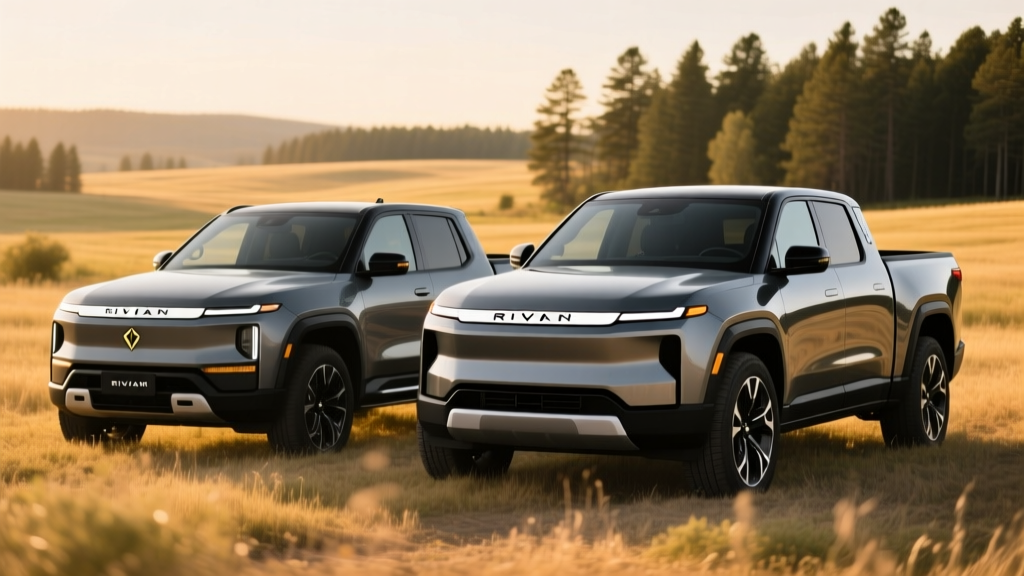
Rivian offers two consumer vehicles built on the same skateboard platform: the R1S three-row SUV and the R1T pickup truck. Both received a significant mid-cycle refresh for the 2025 model year (internally called "Gen 2"), which introduced a new electrical architecture, updated drive motors, and the addition of a Standard battery pack using LFP chemistry. Here are the core specifications for the current dual-motor configurations:
| Spec | R1S Dual-Motor (Standard) | R1T Dual-Motor (Standard) |
|---|---|---|
| EPA Range | 270 miles | 270 miles |
| Battery Capacity (usable) | ~92 kWh (LFP) | ~92 kWh (LFP) |
| Battery Chemistry | LFP (Lithium Iron Phosphate) | LFP (Lithium Iron Phosphate) |
| Drivetrain | Dual-Motor AWD | Dual-Motor AWD |
| Horsepower | 533 hp | 533 hp |
| 0–60 mph | 4.5 seconds | 4.5 seconds |
| Max DC Fast Charge | 200 kW (peak) | 200 kW (peak) |
| 10–80% DC Charge Time | ~30 minutes | ~30 minutes |
| Level 2 Home Charge Rate | 11.5 kW (~25 mi/hr) | 11.5 kW (~25 mi/hr) |
| MPGe (combined) | 73 MPGe | 73 MPGe |
| Efficiency | 46 kWh/100 mi | 46 kWh/100 mi |
| Towing Capacity | 7,700 lbs | 11,000 lbs |
| Starting MSRP | $75,900 | $69,900 |
Sources: EPA fueleconomy.gov, Rivian official specs.
Real-World Range: What the EPA Sticker Doesn't Tell You
Real-World Expectation: ~230–250 miles highway at 70 mph; ~180–200 miles in sub-freezing temperatures; ~200–220 miles while towing a 5,000-lb trailer.
The R1S and R1T are heavy, boxy vehicles with the aerodynamics of adventure gear, not teardrops. On highway loops at sustained 70–75 mph speeds, expect efficiency to drop to roughly 2.0–2.2 kWh/mile, which nets around 230–250 real-world miles on the Standard pack before you need to find a charger.
Cold weather compounds this. LFP chemistry, while excellent for cycle life and cost, is more sensitive to low temperatures than NMC. In testing below 30°F, range reduction of 25–35% is typical due to cabin heating demands and reduced battery discharge efficiency. Rivian's heat pump helps mitigate this, but physics still wins in deep winter.
The Max battery pack (NMC chemistry, ~141 kWh usable) extends the EPA figure to 352 miles for the R1S and 352 miles for the R1T, and real-world highway range stretches to roughly 300–320 miles in moderate weather. For road-trippers covering 300+ miles between charging stops, the Max pack is the pragmatic choice despite the $6,000 upcharge.
Charging Speed: DC Fast Charging and Home Level 2
Rivian's Gen 2 architecture brought meaningful charging improvements, though the vehicles still trail the fastest-charging competitors like the Hyundai Ioniq 5 or Lucid Air. Here is the charging breakdown:
| Charging Level | Power / Rate | Speed (Miles Added) | Notes |
|---|---|---|---|
| Level 1 (120V household) | ~1.4 kW | ~3 mi/hr | Emergency/trickle only |
| Level 2 (240V home) | 11.5 kW | ~25 mi/hr | Full charge in ~10 hrs (Standard) |
| DC Fast Charge | 200 kW peak | ~140 mi in 20 min | 10–80% in ~30 min; tapers above 80% |
The 200 kW peak DC fast-charge rate is competitive for the adventure-truck segment but not class-leading. The charge curve is relatively flat between 10–60% State of Charge, sustaining roughly 170–190 kW before tapering sharply above 80%. On a road trip, plan to charge from 10–80% in about 30 minutes at a reliable 150+ kW station — Electrify America, Tesla Superchargers (with Rivian's included NACS adapter), or EVgo.
At home, the onboard 11.5 kW charger is excellent. With a 48-amp Level 2 wall connector on a 60-amp circuit, you'll add roughly 25 miles of range per hour, easily replenishing a day's driving overnight. A full Standard pack charge from 10–100% takes about 10 hours; the Max pack requires closer to 14 hours.
Preconditioning matters. Rivian's navigation system will precondition the battery when a DC fast charger is set as your destination, warming the pack to optimal temperature for maximum charge acceptance. Skipping this step in cold weather can cut peak charge rates by 30–50%.
Pricing, Trims, and Federal Tax Credit Eligibility
Rivian simplified its trim structure for the current generation. Both the R1S and R1T are offered in three battery configurations (Standard, Large, Max) and two primary equipment tiers: Adventure and Ascend (the latter replacing the former Launch Edition as the premium package).
| Configuration | MSRP | Est. After §30D Credit |
|---|---|---|
| R1T Dual-Motor Standard (Adventure) | $69,900 | $62,400* |
| R1T Dual-Motor Large (Adventure) | $75,900 | $68,400* |
| R1T Dual-Motor Max (Adventure) | $81,900 | $74,400* |
| R1T Tri-Motor (Ascend) | $99,900 | $92,400* |
*Tax-credit-adjusted prices assume full $7,500 §30D credit eligibility. Actual eligibility depends on buyer income, battery sourcing, and MSRP caps. See IRS guidelines.
Does the Rivian R1T or R1S Qualify for the Federal EV Tax Credit?
This is where Rivian's US manufacturing base becomes directly relevant to your wallet. Under the current §30D rules:
- MSRP Cap: Vans, SUVs, and pickup trucks must have an MSRP at or below $80,000. This means the R1T Standard and Large packs qualify on price, while the Max pack and Tri-Motor configurations exceed the cap.
- Buyer Income Cap: Modified adjusted gross income must not exceed $300,000 (joint filers), $225,000 (head of household), or $150,000 (single).
- Battery Sourcing: A percentage of critical minerals and battery components must be sourced from the US or free-trade-agreement countries. Rivian's US assembly and evolving supply chain have positioned several configurations to meet these thresholds, but eligibility can shift quarterly as sourcing percentages update.
- Point-of-Sale Transfer: Eligible buyers can now transfer the credit to the dealer at purchase, reducing the out-of-pocket price immediately rather than waiting for a tax refund.
Bottom line: The R1T Dual-Motor Standard at $69,900 and the Large at $75,900 are the most credit-friendly configurations. Always verify current eligibility on the IRS website or with a tax professional before purchasing, as battery-sourcing compliance can change between model years.
Interior, Cargo, and Technology
The R1S seats up to seven passengers across three rows, though the third row is best suited for children or occasional use — legroom measures 28.7 inches in the third row versus a generous 41.3 inches in the second row. Behind the third row, cargo volume stands at 10.6 cubic feet; folding the third row opens up 46.7 cubic feet, and folding both rear rows yields a van-like 91.6 cubic feet.
The R1T offers a 54-inch bed with a unique Gear Tunnel — a 11.6-cubic-foot pass-through storage compartment between the cab and bed that's ideal for skis, fishing rods, or camping gear. Combined with the front trunk (frunk) at 11.0 cubic feet, the R1T offers creative cargo solutions no conventional truck matches.
Infotainment and Driver Assistance
Rivian runs its vehicles on a proprietary software stack displayed across a 15.6-inch center touchscreen and a 12.3-inch digital instrument cluster. The interface is fast, visually clean, and supports over-the-air updates that have meaningfully improved features post-purchase — a significant Gen 2 hardware upgrade added faster processors and improved camera resolution.
The Driver+ suite provides SAE Level 2 driver assistance including adaptive cruise control, lane-centering, and automatic lane changes on divided highways. It is not self-driving — you must keep your hands on the wheel and eyes on the road at all times. Driver+ is competent for highway cruising but does not match the geographic coverage or confidence of GM's Super Cruise or Ford's BlueCruise on mapped roads.
Pros, Cons, and the Competition
Pros
- US-built with strong §30D tax-credit eligibility on base trims
- Class-leading adventure capability: 11,000-lb towing (R1T), 14.9 inches ground clearance
- LFP Standard pack offers excellent cycle life and lower replacement cost
- Innovative storage (Gear Tunnel, frunk) unavailable on competitors
- Active OTA updates continually improve the vehicle post-purchase
- Strong build quality from the Normal, IL plant
Cons
- 200 kW peak DC charging trails Hyundai/Kia/Lucid benchmarks
- Real-world highway and cold-weather range drops significantly vs. EPA
- Max pack and Tri-Motor trims exceed $80K MSRP cap for tax credit
- No Apple CarPlay or Android Auto — Rivian's native system only
- Driver+ ADAS less refined than Super Cruise or BlueCruise
- Service center network still expanding in rural areas
How Does It Compare?
The R1T competes most directly with the Ford F-150 Lightning and the Chevrolet Silverado EV. The F-150 Lightning starts lower (~$55,000) and offers Pro Power Onboard for job-site use, but trails the R1T in ground clearance, approach/departure angles, and software sophistication. The Silverado EV offers a massive 400+ mile Max range option but is larger, heavier, and less agile off-road.
The R1S competes with the Tesla Model X, Kia EV9, and the upcoming electric Jeep Wagoneer S. The Model X offers faster charging and access to the Supercharger network natively (though Rivian now includes a NACS adapter), but the R1S wins on off-road capability, build quality perception, and towing. The EV9 is far more affordable (~$55,000 base) but smaller and less powerful.
Warranty and Long-Term Ownership
Rivian provides a competitive warranty package:
- Vehicle Limited Warranty: 5 years / 60,000 miles
- Battery & Drive Unit Warranty: 8 years / 175,000 miles (retains ≥70% capacity)
- Corrosion Warranty: 12 years / unlimited miles
The 175,000-mile battery warranty is notably generous — longer than Tesla's 120,000-mile threshold and among the best in the segment. The LFP Standard pack should deliver strong longevity; LFP chemistry is rated for 3,000+ charge cycles before reaching 80% State of Health, which translates to well over 500,000 miles of theoretical use. Real-world degradation data is still maturing for Rivian's specific LFP cells, but early reports are encouraging.
Who Should Buy a Rivian?
Choose the Rivian R1S if: You want a three-row electric SUV that can handle ski trips, camping weekends, and daily commuting without the compromises of a truck-based platform.
Look elsewhere if: You prioritize the fastest possible DC charging, need Apple CarPlay, live in an area with no Rivian service presence, or require a sub-$60,000 price point.
Frequently Asked Questions
Where is Rivian based?
Rivian's corporate headquarters is in Irvine, California. All consumer vehicles (R1S and R1T) and commercial delivery vans are manufactured at the Rivian Normal Manufacturing Plant in Normal, Illinois.
What is the real-world range of the Rivian R1T and R1S?
The EPA rates the Dual-Motor Standard pack at 270 miles, but real-world highway driving at 70 mph typically yields 230–250 miles. In cold weather below 30°F, expect 180–200 miles. The Max pack extends real-world range to roughly 300–320 miles on the highway in moderate conditions.
How fast does the Rivian charge?
DC fast charging peaks at 200 kW, with a 10–80% charge taking approximately 30 minutes at a capable station. Home Level 2 charging at 11.5 kW adds about 25 miles of range per hour, fully replenishing the Standard pack overnight in roughly 10 hours.
Does the Rivian R1T qualify for the $7,500 federal tax credit?
The R1T Dual-Motor Standard ($69,900) and Large ($75,900) configurations fall under the $80,000 MSRP cap for trucks/SUVs and may qualify for the full $7,500 §30D credit, subject to buyer income limits and current battery-sourcing requirements. The Max pack and Tri-Motor exceed the MSRP cap and are ineligible. Always verify on IRS.gov before purchasing.
Is Rivian a good buy versus the Ford F-150 Lightning?
The R1T offers superior off-road capability, more innovative storage, and a more refined software experience, but starts at a higher price. The F-150 Lightning is more affordable and leverages Ford's vast dealer network for service. If you need a work truck with fleet support, the Lightning wins. If you want an adventure lifestyle vehicle, the R1T is the stronger choice.
Where are Rivian vehicles manufactured?
Every Rivian vehicle is manufactured in the United States at the Normal, Illinois production facility. This US assembly is a key factor in the brand's eligibility for federal EV tax credits.