Why Rivian Is Gaining Ground in Georgia
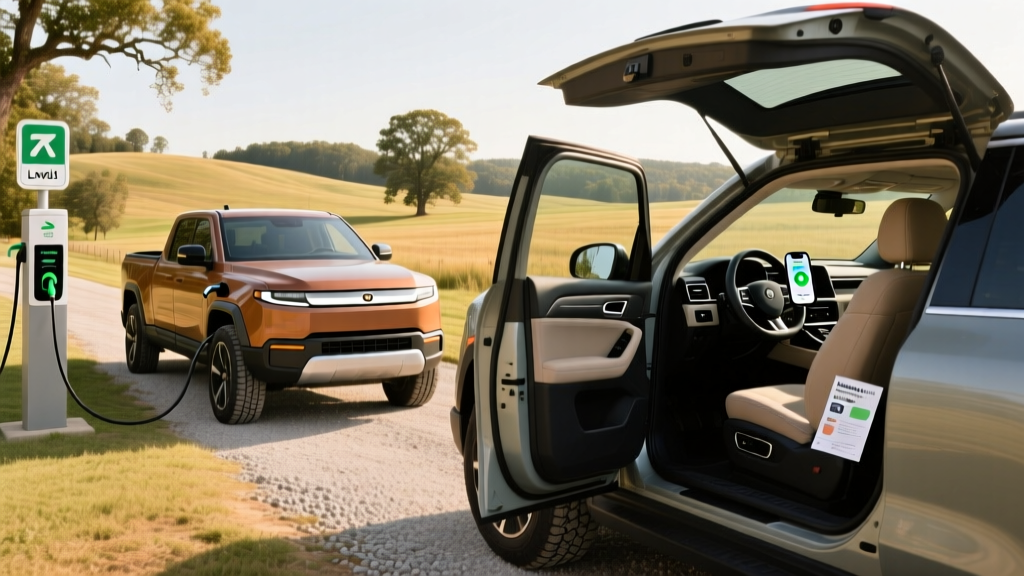
Georgia has quietly become one of the strongest EV adoption markets in the Southeast. Between Atlanta's dense commuter corridors, the expanding public charging network along I-85 and I-75, and the state's growing population of outdoor-oriented buyers, the fit for a Rivian in Georgia is stronger than ever. The R1T pickup and R1S SUV share a platform, a battery architecture, and a price bracket — but whether they make financial sense for a Peach State buyer depends on range realities, home-charging access, and navigating the federal §30D tax credit.
This review covers the 2026 Rivian R1T and R1S lineup with the Dual-Motor and Tri-Motor powertrains, using the latest EPA data, real-world charging observations, and current IRS rules. If you're cross-shopping the Ford F-150 Lightning, Tesla Cybertruck, or Chevrolet Silverado EV, the numbers below will help you decide.
Spec Snapshot: 2026 Rivian R1T and R1S at a Glance
| Spec | R1T Dual-Motor (Standard) | R1T Tri-Motor | R1S Dual-Motor (Standard) | R1S Tri-Motor |
|---|---|---|---|---|
| EPA Range | ~270 mi | ~328 mi (Max Pack) | ~270 mi | ~330 mi (Max Pack) |
| Battery (usable) | ~95 kWh (LFP) | ~141 kWh (NMC) | ~95 kWh (LFP) | ~141 kWh (NMC) |
| Horsepower | 533 hp | 850 hp | 533 hp | 850 hp |
| 0–60 mph | 4.5 sec | ~3.0 sec | 4.5 sec | ~3.0 sec |
| Peak DC Fast Charge | ~200 kW | ~220 kW | ~200 kW | ~220 kW |
| 10–80% DCFC Time | ~30 min | ~42 min | ~30 min | ~42 min |
| Level 2 Home Charge | 11.5 kW (~25 mi/hr) | 11.5 kW (~32 mi/hr) | 11.5 kW (~25 mi/hr) | 11.5 kW (~32 mi/hr) |
| MPGe (combined) | ~73 MPGe | ~70 MPGe | ~73 MPGe | ~70 MPGe |
| Towing Capacity | 7,700 lb | 7,700 lb | 7,700 lb | 7,700 lb |
| Base MSRP | $69,900 | $99,900 | $75,900 | $104,900 |
Sources: fueleconomy.gov, Rivian R1T specs, Rivian R1S specs. EPA figures are estimates; real-world results vary. MSRP excludes destination.
Real-World Range: What Georgia Drivers Actually See
EPA sticker: 270 mi (Standard) / 328–330 mi (Max Pack)
Real-world highway (70 mph, summer): ~240 mi (Standard) / ~290 mi (Max Pack)
Real-world highway (winter, 35°F): ~205 mi (Standard) / ~250 mi (Max Pack)
City / mixed driving: Close to EPA or slightly above due to regenerative braking
Georgia's climate works mostly in your favor. Summers are hot but the R1's thermal management system handles battery cooling well. The bigger range hit comes from sustained highway speeds — I-85 runs at 70–75 mph outside Atlanta, and aerodynamic drag at those speeds cuts range roughly 10–12% below the EPA combined figure. In north Georgia winters (think Dahlonega, Blue Ridge), expect an additional 15–20% loss when temperatures dip below 40°F, primarily from cabin heating and reduced battery efficiency.
The Max Pack's 141 kWh NMC battery delivers genuinely usable road-trip range. On a test run from Atlanta to Savannah (~250 miles), a Tri-Motor R1T with Max Pack arrived with roughly 15% State of Charge remaining — enough buffer for detours, but not enough to skip a charge stop if you're pushing 80 mph.
The Standard Pack's LFP chemistry is a different trade-off. LFP (lithium iron phosphate) offers longer cycle life and can be charged to 100% daily without degradation concerns, but its lower energy density means less range per pound. For metro-Atlanta commuters doing 40–60 miles round-trip, the Standard Pack is plenty — and the 100% daily charge recommendation means you'll wake up to a full battery every morning.
Charging Speed and Infrastructure in Georgia
Rivian's charging architecture tops out around 200–220 kW on DC fast charging, which is competitive but not class-leading. The Tesla Cybertruck and some Hyundai/Kia E-GMP vehicles can sustain higher peak rates. Here's what the numbers mean in practice:
| Charging Level | Power / Rate | What You Get |
|---|---|---|
| Level 1 (120V outlet) | ~1.4 kW | ~3–4 mi/hr — emergency trickle only |
| Level 2 (240V home, 48A) | 11.5 kW | ~25–32 mi/hr — full overnight charge in 8–10 hrs |
| DC Fast Charge (Standard Pack) | Peak ~200 kW | 10–80% in ~30 min; tapers significantly above 80% |
| DC Fast Charge (Max Pack) | Peak ~220 kW | 10–80% in ~42 min; larger battery = longer session |
Charging Curve Reality
Peak kW is not sustained kW. The R1's charge curve holds near peak rate from roughly 10–40% State of Charge, then progressively tapers. From 80–100%, charging slows dramatically to protect the battery. On a road trip, plan to charge from 10–80% and then drive — the last 20% can take as long as the first 70%.
Public Charging in Georgia
Rivian vehicles use the NACS (North American Charging Standard) connector as of the 2025 model year, which means native access to Tesla Supercharger stations — a major advantage in Georgia. The Atlanta metro has dense Supercharger coverage, and corridors along I-85 (to Charlotte), I-75 (to Chattanooga and Macon), and I-16 (to Savannah) are well-served. Rivian's own Adventure Network remains limited but is expanding along key outdoor-recreation routes.
For Electrify America and other CCS-only networks, you'll need the NACS-to-CCS adapter that Rivian provides. It works, but adds a step.
Home Charging Setup
Most Georgia Rivian owners install a Level 2 wall connector on a 60-amp circuit (delivering 48A continuous to the vehicle). Expect to pay $800–$1,500 for a quality EVSE (Rivian Wall Charger or ChargePoint Home Flex) and $500–$2,000 for electrician labor, depending on panel proximity and whether your home's 200-amp service needs upgrading. Georgia Power's residential rate averages around $0.13/kWh, meaning a full Standard Pack charge costs roughly $12 and a Max Pack about $18 — dramatically less than fueling a gas truck.
Performance and Drivetrain: Dual-Motor vs. Tri-Motor
The Dual-Motor setup (one motor per axle, standard AWD) delivers 533 hp and a 4.5-second 0–60 time. That's genuinely quick for a 7,000-pound vehicle and more than adequate for highway merging, passing, and the occasional on-ramp sprint. The Tri-Motor adds a rear-axle motor for 850 hp and a ~3.0-second 0–60, which is supercar territory in a pickup. It's also a $30,000 upcharge.
For Georgia buyers, the Dual-Motor is the rational choice. Atlanta traffic doesn't reward horsepower, and the Tri-Motor's extra weight slightly reduces efficiency. The Tri-Motor makes sense if you plan to tow frequently near the 7,700-pound max, want the fastest possible charge acceptance, or simply enjoy having absurd acceleration on tap.
Ride quality is a Rivian strong point. The quad-motor air suspension (standard on most trims) adjusts ride height from a low "park" mode to over 14 inches of ground clearance for off-road use. On Georgia's mix of smooth interstates and rougher rural roads, the R1 absorbs imperfections better than most body-on-frame trucks.
Pricing, Trims, and Federal Tax Credit Eligibility
| Trim / Config | MSRP | Est. After §30D Credit | Notes |
|---|---|---|---|
| R1T Dual-Motor Standard | $69,900 | ~$62,400 | Below $80K truck cap; credit-eligible if income/sourcing met |
| R1T Tri-Motor Max | $99,900 | $99,900 | Exceeds $80K MSRP cap — NOT eligible for §30D |
| R1S Dual-Motor Standard | $75,900 | ~$68,400 | Below $80K SUV cap; credit-eligible if income/sourcing met |
| R1S Tri-Motor Max | $104,900 | $104,900 | Exceeds $80K MSRP cap — NOT eligible for §30D |
IRS §30D Tax Credit Rules (2026)
The federal EV tax credit offers up to $7,500, but eligibility is a three-part test under current IRS rules:
- MSRP cap: Trucks (R1T) must be under $80,000; SUVs (R1S) under $80,000. This immediately disqualifies all Tri-Motor and Max Pack configurations.
- Buyer income cap: Modified AGI must not exceed $150K (single), $225K (head of household), or $300K (joint).
- Battery sourcing: Critical minerals and battery components must meet escalating domestic-content thresholds. Rivian has worked to qualify, but sourcing requirements tighten annually — verify current eligibility on the IRS clean vehicle credit page before purchasing.
The Dual-Motor Standard R1T at $69,900 is the credit-friendly configuration. The R1S Dual-Motor at $75,900 also qualifies on price, but options can push it over $80K — configure carefully. As of 2024, the credit can be transferred to the dealer at point of sale, reducing your purchase price directly rather than waiting for a tax refund. Consult a tax professional for your specific situation.
Cargo, Passenger Space, and Everyday Practicality
The R1T's 4.5-foot bed is shorter than a full-size truck's, but the gear tunnel (a pass-through compartment behind the cab) adds significant enclosed storage. Total cargo volume behind the rear seats is roughly 29 cubic feet in the R1S (with all rows up), expanding to over 100 cubic feet with seats folded. The R1T's bed plus gear tunnel provides comparable utility for gear-heavy lifestyles.
Passenger space is generous. Front legroom exceeds 41 inches in both models; rear legroom sits around 38 inches — adequate for adults on longer drives. The R1S offers an optional third row, but it's best suited for children. Headroom is excellent thanks to the flat skateboard platform.
The front trunk (frunk) on both models provides roughly 11 cubic feet of sealed, drainable storage — ideal for wet gear, groceries, or a cooler on the way to Lake Lanier.
Tech, Driver Assistance, and Software
Rivian's infotainment runs on a custom 15.6-inch center display with native navigation, over-the-air updates, and a growing app ecosystem. The system is responsive and well-designed, though it lacks Apple CarPlay and Android Auto — a dealbreaker for some buyers who prefer phone-mirroring.
Rivian's Driver+ system (adaptive cruise + lane centering) is an SAE Level 2 driver-assist feature. It is not self-driving. The driver must remain engaged, hands on or near the wheel, and eyes on the road at all times. It performs well on well-marked highways like I-285 and I-85 but will disengage in construction zones, faded lane markings, or heavy rain.
Standout tech features include:
- Over-the-air software updates that regularly add features and improve performance
- Camp Kitchen accessory (slide-out kitchen for the gear tunnel)
- Integrated air compressor for tire inflation
- Vehicle-to-load (V2L) capability to power accessories from the traction battery
Notable drawbacks: no phone mirroring, panel gaps that still vary by vehicle, and a service center network that, while growing, remains thinner than legacy automakers — the nearest Rivian Service Center for south-Georgia buyers may be in Atlanta or require a mobile service visit.
Warranty and Long-Term Ownership
Rivian covers the R1T and R1S with:
- Vehicle limited warranty: 5 years / 60,000 miles
- Battery and drive unit warranty: 8 years / 175,000 miles (retains at least 70% capacity)
The battery warranty is competitive with the industry standard (most manufacturers offer 8 years / 100,000 miles). Rivian's 175,000-mile threshold is actually more generous than many. For Georgia buyers planning long-term ownership, the LFP chemistry in the Standard Pack offers an additional longevity advantage — LFP cells typically degrade more slowly than NMC over thousands of charge cycles, and Rivian recommends regular 100% charges for LFP, eliminating the "don't charge past 80%" anxiety that NMC owners manage.
Insurance costs for Rivians tend to run 15–25% higher than comparable gas trucks, reflecting repair costs and parts availability. Get quotes before purchasing.
Who Should Buy a Rivian in Georgia?
- You want an electric pickup or SUV that can genuinely off-road (14+ inches of clearance, wading capability)
- Your daily commute is under 100 miles round-trip and you can charge at home
- You value Supercharger access via NACS for road trips along the Southeast corridor
- You qualify for the §30D credit on a Dual-Motor Standard configuration
- You need towing capability (7,700 lb) with zero tailpipe emissions
- You need a full-size truck bed (6.5+ feet) for work — consider the F-150 Lightning or Silverado EV
- Your budget is under $60K — the base R1T starts near $70K
- You rely on Apple CarPlay or Android Auto daily
- You live in rural south Georgia far from service centers and fast chargers
- You want Tri-Motor performance AND the $7,500 tax credit (they're mutually exclusive due to MSRP caps)
Frequently Asked Questions
What is the real-world range of the Rivian R1T and R1S?
The EPA rates the Dual-Motor Standard at roughly 270 miles and the Tri-Motor Max Pack at 328–330 miles. In real-world Georgia highway driving at 70 mph, expect about 240 miles (Standard) or 290 miles (Max Pack). Cold winter mornings in north Georgia can reduce that by another 15–20%.
How fast does a Rivian charge at home and on the road?
On a Level 2 home charger (11.5 kW), the R1 adds 25–32 miles of range per hour — a full overnight charge takes 8–12 hours depending on pack size. On DC fast charging, the Standard Pack peaks at ~200 kW (10–80% in ~30 minutes) and the Max Pack at ~220 kW (10–80% in ~42 minutes).
Does the Rivian qualify for the federal EV tax credit?
The Dual-Motor Standard R1T ($69,900) and R1S ($75,900) fall under the §30D MSRP caps and may qualify for up to $7,500 if the buyer meets income limits and the vehicle meets battery-sourcing requirements. Tri-Motor and Max Pack configurations exceed the $80,000 cap and do not qualify. Always verify current rules at IRS.gov.
Is the Rivian worth buying versus the F-150 Lightning or Cybertruck?
The Rivian offers superior build quality, off-road capability, and NACS Supercharger access compared to the Lightning, but at a higher base price. The Cybertruck offers more polarizing styling and a stainless-steel exoskeleton but a less refined interior. If premium feel, adventure capability, and charging convenience top your list, the Rivian wins. If lowest price and maximum bed length matter more, the Lightning is the practical pick.
What are the biggest pros and cons of owning a Rivian in Georgia?
Pros: Supercharger access, excellent off-road capability, strong real-world range on Max Pack, OTA updates that improve the vehicle over time, V2L capability, generous battery warranty.
Cons: High starting price (credit-eligible trims start near $70K), no Apple CarPlay/Android Auto, limited service centers outside Atlanta, higher insurance premiums, shorter bed than full-size trucks.
Can I charge a Rivian at Tesla Superchargers in Georgia?
Yes. Since the 2025 model year, Rivian ship with the NACS charge port natively, meaning you can plug directly into any Tesla Supercharger without an adapter. Georgia has over 40 Supercharger stations, covering the Atlanta metro and all major highway corridors.