Rivian's Manufacturing Home: Normal, Illinois
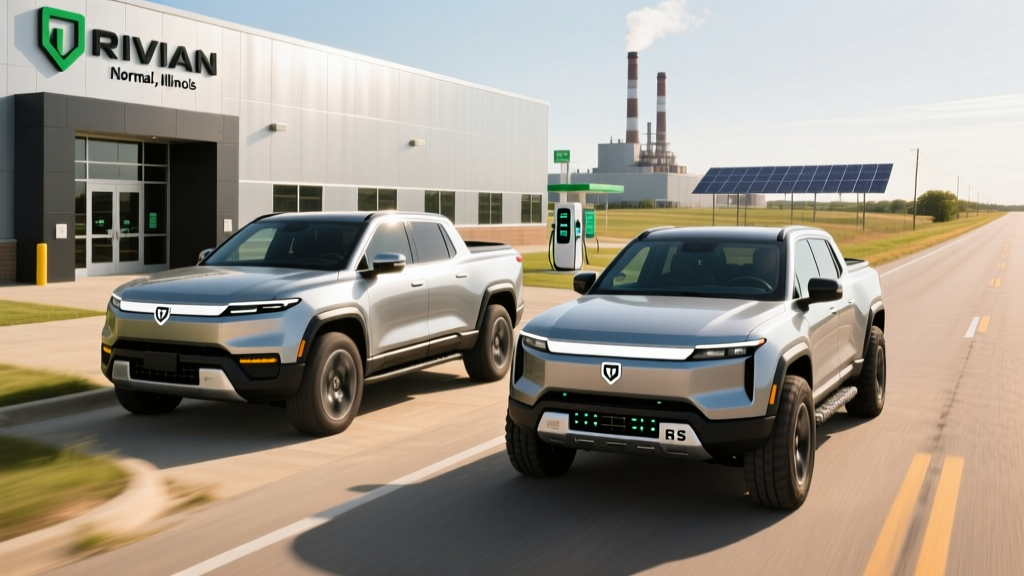
Every Rivian R1T pickup and R1S SUV rolling onto American roads shares a common birthplace: a massive 3.3-million-square-foot factory in Normal, Illinois. Originally a Mitsubishi Diamond-Star Motors plant (later solely Mitsubishi), Rivian acquired the facility in 2017 and has since invested over $2 billion transforming it into a dedicated electric-vehicle production campus.
As of 2026, the Normal plant remains Rivian's sole vehicle assembly site. The company has announced a second factory in Stanton, Georgia, but that facility is still under construction and not yet producing vehicles. Every R1T, R1S, and Amazon EDV delivery van currently on the road was built in Illinois.
This matters to buyers for several reasons: domestic manufacturing affects federal tax-credit eligibility, supply-chain transparency, and service/parts logistics. Rivian's vertically integrated approach — building battery packs, drive units, and vehicle software in-house at Normal — gives the company tighter quality control than automakers relying heavily on Tier 1 suppliers.
2026 Rivian R1T and R1S: Core Specifications
For the 2026 model year, Rivian offers the R1T (crew-cab pickup) and R1S (three-row SUV) on its updated Gen 2 platform, featuring a redesigned electrical architecture, fewer ECUs, and an available Max battery pack. Here's what the numbers look like across the lineup.
| Specification | R1T (Pickup) | R1S (SUV) |
|---|---|---|
| EPA Range (Standard Pack) | 270 miles | 270 miles |
| EPA Range (Large Pack) | 352 miles | 341 miles |
| EPA Range (Max Pack) | 420 miles | 400 miles |
| Battery Capacity (Standard) | ~92 kWh usable (LFP) | ~92 kWh usable (LFP) |
| Battery Capacity (Large) | ~128 kWh usable (NMC) | ~128 kWh usable (NMC) |
| Battery Capacity (Max) | ~149 kWh usable (NMC) | ~149 kWh usable (NMC) |
| Horsepower (Dual-Motor) | 533 hp | 533 hp |
| 0-60 mph (Dual-Motor) | 4.5 seconds | 4.6 seconds |
| Drivetrain | AWD (dual-motor) | AWD (dual-motor) |
| Efficiency (Dual-Motor, Large) | 73 MPGe / 46 kWh/100mi | 71 MPGe / 47 kWh/100mi |
| Max Towing (R1T) | 11,000 lbs | N/A |
Tri-Motor and Quad-Motor configurations push output to 850 hp and up to 1,025 hp respectively, dropping 0-60 times into the low-3-second range. These higher-output variants carry a weight and efficiency penalty, reducing range by roughly 10-15% compared to Dual-Motor equivalents.
Charging Speed: DC Fast Charge and Home Level 2
Rivian's Gen 2 platform supports NACS (Tesla Supercharger connector) natively on 2026 models, eliminating the need for a CCS adapter that earlier models required. This is a significant advantage for road-trip charging access, as the Tesla Supercharger network remains the most reliable DC fast-charging infrastructure in the U.S.
| Charging Level | Power / Rate | Speed / Time |
|---|---|---|
| Level 1 (120V household) | ~1.4 kW | ~3-4 miles per hour |
| Level 2 (240V home, 48A) | 11.5 kW | ~25-27 miles per hour |
| Level 2 (240V home, 32A) | 7.7 kW | ~17-18 miles per hour |
| DC Fast Charge (peak, Large/Max) | 220 kW | 10-80% in ~30 minutes |
| DC Fast Charge (Standard LFP) | 175 kW | 10-80% in ~28 minutes |
Charging curve reality: The 220 kW peak applies only to the Large and Max NMC packs and is sustained roughly between 10-35% state of charge. Above 50%, the curve tapers progressively, dropping below 100 kW past 70%. This is standard behavior for NMC chemistry — the Battery Management System (BMS) throttles current to protect cell longevity. The Standard LFP pack charges at a lower peak but maintains a flatter curve, making its 10-80% time competitive despite the lower peak kW.
For home charging, a 48-amp Level 2 wall connector on a 60-amp circuit is the recommended setup. This adds roughly 25 miles of range per hour, meaning a full overnight charge (8-10 hours) easily replenishes any daily driving. Budget $800-$1,500 for a quality Level 2 unit (Rivian Wall Connector, ChargePoint Home Flex, or Emporia Vue) plus $500-$2,000 for electrician installation depending on panel proximity and local permit costs.
Pricing, Trim Levels, and Federal Tax Credit Eligibility
Rivian positions the R1T and R1S as premium adventure vehicles, and pricing reflects that positioning. Here's the 2026 MSRP breakdown before any incentives:
| Configuration | R1T MSRP | R1S MSRP | §30D Credit Eligible? |
|---|---|---|---|
| Dual-Motor, Standard Pack | $69,900 | $75,900 | Yes (if income caps met) |
| Dual-Motor, Large Pack | $75,900 | $81,900 | Yes (if income caps met) |
| Dual-Motor, Max Pack | $83,900 | $89,900 | Yes (if income caps met) |
| Tri-Motor, Large Pack | $93,900 | $99,900 | No (exceeds $80K/$85K cap) |
| Quad-Motor | $99,900+ | $105,000+ | No (exceeds MSRP cap) |
Federal tax credit rules (IRS §30D, 2026): The new-vehicle EV credit provides up to $7,500, split into two halves — $3,750 for battery-component sourcing and $3,750 for critical-minerals sourcing. To qualify, buyers must meet several requirements:
- MSRP cap: Vans/SUVs/trucks must be under $80,000. This eliminates Tri-Motor and Quad-Motor trims but keeps most Dual-Motor configurations eligible.
- Income cap: Modified AGI must not exceed $300,000 (joint), $225,000 (head of household), or $150,000 (single).
- Battery sourcing: Battery components must be manufactured or assembled in North America (phasing percentages increase yearly). Critical minerals must be sourced from the U.S. or FTA partners. Rivian's domestic manufacturing in Illinois and U.S./Canada supply chain generally positions eligible trims favorably, but final determination depends on the specific battery pack and model year. Check fueleconomy.gov for the latest per-model eligibility.
- Point-of-sale transfer: As of 2024, the credit can be transferred to the dealer at purchase, reducing your out-of-pocket cost immediately rather than waiting for tax filing.
Always confirm eligibility with your tax professional before purchase, as sourcing requirements tighten annually and individual circumstances vary.
Cargo, Passenger Space, and Practicality
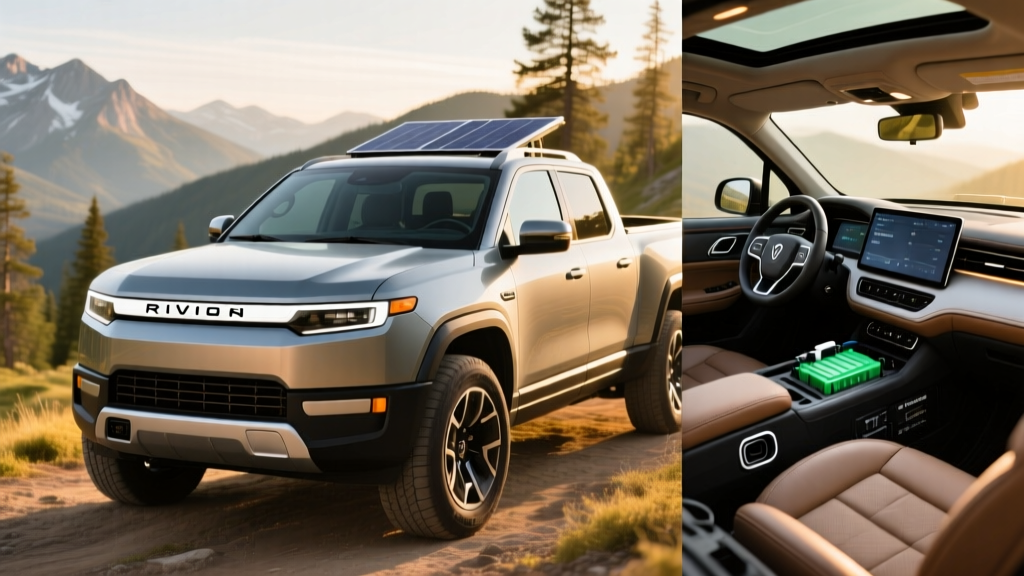
The R1T's defining practicality feature is its 4.5-foot bed with the innovative Gear Tunnel — a lockable, pass-through storage compartment spanning the width of the truck behind the rear seats. Combined with the front trunk (frunk), the R1T offers versatile cargo solutions that traditional pickups can't match.
| Dimension | R1T | R1S |
|---|---|---|
| Bed Length (R1T) / Cargo behind 3rd row (R1S) | 54 inches (4.5 ft) | 20.4 cu ft |
| Gear Tunnel Volume | 11.7 cu ft | N/A |
| Frunk Volume | 11.1 cu ft | 11.1 cu ft |
| Cargo (behind 2nd row, seats folded) | N/A | 57.7 cu ft |
| Cargo (max, all rear seats folded) | N/A | 104.7 cu ft |
| Front Legroom | 41.3 inches | 41.3 inches |
| Rear Legroom (2nd row) | 38.2 inches | 38.2 inches |
| 3rd Row Legroom (R1S) | N/A | 30.2 inches |
The R1S third row is best suited for children or occasional adult use on short trips — the 30.2 inches of legroom is tight compared to dedicated three-row SUVs like the Kia EV9 (which offers roughly 32 inches). However, for families who need a third row occasionally but prioritize electric adventure capability, the R1S fills a unique niche.
Technology, Driver Assistance, and Software
Rivian's software-defined vehicle approach is among the strongest in the EV industry. The 15.6-inch center display runs Rivian's proprietary OS, receiving regular over-the-air (OTA) updates that add features, improve efficiency, and refine the driving experience. The 2026 Gen 2 hardware is faster and more responsive than the Gen 1 system.
Rivian Driver+ (ADAS): This is a SAE Level 2 driver-assistance system combining adaptive cruise control, lane-centering, and automatic lane changes on highways. It requires continuous driver supervision — hands must remain on the wheel, and eyes must remain on the road. It is not autonomous driving. Driver+ competes with Ford BlueCruise and GM Super Cruise in capability, though those systems offer hands-free operation on mapped highways (still Level 2, but with different monitoring requirements).
Standout tech features:
- Camp Kitchen accessory (slide-out induction cooktop and sink for the Gear Tunnel)
- Powered tonneau cover with integrated bed lighting
- Vehicle-to-load (V2L) capability — power tools, campsite equipment, or tailgate appliances from the truck's battery
- Integrated air compressor with preset tire-pressure targets
- Rivian app with remote climate control, charging status, and trip planning
Pros, Cons, and the Competition
Pros
- Class-leading adventure utility: Gear Tunnel, frunk, 11,000-lb towing (R1T)
- Native NACS access to Tesla Supercharger network (2026 models)
- Up to 420 miles EPA range with Max Pack
- OTA updates continuously improve the vehicle post-purchase
- Strong off-road capability with adjustable air suspension (up to 14.9" ground clearance)
- Domestic manufacturing in Normal, Illinois
Cons
- Premium pricing — well-equipped models push past $90,000
- Efficiency trails lighter competitors (73 MPGe vs. ~100+ MPGe for lighter SUVs)
- Third row (R1S) is cramped for adults
- Service center network still expanding — rural owners may face longer wait times
- Heavy vehicle weight (~7,000+ lbs) increases tire wear and reduces cold-weather range
- No hands-free driving mode (Driver+ requires hands on wheel)
Key competitors: The R1T competes with the Ford F-150 Lightning (more affordable, less range and off-road capability), Chevrolet Silverado EV (larger bed, lower efficiency), and the Tesla Cybertruck (polarizing design, stainless-steel body, comparable performance). The R1S faces the Kia EV9 (lower price, less off-road ability), Tesla Model X (faster, less rugged), and the upcoming electric Jeep Wagoneer S.
Choose the Rivian R1S if: You want a three-row electric SUV with real off-road chops and don't need adult-friendly third-row seating for long trips.
Look elsewhere if: Budget is the primary concern (consider the F-150 Lightning or EV9), you prioritize maximum efficiency over capability, or you need a mature service network in a rural area.
Warranty and Long-Term Ownership
Rivian backs both the R1T and R1S with a competitive warranty package:
- Battery and Drive Unit: 8 years / 175,000 miles (whichever comes first), with a guaranteed minimum 70% capacity retention over the warranty period
- Vehicle (Bumper-to-Bumper): 5 years / 60,000 miles
- Corrosion Perforation: 5 years / unlimited miles
- Roadside Assistance: 5 years / 60,000 miles
The 175,000-mile battery warranty is generous compared to the industry-standard 100,000 miles. Rivian's use of LFP chemistry in the Standard Pack is a longevity positive — LFP cells typically degrade more slowly than NMC and can be charged to 100% daily without accelerated wear. NMC packs (Large and Max) benefit from daily charge limits of 80-90% for longest life.
Frequently Asked Questions
Where exactly is Rivian built?
All Rivian vehicles — the R1T, R1S, and Amazon EDV delivery vans — are manufactured at the company's factory in Normal, Illinois. This 3.3-million-square-foot facility was formerly a Mitsubishi plant and has been fully converted for EV production. A second factory in Stanton, Georgia, is announced but not yet operational as of 2026.
What is the real-world range of the 2026 Rivian R1T?
The EPA rates the Dual-Motor Large Pack R1T at 352 miles. In real-world highway driving at 70-75 mph, expect approximately 290-310 miles. In cold weather (below 30°F), that drops to roughly 250-270 miles. The Max Pack (420 miles EPA) provides a more comfortable buffer for highway and winter driving.
How fast does the Rivian R1T charge?
On a DC fast charger, the Large and Max packs peak at 220 kW, achieving a 10-80% charge in approximately 30 minutes. The Standard LFP pack peaks at 175 kW with a similar 10-80% time due to its flatter charge curve. At home on a 48-amp Level 2 charger, the R1T adds about 25-27 miles of range per hour.
Does the 2026 Rivian R1T qualify for the $7,500 federal tax credit?
Dual-Motor trims priced under the $80,000 MSRP cap (Standard, Large, and some Max Pack configurations) can qualify for up to $7,500 under IRS §30D, provided the buyer meets income caps ($300K joint / $150K single) and the vehicle meets battery-sourcing requirements. Tri-Motor and Quad-Motor trims exceed the MSRP cap and are not eligible. Always verify current eligibility on fueleconomy.gov and consult a tax professional.
Is the Rivian R1T worth buying over the Ford F-150 Lightning?
The R1T is worth the premium if you value off-road capability (14.9" ground clearance, quad-motor torque vectoring), the Gear Tunnel, higher maximum range (420 vs. 320 miles), and native Supercharger access. The F-150 Lightning wins on price (starting ~$15,000 lower), bed length (5.5-6.5 ft vs. 4.5 ft), and a more established dealer/service network. Choose based on your priorities: adventure capability vs. value and familiarity.
Can I charge a Rivian at Tesla Superchargers?
Yes. 2026 Rivian models come with a native NACS charge port, providing direct access to Tesla's Supercharger network without an adapter. Earlier Rivian models (2022-2024) with CCS ports can use Superchargers with a Rivian-provided NACS adapter.