Rivian's Factory Warranty Baseline: What You Get on Day One
Before evaluating any extended protection plan, Rivian buyers need to understand the factory coverage that comes standard on every 2026 R1T pickup and R1S SUV. Rivian structures its warranty around three pillars: the limited vehicle warranty, the battery warranty, and the drivetrain warranty. Each has distinct terms, and understanding the gaps between them is essential for deciding whether supplemental coverage makes financial sense.
Rivian's baseline warranty package includes:
- Limited Vehicle Warranty: 5 years / 60,000 miles (bumper-to-bumper coverage on most vehicle components)
- Battery Warranty: 8 years / 175,000 miles (covers the high-voltage traction battery against defects and excessive degradation)
- Drivetrain Warranty: 8 years / 175,000 miles (covers electric motors, gearboxes, and associated power electronics)
That 175,000-mile threshold on the battery and drivetrain is notably generous — it exceeds the federal minimum of 8 years / 100,000 miles mandated for EVs sold in the U.S., and it surpasses the 150,000-mile battery warranty offered by some competitors. For most owners who drive the national average of ~13,500 miles per year, the drivetrain and battery coverage extends well beyond the typical first-ownership period.
However, the 5-year / 60,000-mile bumper-to-bumper window is where the calculus for a Rivian extended warranty begins. Once that limited warranty expires, components like the air suspension, thermal management system, infotainment hardware, power-operated tonneau cover (R1T), and powered liftgate (R1S) fall outside factory coverage — and EV-specific repairs can be expensive.
| Spec | Value |
|---|---|
| EPA Range (Max Pack) | 420 miles |
| Battery Capacity (Max Pack) | 149 kWh (NMC lithium-ion) |
| Max DC Fast Charge | 220 kW peak |
| 10–80% DC Fast Charge | ~28 minutes |
| Level 2 Home Charging | 11.5 kW (~25 mi/hr) |
| 0–60 mph | 4.5 seconds (Dual-Motor) |
| Horsepower | 533 hp (Dual-Motor) |
| Drivetrain | Dual-Motor AWD |
| MPGe (Combined) | 73 MPGe |
| Efficiency | 46 kWh/100 mi |
| Max Towing | 11,000 lbs |
| Cargo Bed Volume | 54.1 cu ft (R1T bed) |
| Frunk Volume | 11.1 cu ft |
| Base MSRP (Dual-Motor) | $69,900 |
Real-World Range: EPA Estimates vs. What You'll Actually Get
The EPA range sticker is a starting point, not a guarantee — especially on a vehicle as heavy and aerodynamically challenged as a full-size electric pickup. The 2026 R1T with the Max Pack (149 kWh NMC battery) carries an EPA-estimated 420 miles of range, while the Standard Pack (106 kWh) delivers an EPA-estimated 270 miles. The R1S SUV posts nearly identical numbers due to shared powertrain architecture.
EPA Range vs. Real-World Expectation:
- Max Pack (EPA 420 mi): Expect 340–370 mi on highway road trips at 70+ mph; 280–320 mi in sub-freezing winter conditions.
- Standard Pack (EPA 270 mi): Expect 220–240 mi highway; 180–200 mi in cold weather.
- City/Mixed Driving: Closer to EPA figures or slightly above, thanks to regenerative braking recapturing energy in stop-and-go traffic.
- Towing: Range drops 40–55% when towing near max capacity. Plan for ~180–210 mi with the Max Pack under load.
The R1T's boxy profile and 6,800+ lb curb weight work against highway efficiency. In EPA testing, the R1T Dual-Motor achieves 73 MPGe combined, translating to 46 kWh per 100 miles — thirstier than a Tesla Model X or even the Ford F-150 Lightning Extended Range. Cold-weather range loss is compounded by the energy demands of battery preconditioning and cabin heating, though Rivian's heat pump system helps mitigate this compared to resistive heating setups.
Charging Speed: DC Fast Charging and Home Level 2 Setup
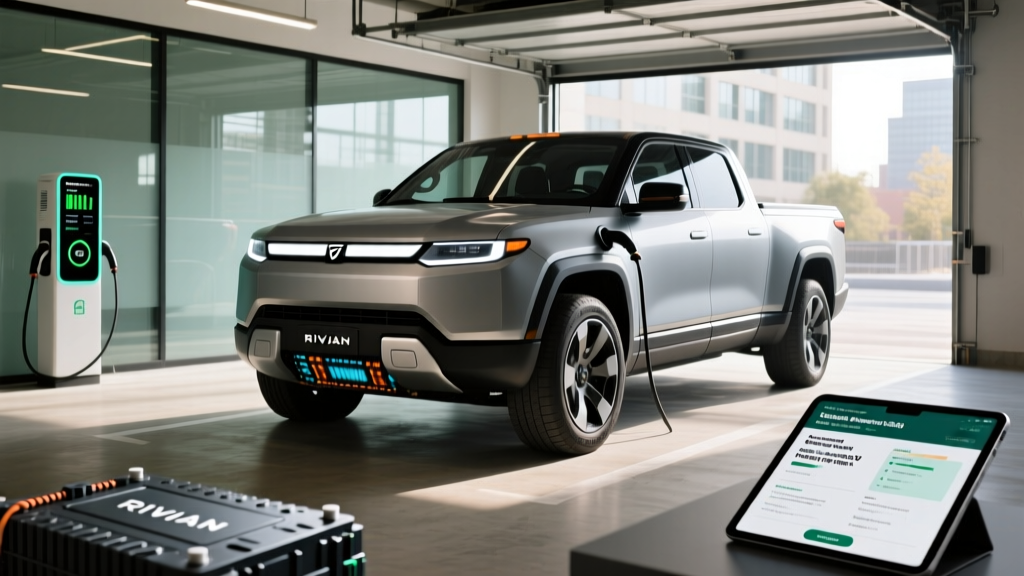
Rivian equips the R1T and R1S with NACS (North American Charging Standard) ports as of the 2025 model year, granting native access to the Tesla Supercharger network — the most reliable and extensive DC fast-charging infrastructure in North America. Prior CCS-equipped Rivians require an adapter, which Rivian has offered to existing owners.
| Charging Level | Power | Speed (Approx.) | Use Case |
|---|---|---|---|
| Level 1 (120V) | 1.4 kW | ~3 mi/hr | Emergency / overnight trickle |
| Level 2 (240V, 48A) | 11.5 kW | ~25 mi/hr | Home daily charging |
| DC Fast Charge | 220 kW peak | 10–80% in ~28 min | Road trips, Supercharger/Electrify America |
A critical nuance: the 220 kW peak charge rate applies only to the Max Pack. The Standard Pack peaks around 190 kW, and the mid-tier Large Pack (128 kWh) sits at approximately 200 kW. Charge curves also taper significantly above 80% state of charge — a session from 80–100% can take as long as the 10–80% portion. For road-trip efficiency, plan stops around the 15–80% window and precondition the battery via the Rivian app or navigation system before arriving at the charger.
For home charging, Rivian's Wall Connector (or any J1772/NACS Level 2 unit on a 60-amp circuit) delivers 11.5 kW, adding roughly 25 miles of range per hour. A full Standard Pack charge takes about 9.5 hours; the Max Pack requires roughly 13 hours from empty. Most owners who charge overnight at home will rarely need a full 0–100% cycle, as daily driving typically consumes 30–60 miles of range.
What a Rivian Extended Warranty Actually Covers
Rivian does not currently sell a branded "extended warranty" in the traditional automaker sense — there is no Rivian-branded plan you can add at the dealership like you might with a Ford or Toyota. Instead, Rivian owners seeking coverage beyond the 5-year/60,000-mile bumper-to-bumper window have two primary paths:
- Third-party extended service contracts: Companies like CarShield, Endurance, and CARCHEX offer EV-compatible vehicle service contracts that can cover components like air suspension, power electronics, HVAC systems, and infotainment hardware after the factory limited warranty expires. Coverage varies widely by provider, and some exclude EV-specific components — read the contract carefully.
- Rivian's own service plans (if/when offered): Rivian has signaled interest in offering proprietary extended coverage, but as of early 2026, no formal Rivian-extended protection plan has been launched. Monitor your Rivian account and owner communications for updates.
Key components that owners commonly seek extended coverage for include:
- Air suspension system: Compressors and air struts are wear items that can fail outside the bumper-to-bumper window. Replacement of a single air strut can cost $1,500–$2,500.
- Thermal management system: The liquid cooling/heating loops for the battery and motors involve pumps, valves, and coolant lines. Failures can cascade into battery damage.
- Powered tonneau cover (R1T): Motor and track mechanisms in the powered gear tunnel and tonneau are known wear points.
- Infotainment and display hardware: The 15.6-inch center touchscreen and digital cluster are expensive to replace out of warranty — $2,000+ for hardware alone.
- Onboard charger (OBC): Converts AC to DC for Level 2 charging; replacement runs $1,200–$1,800.
Importantly, the battery and drivetrain remain covered for 8 years / 175,000 miles regardless of any extended warranty purchase. If your battery degrades below Rivian's stated retention threshold (typically 70% of original capacity within the warranty period), Rivian will repair or replace it at no cost. This is the single most expensive potential repair on any EV, and it's already covered for the vast majority of ownership scenarios.
Pricing, Trim Levels, and Federal Tax Credit Eligibility
The 2026 Rivian R1T and R1S are available in Dual-Motor, Performance Dual-Motor, and Quad-Motor configurations, with Standard, Large, and Max battery pack options. Pricing has stabilized after several rounds of adjustment in prior model years.
| Trim / Config | Base MSRP | Federal Tax Credit (§30D) | Effective Price |
|---|---|---|---|
| Dual-Motor, Standard Pack | $69,900 | Up to $7,500* | ~$62,400 |
| Dual-Motor, Large Pack | $75,900 | Up to $7,500* | ~$68,400 |
| Dual-Motor, Max Pack | $84,900 | Up to $7,500* | ~$77,400 |
| Performance Dual-Motor, Max | $92,900 | Up to $7,500* | ~$85,400 |
| Quad-Motor, Max Pack | $99,900 | Up to $7,500* | ~$92,400 |
*Federal tax credit eligibility under IRS §30D is not automatic. To qualify for the full $7,500 credit, buyers must meet all of the following:
- MSRP cap: Trucks and SUVs must have an MSRP at or below $80,000. This disqualifies the R1T Max Pack, Performance, and Quad-Motor trims from the credit.
- Income cap: Modified adjusted gross income (MAGI) must not exceed $150,000 (single), $225,000 (head of household), or $300,000 (joint filers).
- Battery sourcing: A percentage of critical minerals and battery components must be sourced from the U.S. or free-trade-agreement partners. These thresholds tighten annually. Verify current-year compliance on the IRS clean vehicle credit page or via the DOE/IRS qualifying vehicle list.
- Point-of-sale transfer: As of 2024, buyers can transfer the credit to the dealer at purchase, reducing the out-of-pocket cost at delivery rather than waiting for a tax refund.
This means the Dual-Motor Standard and Large Pack R1T configurations (under the $80,000 MSRP cap) are the most likely to qualify, assuming the buyer meets income and sourcing requirements. Always confirm eligibility with a tax professional before purchase — rules are subject to change.
Who Should Buy a Rivian — And Who Should Look Elsewhere
The R1T and R1S occupy a specific niche: they're adventure-oriented, tech-forward electric vehicles with genuine off-road capability and class-leading utility features like the R1T's gear tunnel. But they're not the right EV for every buyer.
Pros
- Genuine off-road capability with quad-motor torque vectoring and adjustable air suspension (up to 14.9 inches of ground clearance)
- R1T's gear tunnel (11.7 cu ft) is a uniquely useful storage feature no competitor offers
- NACS port provides native Supercharger access — the gold standard for road-trip charging
- Class-leading 8-year/175,000-mile battery and drivetrain warranty
- Over-the-air software updates continuously add features and refine performance
- 11,000-lb towing capacity (when properly equipped) beats most EV competitors
Cons
- Highway efficiency is below average for the EV segment — 46 kWh/100 mi is thirsty
- Service center network is still limited; many owners rely on mobile service or long tow distances for major repairs
- No proprietary extended warranty product from Rivian as of 2026
- Higher trims exceed the $80,000 MSRP cap for the federal tax credit
- Ride quality on 22-inch wheels can be firm on broken pavement
- Regenerative braking is less aggressive than some competitors — one-pedal driving is available but not as strong as Tesla or Hyundai/Kia systems
The R1T/R1S is ideal for: Outdoor-oriented families and individuals who need real towing and off-road capability, have home charging access, and want an EV that can replace a traditional truck or large SUV without compromise on utility. It's also well-suited for buyers who plan to keep the vehicle 6+ years and will benefit from the generous 175,000-mile drivetrain coverage.
Consider alternatives if: You primarily commute in urban environments and don't need truck/SUV capability (a Tesla Model Y, Hyundai Ioniq 5, or Kia EV6 will be more efficient and less expensive). Also look elsewhere if you live far from a Rivian service center and cannot tolerate potential delays for warranty repairs.
Is the Rivian R1T/R1S Worth It vs. Key Competitors?
The R1T's most direct rival is the Ford F-150 Lightning, which starts significantly lower (~$55,000 for the Pro trim) and offers a more traditional truck experience, but with less range (EPA 320 mi max), lower towing capacity on base trims, and a CCS charge port requiring an adapter for Supercharger access. The F-150 Lightning's battery warranty matches the federal minimum of 8 years / 100,000 miles — notably shorter than Rivian's 175,000-mile coverage.
The Chevrolet Silverado EV offers competitive range (up to EPA 440 mi on the 4WT trim) and a lower starting price for fleet-oriented configurations, but its availability and trim proliferation remain limited in early 2026. The Tesla Cybertruck undercuts on price in dual-motor form but has a polarizing design, a smaller bed, and a less proven service track record for a vehicle in its second production year.
For SUV buyers cross-shopping the R1S, the Kia EV9 offers three rows of seating at a significantly lower price point (~$55,000 base), though it sacrifices off-road capability, towing capacity, and the adventure-focused features that define the Rivian experience. The Tesla Model X provides faster charging and access to the Supercharger network but is aging in design and carries a higher starting price for comparable range.
From a warranty perspective, Rivian's 8-year/175,000-mile battery and drivetrain coverage is among the best in the segment. This reduces the urgency of purchasing a third-party extended warranty for the most expensive potential failure points. The decision to buy supplemental coverage should focus on the components that fall outside that umbrella: air suspension, thermal management, infotainment, and body-electrical systems.
Frequently Asked Questions
Does Rivian offer its own extended warranty?
As of early 2026, Rivian does not sell a branded extended warranty or extended service contract. Owners seeking coverage beyond the 5-year/60,000-mile limited warranty must turn to third-party providers. Rivian's battery and drivetrain coverage (8 years / 175,000 miles) remains in effect regardless.
How much does a third-party extended warranty for a Rivian cost?
Third-party EV-compatible vehicle service contracts typically range from $2,500 to $5,500 for 3–5 years of additional coverage, depending on the provider, deductible, and component list. Coverage for EV-specific parts (power electronics, thermal management) varies — always confirm that the contract explicitly covers high-voltage system components beyond the battery itself.
What is the real-world range of the Rivian R1T?
The Max Pack R1T (EPA 420 mi) delivers approximately 340–370 miles on highway road trips and 280–320 miles in cold weather. The Standard Pack (EPA 270 mi) yields roughly 220–240 highway miles. Towing near max capacity cuts range by 40–55%.
How fast does the Rivian R1T charge at home and on the road?
At home on a Level 2 (240V, 48A) charger, the R1T adds ~25 miles of range per hour (11.5 kW). On a DC fast charger, the Max Pack peaks at 220 kW and charges from 10–80% in approximately 28 minutes. Charge speed tapers significantly above 80% SoC.
Does the Rivian R1T qualify for the $7,500 federal EV tax credit?
Only trims with an MSRP at or below $80,000 qualify — this includes the Dual-Motor Standard Pack ($69,900) and Dual-Motor Large Pack ($75,900). Max Pack, Performance, and Quad-Motor trims exceed the truck MSRP cap. Buyers must also meet income limits and battery-sourcing requirements per IRS §30D rules.
Is a Rivian extended warranty worth it?
It depends on your risk tolerance and ownership horizon. The battery and drivetrain — the two most expensive systems — are covered for 8 years / 175,000 miles. A third-party extended warranty makes the most sense if you plan to keep the vehicle past 60,000 miles and want protection against air suspension, thermal management, or infotainment failures. Given Rivian's still-growing service network, having coverage that includes towing and rental reimbursement can also add practical value.
What happens if my Rivian battery degrades?
Rivian's battery warranty covers replacement or repair if the battery falls below its stated capacity retention threshold (typically 70% of original capacity) within 8 years or 175,000 miles. NMC battery chemistry in Rivians has shown moderate degradation in early owner data — approximately 5–8% loss over the first 50,000 miles — but long-term data is still accumulating. Proper care (avoiding frequent 100% charges, using preconditioning for fast charging) can help minimize degradation.