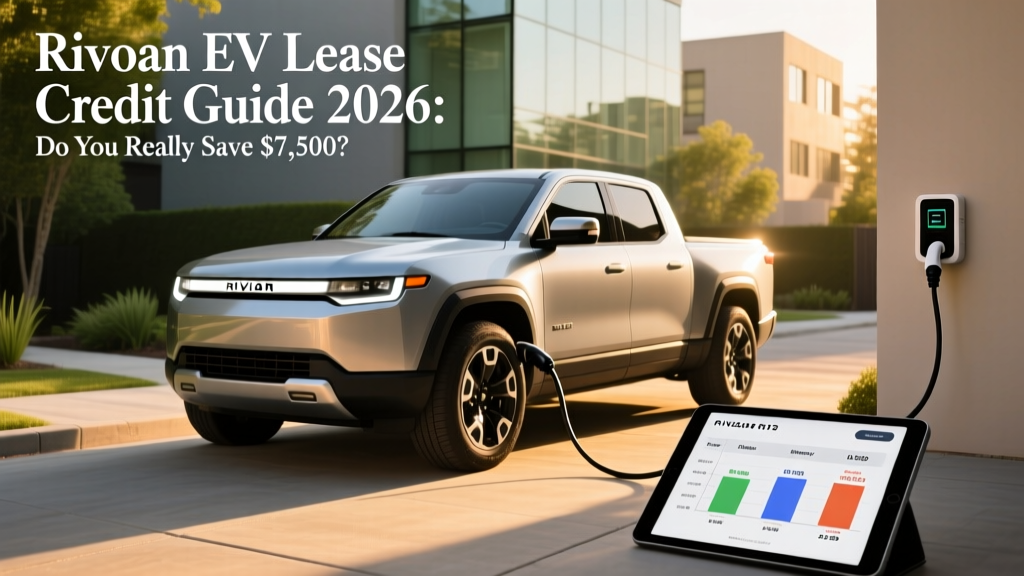
The Rivian R1S and R1T sit in a unique position in the electric-vehicle market: they are premium, American-built adventure vehicles with genuine off-road capability, but their starting prices often push past the federal tax credit's MSRP caps. That's where the Rivian EV lease credit comes in — a mechanism that has become one of the most discussed strategies for lowering the effective cost of a Rivian in 2026.
But how does it actually work? Is the lease credit guaranteed? And when you factor in insurance, charging, depreciation, and maintenance, what does five years of Rivian ownership really cost? This guide breaks down every number you need before signing.
How the Rivian EV Lease Credit Works
The core issue is straightforward: under IRS §30D rules, the federal clean vehicle credit of up to $7,500 is subject to MSRP caps — $80,000 for SUVs and vans, $55,000 for sedans and trucks. Many Rivian R1S and R1T configurations exceed these thresholds, especially Dual-Motor Large and Max Pack variants, which can push well past $90,000.
However, when you lease a vehicle rather than purchase it, the transaction falls under a different section of the tax code — §45W, the commercial clean vehicle credit. In a lease arrangement, the leasing company (the lessor) is considered the vehicle's buyer. They claim the $7,500 credit and, in competitive lease markets, pass some or all of that savings to you through a reduced capitalized cost (the "cap cost" — essentially the negotiated price of the vehicle in a lease).
§30D Purchase Credit vs. §45W Lease Credit: Key Differences
- Purchase (§30D): Buyer must meet income caps ($150K single / $300K joint MAGI), vehicle must be under MSRP cap, battery must meet critical-mineral and component sourcing thresholds, and the buyer claims the credit on their tax return or elects a point-of-sale transfer at the dealer.
- Lease (§45W): No buyer income cap applies to the lessee. No MSRP cap applies to the leased vehicle. The lessor claims the credit and may pass savings to you — but is not legally required to. The lease must be a genuine lease (not a disguised purchase) per IRS guidelines.
- Critical caveat: The lessor's willingness to pass through the full $7,500 varies. Always confirm the cap cost reduction in writing before signing.
In practice, most major leasing companies and Rivian's own financing arm have been passing the full $7,500 through to lessees in 2026, driven by competitive pressure. But this is a market dynamic, not a legal guarantee — and it can change.
Rivian R1S and R1T: 2026 Specs at a Glance
| Spec | R1S Dual-Motor (Standard) | R1T Dual-Motor (Standard) | R1S Tri-Motor Max |
|---|---|---|---|
| Base MSRP | $75,900 | $69,900 | $99,500 |
| EPA Range | 270 mi | 270 mi | 380 mi (est.) |
| Real-World Highway Range | ~220–240 mi | ~220–240 mi | ~310–340 mi |
| Battery (usable) | ~92 kWh (NMC) | ~92 kWh (NMC) | ~141 kWh (NMC) |
| Max DC Fast Charge | ~200 kW peak | ~200 kW peak | ~200 kW peak |
| 10–80% DCFC Time | ~28 min | ~28 min | ~42 min |
| Level 2 Charge Rate | 11.5 kW | 11.5 kW | 11.5 kW |
| 0–60 mph | 4.5 sec | 4.5 sec | 2.9 sec |
| Horsepower | 533 hp | 533 hp | 850 hp |
| Towing Capacity | 7,700 lbs | 11,000 lbs | 7,700 lbs |
| Battery Warranty | 8 yr / 175,000 mi | 8 yr / 175,000 mi | 8 yr / 175,000 mi |
Five-Year Total Cost of Ownership: Rivian vs. Comparable Gas SUV
The lease credit lowers your entry cost, but long-term ownership economics depend on five major categories: acquisition, energy, maintenance, insurance, and depreciation. Here's a 60-month comparison between a leased R1S Dual-Motor and a similarly equipped gas-powered midsize SUV (e.g., BMW X5 xDrive40i, ~$67,000 MSRP, 25 MPG combined).
| Cost Category | Rivian R1S (Leased, Dual-Motor) | Gas SUV (Purchased, 25 MPG) |
|---|---|---|
| Acquisition (5-yr net) | $39,600 (est. $660/mo × 60, with $7,500 cap cost reduction) | $42,000 (est. loan payments after down payment) |
| Energy / Fuel | $4,320 (15,000 mi/yr × $0.12/kWh ÷ 2.5 mi/kWh × 5 yr, home charging dominant) | $10,500 (15,000 mi/yr ÷ 25 MPG × $3.50/gal × 5 yr) |
| Maintenance | $1,800 (cabin filters, wipers, tire rotation, brake fluid) | $4,500 (oil changes, filters, spark plugs, brake pads, transmission fluid) |
| Insurance | $14,400 ($240/mo avg) | $9,600 ($160/mo avg) |
| Depreciation (equity loss) | $0 (leased — residual risk borne by lessor) | $18,000 (~40% over 5 yr on $45K purchase) |
| Total 5-Year Cost | ~$60,120 | ~$84,600 |
Key takeaway: The Rivian lease, when structured with the full $7,500 pass-through, can deliver meaningful 5-year savings — primarily driven by fuel and maintenance reductions and by eliminating depreciation risk (which the lessor absorbs). However, the insurance premium gap is real and substantial.
Charging vs. Gas: The Per-Mile Cost Breakdown
Electricity costs vary enormously depending on where and how you charge. Here's the math with concrete assumptions:
| Scenario | Rate | Cost Per Mile (R1S ~2.5 mi/kWh) |
|---|---|---|
| Home Level 2 (national avg residential) | $0.16/kWh | $0.064/mi |
| Home Level 2 (off-peak utility rate) | $0.08/kWh | $0.032/mi |
| Public DC Fast Charging (avg) | $0.40/kWh | $0.16/mi |
| Tesla Supercharger (Rivian NACS adapter) | $0.28/kWh | $0.112/mi |
| Gas SUV (25 MPG, $3.50/gal) | — | $0.14/mi |
If 80%+ of your charging happens at home on a Level 2 circuit, your effective per-mile energy cost sits around $0.05–$0.07 — roughly half what a comparable gas SUV costs. But if you rely primarily on public DC fast chargers at $0.35–$0.48/kWh, your per-mile cost can exceed gasoline. Home charging access is the single biggest variable in EV ownership economics.
Maintenance Savings: Where EVs Genuinely Win
| Service Item | Gas SUV (5 yr / 75K mi) | Rivian R1S (5 yr / 75K mi) |
|---|---|---|
| Engine oil changes | $600–$900 (8–12 changes) | $0 |
| Transmission fluid | $200–$400 | $0 (single-speed reduction gear) |
| Spark plugs / ignition | $300–$500 | $0 |
| Brake pads | $400–$800 (1–2 replacements) | $0–$200 (regen braking preserves pads; may last 100K+ mi) |
| Air / fuel / cabin filters | $300–$500 | $150–$250 (cabin filter only) |
| Coolant / belts / hoses | $200–$400 | $0 (sealed thermal management system) |
| Tires | $1,200–$2,000 | $1,400–$2,200 (EVs are heavier; tires wear faster) |
| Total Estimated | $3,000–$5,500 | $1,550–$2,650 |
The maintenance advantage is genuine but not infinite. EVs eliminate the entire internal-combustion service schedule — no oil, no spark plugs, no exhaust system, no multi-speed transmission. Regenerative braking dramatically extends brake pad life (many EV owners report original pads at 80,000+ miles). The offset: EVs are heavier, and tire replacement costs are comparable or slightly higher. Rivian's 8-year/175,000-mile battery and drive unit warranty also reduces long-term powertrain risk.
Insurance: The Cost Most Buyers Underestimate
EV insurance premiums are typically 15–30% higher than equivalent gas vehicles. For the Rivian R1S, national average premiums in 2026 range from $200–$320/month depending on your state, driving record, coverage level, and insurer. Several factors drive this:
- Higher repair costs: EV-specific components (battery packs, power electronics, aluminum body panels) require specialized training and equipment to repair. Collision repair networks are still scaling EV capability.
- Higher vehicle values: A $75,000–$100,000 vehicle carries proportionally higher comprehensive and collision premiums.
- Total-loss thresholds: Battery damage in a collision often triggers a total-loss declaration even when structural damage is minor, because battery safety assessment protocols are conservative.
- Limited actuarial data: Insurers have decades of loss data on gas vehicles. EV-specific data sets are still maturing, and insurers price in uncertainty.
Shop aggressively. Insurers like Geico, Progressive, and Lemonade have begun offering EV-specific policies, and some offer discounts for garaged home-charger installations. Always get quotes before committing to a purchase or lease.
Depreciation and Resale Value: What Rivian Owners Should Expect
EV depreciation has been volatile. In 2023–2024, aggressive Tesla price cuts cascaded through the used EV market, pulling down resale values across all brands. By 2026, the market has stabilized somewhat, but EVs still face depreciation headwinds that gas vehicles do not:
- Battery degradation uncertainty: Used buyers discount for unknown battery State of Health (SoH). Rivian's 8-year/175,000-mile warranty (covering capacity below 70%) provides a floor, but the perception of risk persists.
- Technology obsolescence: Newer EVs charge faster, go farther, and offer better software. A 2024 R1S already looks dated next to 2026 models with improved charge curves and NACS-native ports.
- Tax credit pressure: When new buyers can access $7,500 credits, used EV prices must drop to remain competitive.
Industry data from sources like iSeeCars and Kelley Blue Book suggest that premium EVs like the Rivian R1S and R1T have depreciated approximately 35–45% over three years as of early 2026 — steeper than comparable gas SUVs (typically 25–35% over the same period). This is precisely why leasing can be strategically smart: you transfer the residual-value risk to the lessor. If the R1S depreciates more than the lease residual assumes, that's the lessor's problem, not yours.
State, Local, and Utility Incentives: The Layered Savings Stack
- California (CVRP): Up to $2,000 rebate for income-qualified buyers; additional $1,000–$2,500 through utility programs like PGW's Clean Fuel Rebate.
- Colorado: State tax credit of up to $5,000 for EVs with MSRP under $80,000 (note: many Rivians exceed this cap, but the lease §45W pathway may still apply at the lessor level).
- New York (Drive Clean Rebate): Up to $2,000 point-of-sale rebate, income-tiered.
- Utility rebates: Many utilities offer $250–$1,500 for Level 2 home charger purchase and installation. Examples: Xcel Energy (CO/MN), Con Edison (NY), SCE (CA). Check your local utility's EV programs page.
- HOV lane access: Several states (CA, CO, VA, MD, NJ) grant solo HOV lane access to EVs — a significant time-savings benefit that doesn't appear on a balance sheet but has real daily value.
These incentives can stack with the federal lease credit, potentially reducing your effective acquisition cost by an additional $2,000–$7,000 depending on your location. Always confirm eligibility before counting on these amounts.
Frequently Asked Questions
How much does it really cost to own a Rivian R1S over 5 years?
Based on 2026 data with a lease structure including the $7,500 cap cost reduction, 15,000 miles/year, and predominantly home charging, expect approximately $60,000–$65,000 in total 5-year cost. The largest line items are lease payments (~$39,600), insurance (~$14,400), and energy (~$4,300). A comparable gas SUV over the same period typically costs $80,000–$90,000 when fuel, maintenance, and depreciation are included.
Do I qualify for the Rivian EV lease credit regardless of income?
Yes — unlike the §30D purchase credit, the §45W commercial credit applied to leases has no buyer income cap. The MSRP cap also does not apply to leased vehicles. However, the lessor must claim the credit and choose to pass savings to you. Confirm the cap cost reduction in your lease agreement before signing.
How much do I save on fuel and maintenance with a Rivian?
Compared to a 25 MPG gas SUV at $3.50/gallon, a Rivian charged primarily at home ($0.12–$0.16/kWh) saves approximately $5,000–$6,500 in fuel costs over 5 years at 15,000 miles/year. Maintenance savings add another $2,000–$3,500 over the same period, driven by eliminated oil changes, spark plugs, and dramatically reduced brake wear from regenerative braking.
Are Rivians more expensive to insure than gas SUVs?
Yes. Expect Rivian insurance premiums to run 15–30% higher than a comparably priced gas SUV. National averages for the R1S range from $200–$320/month. The primary drivers are higher repair costs (specialized EV components, aluminum bodywork), higher vehicle values, and conservative battery-damage total-loss protocols. Always obtain quotes before committing.
How well do Rivians hold their value?
As of early 2026, Rivian R1S and R1T models have depreciated approximately 35–45% over three years, which is steeper than comparable gas SUVs (25–35%). Battery degradation uncertainty, rapid technology advancement, and new-vehicle tax credit availability all pressure used EV prices. Leasing transfers this depreciation risk to the lessor — a significant strategic advantage if resale values continue to soften.
Can I charge a Rivian at Tesla Superchargers?
Yes. As of 2026, Rivian vehicles can access the Tesla Supercharger network using a NACS adapter (included with new vehicles or available as an accessory). Rivian's native NACS charge port is standard on 2025+ models. Supercharger rates average $0.25–$0.32/kWh, making them a cost-effective public charging option for road trips.
What happens if the Rivian battery degrades significantly?
Rivian's battery warranty covers capacity retention below 70% for 8 years or 175,000 miles, whichever comes first. Real-world data from early R1S and R1T owners suggests NMC battery degradation of approximately 5–8% over the first 100,000 miles with normal use — well within the warranty threshold. Battery replacement outside of warranty, while rare, would cost $15,000–$25,000 depending on pack size.
The Bottom Line on the Rivian EV Lease Credit
The Rivian EV lease credit is a legitimate and currently available mechanism for accessing $7,500 in federal incentive value on configurations that would not qualify under a direct purchase due to MSRP caps. It is not a loophole — it's a structurally different tax pathway (§45W vs. §30D) that happens to benefit higher-priced vehicles. In 2026's competitive EV lease market, most lessors pass the full credit through to lessees.
But the lease credit alone doesn't make a Rivian affordable. The true ownership story is a combination of lower fuel and maintenance costs, higher insurance premiums, eliminated depreciation risk (via leasing), and the ongoing requirement of reliable home charging access to capture the per-mile savings that make EVs economically compelling. Run your own numbers with your local electricity rate, insurance quote, and driving pattern before signing — the math works for many buyers, but it's not universal.