Quick Verdict: The Rivian EDV at a Glance
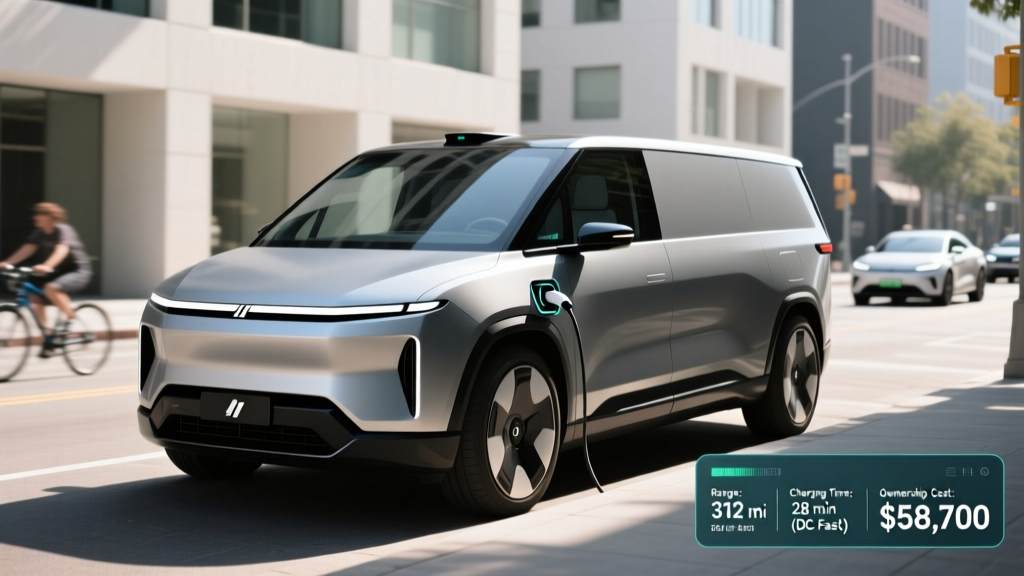
The Rivian Electric Delivery Van (EDV) is not a vehicle you can walk into a dealership and buy. Built exclusively for Amazon's last-mile delivery fleet since 2022, the EDV remains a commercial-only platform as of 2026. However, its engineering DNA — the same skateboard architecture, battery chemistry, and thermal management found in the R1T and R1S — makes it a critical reference point for fleet operators, commercial EV buyers, and anyone tracking Rivian's long-term viability. This profile breaks down every known spec, the real Rivian van cost structure, and what the EDV signals about Rivian's commercial ambitions.
| Spec | Rivian EDV (Large Van) | Rivian EDV (Medium Van) |
|---|---|---|
| EPA Est. Range | ~150 miles | ~120 miles |
| Battery Capacity | ~135 kWh (estimated, NMC) | ~90 kWh (estimated, NMC) |
| Max DC Fast Charge | ~125 kW (estimated) | ~115 kW (estimated) |
| 10–80% DC Charge | ~50 minutes (estimated) | ~45 minutes (estimated) |
| Level 2 Charge Rate | ~11.5 kW | ~11.5 kW |
| Drivetrain | Single-motor FWD | Single-motor FWD |
| Cargo Volume | ~660 cu ft | ~420 cu ft |
| Payload Capacity | ~2,500 lbs | ~1,900 lbs |
| Base MSRP | Not publicly listed — fleet contract pricing only | |
Real-World Range: What the EDV Actually Delivers
Rivian has not published official EPA range figures for the EDV in the same consumer-facing manner as the R1T or R1S, largely because the van is not sold through retail channels. Based on fleet operator reports, Amazon DSP (Delivery Service Partner) data, and Rivian's own engineering disclosures, the large EDV variant achieves approximately 150 miles of range under typical urban delivery conditions — stop-and-go routes with frequent regenerative braking opportunities.
EPA / Sticker Range: ~150 miles (Large EDV, urban delivery cycle)
Real-World Expectation: 110–130 miles on mixed highway/suburban routes; 80–100 miles in extreme cold (below 20°F) with cabin heating and no route preconditioning. Delivery routes with dense stops and heavy regen recovery can approach or exceed the 150-mile figure.
The EDV's range profile is fundamentally different from a consumer EV. Delivery vans operate on predictable, short-radius routes — most Amazon DSP routes cover 60–90 miles per shift, leaving substantial buffer. The single-motor front-wheel-drive layout prioritizes efficiency and interior volume over performance. Unlike the dual- and quad-motor R1 platforms, the EDV sacrifices acceleration for payload capacity and energy conservation.
Cold-weather degradation is the EDV's most significant operational limitation in northern markets. Amazon DSPs in Chicago, Minneapolis, and Boston have reported range reductions of 25–35% during winter months, requiring mid-shift charging on longer routes. Rivian's thermal management system — shared with the R1 fleet — includes a heat pump that mitigates some of this loss, but the van's large, uninsulated cargo bay and frequent door openings limit its effectiveness compared to sealed consumer vehicles.
Charging Speed and Fleet Infrastructure
The EDV charges via a CCS1 connector (not NACS, as Rivian's consumer vehicles are transitioning to) and supports DC fast charging at rates estimated around 125 kW for the large variant. However, fleet charging infrastructure varies enormously by DSP location. Many Amazon delivery stations are equipped with depot-level Level 2 chargers (11.5 kW) for overnight charging, with DC fast chargers available at select hubs for mid-shift top-ups.
| Charging Level | Power (kW) | Time / Rate | Typical Use Case |
|---|---|---|---|
| Level 1 (120V) | ~1.4 kW | ~3–4 miles/hour | Not practical for fleet ops |
| Level 2 (240V) | ~11.5 kW | ~25–30 miles/hour; full charge in ~12–14 hrs | Overnight depot charging |
| DC Fast Charge | ~125 kW peak | 10–80% in ~50 min (large); taper above 80% | Mid-shift top-up at hub |
The EDV's charge curve follows a pattern familiar to R1T and R1S owners: peak charge rates are sustained only between roughly 10–40% State of Charge (SoC), with a pronounced taper above 60% and a steep drop above 80%. This is normal NMC lithium-ion behavior — charging speed is not constant across the battery's capacity. Fleet operators are trained to charge to 80% for daily use to preserve battery longevity and avoid the slow, inefficient top-off phase.
For individual buyers or small fleets considering used EDVs (a secondary market has begun emerging as Amazon's earliest delivery vans age out of primary service), home Level 2 installation is essential. A 240V / 48-amp circuit delivering 11.5 kW requires a dedicated 60-amp breaker and, in many homes, a panel upgrade from 100A to 200A service. Expect installation costs of $1,200–$3,500 depending on panel condition and conduit run distance — always get a licensed electrician's assessment before committing.
Performance and Drivetrain
The EDV is not a performance vehicle, and Rivian has never marketed it as one. The single front-mounted motor produces an estimated 250–280 horsepower — adequate for loaded urban delivery but unremarkable by Rivian's consumer-vehicle standards. The 0–60 mph time is estimated at 8–10 seconds under typical payload, which is competitive with internal-combustion delivery vans like the Ford E-Transit (0–60 in roughly 9–10 seconds) but far behind the R1T Dual-Motor's 4.5-second sprint.
The front-wheel-drive layout is a deliberate engineering choice for the EDV. A flat floor with no rear drive unit maximizes cargo volume and allows the low-step entry that delivery drivers need for hundreds of daily ingress/egress cycles. The trade-off is reduced traction in snow and mud compared to Rivian's AWD consumer platforms — a known limitation for DSPs operating in mountainous or heavily snow-affected regions.
Rivian Van Cost: Pricing, Fleet Economics, and Tax Credits
The Rivian van cost question is complicated by the EDV's exclusive fleet distribution model. Rivian does not publish a retail MSRP for the EDV because it is not available through consumer channels. The van was developed under an exclusive agreement with Amazon, which holds contractual rights to the EDV platform through at least 2030. However, industry analysts and supply-chain reporting estimate the per-unit manufacturing cost at $55,000–$70,000 for the large variant, depending on battery size and configuration.
| Cost Factor | Estimated Figure | Notes |
|---|---|---|
| Est. Manufacturing Cost (Large) | $55,000–$70,000 | Not a retail price; Amazon contract pricing is confidential |
| Est. Manufacturing Cost (Medium) | $45,000–$58,000 | Smaller battery, reduced payload |
| Federal Tax Credit (§30D) | Up to $7,500 (if eligible) | Commercial fleets claim via §45W commercial credit, not §30D consumer credit |
| Used EDV (Secondary Market) | $25,000–$40,000 (est.) | Emerging market; high-mileage fleet vehicles, condition varies |
| Home Level 2 Install | $1,200–$3,500 | Electrician, panel upgrade if needed, permit |
Does the Rivian EDV Qualify for the Federal EV Tax Credit?
This is where the EDV's commercial status matters enormously. Individual consumers cannot currently purchase a new EDV, so the consumer-facing IRS §30D clean vehicle credit — which offers up to $7,500 for qualifying new EV purchases — does not apply in practice. However, commercial fleet operators who acquire EDVs (or equivalent commercial EVs) may be eligible for the §45W commercial clean vehicle credit, which provides up to $7,500 for vehicles under 14,000 lbs GVWR and up to $40,000 for heavier commercial vehicles.
The §45W credit has its own eligibility requirements, including domestic assembly (the EDV is built at Rivian's Normal, Illinois facility, satisfying this rule) and battery-component sourcing thresholds that tighten annually through 2032. Fleet operators should consult a tax professional for current-year eligibility, as these rules are subject to legislative change and IRS guidance updates.
For individual buyers watching the secondary market: if a used EDV becomes available and qualifies under the used clean vehicle credit (§25E), the buyer could claim up to $4,000 or 30% of the sale price (whichever is lower), subject to income caps ($75,000 single / $150,000 joint) and a vehicle sale price cap of $25,000. Given current used EDV pricing estimates above that cap, the §25E credit may not apply to most used examples.
Efficiency, Cargo, and Standout Features
The EDV achieves an estimated 1.8–2.2 kWh per mile in typical delivery operation — equivalent to roughly 1.5–1.8 MPGe when adjusted for the EPA's MPGe calculation methodology (33.7 kWh = 1 gallon of gasoline). This is competitive with the Ford E-Transit's ~2.0 kWh/mile and significantly better than any internal-combustion delivery van in the same class, which typically achieve 10–14 MPG loaded.
Cargo volume is the EDV's headline advantage. The large variant offers approximately 660 cubic feet of cargo space — substantially more than the Ford E-Transit's ~487 cu ft and the Mercedes-Benz eSprinter's ~530 cu ft. The van's right-side curbside door, wide opening rear doors, and low load floor (enabled by the skateboard battery platform) are purpose-built for Amazon's delivery workflow. The driver's compartment includes a custom Rivian-designed infotainment system with integrated route navigation, package scanning, and fleet telematics — none of which are consumer-facing or transferable to personal use without significant modification.
Notable tech features include:
- Regenerative braking with one-pedal driving — reduces brake wear significantly in stop-heavy delivery routes
- Over-the-air (OTA) updates — Rivian pushes firmware improvements fleet-wide, a capability legacy commercial vans lack
- Integrated fleet telematics — real-time vehicle health, SoC monitoring, and route optimization via Amazon's internal platform
- Heat pump HVAC — more efficient cabin heating than resistive systems, preserving range in cold weather
Drawbacks are significant for any non-Amazon buyer:
- Proprietary fleet software — infotainment and telematics are locked to Amazon's ecosystem
- No consumer warranty support — Rivian's service network is configured for fleet contracts, not individual EDV owners
- Single-motor FWD only — no AWD option for snow/mountain routes
- Limited secondary-market parts availability — body panels, cargo hardware, and fleet-specific components are not stocked at consumer service centers
Warranty and Battery Longevity
Rivian provides fleet operators with a commercial warranty structure that differs from its consumer vehicle warranties. Based on available fleet disclosures and DSP contract reporting, the EDV's battery and powertrain are covered for 8 years or 100,000 miles (whichever comes first), with a capacity retention threshold of approximately 70% — consistent with Rivian's consumer battery warranty terms and industry-standard for commercial EV platforms.
The EDV uses NMC (nickel manganese cobalt) lithium-ion cells, the same chemistry found in the R1T and R1S. NMC offers higher energy density than LFP (lithium iron phosphate), which is critical for maximizing range in a large, heavy van. However, NMC cells are more sensitive to sustained high-SoC storage and extreme heat — fleet operators are instructed to charge to 80% for daily use and avoid leaving vans at 100% SoC for extended periods. Degradation data from Amazon's earliest EDV deployments (2022–2023 models now approaching 80,000–100,000 miles) suggests capacity loss of approximately 8–12% over three years of intensive urban delivery use, which is within expected NMC degradation curves.
Battery replacement cost for the EDV is not publicly disclosed, but based on the R1 platform's replacement pricing ($15,000–$22,000 for a full pack replacement out of warranty), the EDV's larger battery would likely cost $18,000–$28,000 if replacement is needed post-warranty. This is a significant consideration for used EDV buyers evaluating high-mileage examples.
Who Should Consider the Rivian EDV?
The EDV is purpose-built for a single use case: high-frequency, short-radius urban and suburban delivery. It excels in this role — quiet operation, low running costs, regenerative braking that slashes brake maintenance, and cargo volume that outclasses every competitor in its footprint. Amazon's DSP network operates over 10,000 EDVs as of 2026, and the van's reliability data has been largely positive, with fewer unplanned downtime events than comparable ICE delivery vans.
For individual buyers or small commercial fleets, the EDV presents a complicated picture:
Pros
- Class-leading cargo volume (~660 cu ft, large variant)
- Low per-mile energy cost (~$0.06–$0.10/mile depending on electricity rate)
- Minimal brake wear from aggressive regen
- OTA updates and modern EV architecture
- Quiet, zero-tailpipe-emission urban operation
Cons
- Not available new to individual consumers
- Fleet-locked software and telematics
- FWD only — no AWD option
- Cold-weather range loss of 25–35%
- Limited consumer service/parts network
- Used examples may have high mileage and fleet wear
Is the Rivian EDV Worth It vs. Competitors?
If you can acquire one — through a fleet lease, secondary-market purchase, or future Rivian commercial program — the EDV is objectively the most capable electric delivery van in its class by cargo volume and energy efficiency. The Ford E-Transit is more accessible to individual buyers and small fleets, with published retail pricing (~$45,000–$55,000 MSRP), a consumer-facing warranty, and service through any Ford commercial dealer. The Mercedes-Benz eSprinter offers more configurability but at a higher price point and with less range. For pure last-mile delivery optimization, the EDV wins. For accessibility, serviceability, and consumer purchase options, the E-Transit is the pragmatic choice in 2026.
Frequently Asked Questions
Can I buy a Rivian EDV van as an individual?
Not new. The EDV is produced exclusively for Amazon under a long-term fleet contract. A secondary market for used EDVs is beginning to emerge as early-model vans are retired from Amazon DSP service, but availability is extremely limited and vehicles may have proprietary software locks that limit non-fleet use.
What is the real-world range of the Rivian EDV?
Approximately 110–130 miles on mixed routes, with the full ~150-mile figure achievable on dense urban delivery routes with heavy regenerative braking. Cold weather (below 20°F) can reduce range to 80–100 miles. Actual range depends heavily on payload weight, route topography, and HVAC usage.
How fast does the Rivian EDV charge?
DC fast charging peaks at an estimated 125 kW, achieving a 10–80% charge in roughly 50 minutes for the large variant. Level 2 home or depot charging at 11.5 kW adds approximately 25–30 miles per hour, requiring 12–14 hours for a full charge from empty.
How much does a Rivian van cost after tax credits?
New EDVs are not available for retail purchase, so the consumer §30D credit does not apply. Commercial fleet operators may qualify for the §45W commercial clean vehicle credit (up to $7,500 for vans under 14,000 lbs GVWR). Used EDV pricing is estimated at $25,000–$40,000; the §25E used-vehicle credit (up to $4,000) requires a sale price at or below $25,000, which may exclude most used examples.
Does the Rivian EDV have AWD?
No. The EDV is single-motor front-wheel-drive only. This maximizes cargo floor space and efficiency but limits traction in snow, ice, and steep grades compared to Rivian's dual- and quad-motor consumer vehicles.
What is the battery warranty on the Rivian EDV?
Rivian covers the EDV battery and powertrain for 8 years or 100,000 miles, with a capacity retention threshold of approximately 70%. This is consistent with Rivian's consumer battery warranty and standard for commercial EV platforms.
What battery chemistry does the EDV use?
The EDV uses NMC (nickel manganese cobalt) lithium-ion cells, the same chemistry as the R1T and R1S. NMC offers higher energy density than LFP but requires more careful charge management (avoiding sustained 100% SoC) to maximize longevity.
Sources: Rivian Fleet, IRS §45W Commercial Clean Vehicle Credit, fueleconomy.gov. All specifications are based on available fleet data and industry reporting as of 2026; Rivian has not published official consumer-facing specs for the EDV. Tax credit eligibility is subject to change — consult a tax professional for current-year rules.