Quick Verdict: The Purpose-Built Delivery EV Setting the Fleet Standard
The Rivian EDV (Electric Delivery Van) is not a consumer vehicle you can walk into a dealership and buy. Designed from the ground up for Amazon's last-mile delivery network and now expanding to select commercial fleet partners, the Rivian fleet van represents the most data-rich, high-volume electric commercial vehicle on American roads. With over 10,000 units deployed through Amazon's logistics network as of early 2026, the EDV has accumulated billions of real-world delivery miles — making it arguably the most proven electric commercial van in production.
For fleet operators evaluating electrification, the EDV's combination of 150+ mile real-world range, purpose-built cargo architecture, and Rivian's over-the-air improvement cycle makes it a benchmark. But availability remains tightly controlled, and operators outside Amazon's ecosystem face limited ordering options. Here's everything you need to know about specs, charging, and total cost of ownership.
Rivian EDV Specifications at a Glance
| Attribute | Specification |
|---|---|
| EPA Estimated Range | 161 miles (EDV-700, fully loaded) |
| Battery Capacity | ~135 kWh usable (NMC lithium-ion) |
| Drivetrain | Single-motor RWD (dual-motor AWD available) |
| Horsepower | ~320 hp (single motor) |
| 0–60 mph | ~7.5 seconds (unloaded, est.) |
| Cargo Volume | 650 cu ft (EDV-700) |
| Payload Capacity | ~2,500 lbs |
| Max DC Fast Charge | ~150 kW peak |
| Level 2 Charge Rate | ~11.5 kW (240V/48A) |
| Efficiency | ~2.1 kWh/mile (loaded delivery cycle) |
| Battery Warranty | 8 years / 100,000 miles (60%+ SoH) |
| GVWR Class | Class 2b / Class 3 (varies by config) |
Note: The EDV comes in three configurations — EDV-500 (smaller cargo), EDV-700 (standard), and EDV-900 (largest). Amazon primarily deploys the EDV-700 for suburban and urban last-mile routes.
Range and Efficiency: Real-World Delivery Data
EPA Estimated Range: 161 miles (EDV-700, loaded)
Real-World Delivery Route Expectation: 120–145 miles on stop-and-go urban routes with full cargo load; 140–160 miles on lighter suburban routes.
Cold-Weather Impact: Expect 15–25% range reduction in sub-30°F conditions, bringing effective range to 100–125 miles on heavy-load winter routes. The EDV's thermal management system and heat pump mitigate some loss, but frequent door openings during deliveries compound cabin heating demands.
The EDV's 161-mile EPA figure is conservative by design — fleet operators need predictable, worst-case planning numbers, not optimistic best-case scenarios. In Amazon's published deployment data, the vast majority of delivery routes complete well within 100 miles, leaving a comfortable buffer for detours, traffic, and climate demands.
Efficiency in real delivery cycles averages approximately 2.1 kWh per mile, which translates to roughly 48 MPGe equivalent in mixed urban delivery use. This is competitive with — and in many route profiles, superior to — comparable diesel or gasoline step vans, particularly in stop-and-go traffic where regenerative braking recovers significant energy.
Charging Speed: Depot-Based Strategy
| Charging Level | Power | Charge Time (10–80%) | Notes |
|---|---|---|---|
| Level 1 (120V) | ~1.4 kW | Not practical for fleet use | Emergency/trickle only |
| Level 2 (240V/48A) | 11.5 kW | ~8–9 hours (0–100%) | Standard depot overnight charging |
| DC Fast Charge | ~150 kW peak | ~45 minutes (10–80%) | CCS connector; tapers above 80% |
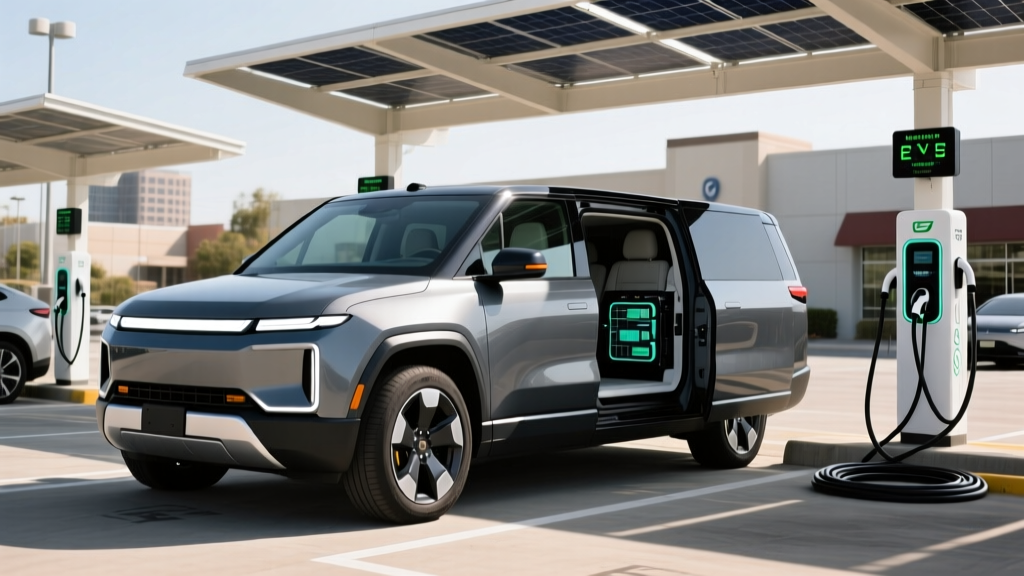
The EDV is engineered primarily for depot-based Level 2 overnight charging, which is the operational model for most last-mile delivery fleets. Vans return to the depot in the evening, plug into Level 2 chargers, and are fully replenished by morning. This eliminates the need for mid-route fast charging in normal operations.
DC fast charging at up to 150 kW is available via CCS1 connector for contingency use — a van that needs a quick top-up during an unusually long route or a depot charger that's offline. The charge curve peaks around 150 kW up to approximately 40% State of Charge, then tapers progressively. A 10–80% charge takes roughly 45 minutes, which is adequate for fleet contingency but not designed for rapid turnaround like a consumer road-trip vehicle.
Fleet operators installing depot charging should budget for commercial-grade Level 2 infrastructure. A 48-amp, 240V circuit per charger is standard, and most depots install networked chargers (ChargePoint, EV Connect, or similar) with load management to avoid demand-charge spikes from utility providers.
Performance and Drivetrain
The EDV-700's single rear-mounted motor delivers approximately 320 horsepower and substantial low-end torque — critical for a vehicle that starts and stops hundreds of times per day with a full cargo load. The 0–60 mph time of roughly 7.5 seconds (unloaded) isn't sports-car territory, but it's noticeably quicker than a comparable gasoline or diesel step van merging onto a highway ramp.
The RWD layout is standard and sufficient for most urban and suburban delivery environments. A dual-motor AWD configuration is available for fleets operating in regions with significant snow, ice, or unpaved route segments. The AWD variant adds weight and reduces range by approximately 8–12 miles but provides meaningful traction improvement in adverse conditions.
Regenerative braking is aggressive and well-calibrated for delivery use. Drivers report significant one-pedal driving capability on urban routes, reducing brake wear — a meaningful maintenance cost saving for fleets logging 20,000–30,000 miles annually with constant stopping.
Cargo Space and Purpose-Built Design
The EDV-700 offers approximately 650 cubic feet of cargo volume with a flat load floor, wide rear door opening, and a low step-in height designed for high-frequency package handling. The driver's compartment is separated from the cargo area by a bulkhead, and the cabin includes features specific to delivery work: a fold-down desk surface for manifest work, multiple device charging ports, and integrated shelving provisions.
Key cargo and usability dimensions:
- Cargo volume (EDV-700): ~650 cu ft
- Cargo volume (EDV-900): ~815 cu ft
- Cargo volume (EDV-500): ~435 cu ft
- Payload capacity: ~2,500 lbs (varies by config)
- Low load floor height: ~22 inches for easy step-in
- Rear door opening: Full-width roll-up with 72+ inch clearance
- Driver legroom: Generous — designed for all-day seated use with entry/exit frequency
The EDV's standout design feature is the passenger-side curbside door — a large sliding door on the right side that allows drivers to exit directly onto the sidewalk without stepping into traffic. This is a safety innovation that conventional step vans lack, and delivery drivers consistently cite it as a quality-of-life improvement.
Pricing, Availability, and Tax Credit Eligibility
The Rivian EDV is not sold through traditional dealerships or listed with consumer MSRPs. It is a commercial fleet vehicle sold directly to qualified fleet operators through Rivian's commercial division. Pricing is negotiated based on fleet size, configuration, and support agreements, and is not publicly listed.
Industry estimates place the EDV-700 at approximately $90,000–$110,000 per unit depending on configuration, volume, and support package — competitive with the total acquisition cost of a diesel step van when accounting for fuel and maintenance savings over a 5-year deployment cycle.
Fleet buyers should note that the EDV qualifies under IRC §45W (Commercial Clean Vehicle Credit), not the consumer §30D credit. Key details:
- Credit amount: Up to $7,500 for vehicles under 14,000 lbs GVWR; up to $40,000 for heavier vehicles
- Eligibility: Qualified commercial vehicles placed in service by a business or tax-exempt organization
- No MSRP cap: Unlike the consumer §30D credit, §45W has no MSRP ceiling
- No personal income cap: Business entity eligibility, not individual income limits
- Battery sourcing: Requirements apply — consult IRS guidance and a tax professional for current-year rules
- Transferability: Credit can be transferred to the seller (Rivian) in exchange for a purchase price reduction under current IRS rules
Source: IRS Commercial Clean Vehicle Credit. Always verify eligibility with a qualified tax professional — rules are subject to legislative change.
For fleets purchasing through Amazon's Delivery Service Partner (DSP) program, vehicle acquisition is typically managed through Amazon's logistics contracts rather than direct Rivian purchase, and tax credit benefits flow through the program structure.
Tech Features and Driver Assistance
The EDV runs Rivian's proprietary software stack with over-the-air (OTA) updates — a significant advantage over legacy commercial vehicles. Features include:
- 15.6-inch central touchscreen with delivery-optimized navigation and route management integration
- Driver+ assistance: SAE Level 2 driver-assist system including adaptive cruise control, lane-keeping assist, and automatic emergency braking. This is not autonomous driving — the driver must remain fully engaged at all times.
- 360-degree camera system with curb-view cameras for tight urban maneuvering
- Telematics integration: Fleet managers can monitor vehicle health, battery SoC, route efficiency, and driver behavior remotely
- OTA updates: Rivian continuously deploys software improvements — range optimization, regenerative braking tuning, and new features are delivered remotely
- Preconditioning: Battery thermal preconditioning for optimal charging speed when depot charger is scheduled
The EDV's Driver+ system is an SAE Level 2 driver-assist feature. It does not drive the vehicle autonomously. The driver must maintain hands on the steering wheel (or demonstrate attentiveness) and eyes on the road at all times. Level 2 systems assist with steering and speed but require full human oversight. Only Level 4 robotaxi services (Waymo, Zoox) operate without a human driver — and those are not available in commercial delivery vans.
Warranty and Long-Term Battery Outlook
Rivian provides a commercial fleet warranty package structured for high-utilization vehicles:
- Battery warranty: 8 years / 100,000 miles, retaining at least 60% of original capacity (State of Health)
- Powertrain warranty: 8 years / 100,000 miles
- Bumper-to-bumper: 5 years / 60,000 miles (commercial use terms apply)
The EDV uses NMC (nickel manganese cobalt) lithium-ion cells — chosen for energy density and the ability to handle the high-cycle-count demands of daily delivery routes. NMC chemistry typically shows 10–15% capacity degradation over the first 100,000 miles under normal use, well within the warranty threshold. Fleet operators should monitor State of Health (SoH) through Rivian's telematics dashboard and avoid routinely charging to 100% unless route demands require it — keeping daily SoC between 20–85% extends long-term cell health.
Battery replacement cost for a ~135 kWh NMC pack is estimated at $18,000–$28,000 based on current commercial cell pricing and labor, though this figure is expected to decline as battery costs continue their long-term downward trend. Most fleet operators plan for battery replacement at the 8–10 year mark if the vehicle remains in service beyond the warranty period.
Pros and Cons
- Purpose-built for delivery: curbside door, low step-in, optimized cargo layout
- Proven at scale: billions of real-world delivery miles across 10,000+ units
- OTA updates continuously improve efficiency and add features
- Lower per-mile operating cost vs. diesel/gas step vans
- Significant reduction in brake wear via regenerative braking
- Driver satisfaction and retention benefits reported by DSPs
- §45W commercial tax credit eligibility (up to $7,500–$40,000)
- Not available for individual consumer purchase — fleet/commercial only
- 150-mile real-world range limits use to defined last-mile routes
- Cold-weather range loss of 15–25% requires route planning adjustments
- DC fast charging at 150 kW is moderate — not designed for rapid mid-route turnaround
- Depot charging infrastructure investment required ($5,000–$15,000+ per charger installed)
- Availability outside Amazon's ecosystem remains limited as of 2026
- Service network is Rivian-specific — fewer touchpoints than legacy commercial dealers
Who the Rivian Fleet Van Suits Best
The EDV is ideal for:
- Last-mile delivery fleets with defined routes under 120 miles per day and depot-based overnight charging
- Urban and suburban logistics operators seeking to reduce fuel and maintenance costs on high-stop-count routes
- Amazon Delivery Service Partners operating within the DSP program infrastructure
- Fleet operators with sustainability mandates requiring verifiable emissions reduction
The EDV is not suited for:
- Long-haul or regional delivery routes exceeding 150 miles between depot charges
- Owner-operators or small businesses without access to commercial depot charging
- Individual consumers seeking an electric van for personal use (consider the Rivian R1S or other consumer EVs)
Frequently Asked Questions
What is the real-world range of the Rivian fleet van?
The EDV-700 delivers approximately 120–145 miles on loaded urban delivery routes and 140–160 miles on lighter suburban routes. Cold weather (below 30°F) reduces effective range by 15–25%. The EPA estimated range is 161 miles, but fleet operators should plan routes around 100–120 miles for worst-case reliability.
How fast does the Rivian EDV charge?
At a depot Level 2 charger (11.5 kW / 240V), a full charge takes 8–9 hours — designed for overnight replenishment. DC fast charging peaks at approximately 150 kW, achieving 10–80% in about 45 minutes via CCS1 connector. The charge curve tapers above 80% SoC to protect battery longevity.
How much does the Rivian fleet van cost after tax credits?
The EDV-700 is estimated at $90,000–$110,000 per unit depending on configuration and volume. The §45W Commercial Clean Vehicle Credit can provide up to $7,500 (or more for heavier configurations) for qualified commercial purchasers. Exact pricing is negotiated directly with Rivian's commercial division and is not publicly listed.
Can I buy a Rivian EDV for personal use?
No. The EDV is sold exclusively to qualified commercial fleet operators. Rivian does not offer the EDV through consumer channels. Individuals seeking an electric van should look at consumer alternatives or wait for Rivian's potential future consumer van offering (not yet announced as of 2026).
Does the Rivian fleet van qualify for the federal EV tax credit?
Yes, but under §45W (Commercial Clean Vehicle Credit), not the consumer §30D credit. The §45W credit has no MSRP cap and no personal income cap — it applies to qualified business entities. Battery sourcing requirements and other eligibility criteria apply. Consult a tax professional for current-year rules.
Is the Rivian EDV worth it vs. a diesel step van?
For defined last-mile routes with depot charging, the EDV typically achieves lower total cost of ownership over 5 years due to reduced fuel costs (electricity at ~$0.12–$0.18/kWh vs. diesel at $3.50–$4.50/gallon), lower maintenance (no oil changes, reduced brake wear), and available tax credits. The breakeven point varies by route profile, local electricity rates, and fleet size. Operators running routes under 120 miles with overnight depot charging see the strongest economics.
What battery chemistry does the EDV use?
The EDV uses NMC (nickel manganese cobalt) lithium-ion cells in a ~135 kWh usable pack. NMC offers high energy density suitable for the EDV's payload and range requirements. Fleet operators should maintain 20–85% daily SoC where possible and use Rivian's telematics to monitor long-term State of Health.
How does the EDV compare to the Ford E-Transit?
The Ford E-Transit is the EDV's closest competitor and is available to a broader range of fleet buyers. The E-Transit offers ~126 miles EPA range, ~68 kWh battery, and ~115 kW DC fast charging — lower specs than the EDV but at a lower price point (~$45,000–$55,000 MSRP) and with wider dealer-based availability. The EDV offers more range, more cargo volume, and a more purpose-built delivery design, but with limited availability outside Amazon's network. Fleet operators with access to the EDV generally prefer it; those without access find the E-Transit a capable alternative.
Sources: Rivian Commercial, IRS §45W Commercial Clean Vehicle Credit, EPA Fuel Economy. Specifications are based on 2026 model-year data and may vary by configuration. Always confirm current specs and incentive eligibility with the manufacturer and a qualified tax professional.