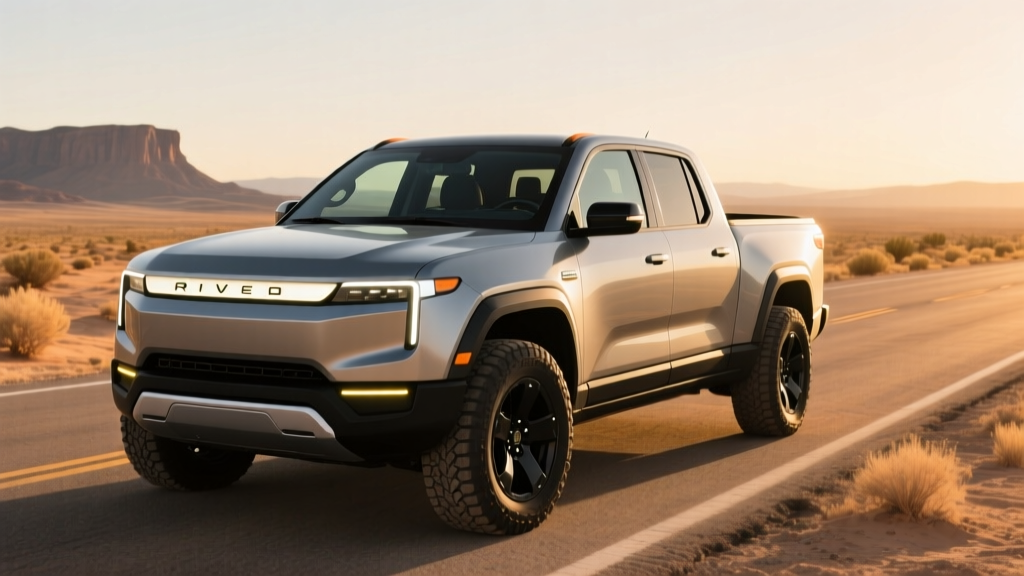
When prospective EV buyers search for Rivian CEO Scaringe compensation, they're usually asking a deeper question: is this company financially stable enough to support my $70,000+ electric truck purchase for the next decade? Leadership pay, corporate governance, and product quality are inextricably linked in the EV startup space. In this review, we break down RJ Scaringe's compensation structure and what it signals about Rivian's priorities, then put the flagship 2026 Rivian R1T Dual-Motor through a complete spec-by-spec evaluation — from its EPA range and charging curve to real-world ownership economics and federal tax credit eligibility.
Rivian Leadership: What Scaringe's Pay Package Means for Buyers
RJ Scaringe founded Rivian in 2009 (originally Mainstream Motors) and has guided it through IPO, production ramp, and the grueling path to positive gross margins. His compensation has drawn scrutiny — a 2021 stock-award package tied to market-cap and revenue milestones was valued at billions on paper, though much of it vests only if Rivian hits aggressive targets (e.g., $100B+ market cap, $20B+ revenue). For context, in proxy filings, Rivian has emphasized performance-based equity over cash salary, aligning Scaringe's incentives with long-term shareholder and, arguably, customer value.
For an EV buyer, the relevant takeaway is this: Scaringe's compensation structure incentivizes scaling production, improving unit economics, and expanding the service network — all things that directly affect your ownership experience. A CEO paid primarily in performance-tied stock is less likely to abandon the R1 platform prematurely and more likely to invest in parts availability and software updates. That said, Rivian's financial trajectory bears watching; service-center density and parts turnaround remain pain points in some metro areas.
2026 Rivian R1T: Core Specs at a Glance
| Specification | 2026 R1T Dual-Motor (Standard Pack) | 2026 R1T Tri-Motor (Max Pack) |
|---|---|---|
| EPA Range | 270 mi | 420 mi (est.) |
| Battery Capacity (usable) | ~95 kWh (NMC) | ~149 kWh (NMC, 4695 cells) |
| Drivetrain | Dual-Motor AWD | Tri-Motor AWD |
| Horsepower | 533 hp | 850 hp |
| 0–60 mph | 4.5 sec | ~3.0 sec |
| Max DC Fast Charge | 200 kW (peak) | 220 kW (peak) |
| 10–80% DCFC Time | ~28 min | ~36 min |
| Level 2 Home Charge | 11.5 kW (~25 mi/hr) | 11.5 kW (~35 mi/hr) |
| Towing Capacity | 11,000 lb | 11,000 lb |
| MPGe (combined) | 73 MPGe | 70 MPGe (est.) |
| EPA Efficiency | 46 kWh/100 mi | 48 kWh/100 mi (est.) |
| Base MSRP | $69,900 | $99,900 |
| As-Tested (Adventure trim) | ~$78,500 | ~$108,000 |
| Battery Warranty | 8 yr / 175,000 mi | 8 yr / 175,000 mi |
Real-World Range: Beyond the EPA Sticker
EPA Estimate: 270 miles (Dual-Motor Standard) / 420 miles (Tri-Motor Max)
Real-World Expectation: Plan on ~230–245 miles highway at 70 mph in mild weather for the Dual-Motor. Cold-weather (below 30°F) highway driving can drop that to ~190–210 miles. The Tri-Motor Max delivers roughly ~340–370 highway miles in similar conditions. Towing a 5,000-lb trailer cuts range roughly in half regardless of pack.
The R1T's boxy truck shape and 5,000+ lb curb weight mean aerodynamic drag dominates at highway speeds. EPA data via fueleconomy.gov confirms the 73 MPGe combined figure, which translates to roughly 2.1–2.3 miles per kWh in mixed driving. City and suburban driving with regenerative braking recovers more energy, often pushing real-world efficiency to 2.5+ mi/kWh. If your commute is stop-and-go, expect to beat the EPA sticker; if your road trips are 80-mph interstate sprints through winter, plan charging stops conservatively.
Charging Speed and Infrastructure
| Charging Level | Power / Voltage | Miles Added Per Hour | Notes |
|---|---|---|---|
| Level 1 (120V) | ~1.4 kW | ~3 mi/hr | Emergency/trickle only |
| Level 2 (240V, 48A) | 11.5 kW | 25–35 mi/hr | Fully charges overnight (~9–12 hr) |
| DC Fast (CCS/NACS) | Up to 220 kW peak | ~500+ mi/hr at peak | 10–80% in ~28–36 min |
Rivian's charge curve is competitive but not class-leading. Peak rates of 200–220 kW are sustained roughly between 15% and 45% SoC before tapering. Above 80%, charging slows dramatically — a universal lithium-ion behavior to protect cell longevity, but worth knowing when you're tempted to top off at a rest stop. For 2026, Rivian has adopted the NACS (Tesla-style) connector natively on new builds, granting access to Tesla Supercharger V3/V4 stalls via Rivian's integrated navigation preconditioning. CCS adapters remain available for older models and Electrify America / EVgo networks.
At home, a 48-amp Level 2 wall connector on a 60-amp circuit is the sweet spot. Expect a full Standard Pack charge in ~9 hours; Max Pack takes ~13 hours. Budget $800–$1,500 for a quality Level 2 unit plus $500–$2,000 for licensed electrician installation (panel upgrades can add $1,500+ if you're near capacity).
Performance, Cargo, and Daily Utility
The Dual-Motor R1T's 533 hp and 4.5-second 0–60 time outpace most body-on-frame trucks, and the instantaneous torque makes merging and passing effortless. The Tri-Motor's 850 hp is supercar territory in a pickup, though the efficiency penalty (~3 MPGe) is noticeable. Rivian's quad-motor configuration (one per wheel on the Tri) enables genuine torque vectoring, which translates to sharper cornering and better low-traction control than conventional AWD.
Cargo and space: The 4.5-foot bed (extending to ~6 ft with the Gear Tunnel) is shorter than a traditional full-size truck, but the lockable Gear Tunnel (11.7 cu ft) and front trunk (frunk, ~11 cu ft) compensate for secure storage. Rear-seat legroom measures ~38.5 inches — adequate for adults on long drives. Interior materials (vegan leather, ash wood) feel premium, and the 15.6-inch landscape touchscreen runs Rivian's in-house OS, which receives regular OTA updates. Wireless Apple CarPlay and Android Auto are standard.
Driver assistance: Rivian's Driver+ system is a SAE Level 2 hands-on highway assist — adaptive cruise, lane centering, and automatic lane changes on supported roads. It is not self-driving. You must remain engaged. It competes with Ford BlueCruise and GM Super Cruise, though it lacks the hands-free certification those systems carry on mapped highways.
Pricing, Tax Credits, and Ownership Cost
| Trim | MSRP | Federal §30D Credit (if eligible) | Effective Price |
|---|---|---|---|
| Dual-Motor Standard (Adventure) | $69,900 | Up to $7,500 (point-of-sale) | ~$62,400 |
| Dual-Motor Large Pack | $75,900 | Up to $7,500 | ~$68,400 |
| Tri-Motor Max (Adventure) | $99,900 | $0 (above $80K truck MSRP cap) | $99,900 |
The IRS §30D clean vehicle credit has strict rules for 2026: trucks must have an MSRP at or below $80,000, the buyer's AGI must not exceed $300,000 (joint) / $225,000 (head of household) / $150,000 (single), and the battery must meet critical-mineral and component-sourcing thresholds that tighten annually. The Dual-Motor Standard and Large Pack typically qualify for the full $7,500, transferable to the dealer at point of sale as an immediate discount. The Tri-Motor Max exceeds the $80K MSRP cap and is ineligible regardless of buyer income.
Always verify current-year sourcing requirements on IRS.gov before purchase — battery supply chains shift, and a vehicle that qualified in January may not in December. State incentives (e.g., California's CVRP, Colorado's $5,000 credit) stack on top but vary by jurisdiction.
5-year total cost of ownership favors the R1T over comparable ICE trucks (Ford F-150 Lariat, Ram 1500 Limited) primarily through fuel savings (electricity at $0.14/kWh ≈ $0.06/mi vs. gasoline at $3.50/gal ≈ $0.22/mi for a 16-mpg truck). Insurance premiums run 15–25% higher than ICE trucks, and Rivian's direct-service model means fewer local repair options in rural areas.
Warranty and Long-Term Battery Outlook
Rivian covers the R1T with a 5-year/60,000-mile bumper-to-bumper warranty and an 8-year/175,000-mile battery and driveunit warranty, retaining at least 70% capacity. The 175,000-mile threshold is generous compared to the industry-standard 100,000 miles. Real-world degradation data from early 2022–2023 R1 owners (tracked via Rivian forums and Recurrent Auto) shows ~4–6% capacity loss at 50,000 miles, consistent with NMC chemistry under active thermal management.
Out-of-warranty battery replacement remains expensive — estimates range from $15,000 to $25,000 depending on pack size — but Rivian's modular pack architecture is designed for sectional repair rather than full replacement, potentially lowering costs as the platform matures.
Pros, Cons, and Who Should Buy
Pros
- Class-leading combination of off-road capability, on-road refinement, and truck utility
- Gear Tunnel and frunk add secure, weatherproof storage no conventional truck matches
- Over-the-air updates continuously add features (camp mode, pet mode, range improvements)
- 11,000-lb towing capacity with integrated trailer brake controller
- 8-yr/175,000-mi battery warranty exceeds most competitors
- NACS native access to Tesla Supercharger network (2026+ builds)
Cons
- High starting price; Tri-Motor Max pushes into luxury territory
- Service-center footprint still limited outside major metros
- Highway efficiency suffers vs. sleeker EVs — towing range is halved
- Driver+ is competent but not hands-free like BlueCruise or Super Cruise
- Bed length (4.5 ft) shorter than full-size ICE trucks
Best for: Adventure-oriented families, outdoor professionals, and truck buyers who want daily-driver comfort with genuine off-road chops and don't regularly need an 8-foot bed. Commuters with home charging and weekend towing needs will find the R1T uniquely versatile.
Consider instead: If you need maximum towing range, a heavy-duty diesel remains hard to beat. If budget is the primary concern, the Ford F-150 Lightning (starting ~$55K) offers similar utility at a lower entry point. If you want hands-free highway driving, GM's Silverado EV with Super Cruise may suit better.
Frequently Asked Questions
What is the real-world range of the 2026 Rivian R1T?
The Dual-Motor Standard delivers ~230–245 highway miles in mild weather; expect ~190–210 in cold conditions. The Tri-Motor Max reaches ~340–370 highway miles. Towing halves range regardless of pack size.
How fast does the R1T charge at home and on the road?
At home on Level 2 (11.5 kW), you gain 25–35 miles per hour, fully charging overnight. On DC fast chargers, peak rates of 200–220 kW deliver 10–80% in roughly 28–36 minutes, with taper above 80%.
Does the Rivian R1T qualify for the federal EV tax credit?
The Dual-Motor Standard and Large Pack trims (MSRP under $80,000) generally qualify for the full $7,500 §30D credit, subject to buyer income caps and battery-sourcing rules. The Tri-Motor Max exceeds the MSRP cap and does not qualify. Always verify current rules on IRS.gov.
Is the R1T worth buying versus the F-150 Lightning or Silverado EV?
If you prioritize off-road capability, premium interior, and unique storage (Gear Tunnel, frunk), the R1T is worth its premium. If budget or maximum towing range is paramount, the Lightning or Silverado EV may be stronger choices.
What is Rivian CEO RJ Scaringe's compensation tied to?
Scaringe's compensation is primarily performance-based equity tied to market-cap and revenue milestones. This structure incentivizes long-term platform investment and production scaling, which directly benefits owners through continued software updates, service expansion, and parts availability.
How reliable is Rivian's service network?
Rivian operates a mix of company-owned service centers and mobile service vans. Coverage is strong in coastal and major metro areas but sparse in rural regions. Parts availability has improved since 2023 but can still lag mainstream OEMs for collision repairs.
Sources: EPA fueleconomy.gov, Rivian official specifications (rivian.com), IRS §30D clean vehicle credit guidance (irs.gov).