When you're spending $75,000+ on an electric vehicle, the manufacturer's balance sheet matters as much as its battery pack. Buyers researching the Rivian R1S SUV and R1T pickup frequently search for Rivian cash on hand — and for good reason. A company's liquidity signals whether it can honor long-term warranties, maintain its charging and service network, and continue pushing software updates for the vehicle sitting in your driveway.
This review tackles both sides of the equation: Rivian's financial position heading into 2026, and the hard ownership specs of the second-generation R1S and R1T. We'll cover EPA range, real-world efficiency, DC fast-charging curves, §30D tax credit eligibility, and whether these vehicles justify their premium pricing against competitors like the Tesla Model X, Ford F-150 Lightning, and GMC Hummer EV.
Rivian's Financial Position: Cash, Liquidity, and What It Means for Buyers
As of its most recent quarterly filings, Rivian reported approximately $6.5 to $7.5 billion in total liquidity, including cash, cash equivalents, and available credit facilities. The company has been burning cash at a rate that has drawn analyst scrutiny, but a pivotal $5.8 billion investment from Volkswagen Group (structured as a joint venture for EV architecture licensing) injected substantial capital into Rivian's coffers in late 2024 and early 2025.
Why should an EV buyer care about corporate cash reserves? Three reasons:
- Warranty fulfillment: Rivian backs the R1S/R1T battery and drive system for 8 years/120,000 miles. That's a long-tail obligation requiring sustained corporate viability.
- Software and infrastructure: Over-the-air updates, the Rivian Adventure Network (its proprietary DC fast-charging corridor), and mobile service all demand ongoing R&D spend.
- Parts and service continuity: Startup automakers that fail to maintain liquidity can leave owners stranded with orphan vehicles — a scenario Fisker and Lordstown owners know well.
Rivian's trajectory shows improving gross margins per vehicle delivered, with the company targeting sustained positive gross profit by mid-2026. The launch of the more affordable R2 platform (expected 2026-2027) will be the next major inflection point for both revenue and cash consumption.
2026 Rivian R1S and R1T: Core Specs at a Glance
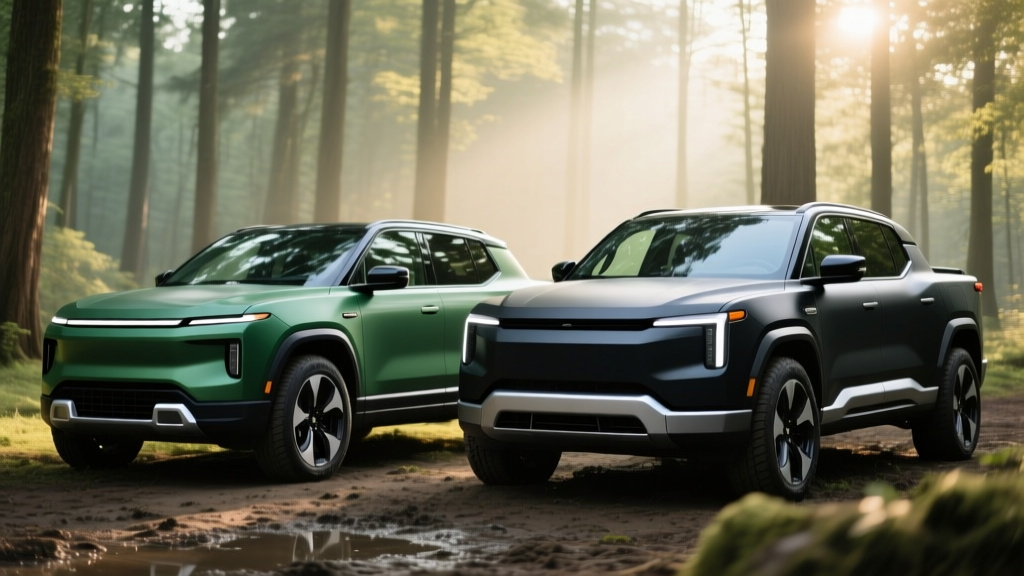
The second-generation R1S (3-row SUV) and R1T (crew-cab pickup) received significant powertrain and battery updates for the 2025 model year that carry into 2026. Rivian now offers three battery configurations across multiple motor layouts.
| Spec | R1S (SUV) | R1T (Pickup) |
|---|---|---|
| EPA Range (Max Pack) | 410 miles | 420 miles |
| Battery Capacity (usable) | ~141 kWh | ~141 kWh |
| Battery Chemistry | NMC (Nickel Manganese Cobalt) | NMC |
| Peak DC Fast Charge | ~220 kW | ~220 kW |
| 10–80% DC Charge Time | ~36 minutes | ~36 minutes |
| Level 2 Home Charging | 11.5 kW (~30 mi/hr) | 11.5 kW (~30 mi/hr) |
| 0–60 mph | 3.4 sec (Dual-Motor Performance) | 3.0 sec (Dual-Motor Performance) |
| Horsepower | 665 hp (Dual-Motor Perf.) | 665 hp (Dual-Motor Perf.) |
| Drivetrain | AWD (Dual-Motor) | AWD (Dual-Motor) |
| Efficiency (MPGe) | 70 MPGe combined | 73 MPGe combined |
| Efficiency (kWh/100 mi) | 48 kWh/100 mi | 46 kWh/100 mi |
| Max Towing | 7,700 lbs | 11,000 lbs |
| Base MSRP | $79,900 (Dual-Motor Standard) | $73,000 (Dual-Motor Standard) |
Rivian also offers a Standard battery (~106 kWh, NMC) with approximately 270 miles of range and a Large battery (~128 kWh) with roughly 352 miles, giving buyers flexibility based on budget and use case. The quad-motor configuration (four independent motors, one per wheel) pushes output to 1,025 hp but reduces range to approximately 321 miles for the R1T.
Real-World Range: What the EPA Sticker Doesn't Tell You
EPA Estimated Range: 420 miles
Real-World Highway (70 mph, moderate temps): ~340–360 miles
Real-World Cold Weather (below 30°F, mixed driving): ~280–310 miles
Towing (5,000 lb trailer, flat terrain): ~180–210 miles
The R1T's 420-mile EPA figure is impressive on paper, but large, heavy EVs with boxy aerodynamics lose efficiency faster at highway speeds than sleek sedans. In real-world testing at sustained 70–75 mph on flat interstates, expect roughly 340–360 miles from the Max Pack. That's still enough for most single-day road trips without a charge stop, but it's a meaningful gap from the sticker.
Cold weather compounds the loss. NMC chemistry performs better than LFP in low temperatures, but you'll still see 20–30% range reduction below freezing, especially if you're using cabin heat frequently. Rivian's heat pump (standard on Gen 2 models) mitigates some of this, but physics wins — plan for ~280–310 miles in deep winter conditions.
Towing is where range evaporates fastest. The R1T's 11,000-pound max towing capacity is best-in-class for an EV pickup, but pulling even a moderate 5,000-pound travel trailer will cut range roughly in half. Rivian's navigation system accounts for this when route-planning through the Adventure Network, which is a genuinely useful feature for truck owners.
Charging Performance: DC Fast, Level 2, and the Adventure Network
Rivian's Gen 2 vehicles use an upgraded electrical architecture that supports peak DC fast-charging rates of approximately 220 kW. The charge curve is relatively flat through the 20–60% state of charge window, then tapers progressively above 80% — typical behavior for NMC cells managed conservatively to preserve longevity.
| Charging Method | Power | Speed (Approx.) | Notes |
|---|---|---|---|
| DC Fast Charge (10–80%) | Peak 220 kW | ~36 minutes | Tapers above 80%; preconditioning required for peak rate |
| DC Fast Charge (80–100%) | ~40–60 kW | ~45 additional minutes | Not recommended for routine use |
| Level 2 Home (240V, 48A) | 11.5 kW | ~30 miles/hour | Full charge in ~13 hours (Max Pack) |
| Level 2 Home (240V, 32A) | 7.7 kW | ~20 miles/hour | Common for NEMA 14-50 outlet installs |
| Level 1 (120V) | 1.4 kW | ~3–4 miles/hour | Emergency/trickle only |
For home charging, the Rivian Wall Connector delivers up to 11.5 kW on a dedicated 60-amp circuit (48 amps continuous). That translates to roughly 30 miles of range per hour of charging — enough to fully replenish the Max Pack overnight in about 13 hours. If you're installing a NEMA 14-50 outlet on a 50-amp breaker, you'll get 32 amps / 7.7 kW, which still comfortably covers daily driving needs for most owners.
The Rivian Adventure Network is the company's proprietary DC fast-charging infrastructure, strategically placed along outdoor-recreation corridors (national parks, ski areas, trailheads). As of early 2026, it includes over 50 stations with chargers capable of 200+ kW. Rivian vehicles also have full access to the Tesla Supercharger network via the integrated NACS port (standard on Gen 2 models), plus CCS adapters for Electrify America and other networks. This multi-network compatibility is a genuine advantage for road-trippers.
Pricing, Trims, and Federal Tax Credit Eligibility
Rivian positions the R1S and R1T in the premium segment, with pricing that reflects both capability and the company's need to reach positive unit economics.
| Configuration | R1S MSRP | R1T MSRP |
|---|---|---|
| Dual-Motor Standard Battery | $79,900 | $73,000 |
| Dual-Motor Large Battery | $85,900 | $79,000 |
| Dual-Motor Max Pack | $94,900 | $88,000 |
| Performance Dual-Motor Max | $99,900 | $93,000 |
| Quad-Motor (R1T only) | — | $99,500 |
Does the Rivian R1S/R1T Qualify for the §30D Federal Tax Credit?
Under current IRS rules (IRS §30D), the federal clean vehicle credit offers up to $7,500 for qualifying new EVs — but several hurdles apply to Rivian:
- MSRP Cap: SUVs (R1S) must have an MSRP at or below $80,000. Pickups and vans (R1T) have an $80,000 cap as well. This means most R1S configurations exceed the cap, while the base R1T Dual-Motor Standard at $73,000 qualifies on price.
- Buyer Income Limits: Adjusted gross income must not exceed $150,000 (single), $225,000 (head of household), or $300,000 (joint filers).
- Battery Sourcing Requirements: The credit splits into two halves — $3,750 for critical minerals and $3,750 for battery component sourcing. Rivian has been working to qualify for the critical-minerals portion, but full $7,500 eligibility depends on supply-chain compliance that shifts annually.
- Point-of-Sale Transfer: If eligible, you can transfer the credit to the dealer at purchase, reducing your out-of-pocket cost immediately rather than waiting for tax filing.
Bottom line: The base R1T Dual-Motor Standard is the most likely configuration to qualify for at least a partial credit, but buyers should verify current-year eligibility at fueleconomy.gov and consult a tax professional before relying on the credit in their purchase math.
Interior, Cargo, Tech, and Daily Livability
The R1S is a genuine 3-row SUV with seating for seven. Cargo volume behind the third row is approximately 10.6 cu ft, expanding to 46.7 cu ft with the third row folded, and 91.6 cu ft with both rear rows down. The R1T offers a 4.5-foot bed (54 inches) with a unique Gear Tunnel — a pass-through storage compartment behind the cab that holds roughly 11 cu ft of gear and is accessible from both sides of the truck.
Both vehicles share Rivian's 15.6-inch center touchscreen running the company's proprietary infotainment OS. The interface is clean and responsive, with native route planning that integrates charging stops, elevation data, and weather. Apple CarPlay is not supported — Rivian has committed to its own platform, which is a dealbreaker for some buyers who prefer phone-mirroring. Android Auto is also absent.
Driver-assistance features fall under the Rivian Driver+ suite, which includes adaptive cruise control, lane-centering, and automatic emergency braking. This is a Level 2 SAE system — the driver must remain engaged with hands on the wheel and eyes on the road at all times. It is not autonomous driving. Highway assist works well on divided interstates but requires active supervision, particularly in construction zones and during lane-merge scenarios.
Standout features include:
- Camp Kitchen (R1T): An optional slide-out kitchen module that integrates into the Gear Tunnel — uniquely positioned for overland and camping use.
- Powered tonneau cover: Electric retractable bed cover on the R1T, operable from the app or bed-side button.
- Vehicle-to-Load (V2L): The R1T can output up to 3.5 kW of AC power from bed outlets, enough to run power tools, camp appliances, or provide emergency home backup.
- Over-the-air updates: Rivian pushes regular software improvements covering everything from suspension tuning to new driver-assist behaviors.
Notable drawbacks:
- No Apple CarPlay or Android Auto — a persistent buyer complaint.
- Service center footprint is still limited outside major metro areas; mobile service helps but can't handle everything.
- Insurance premiums run 15–30% higher than comparable ICE vehicles, per industry data.
- The R1S third row is tight for adults on long trips — best suited for children or short drives.
Warranty and Long-Term Ownership
Rivian provides the following coverage on the 2026 R1S and R1T:
- Battery & Drive Unit: 8 years / 120,000 miles (whichever comes first), with a capacity retention threshold of 70% — meaning Rivian will repair or replace the battery if usable capacity drops below 70% of original within the warranty period.
- Bumper-to-Bumper: 5 years / 60,000 miles.
- Roadside Assistance: 5 years / 60,000 miles.
The 8-year/120,000-mile battery warranty is competitive with industry norms (Tesla offers 8 years/150,000 miles on Model X; Ford offers 8 years/100,000 miles on the F-150 Lightning). The 70% retention threshold is standard, though some buyers may wish for a higher guarantee given the premium pricing.
Long-term battery degradation data for Gen 2 Rivians is still accumulating, but NMC chemistry managed with Rivian's thermal system (liquid cooling and heating) should deliver well over 150,000 miles before approaching the 70% threshold under normal use. Avoiding routine DC fast-charging to 100% and keeping daily charge limits around 80% will maximize longevity.
How the R1S/R1T Stacks Up Against Competitors
The Rivian R1T competes most directly with the Ford F-150 Lightning (lower price, shorter range, broader service network) and the GMC Hummer EV Pickup (more extreme off-road capability, significantly higher price and weight). The R1S sits in a near-unique position as a premium 3-row electric SUV with genuine off-road chops — the Tesla Model X is the closest alternative but lacks the R1S's adventure-oriented design and ground clearance.
- You need a premium electric truck with best-in-class range and genuine off-road capability
- The Gear Tunnel and Camp Kitchen align with your outdoor lifestyle
- You value NACS + Adventure Network multi-network charging access
- Budget is under $70,000 (consider the F-150 Lightning Pro or XLT)
- You need Apple CarPlay for daily navigation
- You live far from a Rivian service center and can't rely on mobile service
Frequently Asked Questions
What is Rivian's cash on hand, and is the company at risk of failing?
Rivian reported approximately $6.5–$7.5 billion in total liquidity as of recent filings, bolstered by the Volkswagen joint-venture investment. While the company still posts net losses, its cash runway extends several years, and gross margins are improving. It is not currently at imminent risk of insolvency, but the R2 launch and production scaling remain critical milestones.
What is the real-world range of the Rivian R1T?
The EPA rates the R1T Dual-Motor Max Pack at 420 miles. Real-world highway driving at 70 mph yields approximately 340–360 miles. In cold weather (below 30°F), expect 280–310 miles. Towing a 5,000-pound trailer reduces range to roughly 180–210 miles.
How fast does the Rivian R1T charge?
The Gen 2 R1T peaks at approximately 220 kW on a DC fast charger, achieving a 10–80% charge in about 36 minutes with battery preconditioning enabled. Home Level 2 charging at 11.5 kW adds roughly 30 miles per hour.
Does the Rivian R1T qualify for the $7,500 federal tax credit?
The base R1T Dual-Motor Standard ($73,000 MSRP) falls under the $80,000 MSRP cap for pickups, making it potentially eligible. However, buyer income limits ($300,000 joint / $150,000 single) and battery-sourcing requirements determine actual credit amount (up to $7,500). Verify at fueleconomy.gov and consult a tax professional.
Is the Rivian R1S a good family SUV?
Yes, with caveats. It seats seven, offers strong safety credentials, and has excellent cargo flexibility. However, the third row is tight for adults, the premium pricing pushes many configurations above the §30D tax credit MSRP cap, and no Apple CarPlay means the family co-pilot can't use their preferred phone navigation app on the big screen.
How does Rivian's warranty compare to Tesla and Ford?
Rivian offers 8 years/120,000 miles on the battery and drive unit with a 70% retention guarantee. Tesla's Model X warranty is 8 years/150,000 miles. Ford's F-150 Lightning is 8 years/100,000 miles. Rivian sits in the middle — adequate for the segment but not class-leading.
Sources: fueleconomy.gov (EPA range and efficiency data), IRS §30D Clean Vehicle Credits, Rivian Automotive investor relations and press materials.