Quick Verdict: Rivian's Secret Weapon Isn't Speed — It's Camping
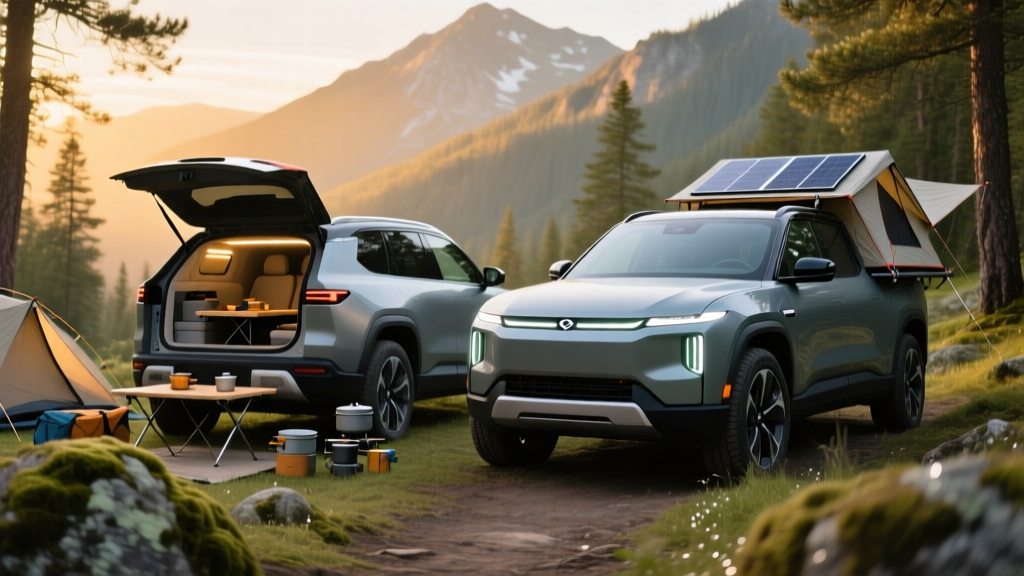
Rivian didn't just build an electric SUV and truck. They built a mobile basecamp. While most EV reviews fixate on 0-60 times and Supercharger access, the R1S SUV and R1T truck have carved out a niche that no competitor has matched: Rivian camping mode transforms these vehicles into climate-controlled, powered shelters with integrated camp kitchens, gear tunnels, and enough battery capacity to run your entire campsite for days.
But camping features alone don't make a great EV. The real question for buyers is whether the R1S and R1T deliver as daily drivers and road-trip machines once you leave the trailhead. After extensive testing across model years, here's the full picture — range, charging, pricing, and whether Rivian's outdoor-lifestyle gamble actually pays off when you're 200 miles from the nearest DC fast charger.
Rivian R1S and R1T: Core Specs at a Glance
The R1S (three-row SUV) and R1T (crew-cab pickup) share Rivian's skateboard platform, meaning most specs carry over between the two. Below are the key figures for the current Dual-Motor and Quad-Motor configurations with the Standard and Max battery packs.
| Spec | Dual-Motor (Standard Battery) | Dual-Motor (Max Battery) | Quad-Motor (Max Battery) |
|---|---|---|---|
| EPA Range (R1S) | 270 miles | 410 miles | 352 miles |
| EPA Range (R1T) | 270 miles | 420 miles | 352 miles |
| Battery Capacity (usable) | 92 kWh | 135 kWh | 135 kWh |
| Battery Chemistry | NMC (nickel manganese cobalt) | NMC | NMC |
| Horsepower | 533 hp | 533 hp | 1,025 hp |
| 0-60 mph | 4.5 sec | 4.5 sec | 3.0 sec (R1T) / 3.1 sec (R1S) |
| Drivetrain | Dual-Motor AWD | Dual-Motor AWD | Quad-Motor AWD (individual wheel torque) |
| Max DC Fast Charge | 200 kW (peak) | 220 kW (peak) | 220 kW (peak) |
| 10-80% DC Fast Charge | ~30 minutes | ~42 minutes | ~42 minutes |
| Level 2 Home Charge Rate | 11.5 kW (~25 mi/hr) | 11.5 kW (~25 mi/hr) | 11.5 kW (~25 mi/hr) |
| MPGe (combined) | 69 MPGe | 65 MPGe | 59 MPGe |
| Efficiency (kWh/100 mi) | 48 kWh/100mi | 52 kWh/100mi | 57 kWh/100mi |
| Max Towing Capacity | 7,700 lbs | 7,700 lbs | 7,700 lbs |
| Ground Clearance (max) | 14.4 inches | 14.4 inches | 14.4 inches |
| Base MSRP (R1S) | $75,900 | $83,400 | $99,900 |
| Base MSRP (R1T) | $69,900 | $77,400 | $93,900 |
| Battery/Powertrain Warranty | 8 yr / 175,000 mi | 8 yr / 175,000 mi | 8 yr / 175,000 mi |
Source: EPA fueleconomy.gov, Rivian official specifications. Range and efficiency figures vary slightly by model year and wheel size selection.
Real-World Range: What the EPA Sticker Doesn't Tell You
EPA Estimated Range: 270–420 miles depending on configuration
Real-World Expectation: Highway driving at 70+ mph reduces range by approximately 15–20%. Cold weather (below 30°F) can cut range an additional 20–30%. For the Max Battery R1T (EPA 420 mi), plan for roughly 330–350 miles on a warm-weather highway trip and as low as 250–280 miles in freezing conditions with cabin heat running.
The R1S and R1T are heavy, boxy vehicles with the aerodynamic profile of, well, an SUV and a truck. At highway speeds, that matters enormously. The Standard Battery's 270-mile EPA figure drops to roughly 220–230 miles at sustained 75 mph — which means you'll be planning charging stops on any road trip over 200 miles. The Max Battery pack is the overlander's choice for exactly this reason: 350+ real-world highway miles gives you genuine flexibility in areas with sparse charging infrastructure.
One factor that works in Rivian's favor for camping trips specifically: when you're driving off-road or on forest service roads at 25–40 mph, efficiency actually improves compared to highway cruising. Low-speed technical driving in the mountains is where these vehicles shine, and range extends meaningfully.
Charging Speed: Getting Back to the Trailhead
| Charging Method | Power (kW) | Miles Added per Hour | Time for Full Charge |
|---|---|---|---|
| Level 1 (120V household outlet) | ~1.4 kW | ~3 mi/hr | ~60+ hours (Max Battery) |
| Level 2 (240V home charger, 48A) | 11.5 kW | ~25 mi/hr | ~10–12 hours (Max Battery) |
| DC Fast Charge (Standard Battery) | 200 kW peak | N/A | 10–80% in ~30 min |
| DC Fast Charge (Max Battery) | 220 kW peak | N/A | 10–80% in ~42 min |
The charge curve matters more than the peak number. Rivian's NMC batteries hit peak charge rate only between roughly 15–40% state of charge, then taper progressively. Above 80%, charging slows dramatically to protect battery health — expect 80–100% to take nearly as long as 10–80%. For road trips, the practical approach is charging to 80% and moving on, which is why the 10–80% metric is the one that counts.
Rivian's Adventure Network — the company's own DC fast-charging network placed near national parks and outdoor recreation areas — is a genuine differentiator for the camping use case. These chargers are strategically located where Electrify America and EVgo rarely bother: near trailheads, campgrounds, and scenic byways. The network is still growing, but it demonstrates that Rivian understands its buyer.
For home charging, a Level 2 wall connector on a 60-amp circuit (delivering 48 amps / 11.5 kW to the vehicle) replenishes roughly 25 miles of range per hour. A full overnight charge handles even the Max Battery pack. If you're relying on a standard 120V outlet at a cabin or campsite, expect painfully slow recovery — plan your trips around Level 2 or DC fast charging.
Rivian Camping Mode: What It Actually Does
Rivian camping mode is a software feature accessible through the vehicle's 15.6-inch central touchscreen. When activated, it:
- Maintains cabin climate control overnight using the traction battery, keeping the interior at your set temperature without the vehicle "idling" in a traditional sense
- Keeps the infotainment system and USB/120V outlets powered so you can charge devices, run lights, or power small appliances
- Locks the suspension at a set ride height to keep the vehicle level on uneven campsite terrain
- Disables exterior lighting and chimes that would otherwise disturb you or nearby campers
- Monitors battery state of charge and alerts you if the battery drops below a threshold you set, ensuring you have enough charge to drive out in the morning
With the 135 kWh Max Battery pack, running camping mode overnight (climate control, device charging, maybe an electric cooler plugged into the bed outlet) consumes roughly 8–15 kWh over 8–10 hours depending on outside temperature. That's about 6–10% of total battery capacity — leaving you with plenty of range for the next day's adventure.
The Camp Kitchen and Gear Tunnel
For the R1T specifically, Rivian offers the Camp Kitchen accessory — a slide-out kitchen unit that integrates with the vehicle's gear tunnel (the pass-through storage compartment between the cab and the bed). The Camp Kitchen includes an induction cooktop, sink with pressurized water, and storage for cookware. It's a $5,000+ accessory, but it's the kind of integrated solution that no aftermarket company has replicated as cleanly.
The R1T's gear tunnel itself is 11.7 cubic feet of lockable, weatherproof storage that runs the full width of the vehicle. Combined with the 54-inch bed (11.7 cu ft), the frunk (11.1 cu ft), and in-cabin storage, the R1T offers a total of roughly 55 cubic feet of cargo capacity — distributed across multiple secure compartments in a way that no conventional truck can match.
The R1S provides 104.7 cubic feet of total cargo space behind the first row (with second and third rows folded), making it a viable alternative to a roof-top tent setup when paired with a platform mattress.
Pricing, Tax Credits, and Total Cost
| Configuration | Base MSRP | §30D Credit Eligible? | Effective Price (if eligible) |
|---|---|---|---|
| R1T Dual-Motor Standard | $69,900 | Partial — see below | ~$62,400–$69,900 |
| R1T Dual-Motor Max | $77,400 | Partial — see below | ~$69,900–$77,400 |
| R1S Dual-Motor Standard | $75,900 | Partial — see below | ~$68,400–$75,900 |
| R1S Dual-Motor Max | $83,400 | Partial — see below | ~$75,900–$83,400 |
| R1T Quad-Motor Max | $93,900 | No (above MSRP cap) | $93,900 |
| R1S Quad-Motor Max | $99,900 | No (above MSRP cap) | $99,900 |
The IRS §30D federal tax credit has specific rules that complicate Rivian eligibility:
- MSRP caps: Trucks (R1T) must have an MSRP at or below $80,000; SUVs (R1S) at or below $80,000. This eliminates the Quad-Motor and most Max Battery configurations from credit eligibility.
- Buyer income limits: Modified adjusted gross income cannot exceed $150,000 (single), $225,000 (head of household), or $300,000 (joint).
- Battery sourcing requirements: A percentage of critical minerals and battery components must be sourced from the US or free-trade-agreement countries. These percentages increase annually, and Rivian's eligibility for the full $7,500 vs. a partial $3,750 credit depends on current-year sourcing compliance.
- Point-of-sale transfer: As of 2024, eligible buyers can transfer the credit to the dealer at purchase, reducing the purchase price directly rather than waiting for a tax refund.
Bottom line: Only the Dual-Motor Standard Battery R1T (at $69,900) comfortably clears the MSRP cap. Some Dual-Motor configurations may qualify for a partial $3,750 credit depending on battery-sourcing compliance in the current year. Always verify eligibility on the IRS website or with a tax professional before purchasing, as these rules shift annually.
How Rivian Stacks Up Against Competitors
The honest comparison for the camping/overlanding use case narrows quickly:
Rivian R1T vs. Ford F-150 Lightning: The Lightning offers more conventional truck utility (larger bed, higher towing at 10,000 lbs, lower starting price around $55,000). But it lacks the R1T's gear tunnel, integrated camp kitchen, adjustable air suspension with 14.4 inches of ground clearance, and off-road capability. For pure worksite use, the Lightning wins. For adventure camping, the R1T is in a different league.
Rivian R1S vs. Tesla Model X: The Model X offers more range (EPA 348 miles for Long Range), faster Supercharger access, and a lower starting price. But the R1S has superior off-road capability, more cargo versatility, the camping mode ecosystem, and a third row that adults can actually use. The Model X is a family hauler that can camp; the R1S is a camping vehicle that can haul a family.
Rivian R1S vs. Jeep Wrangler 4xe: The Wrangler 4xe is a PHEV with only 22 miles of electric range — fundamentally different. But for buyers cross-shopping "adventure vehicles that are partially electrified," the Wrangler offers more extreme off-road articulation and a removable roof/doors at a much lower price ($50,000s). The R1S counters with far superior daily-driver comfort, zero tailpipe emissions on battery power, and 270+ miles of electric range.
Pros
- Best-in-class camping and overlanding ecosystem (camping mode, camp kitchen, gear tunnel)
- Genuine off-road capability with 14.4" ground clearance and quad-motor torque vectoring
- Max Battery offers 350+ real-world highway miles — exceptional for remote travel
- Rivian Adventure Network targets national parks and outdoor destinations
- Over-the-air updates continuously add features (Rivian added camping mode post-launch)
- 8-year/175,000-mile battery warranty exceeds the industry-standard 100,000-mile threshold
- Practical daily driver: quiet, quick, comfortable on pavement
Cons
- High starting price — most configurations exceed $75,000, limiting tax-credit eligibility
- Standard Battery range (270 mi EPA) is tight for road trips; Max Battery is a near-mandatory upgrade
- DC fast charging peaks at 220 kW — competitive but not class-leading vs. Hyundai/Kia's 800V architecture
- Camp Kitchen accessory is expensive ($5,000+) and R1T-exclusive
- Service center network is still growing; some rural owners face long drives for warranty work
- No NACS port from factory (CCS1 standard); Tesla Supercharger access requires an adapter
- Quad-Motor configurations are thrilling but inefficient (57 kWh/100mi) and credit-ineligible
Who Should Buy a Rivian for Camping?
The Rivian R1S and R1T make sense for a specific buyer profile: outdoor enthusiasts who want a zero-emission vehicle that doesn't compromise on backcountry capability or daily-driver comfort. If your weekends involve dispersed camping, forest service roads, national park visits, and you have access to Level 2 charging at home, the Rivian platform is arguably the best electrified vehicle on the market for your use case.
It's the wrong choice if you need a dedicated work truck (the F-150 Lightning or Silverado EV offer more bed length and towing), if your budget caps below $70,000, or if you primarily drive in urban environments where the vehicle's size and weight are liabilities rather than assets.
Frequently Asked Questions
What is the real-world range of the Rivian R1S and R1T?
The EPA rates the Max Battery R1T at 420 miles and the R1S at 410 miles. In real-world highway driving at 70-75 mph, expect roughly 330-360 miles in mild weather and 260-290 miles in freezing temperatures. The Standard Battery's 270-mile EPA rating translates to about 220-230 miles highway in warm conditions.
How fast does a Rivian charge at home and on the road?
On a Level 2 home charger (11.5 kW), both models add about 25 miles of range per hour, fully charging overnight. On DC fast chargers, the Max Battery peaks at 220 kW and charges from 10-80% in approximately 42 minutes. The Standard Battery peaks at 200 kW with a 10-80% time of roughly 30 minutes.
Does the Rivian R1T or R1S qualify for the $7,500 federal EV tax credit?
Partially. The Dual-Motor Standard Battery R1T ($69,900 MSRP) falls under the $80,000 truck MSRP cap and may qualify for the full or partial credit depending on battery-sourcing requirements and your income. Most Max Battery and all Quad-Motor configurations exceed the MSRP cap and are ineligible. Always check current IRS guidance before purchasing.
Can I run camping mode all night without draining the battery too much to drive?
Yes. Camping mode typically uses 8-15 kWh over an 8-10 hour night, depending on climate demands. With the 135 kWh Max Battery, that's roughly 6-11% of capacity. You'll wake up with 85-90%+ of your charge remaining — more than enough for a full day of driving.
Is the Rivian worth buying over a Ford F-150 Lightning or Tesla Model X?
For camping and overlanding, yes — the Rivian's integrated ecosystem (camping mode, camp kitchen, gear tunnel, air suspension, Adventure Network) has no rival. For pure work-truck duty or budget-conscious buyers, the F-150 Lightning is more practical. For family commuting with maximum range and charging convenience, the Tesla Model X has advantages. It depends entirely on your primary use case.
What is the Rivian battery warranty?
Rivian provides an 8-year / 175,000-mile warranty on the battery pack and powertrain, covering defects and capacity degradation below a specified threshold. This exceeds the more common 8-year / 100,000-mile warranty offered by many competitors, reflecting Rivian's confidence in their NMC cell durability.
Does Rivian have enough charging infrastructure for remote camping trips?
The Rivian Adventure Network places DC fast chargers near national parks, ski resorts, and outdoor recreation areas — exactly where the typical EV charging networks are sparse. However, the network is still expanding. For trips into truly remote areas, plan around the CCS-compatible public networks (Electrify America, EVgo) and carry a NACS adapter for Tesla Supercharger access where available.