Rivian's expanding lineup has generated intense interest in the upcoming Borealis, a larger, three-row electric SUV positioned above the R1S. Among the most searched questions from prospective buyers: what Rivian Borealis color options will be available, and does the rest of the package — range, charging speed, and pricing — justify the wait? This profile breaks down every confirmed and estimated spec, the exterior and interior palette, and the real-world ownership picture so you can decide whether to reserve or look at alternatives available today.
Range Reality Check
EPA Estimated Range: ~340 miles (Large Pack, Dual-Motor, preliminary)
Real-World Expectation: Plan for 280–310 miles on highway road trips at 70–75 mph; cold-weather (below 30°F) driving can reduce range by 20–30%, bringing effective range to approximately 230–270 miles depending on cabin heating use and terrain. These figures are estimates based on Rivian's R1 platform efficiency and are subject to change upon EPA certification.
Rivian Borealis Color Palette and Exterior Design
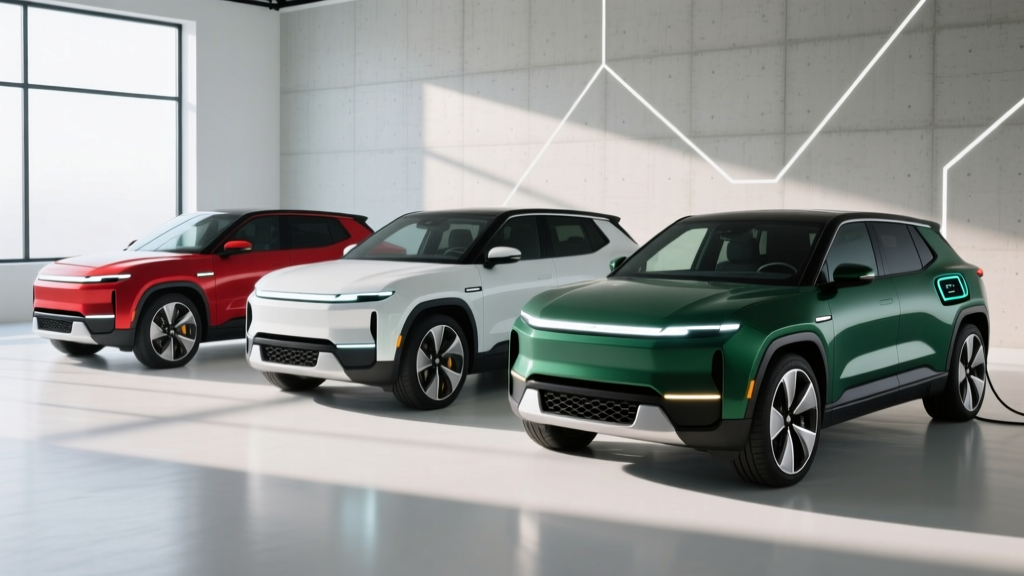
The Borealis is expected to inherit Rivian's nature-inspired color philosophy while introducing several new hues befitting its flagship positioning. Based on Rivian's current design language and trademark filings, buyers can anticipate the following Rivian Borealis color options:
- El Cap Granite — a deep metallic gray with warm undertones, carried over from the R1 lineup
- Glacier White — Rivian's signature pearlescent white, popular for its heat-reflective properties
- Rivian Blue — the brand's launch color, a saturated metallic blue
- Forest Green — a rich, dark green metallic that emphasizes the adventure-SUV identity
- Midnight Black — a stealth, high-gloss black with blacked-out chrome delete standard
- Canyon Sand (new) — a warm, desert-tan metallic expected to debut with the Borealis
- Aurora Red (new) — a deep, shifting red metallic named for the northern lights
Rivian typically offers a no-cost standard palette (white, black, gray) with premium metallics running $1,500–$2,500 as add-ons. Interior colorways are expected to include Black Mountain (vegan leather in black), Ocean Coast (light gray/blue), and a new Forest Edge (dark green/brown) option that pairs with the exterior Forest Green.
Battery, Range, and Efficiency Specs
The Borealis is built on Rivian's next-generation skateboard platform, expected to feature a structural battery pack. Here is what we know from Rivian's announcements and platform data:
| Specification | Estimated / Confirmed |
|---|---|
| Battery Capacity (usable) | ~135 kWh (Large Pack) |
| Battery Chemistry | NMC (Nickel Manganese Cobalt) — high energy density for 3-row SUV weight demands |
| EPA Range (Dual-Motor) | ~340 miles (preliminary) |
| EPA Range (Tri-Motor) | ~310 miles (preliminary, higher output reduces efficiency) |
| Efficiency (Dual-Motor) | ~2.4 kWh/mile / 78 MPGe (estimated) |
| Drivetrain | Dual-Motor AWD or Tri-Motor AWD with quad-motor option possible |
| 0–60 mph (Dual-Motor) | ~4.5 seconds |
| 0–60 mph (Tri-Motor) | ~3.0 seconds |
| Horsepower (Tri-Motor) | ~850 hp (estimated) |
| Towing Capacity | Up to 7,700 lbs (estimated, matching or exceeding R1S) |
| Battery Warranty | 8 years / 175,000 miles (expected, per Rivian's current policy) |
| Powertrain Warranty | 8 years / 175,000 miles (expected) |
Rivian uses NMC chemistry across its Large Pack lineup to maximize energy density, critical for a three-row SUV carrying up to seven passengers and cargo. While Rivian's official specs page will confirm final numbers upon launch, the 135 kWh usable capacity estimate is based on the current R1T/R1S Large Pack (128.9 kWh usable) scaled up for the larger Borealis platform.
Charging Speed: DC Fast and Home Level 2
Charging speed is arguably the most important spec for road-trip-capable EVs. The Borealis is expected to support Rivian's latest charging architecture:
| Charging Level | Max Power | Speed / Time |
|---|---|---|
| Level 1 (120V household) | ~1.4 kW | ~3–4 miles of range per hour |
| Level 2 (240V home, 48A) | 11.5 kW | ~25–28 miles of range per hour; full charge in ~12–14 hours |
| Level 2 (240V home, 80A) | 19.2 kW | ~42–45 miles of range per hour; full charge in ~8 hours |
| DC Fast Charge (peak) | ~220 kW (estimated) | 10–80% in ~28–32 minutes |
| DC Fast Charge (sustained avg.) | ~150–170 kW | Expect the charge curve to taper above 80% SoC; 80–100% adds another 20+ minutes |
The Borealis uses the NACS (North American Charging Standard) connector natively, giving it seamless access to the Tesla Supercharger network — now the most extensive and reliable DC fast-charging network in the U.S. with over 25,000 stalls. Rivian owners also access the Rivian Adventure Network, with chargers strategically placed near national parks and outdoor destinations.
Charging curve reality: Like all large NMC packs, the Borealis will sustain peak charging rates between roughly 10–50% SoC, then progressively taper. Plan road-trip stops around 10–80% sessions (about 30 minutes) rather than attempting full charges, which waste time at low power levels.
Pricing, Trims, and Federal Tax Credit Eligibility
The Borealis slots above the R1S in Rivian's lineup, targeting the premium three-row SUV segment occupied by the Tesla Model X, BMW iX, and Mercedes EQS SUV. Pricing is preliminary and subject to change before deliveries begin.
| Trim | Estimated MSRP | §30D Credit Eligibility | Effective Price (if eligible) |
|---|---|---|---|
| Dual-Motor Standard | ~$85,000 | Likely eligible (under $80K SUV cap — note: IRS classifies vehicles by size; confirm final classification) | ~$77,500 |
| Dual-Motor Large Pack | ~$95,000 | Subject to MSRP cap rules for SUVs ($80,000 limit per IRS §30D) | Varies |
| Tri-Motor Performance | ~$110,000 | Likely exceeds $80,000 SUV MSRP cap — not eligible | $110,000 |
Critical tax credit caveats: The federal §30D Clean Vehicle Credit offers up to $7,500, but eligibility for the Borealis depends on several factors that buyers must verify at purchase time:
- MSRP Cap: SUVs must have an MSRP of $80,000 or less. Higher trims of the Borealis will likely exceed this threshold. The IRS determines vehicle classification (SUV vs. sedan) — check irs.gov for the final Borealis classification.
- Buyer Income Limits: Modified AGI must not exceed $150,000 (single), $225,000 (head of household), or $300,000 (joint filers).
- Battery Sourcing: Critical minerals and battery components must meet escalating North American/free-trade-partner sourcing percentages. Rivian's supply chain compliance will determine whether the full $7,500 or a partial $3,750 credit applies.
- Point-of-Sale Transfer: As of 2024, eligible buyers can transfer the credit to the dealer at purchase, reducing the upfront cost immediately rather than waiting for a tax refund.
Always confirm eligibility with a tax professional and the IRS's official fueleconomy.gov listing before relying on the credit in your purchase decision.
Interior Space, Cargo, and Technology
The Borealis is Rivian's first true three-row SUV, designed to compete with the largest electric family haulers. Expected dimensions and features include:
- Seating: 7-passenger (2+3+2) or optional 6-passenger (2+2+2) with second-row captain's chairs
- Cargo (behind 3rd row): ~20 cu ft (estimated)
- Cargo (3rd row folded): ~55 cu ft (estimated)
- Cargo (all rows folded): ~100+ cu ft (estimated)
- Front trunk (frunk): ~11 cu ft — a Rivian signature, weather-sealed and drainable for gear storage
- Second-row legroom: ~38 inches (estimated)
- Third-row legroom: ~32 inches (estimated, adequate for children and shorter adults)
Infotainment and tech: The Borealis features Rivian's latest software platform on a 15.6-inch center touchscreen with a dedicated driver display. Wireless Apple CarPlay and Android Auto are expected, along with over-the-air updates that continuously improve vehicle function. Rivian's Driver+ system provides Level 2 driver assistance (adaptive cruise, lane centering, automatic lane changes on highways) — but this is not self-driving. The driver must remain engaged and hands-on or eyes-on at all times.
Standout features: Rivian's Gear Tunnel (a pass-through storage compartment between the rear wheels), integrated air compressor, camp kitchen accessory compatibility, and a panoramic glass roof with electrochromic dimming. The Borealis is also expected to offer Vehicle-to-Load (V2L) capability, allowing owners to power campsite equipment or home appliances from the battery pack.
How the Borealis Compares to Key Rivals
The three-row electric SUV market is growing rapidly. Here is how the Borealis stacks up against its most direct competitors on paper:
| Spec | Rivian Borealis (est.) | Tesla Model X | Kia EV9 |
|---|---|---|---|
| EPA Range | ~340 mi | 335 mi (Long Range) | 304 mi (LR RWD) |
| Starting MSRP | ~$85,000 | $79,990 | $54,900 |
| 0–60 mph | ~4.5s (DM) / ~3.0s (TM) | 3.8s (Plaid) | 8.2s (LR) / 4.9s (GT) |
| DC Fast Charge Peak | ~220 kW | 250 kW | 236 kW |
| Seating | 6 or 7 | 5, 6, or 7 | 6 or 7 |
| Towing | ~7,700 lbs | 5,000 lbs | 5,000 lbs |
| NACS Native | Yes | Yes | No (CCS; adapter available) |
The Borealis differentiates on towing capacity, off-road capability (Rivian's quad-motor system and air suspension with up to 14.9 inches of ground clearance), and adventure-oriented design. The Model X offers faster charging and a more established Supercharger experience, while the EV9 undercuts on price significantly but sacrifices performance and range.
Who Should Buy the Rivian Borealis?
Choose the Borealis if:
- You need genuine three-row seating for a family of 5+ and refuse to compromise on EV range
- Towing a trailer, boat, or camper (up to ~7,700 lbs) is a regular requirement
- You value off-road capability and adventure features (Gear Tunnel, air suspension, V2L)
- You want native NACS/Supercharger access without adapters
- Your budget accommodates an $85,000+ premium SUV
Look elsewhere if:
- You need a vehicle today — the Borealis is an announced model with deliveries expected in late 2026 or 2027
- Your budget is under $60,000 (consider the Kia EV9 or a used R1S)
- You primarily drive in cities and don't need towing or off-road capability
- You want the absolute fastest DC charging available (Tesla Model X or Hyundai Ioniq 9 when released)
Pros and Cons at a Glance
Pros
- Class-leading estimated towing capacity (~7,700 lbs)
- Native NACS connector for seamless Supercharger access
- Adventure-first design: Gear Tunnel, frunk, V2L, air suspension
- Strong estimated range (~340 mi) for a three-row SUV
- Over-the-air updates and Rivian's improving software platform
- Premium interior materials and distinctive color options
Cons
- Not yet available for delivery — announced model with preliminary specs
- Higher trims likely exceed the $80,000 MSRP cap for §30D tax credit
- Heavy vehicle means higher tire wear and energy consumption vs. lighter EVs
- DC fast-charging speed (~220 kW peak) trails some 800V competitors (Hyundai/Kia at 240+ kW)
- Third-row space may be tight for tall adults on long trips
- Premium pricing places it out of reach for many family-SUV buyers
Frequently Asked Questions
What is the real-world range of the Rivian Borealis?
The EPA-estimated range is approximately 340 miles for the Dual-Motor Large Pack configuration. In real-world highway driving at 70–75 mph, expect 280–310 miles. Cold weather (below 30°F) can reduce this to 230–270 miles due to battery chemistry limitations and cabin heating demand. These are estimates pending official EPA certification.
How fast does the Borealis charge at home and on the road?
On a 48-amp Level 2 home charger (11.5 kW), the Borealis adds roughly 25–28 miles of range per hour, with a full charge taking 12–14 hours. On an 80-amp Level 2 circuit (19.2 kW), a full charge takes about 8 hours. DC fast charging peaks at an estimated 220 kW, delivering a 10–80% session in approximately 28–32 minutes, with sustained average rates of 150–170 kW during the bulk of the charge.
How much does the Borealis cost after the federal tax credit?
The base Dual-Motor Standard trim is estimated at ~$85,000. If it qualifies for the full $7,500 §30D credit (subject to the $80,000 SUV MSRP cap, buyer income limits, and battery sourcing rules), the effective price drops to ~$77,500. Higher trims at $95,000+ will likely exceed the MSRP cap and not qualify. Always verify current eligibility at irs.gov and with a tax professional.
Is the Borealis worth buying vs. the Tesla Model X or Kia EV9?
The Borealis is best for buyers who prioritize towing, off-road capability, and adventure features over pure charging speed or lowest price. The Model X charges faster (250 kW) and has a longer track record, while the EV9 is significantly more affordable ($54,900 starting) but offers less range, power, and towing capacity. If the Borealis's estimated specs hold and you can wait for deliveries, it fills a unique niche as the most capable adventure-oriented three-row EV.
What Rivian Borealis color options will be available?
Rivian is expected to offer seven exterior colors: El Cap Granite, Glacier White, Rivian Blue, Forest Green, Midnight Black, plus two new Borealis-exclusive colors — Canyon Sand (warm tan metallic) and Aurora Red (deep shifting red). Standard colors are typically no-cost, while premium metallics carry a $1,500–$2,500 upcharge. Interior options include Black Mountain, Ocean Coast, and the new Forest Edge theme.
Does the Borealis qualify for the federal EV tax credit?
Eligibility depends on the specific trim's MSRP (must be ≤$80,000 for SUVs under §30D), the buyer's modified adjusted gross income, and battery component/critical mineral sourcing requirements. The base trim may qualify; higher trims likely will not. Battery sourcing rules tighten annually, so eligibility can change between model years. Confirm on the IRS's official clean vehicle credit page before purchasing.
When will the Rivian Borealis be available?
Rivian has announced the Borealis as part of its upcoming vehicle roadmap, with production expected to begin in late 2026 or 2027 at the company's Normal, Illinois factory (or potentially the upcoming Georgia facility). Reservations may open before production begins. All specs in this article are preliminary and subject to change — check Rivian's official site for the latest confirmed information.