If you've been browsing outdoor forums or scrolling through adventure-travel content lately, you've likely seen the phrase Rivian bikes trending alongside the automaker's headline-grabbing R1T pickup and R1S SUV. But what exactly does that search term mean in 2026, and how do Rivian's electric bicycles fit into the broader ecosystem of its electric vehicles? More importantly, if you're budgeting for an electrified adventure lifestyle, should you be looking at a Rivian e-bike, an R1T, an R1S — or some combination?
This guide cuts through the noise. We'll break down exactly what Rivian offers in the two-wheeled space, then give you the hard numbers on the R1T and R1S — EPA range, charging speeds, battery chemistry, real-world efficiency, pricing after federal tax credits, and cargo capacity — so you can make a data-driven decision about where your money goes.
What "Rivian Bikes" Actually Means in 2026
Let's address the keyword directly. As of early 2026, Rivian does not manufacture or sell consumer electric bicycles under its own brand. The company has explored internal e-bike concepts and has partnered on limited employee/community bike programs near its Normal, Illinois, manufacturing facility, but there is no production Rivian e-bike you can order from rivian.com today.
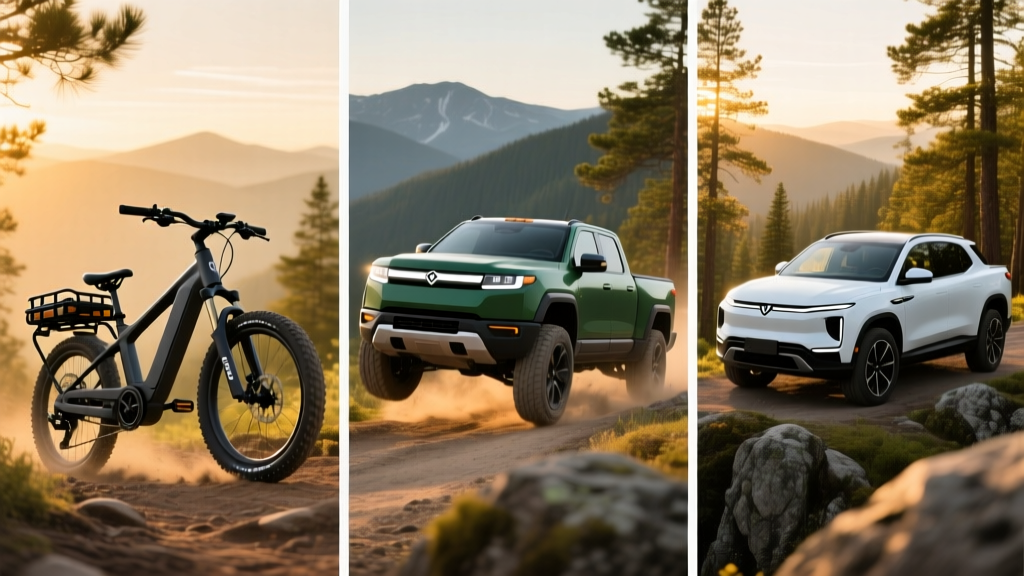
What does exist is a thriving ecosystem of third-party electric bikes and cargo bikes that Rivian owners pair with their vehicles — loaded into the R1T's gear tunnel or mounted on hitch racks behind the R1S. Brands like Rad Power, Specialized, and Trek dominate this space, and many Rivian owners consider an e-bike a natural extension of the electric-adventure lifestyle the brand promotes.
So when shoppers search for "Rivian bikes," they're usually in one of two mindsets: they either want an e-bike that complements their Rivian vehicle, or they're using the term as a gateway to researching Rivian's actual electric vehicles for outdoor use. We'll serve both intents here.
Rivian R1T (2026): The Electric Pickup Built for Trails and Toys
The R1T remains Rivian's flagship adventure vehicle — a midsize electric pickup with a lockable gear tunnel, integrated camp kitchen option, and genuine off-road capability. For 2026, the R1T continues with the Dual-Motor and Quad-Motor powertrains on the updated Gen 2 platform introduced for the 2025 model year, featuring a more efficient electrical architecture, lighter wiring harness, and revised battery packs.
| Spec | Value |
|---|---|
| EPA Range | 420 miles (Max Pack) |
| Battery Capacity | ~149 kWh usable (Max Pack, NMC lithium-ion) |
| Battery Chemistry | NMC (Nickel Manganese Cobalt) |
| Drivetrain | Dual-Motor AWD (Standard, Large, Max); Quad-Motor AWD available |
| Horsepower | 665 hp (Dual-Motor); 1,025 hp (Quad-Motor Tri) |
| 0-60 mph | 4.5 sec (Dual-Motor); ~3.0 sec (Quad-Motor Tri) |
| Max DC Fast Charge | ~220 kW peak (Max Pack) |
| 10-80% DC Charge Time | ~35 minutes (Max Pack) |
| Level 2 Home Charge Rate | 11.5 kW (~25 mi/hr added) |
| EPA Efficiency | 73 MPGe combined / 46 kWh/100 mi |
| Towing Capacity | 11,000 lbs (Dual-Motor Max) |
| Cargo Bed Length | 54.2 in (bed) + 67.6 cu ft (gear tunnel + frunk combined) |
| Base MSRP | $69,900 (Dual-Motor Standard); $87,900 (Dual-Motor Max) |
| Battery Warranty | 8 years / 175,000 miles |
Real-World Range Reality Check
The EPA rates the R1T Dual-Motor Max Pack at 420 miles. In real-world mixed driving, expect closer to 340-370 miles at sustained highway speeds of 70-75 mph. Towing a 5,000-lb trailer can cut range to 200-240 miles. In freezing temperatures (below 30°F), plan for a 15-25% reduction from the EPA sticker. The Standard Pack (342 mi EPA) is more realistic at 270-290 miles in everyday mixed use.
Rivian R1S (2026): Three-Row Electric SUV for Families Who Go Off-Road
The R1S is the three-row SUV sibling of the R1T, sharing the same Gen 2 platform, battery options, and powertrain configurations. It swaps the pickup bed for a fully enclosed cargo area and a usable third row — making it the default choice for families who need seven seats but refuse to sacrifice off-road capability or range.
| Spec | Value |
|---|---|
| EPA Range | 410 miles (Max Pack) |
| Battery Capacity | ~149 kWh usable (Max Pack, NMC) |
| Drivetrain | Dual-Motor AWD / Quad-Motor AWD |
| Horsepower | 665 hp (Dual-Motor); 1,025 hp (Quad-Motor Tri) |
| 0-60 mph | 4.7 sec (Dual-Motor) |
| Max DC Fast Charge | ~220 kW peak |
| 10-80% DC Charge Time | ~35 minutes |
| Level 2 Home Charge Rate | 11.5 kW (~24 mi/hr) |
| EPA Efficiency | 72 MPGe combined / 47 kWh/100 mi |
| Cargo Volume (behind 3rd row) | 21.5 cu ft |
| Cargo Volume (all rows folded) | 104.7 cu ft |
| Base MSRP | $74,900 (Dual-Motor Standard); $92,900 (Dual-Motor Max) |
| Battery Warranty | 8 years / 175,000 miles |
The R1S Max Pack's 410-mile EPA rating is among the highest of any three-row electric SUV sold in the U.S. Real-world highway range lands around 330-360 miles in moderate weather. Cold-weather and towing penalties mirror the R1T.
Charging Speed Deep Dive: What Rivian Owners Actually Experience
Charging speed is where Rivian's Gen 2 platform shows meaningful improvement over the original 2022-2024 models. The Max Pack's ~220 kW peak DC fast-charge rate means you'll add roughly 140 miles in 15 minutes at a compatible 350 kW station (such as Electrify America or EVgo). However, peak rate is not sustained rate.
| Charging Level | Power | Speed / Time |
|---|---|---|
| Level 1 (120V household) | 1.4 kW | ~3 mi/hr — emergency use only |
| Level 2 (240V home wall charger) | 11.5 kW | ~25 mi/hr — full overnight charge in ~13 hrs (Max Pack) |
| DC Fast Charge (peak) | ~220 kW | 10-80% in ~35 min; tapers significantly above 80% |
| DC Fast Charge (sustained avg 10-80%) | ~150-170 kW avg | Real-world average across the curve |
Rivian vehicles come with NACS (North American Charging Standard) ports as of the Gen 2 platform, giving native access to Tesla Supercharger stations — a major advantage for road-trip charging reliability. The charge curve tapers above 80% SoC to protect battery health, so plan your road-trip stops around 10-80% increments rather than topping to 100%.
Preconditioning tip: Always use the Rivian app to precondition the battery when navigating to a DC fast charger. Arriving with a cold battery can slow peak charge rates by 30-50%, especially in winter.
Pricing and Federal Tax Credit Eligibility
Rivian's pricing positions the R1T and R1S in the premium adventure segment. Here's what you'll actually pay, and how the federal tax credit factors in.
| Model / Trim | Base MSRP |
|---|---|
| R1T Dual-Motor Standard Pack | $69,900 |
| R1T Dual-Motor Large Pack | $75,900 |
| R1T Dual-Motor Max Pack | $87,900 |
| R1T Quad-Motor Tri Max | $99,900 |
| R1S Dual-Motor Standard Pack | $74,900 |
| R1S Dual-Motor Large Pack | $80,900 |
| R1S Dual-Motor Max Pack | $92,900 |
| R1S Quad-Motor Tri Max | $104,900 |
Does the R1T or R1S Qualify for the §30D Federal Tax Credit?
Under current IRS §30D rules, the federal clean vehicle credit offers up to $7,500 — but eligibility is far from guaranteed for Rivian buyers. Here's the checklist:
- MSRP cap: Trucks (R1T) must be under $80,000 MSRP; SUVs (R1S) must be under $80,000. This means the R1T Standard ($69,900) and Large ($75,900) packs qualify on price, but the Max Pack ($87,900) and all Quad-Motor trims exceed the cap. The R1S Standard ($74,900) qualifies on price; Large and Max do not.
- Buyer income cap: Modified AGI must not exceed $150,000 (single), $225,000 (head of household), or $300,000 (joint).
- Battery sourcing: A percentage of critical minerals and battery components must be sourced from the U.S. or free-trade-agreement countries. Rivian has worked to improve supply-chain compliance, but exact eligibility varies by build date and battery pack. Always verify the specific VIN on fueleconomy.gov before purchasing.
- Point-of-sale transfer: As of 2024, the credit can be transferred to the dealer at purchase, reducing your out-of-pocket cost immediately rather than waiting for tax filing.
Bottom line: The R1T Dual-Motor Standard and Large Packs, and the R1S Dual-Motor Standard, are the trims most likely to qualify for the full or partial $7,500 credit — provided your income and the vehicle's battery sourcing meet requirements. Consult a tax professional and verify your VIN.
Pairing E-Bikes with Your Rivian: The Adventure Combo
Since Rivian doesn't make its own production e-bike, here's how owners actually integrate two-wheeled electric transport into their vehicle setup:
- R1T Gear Tunnel: The R1T's 11.6 cu ft gear tunnel (between the cab and bed) can fit a compact folding e-bike like the Brompton Electric or a RadMini — keeping it locked and out of the elements.
- Hitch-Mounted E-Bike Racks: Both the R1T and R1S have a Class IV receiver hitch rated for significant tongue weight. Racks like the 1Up USA Equip or Kuat NV 2.0 can carry two full-size e-bikes (up to 60 lbs each) without blocking the tailgate or camera view.
- Bed-Mounted (R1T): The 54.2-inch bed can accommodate a standard e-bike laid flat with the tailgate down, or two bikes with a bed rack system.
- Charging on the go: Rivian's 120V and 240V bed outlets (R1T) allow you to charge e-bike batteries while driving — a genuine advantage over gas trucks for multi-day bike-packing trips.
If your search for "Rivian bikes" was really about building this kind of adventure combo, the R1T Dual-Motor Large Pack at $75,900 (potentially $68,400 after the tax credit) is arguably the most capable e-bike hauler on the market — lockable storage, onboard power, and 350+ real-world miles of range to reach remote trailheads.
Rivian R1T and R1S vs. Key Competitors
| Vehicle | EPA Range | 0-60 mph | Max DC kW | Starting MSRP |
|---|---|---|---|---|
| Rivian R1T Dual-Motor Max | 420 mi | 4.5 sec | ~220 kW | $87,900 |
| Ford F-150 Lightning Ext. Range | 320 mi | ~5.0 sec | ~150 kW | $76,995 |
| Chevy Silverado EV 4WT | 440 mi | ~4.5 sec | ~350 kW | $79,900 |
| Rivian R1S Dual-Motor Max | 410 mi | 4.7 sec | ~220 kW | $92,900 |
| Kia EV9 GT-Line AWD | 270 mi | 4.9 sec | ~236 kW | $73,900 |
| Tesla Model X Long Range | 335 mi | 3.8 sec | ~250 kW | $79,990 |
The R1T's main advantage over the F-150 Lightning is real-world range and off-road geometry (Rivian's adjustable air suspension provides up to 14.4 inches of ground clearance). The Silverado EV edges it on max range and DC charge speed, but lacks the R1T's adventure-specific features like the gear tunnel and camp kitchen. Among three-row SUVs, the R1S Max Pack's 410-mile range dwarfs the EV9, though the Kia comes in at a significantly lower price point.
R1T/R1S Pros
- Class-leading range with Max Pack (410-420 mi EPA)
- NACS port = native Supercharger access
- Best-in-class off-road capability (air suspension, 14.4" clearance, tank turns on Quad-Motor)
- Gear tunnel (R1T) is a genuinely unique adventure feature
- Over-the-air updates continue adding features post-purchase
- Strong battery warranty: 8 yr / 175,000 mi
R1T/R1S Cons
- Max Pack and Quad-Motor trims exceed $80K tax-credit MSRP cap
- 220 kW peak DC charge rate trails Silverado EV and Hyundai Ioniq-class platforms
- Third-row space in R1S is tight for adults on long trips
- Insurance premiums run 15-25% above segment average
- Service center network still expanding — rural owners may face long tow distances
Who Should Buy a Rivian (and Who Should Look Elsewhere)?
Buy the R1T if: You need a midsize truck for towing (up to 11,000 lbs), want genuine off-road capability, value the gear tunnel for securing adventure gear (or e-bikes), and prioritize range over absolute lowest price. The Dual-Motor Standard or Large Pack is the smartest buy if you want to capture the federal tax credit.
Buy the R1S if: You need three rows of seating and enclosed cargo space but want the same off-road chops and range as the R1T. Families who camp, ski, or bike will find the R1S more practical than a Model X, though the Kia EV9 is a strong budget alternative if 270 miles of range is sufficient.
Look elsewhere if: Your budget is under $60,000, you don't need off-road capability, or you live in an area with limited Rivian service coverage. The Ford F-150 Lightning (truck) or Kia EV9 (SUV) may offer better value and dealer support in your region.
Frequently Asked Questions
Does Rivian make its own electric bike?
No. As of 2026, Rivian does not sell a production consumer e-bike. The company has explored internal concepts and limited community programs, but no Rivian-branded bicycle is available for purchase. Most Rivian owners pair their vehicles with third-party e-bikes from brands like Rad Power, Specialized, or Trek.
What is the real-world range of the Rivian R1T and R1S?
The R1T Dual-Motor Max Pack is EPA-rated at 420 miles; expect 340-370 miles in real-world highway driving and 200-240 miles while towing. The R1S Max Pack is rated at 410 miles EPA with similar real-world reductions. Cold weather (below 30°F) typically reduces range by 15-25%.
How fast does a Rivian charge at home and on the road?
At home on a Level 2 (240V) Rivian Wall Charger at 11.5 kW, you'll add about 25 miles of range per hour — a full Max Pack charge takes roughly 13 hours overnight. On DC fast chargers, the Max Pack peaks at ~220 kW and charges from 10-80% in about 35 minutes, though sustained average is closer to 150-170 kW across the curve.
How much does a Rivian cost after the federal tax credit?
The R1T Dual-Motor Standard starts at $69,900 MSRP. If you qualify for the full $7,500 §30D credit (income, sourcing, and MSRP caps all met), your effective price drops to $62,400. The Large Pack at $75,900 also falls under the $80K truck cap. Max Pack and Quad-Motor trims exceed the MSRP cap and are not eligible. Always verify your specific VIN on fueleconomy.gov and consult a tax professional.
Is the Rivian R1T or R1S worth buying vs. the F-150 Lightning or Kia EV9?
If off-road capability, maximum range, and adventure-specific features (gear tunnel, camp kitchen, air suspension) are priorities, the Rivian is worth the premium. If you want the lowest entry price and widest dealer service network, the F-150 Lightning (truck) or Kia EV9 (SUV) are strong alternatives. The Rivian's NACS Supercharger access is a significant road-trip advantage over CCS-only competitors.
What is the battery warranty on the R1T and R1S?
Rivian covers the battery and drive unit for 8 years or 175,000 miles, whichever comes first. The warranty guarantees the battery will retain a minimum capacity threshold (typically 70% state of health) over that period. The vehicle limited warranty is 5 years / 60,000 miles.
Sources: fueleconomy.gov, IRS §30D Clean Vehicle Credit, Rivian official specifications (rivian.com).