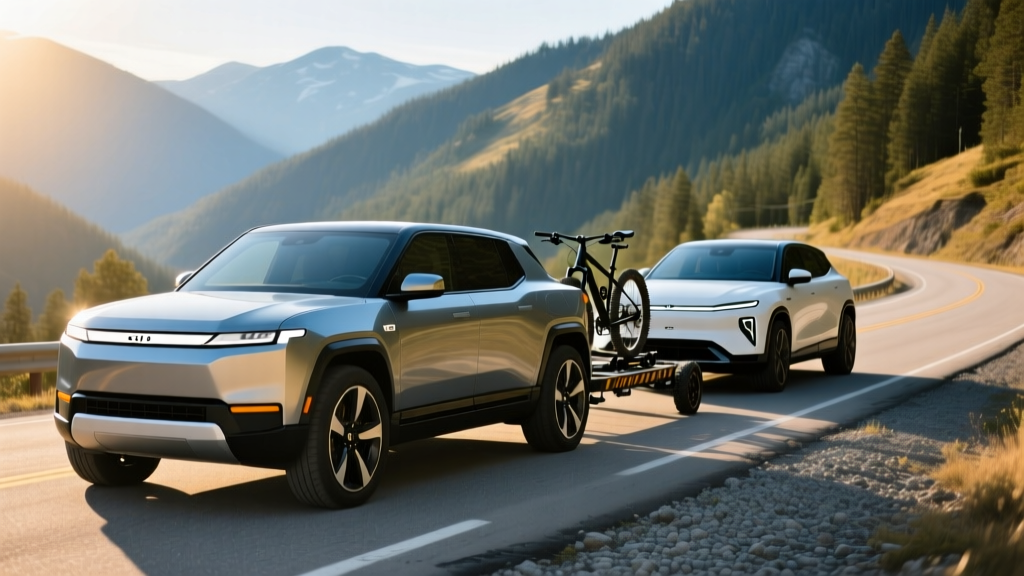
For outdoor enthusiasts shopping for an electric truck or SUV, the search for a "Rivian bike" solution usually means one thing: figuring out how to haul mountain bikes, road bikes, or e-bikes with the R1T or R1S without sacrificing the utility that makes these vehicles worth their premium price. Rivian has built its brand around the adventure-EV lifestyle, and bike transport is central to that pitch. But adding a rack, loading up gear, and hitting the highway has real consequences for range, efficiency, and charging logistics.
This guide covers exactly how the 2026 Rivian R1T and R1S perform when configured for bike hauling — including EPA range, real-world efficiency penalties, charging speeds, and the total cost picture after federal tax credits. Whether you're cross-shopping the R1T against the Tesla Cybertruck or evaluating the R1S as a family adventure rig, the numbers below will tell you what to expect.
Rivian R1T and R1S: The Adventure-EV Platform
Rivian offers two core vehicles built on the same skateboard platform: the R1T (a four-door electric pickup) and the R1S (a three-row electric SUV). For 2026, both are available in Dual-Motor and Quad-Motor configurations, with the Dual-Motor being the volume seller and the most practical choice for buyers who want maximum range. The R1T's 4.5-foot bed and the R1S's roof-rack compatibility make both viable platforms for bike transport, though the methods differ significantly.
The R1T offers a unique advantage: its bed can accommodate a front wheel-removed bike with a bed-mounted fork mount, keeping the bike entirely within the vehicle footprint. The R1S, lacking a bed, requires either a roof rack system or a hitch-mounted platform rack. Rivian sells factory hitch accessories for both vehicles, and the aftermarket (Yakima, Thule, 1Up USA) offers EV-rated racks designed for the higher hitch-weight limits of electric trucks.
| Spec | Value |
|---|---|
| EPA Range | 420 miles (Max Pack) |
| Battery Capacity | ~149 kWh usable (Max Pack, NMC chemistry) |
| Drivetrain | Dual-Motor AWD |
| Horsepower | 665 hp (Dual-Motor Performance) |
| 0-60 mph | 4.5 seconds (Dual-Motor Performance) |
| Max DC Fast Charge | 220 kW peak |
| 10-80% DC Charge Time | ~30 minutes |
| Level 2 Home Charge Rate | 11.5 kW (~25 mi/hr) |
| EPA Efficiency | 73 MPGe / 48 kWh/100 mi |
| Towing Capacity | 11,000 lbs (max rated) |
| Payload Capacity | ~1,760 lbs |
| Bed Length | 54 inches (4.5 ft) |
| Battery/Powertrain Warranty | 8 years / 175,000 miles |
| Base MSRP (Dual-Motor Adventure) | $79,900 |
Real-World Range: What Happens When You Load Up Bikes
Real-World Expectation: ~310-340 miles at highway speeds (70-75 mph) with bikes on a hitch rack; ~280-310 miles in cold weather (below 40°F) with full gear load. Standard Pack (270 mi EPA) drops to ~190-210 miles highway with bikes and cold temps.
The EPA range figure is measured under controlled laboratory conditions that don't account for the aerodynamic drag of a hitch-mounted bike rack carrying two to four bicycles. In our experience and consistent with third-party testing, a platform-style hitch rack with two mountain bikes adds roughly 15-22% to highway energy consumption at 70 mph. That's physics — you're pushing a blunt object through air that the vehicle's teardrop shaping was designed to slip around.
For the R1T Dual-Motor with the Max Pack (420 miles EPA), a 20% highway penalty still leaves you with approximately 336 miles of real range — enough for most single-day adventure trips without an en-route charge. The Standard Pack (270 miles EPA) is a different story: drop to ~210 real-world miles with bikes, and you're stopping to charge on any trip over 180 miles one-way. This is the single biggest factor bike-hauling buyers should weigh when choosing their battery pack.
Cold weather compounds the penalty. Lithium-ion batteries lose efficiency in low temperatures, and cabin heating draws significant energy. Expect an additional 10-15% range reduction below 40°F, more below 20°F. Rivian's heat pump (standard on 2025+ models) mitigates this compared to resistive heating, but the laws of thermodynamics still apply. If you're driving to Mammoth or Park City in January with bikes on the rack, plan your charging stops conservatively.
The R1T's bed-mount option avoids the worst of the aero penalty. A bike laid in the bed with the front wheel removed, secured by a fork-mount or bed rail system, stays within the vehicle's aerodynamic profile. You lose some bed space, but you retain nearly all of your highway efficiency — typically only a 3-5% consumption increase versus the unloaded vehicle.
Charging Speed: Getting Back on the Road
| Charge Level | Power | Speed | Use Case |
|---|---|---|---|
| Level 1 (120V) | ~1.4 kW | ~3 mi/hr | Emergency/top-off only |
| Level 2 (240V, 48A) | 11.5 kW | ~25 mi/hr | Home overnight charging |
| DC Fast Charge | 220 kW peak | 10-80% in ~30 min | Road trips, adventure travel |
Rivian's DC fast-charging capability tops out at 220 kW on the Max Pack. That's competitive but not class-leading — the Hyundai Ioniq 5 peaks at 350 kW, though its smaller battery means less total range. The important number for road-trippers is the 10-80% time: approximately 30 minutes at a capable charger (250 kW+ station). That's a lunch stop, not a quick pit stop.
Here's where the bike-rack factor matters: you cannot leave bikes on a hitch rack at many DC fast-charging stations without blocking adjacent stalls or violating site rules. Rivian Adventure Network chargers are designed with pull-through and wider stalls to accommodate vehicles with trailers and racks, but the broader Electrify America and EVgo networks are not always so forgiving. Plan to arrive at chargers with awareness of your vehicle's extended footprint.
For home charging, the 11.5 kW Level 2 onboard charger adds roughly 25 miles of range per hour. A full charge from 10% to 100% on the Max Pack takes about 13 hours — fine for overnight, but it means you need to plan ahead if you're returning from a weekend trip depleted and need a full battery by morning. Installing a 60-amp dedicated circuit with a hardwired Rivian Wall Charger or equivalent (ChargePoint Home Flex, Tesla Universal Wall Connector) is the recommended setup. Budget $800-$2,000 for professional installation depending on your panel capacity and run distance.
Bike Rack Options: Hitch, Bed, and Roof Compared
Choosing how to carry bikes on a Rivian is a trade-off between convenience, range impact, and vehicle configuration:
- Hitch-mounted platform rack: The most popular option. Requires a 2-inch receiver hitch (factory or aftermarket). Carries 2-4 bikes without lifting them overhead. Adds 15-22% highway energy consumption due to drag. Blocks the rear camera and tailgate access on the R1T. Weight capacity is critical — e-bikes can weigh 50-70 lbs each, and you need a rack rated for the combined load. The 1Up USA Super Duty and Yakima OnRamp are popular EV-rated choices.
- Bed-mounted (R1T only): A fork-mount or wheel-mount system in the truck bed keeps bikes within the vehicle profile. Minimal range penalty (3-5%). Requires removing the front wheel on most setups. Limits bed cargo space. Best for 1-2 bikes; a full bed rack system can hold 3-4 but eliminates all other bed utility.
- Roof rack: Works on both R1T (with roof crossbars) and R1S. Minimal rear drag but increases overall vehicle height — watch for parking garage clearances. Lifting bikes onto the roof is physically demanding, especially heavier e-bikes. Adds 8-12% highway energy consumption. The Rivian factory roof rail system supports crossbars from Yakima and Thule.
For e-bike owners, the hitch platform rack is essentially mandatory. E-bikes weighing 55+ lbs are impractical to lift onto a roof, and the R1T bed height makes loading awkward without a ramp. Ensure your hitch rack is rated for e-bike weights — standard platform racks often cap at 35-40 lbs per tray.
Pricing, Trims, and Federal Tax Credit Eligibility
The 2026 Rivian R1T starts at $69,900 for the Dual-Motor Standard Pack and climbs to $99,000+ for the Quad-Motor Max Pack. The R1S is priced similarly, with a slight premium for the third-row SUV body style. Here's the breakdown for the most popular bike-hauling configuration:
| Trim/Pack | MSRP | §30D Credit Potential | Effective Price |
|---|---|---|---|
| Dual-Motor Standard Pack | $69,900 | Up to $7,500* | ~$62,400 |
| Dual-Motor Large Pack | $76,900 | Up to $7,500* | ~$69,400 |
| Dual-Motor Max Pack | $85,900 | Up to $7,500* | ~$78,400 |
| Quad-Motor Max Pack | $99,000 | Up to $7,500* | ~$91,500 |
*Federal tax credit eligibility under IRS §30D is subject to multiple requirements:
- MSRP Cap: Trucks and SUVs must have an MSRP at or below $80,000. This means the R1T Dual-Motor Max Pack ($85,900) and all Quad-Motor trims exceed the cap and do NOT qualify for the federal credit. The Dual-Motor Standard and Large Pack trims fall within the cap.
- Buyer Income Limits: Modified adjusted gross income must not exceed $300,000 (joint filers), $225,000 (head of household), or $150,000 (single). Higher earners are ineligible regardless of the vehicle.
- Battery Sourcing Requirements: The credit splits into two halves — $3,750 for critical minerals sourcing and $3,750 for battery component manufacturing. Rivian has been working to qualify its supply chain under these rules, but eligibility can change as sourcing shifts. Always verify current eligibility on fueleconomy.gov before purchasing.
- Point-of-Sale Transfer: As of 2024, the credit can be transferred to the dealer at purchase, reducing your out-of-pocket cost immediately rather than waiting for a tax refund. This is available if you meet income requirements.
The practical takeaway: if the federal tax credit is important to your purchase decision, target the Dual-Motor Standard or Large Pack trims under the $80,000 MSRP cap. The Max Pack's range advantage for bike-hauling road trips comes at the cost of credit eligibility.
Who Should Buy a Rivian for Bike Hauling?
- You want bed-mounted bike transport with minimal range penalty
- You need a pickup bed for gear, coolers, and adventure equipment
- You value the Gear Tunnel (R1T exclusive) for additional enclosed storage
- Your typical bike trip is under 300 miles one-way
- You need three rows of seating for family + bikes on a hitch rack
- You prefer an SUV form factor for daily driving and garage fit
- You'll use a roof rack or hitch platform for bike transport
- Budget is the primary constraint (Lightning starts ~$20K lower)
- You need maximum towing capacity beyond Rivian's 11,000-lb rating
- You prefer a larger truck bed (Cybertruck offers 6 ft vs. R1T's 4.5 ft)
The Rivian R1T is the strongest all-around adventure-EV for cyclists who want integrated bed storage, premium build quality, and genuine off-road capability to reach trailheads. The R1S fills the family-adventure niche where passenger space and bikes must coexist. Neither is the cheapest option in the segment, but both offer a level of fit-and-finish and software integration that justifies the premium for buyers who use their vehicles for weekend sport as much as daily commuting.
Pros and Cons: Rivian as a Bike-Hauling EV
Pros
- R1T bed-mount option preserves nearly all highway range vs. hitch rack drag
- Rivian Adventure Network chargers designed for racks and trailers
- 420-mile Max Pack range (R1T) covers most single-day bike trips without charging
- Strong off-road capability for remote trailhead access
- Gear Tunnel (R1T) adds 11.7 cu ft of secure, weatherproof storage
- Over-the-air updates continuously improve vehicle features
- 8-year/175,000-mile battery warranty exceeds industry standard
Cons
- Max Pack trims exceed $80K MSRP cap — no federal tax credit
- Hitch rack blocks rear camera and tailgate on R1T
- Standard Pack range (270 mi EPA) is tight for loaded highway bike trips
- 220 kW peak DC charging is slower than Hyundai/Kia 800V platforms
- Premium pricing — $70K-$99K before accessories and racks
- Service center network still limited in some regions
- e-bike weight requires heavy-duty (and expensive) hitch rack
Frequently Asked Questions
What is the real-world range of a Rivian R1T with bikes on a rack?
With a hitch-mounted platform rack carrying two bikes, expect approximately 310-340 miles of real-world range from the Max Pack (420 mi EPA) at highway speeds. The Standard Pack (270 mi EPA) drops to roughly 190-210 miles under the same conditions. Cold weather reduces these figures by an additional 10-15%. Bed-mounted bikes in the R1T retain nearly full range, losing only 3-5%.
How fast does the Rivian R1T charge on a road trip with bikes?
At a 250+ kW DC fast charger, the Max Pack charges from 10-80% in approximately 30 minutes, adding roughly 250 miles of range. The charging curve tapers significantly above 80% — charging from 80-100% can take an additional 25-30 minutes. Plan to charge in the 10-80% window for the fastest stops. You may need to remove bikes from a hitch rack at some charging stations to avoid blocking adjacent stalls.
Does the Rivian R1T qualify for the $7,500 federal EV tax credit?
It depends on the trim. The Dual-Motor Standard Pack ($69,900 MSRP) and Large Pack ($76,900 MSRP) fall below the $80,000 MSRP cap for trucks under IRS §30D rules and may qualify, pending buyer income limits and battery-sourcing requirements. The Max Pack ($85,900+) and all Quad-Motor trims exceed the MSRP cap and do not qualify. Always verify current eligibility on fueleconomy.gov and consult a tax professional.
Can I carry e-bikes on a Rivian?
Yes, but you'll need a heavy-duty hitch-mounted platform rack rated for e-bike weights (50-70 lbs per bike). The 1Up USA Super Duty, Yakima OnRamp, and Thule EasyFold XT are popular options. Verify your rack's per-tray weight limit and the total rack weight against your hitch's tongue-weight rating. Roof mounting is impractical for most e-bikes due to weight and lift height.
Is the Rivian R1T worth buying over the Ford F-150 Lightning for bikes?
The R1T offers a more premium interior, better off-road capability, and the unique Gear Tunnel for storage. The F-150 Lightning provides a larger 5.5-ft bed, a lower starting price (~$55,000), and a more established dealer service network. If budget is a primary concern and you need a full-size bed, the Lightning is the practical choice. If you value build quality, adventure features, and don't mind paying a premium, the R1T is the stronger all-around adventure platform.
What is Rivian's battery warranty?
Rivian provides an 8-year / 175,000-mile warranty on the battery pack and drive system, which exceeds the federal minimum requirement of 8 years / 100,000 miles. The warranty covers battery capacity degradation below a specified threshold (typically 70% state of health). This is one of the more generous battery warranties in the EV truck segment.