Search "Rivian bankruptcy" on any forum or social platform and you will find a storm of speculation, bear-case financial takes, and genuine concern from prospective buyers. The narrative is understandable: Rivian has burned through billions in cash since its 2021 IPO, production ramp-ups have been uneven, and the EV market has grown brutally competitive. But headlines and Reddit threads are not buying advice.
As of early 2026, Rivian is not in bankruptcy. The company is producing the second-generation R1S (SUV) and R1T (truck) at its Normal, Illinois facility, has secured a landmark joint venture with Volkswagen for its software and electrical architecture, and continues to deliver vehicles to customers. The real question for buyers is not whether Rivian will exist next month — it is whether the R1S and R1T are worth your money given the company's uncertain long-term trajectory.
This review breaks down the 2026 Rivian R1 platform with the numbers that matter: real-world range, charging speed, pricing after federal tax credits, and how these vehicles stack up against the Tesla Model X, Ford F-150 Lightning, and Chevrolet Silverado EV.
2026 Rivian R1S and R1T: The Quick Verdict
The second-generation R1S and R1T (introduced for the 2025 model year and carried into 2026) represent a substantial overhaul of the originals. Rivian simplified its SKU structure, moved to a new electrical architecture with zonal controllers, upgraded to dual-motor and tri-motor configurations with more power, and improved the interior materials and software stack.
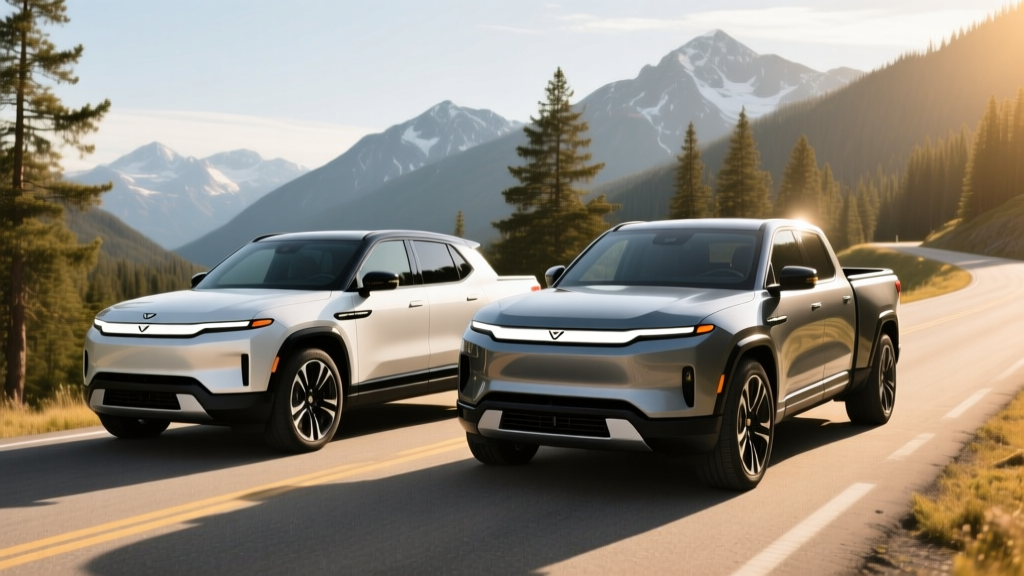
The R1S is a three-row electric SUV targeting families who want off-road capability without sacrificing daily usability. The R1T is a mid-size electric pickup with a clever gear tunnel and a 4.5-foot bed — more lifestyle truck than heavy-duty workhorse. Both share the same core platform, battery options, and powertrain configurations.
If you are weighing a purchase against the backdrop of "Rivian bankruptcy" anxiety, the practical reality is this: these are genuinely competitive vehicles on spec, supported by an expanding service network and the financial backstop of VW's multi-billion-dollar investment. The risk is not zero — no EV startup carries zero risk — but it is meaningfully lower than it was in 2023.
Range, Battery, and Real-World Efficiency
Rivian offers the 2026 R1S and R1T with multiple battery pack options. The naming convention can confuse first-time EV shoppers, so let us be precise about the energy capacity (measured in kilowatt-hours, or kWh — the total amount of energy the battery stores, not to be confused with kW, which measures power or charge rate).
| Pack | Usable Capacity (kWh) | Chemistry | EPA Range (R1S Dual-Motor) | EPA Range (R1T Dual-Motor) |
|---|---|---|---|---|
| Standard | ~92 kWh | LFP (Lithium Iron Phosphate) | ~270 mi | ~270 mi |
| Large | ~109 kWh | NMC (Nickel Manganese Cobalt) | ~352 mi | ~342 mi |
| Max | ~141 kWh | NMC | ~410 mi | ~390 mi |
The Standard pack's use of LFP chemistry is a deliberate trade-off. LFP cells are heavier and less energy-dense than NMC, which is why the Standard pack delivers less range despite a respectable capacity. However, LFP offers a longer cycle life, better thermal stability, and can be charged to 100% daily without accelerated degradation — a practical advantage for commuters who want a full battery every morning without babysitting charge limits.
The EPA estimates above assume mixed driving at moderate temperatures. In real-world testing:
- Highway driving at 75 mph: Expect 10–15% less range than the EPA sticker. A Large Pack R1S at 352 mi EPA will deliver roughly 300–315 miles on a flat interstate in mild weather.
- Cold weather (below 32°F): Range drops of 20–30% are typical for all EVs, and the R1 platform is no exception. The Max Pack's 410 mi EPA could shrink to 290–330 mi in freezing conditions, depending on cabin heating demand and whether you precondition.
- Towing: The R1T is rated to tow up to 11,000 lbs, but towing a 5,000-lb trailer at highway speeds can cut range by 40–50%. Plan for 180–210 miles between charges with a heavy trailer on the Max Pack.
Rivian includes a heat pump on 2026 models, which reduces cold-weather energy loss compared to resistive cabin heating. Preconditioning the battery while plugged in — a feature accessible through the Rivian app — is essential for preserving range and enabling peak DC fast-charging speeds in cold weather.
Efficiency for the Dual-Motor R1S with the Large Pack is rated by the EPA at approximately 73 MPGe combined, which translates to roughly 46 kWh per 100 miles. That is competitive with the Tesla Model X but less efficient than lighter crossovers like the Hyundai Ioniq 5. The physics are straightforward: the R1S weighs over 6,800 lbs and has the aerodynamic profile of a traditional SUV. If efficiency is your top priority, a smaller EV will always win this metric.
Charging Speed: DC Fast Charging and Home Level 2
Charging speed is where the second-generation R1 platform made its most significant gains. The new architecture supports faster DC fast-charging rates and improved Level 2 throughput.
| Charging Level | Power (kW) | Rate / Time | Connector |
|---|---|---|---|
| Level 1 (120V household) | ~1.4 kW | ~3–4 mi/hr | J1772 / NACS |
| Level 2 (240V home/public) | Up to 19.2 kW | ~50–58 mi/hr | J1772 / NACS |
| DC Fast Charge (peak) | Up to 220 kW | 10–80% in ~21 min (Large Pack) | NACS (native) |
Rivian transitioned to the NACS (North American Charging Standard) connector for 2025 and 2026 models, meaning you can plug directly into Tesla Superchargers without an adapter. This is a significant practical advantage for road trips, as the Supercharger network remains the most reliable and widely available DC fast-charging infrastructure in the U.S.
The peak charge rate of 220 kW is competitive but not class-leading — the Hyundai Ioniq 5 peaks at 240 kW, and the Porsche Macan EV can sustain over 270 kW. More importantly, peak kW is not sustained kW. Rivian's charge curve holds near peak rate from roughly 10% to 50% State of Charge (SoC), then tapers progressively. A 10–80% session on the Large Pack takes approximately 21 minutes under ideal conditions (warm battery, low SoC start, functioning 250+ kW station). In practice, at a busy Electrify America or EVgo station, expect 25–30 minutes.
For home charging, the 19.2 kW onboard charger is excellent. On a hardwired 80-amp Level 2 circuit, you will add roughly 50–58 miles of range per hour — enough to fully replenish even the Max Pack overnight. Installation of a 240V/80A circuit typically costs $800–$2,500 depending on your panel capacity and run length. If your home has a 200-amp electrical panel with spare capacity, the installation is straightforward. Homes with older 100-amp panels may need a panel upgrade ($1,500–$3,500) before adding an 80-amp EV circuit. Always consult a licensed electrician for a site-specific assessment.
Performance and Drivetrain
The 2026 R1S and R1T offer three powertrain configurations:
| Configuration | Horsepower | Torque (lb-ft) | 0–60 mph | Drivetrain |
|---|---|---|---|---|
| Dual-Motor AWD | 533 hp | 610 | ~4.5 sec | AWD (one motor per axle) |
| Performance Dual-Motor | 665 hp | 829 | ~3.4 sec | AWD |
| Tri-Motor AWD | 850+ hp | 1,100+ | ~2.9 sec | AWD (one front, two rear) |
The Dual-Motor is the volume configuration and the one most buyers should consider. At 533 hp and a 4.5-second 0–60 time, it is quicker than almost any internal-combustion SUV or truck it competes with, and it provides genuine off-road capability with Rivian's torque vectoring and adjustable air suspension.
The Tri-Motor configuration is a performance halo — thrilling but expensive, and it reduces range due to the additional motor weight and energy consumption. Unless you are buying for performance-first priorities, the Dual-Motor delivers the best balance of acceleration, range, and price.
Ride quality deserves mention. Rivian's air suspension provides up to 14.9 inches of ground clearance in off-road mode and drops for easy entry and highway efficiency. The adaptive dampers manage the R1's considerable mass well, though you will feel the weight during aggressive cornering — this is a 6,800+ lb vehicle, and physics is physics.
Pricing, Trims, and Federal Tax Credit Eligibility
Rivian simplified its trim structure for the second generation. Pricing for the 2026 model year starts in the low $70,000s for the R1S and R1T with the Standard (LFP) battery and Dual-Motor configuration.
| Configuration | Base MSRP | As-Tested (Typical Options) |
|---|---|---|
| Dual-Motor / Standard Pack | ~$71,700 | $75,000–$78,000 |
| Dual-Motor / Large Pack | ~$77,700 | $82,000–$88,000 |
| Performance Dual-Motor / Large Pack | ~$84,700 | $90,000–$96,000 |
| Tri-Motor / Max Pack | ~$99,900 | $105,000–$110,000 |
R1T pricing tracks closely with the R1S, typically within $1,000–$2,000 at equivalent configurations.
Does the Rivian R1S/R1T Qualify for the Federal EV Tax Credit?
This is where IRS §30D rules require careful attention. As of 2026, the federal clean vehicle credit provides up to $7,500, but eligibility hinges on several requirements that change annually:
- MSRP Cap: SUVs (including the R1S) must have an MSRP at or below $80,000. Pickup trucks (including the R1T) also fall under the $80,000 cap. This means Dual-Motor / Standard and Large Pack configurations generally qualify, but Performance Dual-Motor and Tri-Motor builds that exceed $80,000 MSRP do not.
- Buyer Income Cap: Adjusted gross income must not exceed $150,000 (single), $225,000 (head of household), or $300,000 (married filing jointly).
- Battery Sourcing: The $7,500 credit is split into two halves — $3,750 for critical minerals and $3,750 for battery component sourcing. Rivian has worked to qualify for both halves, but the specific amount available depends on the battery pack chemistry and the current-year sourcing thresholds set by the IRS. LFP cells (Standard Pack) have historically faced more scrutiny under the critical-minerals requirement due to supply-chain concentration in China.
- Point-of-Sale Transfer: As of 2024, buyers can transfer the credit to the dealer at the point of sale, effectively reducing the purchase price by up to $7,500 at checkout rather than waiting for a tax refund.
Bottom line: A Dual-Motor R1S with the Standard or Large Pack, priced under $80,000 MSRP, purchased by a buyer within the income limits, may qualify for up to $7,500 — but confirm the exact amount for your specific build and tax situation by consulting the IRS clean vehicle credit page and a qualified tax professional. Never assume a flat $7,500 applies to every configuration.
Interior, Cargo, and Technology
The second-generation R1 interior is a meaningful step up from the 2022–2024 models. Rivian upgraded materials, improved seat comfort, and overhauled the software stack on a new zonal electrical architecture developed in partnership with Volkswagen.
R1S (SUV) cargo and passenger space:
- Behind third row: ~10.5 cu ft
- Behind second row (third row folded): ~46 cu ft
- Behind front row (all rear rows folded): ~92 cu ft
- Front trunk (frunk): ~11 cu ft
- Second-row legroom: ~38.5 inches
- Third-row legroom: ~30.2 inches (best suited for children on longer trips)
R1T (Truck) cargo:
- Bed length: 4.5 feet (54 inches)
- Gear Tunnel: ~11 cu ft of enclosed, lockable storage running laterally behind the rear seats — a signature Rivian feature, ideal for camping gear, golf bags, or groceries
- Frunk: ~11 cu ft
The infotainment system runs on Rivian's proprietary software, which received major performance and UI improvements with the Gen 2 architecture. Wireless Apple CarPlay and Android Auto are supported. The 15.6-inch center display is responsive, and the digital instrument cluster is clean and configurable.
Driver Assistance: Rivian's Driver+ system is a Level 2 (SAE) driver-assist feature, combining adaptive cruise control and lane-centering on divided highways. It is not self-driving — the driver must remain engaged, with hands on the wheel and eyes on the road. It is competent for long highway drives but less aggressive in its lane-change logic than Ford's BlueCruise or GM's Super Cruise. Rivian does not currently offer a hands-free highway driving mode, though the hardware is present for future over-the-air updates.
Warranty and Long-Term Ownership
| Component | Coverage |
|---|---|
| Basic Vehicle | 5 years / 60,000 miles |
| Battery & Drive Units | 8 years / 175,000 miles |
| Battery Capacity Retention | Warranted to retain ≥70% of original capacity over 8 yr / 175,000 mi |
Rivian's battery warranty is competitive and aligns with the industry standard established by Tesla and Hyundai. The 70% retention threshold is typical — it means that if your battery degrades below 70% of its original usable capacity within the warranty period, Rivian will repair or replace it.
For buyers concerned about Rivian's financial stability in the context of bankruptcy speculation, the battery warranty is backed by the company, which now has Volkswagen as a significant financial partner. VW's investment in Rivian's software architecture includes billions in committed funding through the joint venture, reducing — though not eliminating — the risk of a sudden service-support gap.
Service infrastructure has expanded, with Rivian operating a growing network of service centers and mobile service vans. However, coverage in rural areas remains thinner than legacy automakers. If you live more than 60 miles from a Rivian service center, factor in potential logistics friction for warranty repairs.
Rivian vs. Competitors: Is It Worth Buying?
- You need a three-row electric SUV with genuine off-road capability
- You value a premium, adventure-oriented design over mass-market anonymity
- You plan to use NACS/Tesla Supercharger access for road trips
- The Gear Tunnel (R1T) or frunk storage solves a real cargo problem for you
- Tesla Model X: You want maximum efficiency, the longest Supercharger-native ecosystem, and faster charging — but can accept polarizing styling and Tesla's corporate volatility.
- Ford F-150 Lightning: You need a full-size truck bed (5.5–6.5 ft), lower starting price (~$55,000), and a legacy dealer network — but can accept lower range and a less refined interior.
- Chevrolet Silverado EV: You need a large bed, 400+ mile range (Max Pack), and GM's Ultium platform — but the Silverado EV's size and pricing push it into a different segment.
- Genuine off-road capability with air suspension and torque vectoring
- NACS connector for direct Tesla Supercharger access
- Excellent build quality improvement in Gen 2
- Gear Tunnel (R1T) is a uniquely practical feature
- Strong 8-year/175,000-mile battery warranty
- VW partnership reduces long-term financial risk
- Expensive — most configurations exceed $80,000, limiting tax credit eligibility
- Third-row space is tight for adults (R1S)
- R1T bed is only 4.5 feet — too short for full-size truck buyers
- Charging speed (220 kW peak) trails Hyundai/Kia and Porsche platforms
- Service network still thinner than legacy OEMs in rural areas
- Driver+ is competent but not class-leading among Level 2 systems
Frequently Asked Questions
Is Rivian going bankrupt in 2026?
As of early 2026, Rivian is not in bankruptcy and has not filed for bankruptcy protection. The company has secured significant financial backing through its Volkswagen joint venture and continues production and deliveries. However, like all EV startups, Rivian faces ongoing profitability pressure, and its long-term financial health depends on scaling production and achieving positive gross margins. The "Rivian bankruptcy" search trend reflects market anxiety, not current legal proceedings.
What is the real-world range of the Rivian R1S?
The EPA rates the R1S Dual-Motor with the Large Pack at approximately 352 miles. In real-world highway driving at 75 mph in mild weather, expect roughly 300–315 miles. In freezing temperatures, that can drop to 250–280 miles. The Max Pack extends the EPA figure to ~410 miles, providing a larger buffer for cold weather and towing.
How fast does the Rivian R1T charge at home and on the road?
On a Level 2 home charger at 19.2 kW, the R1T adds approximately 50–58 miles of range per hour, fully charging overnight. On DC fast chargers, it peaks at 220 kW and charges from 10–80% in roughly 21 minutes (Large Pack) under ideal conditions, tapering significantly above 80% SoC.
Does the Rivian R1S qualify for the $7,500 federal EV tax credit?
It depends on the specific configuration and your income. The R1S must have an MSRP at or below $80,000 (the SUV cap under §30D), and your adjusted gross income must fall within IRS limits ($150K single / $300K married filing jointly). Battery sourcing requirements also affect whether you receive the full $7,500 or a partial amount. Consult the IRS clean vehicle credit guidelines and a tax professional before assuming eligibility.
Should I buy a Rivian now or wait?
If the R1S or R1T meets your needs on range, space, and budget, buying now gets you a competitive vehicle with VW-backed financial stability. Waiting carries the risk of pricing increases, tax credit rule changes, and continued uncertainty about Rivian's long-term trajectory. The Gen 2 platform is mature and well-reviewed — it is not a first-year product. If the "Rivian bankruptcy" concern is keeping you up at night, consider leasing rather than purchasing, which can shift residual-value risk to the lessor.
Sources: EPA fuel economy data via fueleconomy.gov; Rivian official specifications at rivian.com; IRS §30D clean vehicle credit rules at irs.gov.