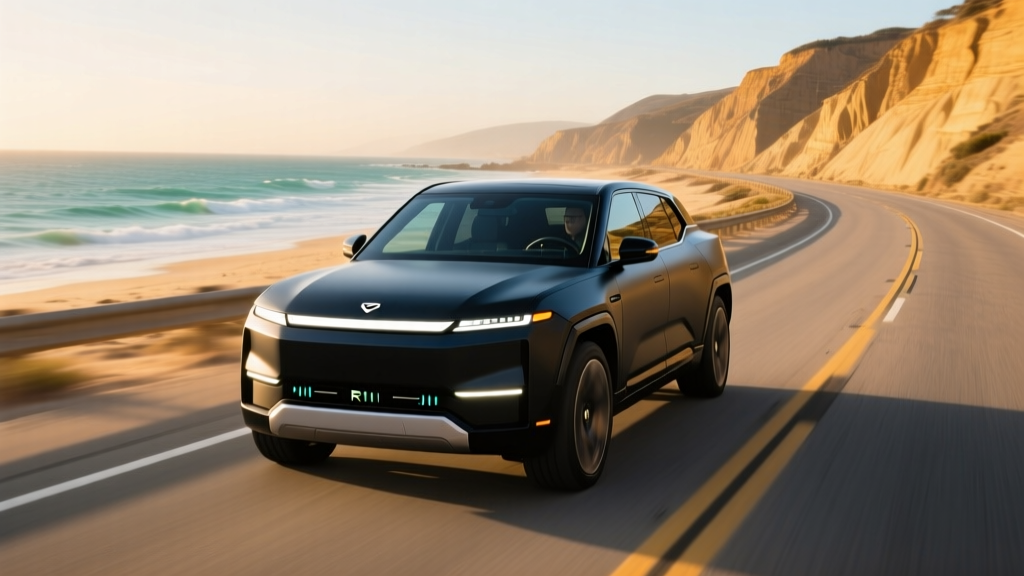
If you've been following Rivian's software roadmap, the phrase Rivian Autonomy Plus has likely surfaced in forums and owner groups. It's the brand's premium driver-assistance tier — a hardware-and-software bundle that pushes the R1S and R1T further into the SAE Level 2+ conversation alongside Tesla's FSD Supervised, Ford's BlueCruise, and GM's Super Cruise. But what does Autonomy Plus actually deliver on the road, and does the underlying EV hardware justify the premium?
In this review, we evaluate the 2026 Rivian R1S (Dual-Motor and Quad-Motor configurations) equipped with the Autonomy Plus package. We'll cover real-world range, DC fast-charging behavior, the driver-assist system's capabilities and limitations, interior practicality, pricing after federal incentives, and whether this package makes the R1S the smartest luxury electric SUV buy of the year.
2026 Rivian R1S at a Glance: Specs, Range, and Pricing
| Spec | Dual-Motor Standard | Dual-Motor Max | Quad-Motor |
|---|---|---|---|
| EPA Range | 270 mi | 352 mi | 321 mi |
| Battery (usable) | 92 kWh (NMC) | 135 kWh (NMC) | 135 kWh (NMC) |
| Max DC Fast Charge | 200 kW | 220 kW | 220 kW |
| 10–80% DC Time | ~28 min | ~33 min | ~33 min |
| Level 2 Home Rate | 11.5 kW (~25 mi/hr) | 11.5 kW (~25 mi/hr) | 11.5 kW (~25 mi/hr) |
| 0–60 mph | 4.5 sec | 4.5 sec | 3.0 sec |
| Horsepower | 533 hp | 533 hp | 835 hp |
| Drivetrain | AWD (dual-motor) | AWD (dual-motor) | AWD (quad-motor) |
| Efficiency (combined) | 73 MPGe / 46 kWh/100mi | 79 MPGe / 43 kWh/100mi | 70 MPGe / 48 kWh/100mi |
| Base MSRP | $79,900 | $89,900 | $99,900 |
| Towing Capacity | 7,700 lbs | 7,700 lbs | 7,700 lbs |
Charging Speed: DC Fast and Home Level 2
Rivian uses the NACS (North American Charging Standard) connector on all 2026 models, granting native access to the Tesla Supercharger network in addition to Electrify America, EVgo, and other CCS stations via adapter. The Max pack's 220 kW peak DC fast-charge rate is competitive with the Hyundai Ioniq 5 and Porsche Macan EV, though it falls short of the Lucid Air's 300+ kW capability.
| Charging Level | Power | Miles Added per Hour | Notes |
|---|---|---|---|
| Level 1 (120V) | 1.4 kW | ~3 mi/hr | Emergency/trickle only |
| Level 2 (240V, 48A) | 11.5 kW | ~25 mi/hr | Full overnight charge in 10–12 hr |
| DC Fast (peak) | 220 kW | ~550 mi/hr (at peak) | 10–80% in ~33 min; tapers significantly above 80% |
Charging-curve reality: Like most NMC packs, the R1S sustains peak charge rate only in a narrow State of Charge (SoC) window — roughly 10–35%. Above 50% SoC, the rate drops to around 120–140 kW, and above 80%, it slows to under 50 kW. On a road trip, the optimal strategy is to charge from 10% to 80% and move on rather than wait for a full top-off. Rivian's navigation system handles preconditioning — warming the battery before arrival at a DC charger — which is essential for achieving advertised speeds in cooler weather.
Rivian Autonomy Plus: What It Is and What It Isn't
The Rivian Autonomy Plus package builds on the standard Driver Assist+ suite with enhanced hardware and software. On the 2026 R1S, it includes:
- Enhanced sensor suite: 11 cameras, 5 radar units, and LiDAR (roof-mounted, integrated into the gear-guard rail area on newer builds)
- Highway Assist with lane-centering: Hands-on-wheel monitoring via torque sensor and driver-facing camera
- Automatic Lane Change: Confirmed lane changes on divided highways when the turn signal is activated and the system verifies a clear gap
- Predictive Speed Assist: Adjusts cruising speed for curves, speed-limit changes, and traffic conditions ahead
- Parking Assist: Automated parallel and perpendicular parking with remote capability (move the vehicle in/out of tight spots via the app)
- Intersection Assist: Alerts and automatic braking for cross-traffic when pulling through obstructed intersections
- It does not navigate city streets autonomously or handle stoplights/stop signs without driver input
- It does not allow hands-off or eyes-off driving — driver monitoring is active and will issue escalating warnings and eventually disengage
- It does not operate in construction zones, unmapped roads, or severe weather (heavy rain, snow, fog) with full reliability
- It is not a subscription — Autonomy Plus is bundled into the vehicle purchase or available as a one-time over-the-air unlock, depending on model year and build date
In real-world highway use, Autonomy Plus performs comparably to Ford BlueCruise 1.4 in terms of lane-centering smoothness and curve handling. Where it falls behind GM's Super Cruise is in hands-free operation on mapped highways — Rivian still requires torque on the steering wheel. The LiDAR addition in 2026 builds improves object detection confidence in low-light conditions, a tangible upgrade over the camera-and-radar-only 2024–2025 hardware.
Interior, Cargo, and Practicality
The R1S is a three-row electric SUV with genuine adult-usable third-row seating — a rarity in the EV space. Interior dimensions and cargo capacity:
- Front legroom: 41.4 inches
- Second-row legroom: 39.6 inches
- Third-row legroom: 32.3 inches (tight for adults on long trips, fine for children)
- Cargo behind 3rd row: 10.4 cu ft
- Cargo behind 2nd row (3rd row folded): 46.7 cu ft
- Cargo behind 1st row (all rear rows folded): 83.5 cu ft
- Front trunk (frunk): 11.0 cu ft — large enough for a carry-on bag and charging cables
The 11-cubic-foot frunk is a standout feature that competitors like the BMW iX and Mercedes EQS SUV lack entirely. Build quality on 2026 models has improved noticeably over early 2022–2023 deliveries, with tighter panel gaps and more consistent interior trim finishing. The 15.6-inch center touchscreen runs Rivian's proprietary infotainment OS, which supports wireless Apple CarPlay and Android Auto, over-the-air updates, and integrated trip planning with charging stops.
Pricing, Trims, and Federal Tax Credit Eligibility
| Configuration | Base MSRP | Autonomy Plus Add-On | As-Tested (with destination) | §30D Credit Eligibility |
|---|---|---|---|---|
| Dual-Motor Standard | $79,900 | Included (2026) | $81,500 | Eligible — up to $7,500 (subject to income & sourcing) |
| Dual-Motor Max | $89,900 | Included (2026) | $91,500 | Eligible — up to $7,500 (subject to income & sourcing) |
| Quad-Motor | $99,900 | Included (2026) | $101,500 | Eligible — up to $7,500 (subject to income & sourcing) |
Federal tax credit details (IRS §30D, 2026 rules): The Rivian R1S qualifies as an SUV under the §30D MSRP cap of $80,000. However, only the Dual-Motor Standard trim at $79,900 falls at or below that cap before options. Adding premium packages, the Camp Kitchen, or certain wheel upgrades can push the transaction price above $80,000 and jeopardize eligibility. The Dual-Motor Max and Quad-Motor trims exceed the MSRP cap on their base price alone and will not qualify for the federal credit unless IRS guidance adjusts the cap — consult IRS.gov §30D guidelines for current-year rules.
- MSRP cap: $80,000 for SUVs/vans/pickups; $55,000 for sedans
- Buyer income cap: $300,000 joint / $225,000 head of household / $150,000 single (modified AGI)
- Battery sourcing: Critical minerals and battery components must meet escalating annual thresholds for North American or free-trade-partner sourcing — Rivian's battery supply chain has progressively met these requirements through 2025–2026, but verify at point of sale
- Point-of-sale transfer: Eligible buyers can transfer the credit to the dealer at purchase, reducing the out-of-pocket price immediately rather than waiting for tax filing
- One vehicle per VIN, one credit per taxpayer per year
For buyers who qualify and purchase the Dual-Motor Standard R1S, the effective price after the full $7,500 credit drops to approximately $74,000 — a compelling entry point for a three-row luxury electric SUV with LiDAR-equipped driver assistance.
Ownership Costs, Warranty, and Long-Term Outlook
Rivian's warranty coverage for the 2026 R1S:
- Battery & powertrain: 8 years / 175,000 miles (whichever comes first), with a capacity retention threshold of 70%
- Bumper-to-bumper: 5 years / 60,000 miles
- Roadside assistance: 5 years / 60,000 miles
The 175,000-mile battery warranty is among the most generous in the industry, exceeding Tesla's 120,000-mile threshold and matching the spirit of Hyundai/Kia's coverage. The 70% capacity retention threshold is standard — if your 135 kWh pack drops below ~94.5 kWh usable capacity within the warranty window, Rivian will repair or replace it.
On efficiency and running costs, the Dual-Motor Max achieves roughly 43 kWh per 100 miles. At the national average residential electricity rate of $0.17/kWh (per EIA data), that translates to approximately $0.073 per mile for home charging. Compare that to a gasoline SUV averaging 22 MPG at $3.40/gallon — roughly $0.155 per mile. Over 15,000 miles annually, the R1S saves approximately $1,230 per year on energy alone, not including reduced brake wear from regenerative braking or the elimination of oil changes.
Insurance costs, however, are a real factor. The R1S typically insures for 20–35% more than a comparably priced ICE SUV due to repair complexity, parts availability, and total-loss thresholds. Get quotes before purchasing — in some states, annual premiums can exceed $3,000 for a Quad-Motor configuration.
Pros and Cons: The Honest Take
Pros
- Genuine 3-row seating with usable cargo space and a large frunk
- Class-leading 7,700-lb towing capacity for an electric SUV
- Autonomy Plus with LiDAR is robust for SAE Level 2 highway driving
- 175,000-mile battery warranty exceeds most competitors
- NACS connector provides native Supercharger access
- Strong OTA update track record — vehicles improve over time
- Off-road capability (ground clearance up to 14.9 in) unmatched by BMW iX, Audi e-tron
Cons
- Only the base Dual-Motor Standard trim qualifies for the §30D credit (MSRP cap)
- 220 kW peak charge rate trails Porsche/Hyundai 800V architectures
- Insurance premiums run significantly higher than ICE equivalents
- Third-row legroom is tight for adults on long trips
- Autonomy Plus requires hands on wheel — no hands-free highway mode like Super Cruise or BlueCruise
- Service center network still expanding — rural owners may face long tow distances for warranty work
- Real-world highway range falls 15–20% below EPA on Max pack
Who Should Buy the R1S with Autonomy Plus?
Choose the Rivian R1S with Autonomy Plus if:
- You need three rows for family duty but refuse to drive a minivan
- You tow a boat, camper, or horse trailer and need electric torque (7,700-lb rating)
- You want a premium ADAS experience on highway commutes and road trips without paying Tesla's FSD subscription model
- You have access to home Level 2 charging and can take advantage of overnight off-peak rates
- You value OTA software improvements and an adventure-oriented brand identity
Look elsewhere if:
- You want hands-free highway driving (GM Super Cruise or Ford BlueCruise on mapped roads)
- Your budget is under $70,000 (consider the Tesla Model Y, Hyundai Ioniq 5, or Kia EV9)
- You lack home charging access and rely exclusively on public infrastructure
- You need maximum DC charging speed for frequent long-distance travel (Porsche Macan EV or Hyundai Ioniq 5 charge faster)
Frequently Asked Questions
What is the real-world range of the 2026 Rivian R1S?
The EPA rates the Dual-Motor Max at 352 miles, but real-world highway driving at 70–80 mph yields approximately 280–310 miles. In cold weather (below 30°F), plan for 220–265 miles. The Standard pack delivers around 215–235 real-world highway miles in mild conditions. According to fueleconomy.gov, combined efficiency is 79 MPGe for the Max pack variant.
How fast does the R1S charge at home and on DC fast chargers?
At home on a 240V Level 2 charger (48A), the R1S charges at 11.5 kW, adding roughly 25 miles of range per hour — a full overnight session (10–12 hours) replenishes the Max pack from empty. On DC fast chargers, the Max pack peaks at 220 kW, achieving a 10–80% charge in approximately 33 minutes. The charge curve tapers significantly above 80%, so plan stops to 80% and move on for optimal road-trip timing.
Does the Rivian R1S qualify for the $7,500 federal EV tax credit?
It depends on the trim and your income. Under IRS §30D rules, the SUV MSRP cap is $80,000. Only the Dual-Motor Standard at $79,900 qualifies before options. The Dual-Motor Max ($89,900) and Quad-Motor ($99,900) exceed the cap. You must also meet income limits ($300,000 joint / $150,000 single) and the vehicle must satisfy battery-sourcing requirements. The credit can be transferred at point of sale to reduce your purchase price immediately. Always verify current eligibility at IRS.gov and with your tax professional.
Is Rivian Autonomy Plus a self-driving system?
No. Autonomy Plus is an SAE Level 2 driver-assistance system. It provides lane-centering, adaptive cruise control, automatic lane changes on highways, and predictive speed adjustment — but the driver must remain engaged, monitor the road, and maintain torque on the steering wheel. It does not handle city streets, stoplights, or construction zones autonomously. It is comparable to Tesla Autopilot and Ford BlueCruise in capability tier.
Is the R1S worth buying over the Tesla Model X or Kia EV9?
The R1S wins on towing capacity (7,700 lbs vs. the Model X's 5,000 lbs and the EV9's 5,000 lbs), off-road capability, frunk space, and adventure-oriented design. The Model X offers faster DC charging (250 kW), access to the mature Supercharger network, and a more established service footprint. The Kia EV9 is the value pick — starting around $56,000 with three rows and a 304-mile range — but it lacks the R1S's premium ADAS hardware, air suspension, and off-road chops. Your choice depends on budget, towing needs, and whether you prioritize luxury-adventure (R1S) or efficiency-and-value (EV9).
What battery chemistry does the R1S use, and how long will it last?
The 2026 R1S uses NMC (nickel manganese cobalt) lithium-ion cells in both the 92 kWh Standard and 135 kWh Max packs. NMC offers higher energy density than LFP (lithium iron phosphate), enabling the R1S's range figures, but it is more sensitive to sustained high-State-of-Charge storage and extreme heat. For maximum longevity, Rivian recommends daily charging to 80–85% and only charging to 100% before long trips. With proper care, NMC packs typically retain 85–90% capacity after 100,000 miles based on industry-wide degradation data. The 8-year/175,000-mile warranty with a 70% retention floor provides a strong safety net.