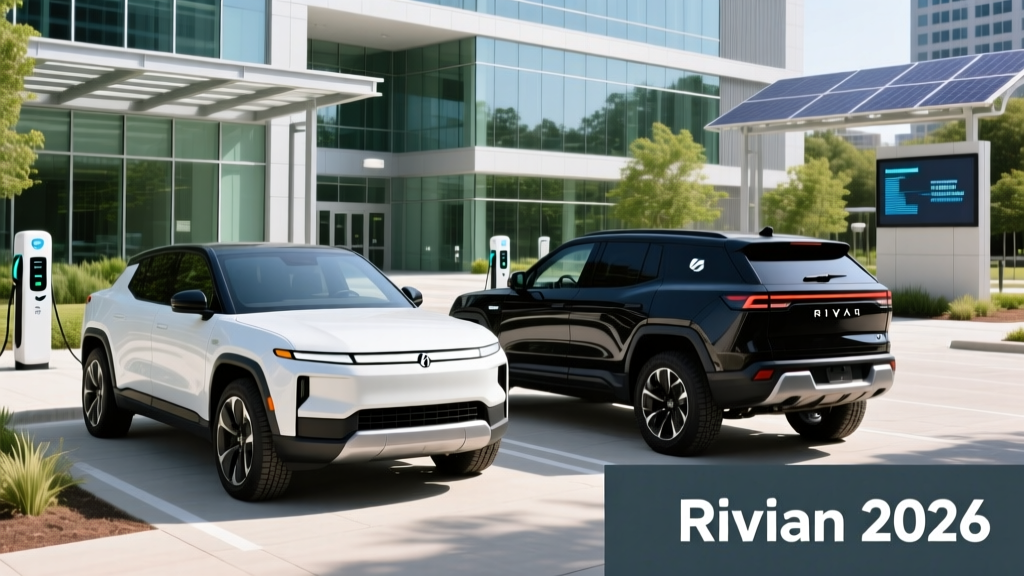
Rivian's decision to establish a major regional headquarters in Atlanta marks a strategic pivot toward the Southeast—one of the fastest-growing EV markets in the United States. For prospective buyers in Georgia, the Carolinas, and Florida, the move promises improved service infrastructure, more visible Rivian Waypoint presence, and easier access to test drives and deliveries. But corporate expansion doesn't change what matters most: does the vehicle itself deliver on range, charging speed, and value?
This review breaks down the current 2026 Rivian R1S (three-row SUV) and R1T (pickup truck) lineup with the exact numbers buyers need—EPA range, battery chemistry, DC fast-charge curves, and federal tax credit eligibility under the latest IRS §30D rules.
2026 Rivian R1S and R1T: Core Specifications at a Glance
Rivian offers both the R1S and R1T on the same Gen 2 skateboard platform, sharing battery packs, powertrain options, and electrical architecture. The table below covers the most popular configurations for the 2026 model year.
| Spec | R1S Dual-Motor (Standard Pack) | R1S Max Pack (Tri-Motor) | R1T Dual-Motor (Large Pack) |
|---|---|---|---|
| EPA Range | 270 mi | 380 mi | 328 mi |
| Battery Capacity (Usable) | 92 kWh (LFP) | 149 kWh (NMC) | 128 kWh (NMC) |
| Horsepower | 533 hp | 850 hp | 533 hp |
| 0-60 mph | 4.5 sec | 2.9 sec | 4.5 sec |
| Drivetrain | AWD (Dual-Motor) | AWD (Tri-Motor) | AWD (Dual-Motor) |
| Max DC Fast Charge | 200 kW | 220 kW | 220 kW |
| 10-80% DC Charge Time | ~28 min | ~41 min | ~34 min |
| Level 2 Home Charge (11.5 kW) | ~16 mi/hr | ~16 mi/hr | ~16 mi/hr |
| EPA Efficiency (Combined) | 73 MPGe | 70 MPGe | 73 MPGe |
| Towing Capacity | 7,700 lbs | 7,700 lbs | 11,000 lbs |
| Base MSRP | $75,900 | $99,900 | $69,900 |
Source: EPA fueleconomy.gov and Rivian official specs.
Real-World Range: What the EPA Sticker Doesn't Tell You
The R1S Max Pack's 380-mile EPA estimate is among the highest of any production SUV. However, real-world highway driving at 70-75 mph typically yields 310-340 miles before needing a charge. In cold weather (below 30°F), expect a further 15-25% reduction—bringing effective range to approximately 240-280 miles on a winter road trip.
The Standard Pack LFP models (270 mi EPA) are best treated as 220-240 mile vehicles for highway planning purposes, and closer to 180-200 miles in freezing conditions.
Rivian's thermal management system includes a heat pump across all 2026 trims, which mitigates some cold-weather cabin heating draw. Preconditioning the battery while plugged in—via the Rivian app's scheduled departure feature—recovers an estimated 5-8% of range that would otherwise be lost to battery warming during the first 30 minutes of driving.
For Atlanta-area owners, the subtropical climate works in Rivian's favor. Range loss due to temperature is minimal for most of the year, and the primary efficiency variable becomes highway speed and terrain on trips toward the Blue Ridge Mountains.
Charging Speed and Network Access
Charging speed is where Rivian's Gen 2 architecture shows both its strengths and its limitations compared to 800V competitors like the Hyundai Ioniq 5 or Porsche Macan EV.
| Charging Level | Power / Voltage | Speed (Miles Added) | Notes |
|---|---|---|---|
| Level 1 (120V household) | 1.4 kW | ~2-3 mi/hr | Emergency/trickle only |
| Level 2 (240V home, 48A) | 11.5 kW | ~16 mi/hr | Full charge overnight (~10 hrs for Large Pack) |
| DC Fast Charge (CCS/NACS) | Up to 220 kW peak | ~210 mi in 20 min (Max Pack) | Tapers significantly above 80% SoC |
Rivian transitioned to the NACS (Tesla-style) charge port on all 2025+ models, granting native access to Tesla Supercharger stations via the included adapter for older models or directly for 2025+ vehicles. For Atlanta buyers, this is significant: the Georgia Supercharger network includes over 30 stations along I-75, I-85, and I-20, dramatically improving road-trip practicality.
Charging curve reality check: The Max Pack's 220 kW peak rate is sustained only between approximately 10-40% State of Charge. From 40-80%, the curve tapers to roughly 140-160 kW. Above 80%, expect charging to slow to under 50 kW—plan your stops to charge to 80% and drive, rather than topping off at the charger.
Interior, Cargo, and Practicality
The R1S offers three rows of seating with the following interior dimensions:
- Cargo (behind 3rd row): 10.4 cu ft
- Cargo (3rd row folded): 46.7 cu ft
- Cargo (all rows folded): 104.7 cu ft
- Front legroom: 41.3 in
- Second-row legroom: 38.2 in
- Third-row legroom: 30.4 in (best for children or short trips)
The R1T pickup offers a 4.5-foot bed (54 cu ft) plus the signature Gear Tunnel—a 11.7 cu ft pass-through storage compartment accessible from both sides of the truck. Combined with the front trunk (frunk) at 11.0 cu ft, the R1T provides more enclosed, weather-sealed storage than most midsize pickups.
Both vehicles feature Rivian's 15.6-inch center touchscreen running the in-house Rivian OS, wireless Apple CarPlay and Android Auto, a 12.3-inch digital instrument cluster, and an available Camp Kitchen accessory (R1T) that slides out of the Gear Tunnel.
Pricing, Trims, and Federal Tax Credit Eligibility
Rivian's pricing places the R1S and R1T in the premium segment, but the federal EV tax credit can meaningfully reduce out-of-pocket cost—for eligible buyers.
| Model / Trim | Base MSRP | As-Tested (Typical Options) | Est. Federal Credit (§30D) | Effective Price |
|---|---|---|---|---|
| R1T Dual-Motor (Standard) | $69,900 | $74,500 | Up to $7,500* | ~$62,400 - $67,000 |
| R1S Dual-Motor (Standard) | $75,900 | $81,000 | Up to $7,500* | ~$68,400 - $73,500 |
| R1S Max Pack (Tri-Motor) | $99,900 | $106,000 | $0 (MSRP cap exceeded) | $99,900+ |
*Federal tax credit caveats (IRS §30D, 2026 rules):
- SUV MSRP cap: $80,000 (R1S qualifies at base, but optioned above ~$80K does not)
- Pickup MSRP cap: $80,000 (R1T qualifies in most configurations)
- Buyer income limits: AGI ≤ $150K single / $300K married filing jointly
- Battery sourcing: Credit splits into $3,750 for critical minerals + $3,750 for battery component manufacturing. Rivian's supply chain sourcing determines partial or full eligibility—verify the specific VIN on the IRS qualifying vehicle list before purchase.
- Point-of-sale transfer: Eligible buyers can transfer the credit to the dealer at purchase, reducing the sale price directly rather than waiting for a tax refund.
For the most current qualifying vehicle list, check IRS.gov qualifying vehicles.
Driver Assistance and Technology
Rivian's driver-assistance suite, branded Rivian Driver+, includes:
- Adaptive cruise control with stop-and-go
- Lane centering assist on divided highways
- Automatic emergency braking (forward and reverse)
- Blind-spot monitoring with rear cross-traffic alert
- Highway Assist (hands-on-wheel lane centering + ACC combo)
Rivian Driver+ is a Level 2 driver-assistance system per SAE J3016. The driver must maintain hands-on-wheel contact and remain fully attentive at all times. This is not autonomous or "self-driving" capability. Hands-free driving features remain under development and are not available in production vehicles as of 2026.
The infotainment system supports over-the-air (OTA) updates, which Rivian deploys roughly every 6-8 weeks to add features, improve efficiency algorithms, and refine the user interface. Recent updates have added improved route planning with charge-stop integration and enhanced battery preconditioning logic.
Pros, Cons, and Who Should Buy
Pros
- Class-leading range on Max Pack (380 mi EPA)
- Excellent build quality and thoughtful storage design
- NACS port provides native Supercharger access
- Strong off-road capability (8.9 in ground clearance, quad-motor tank turns on select trims)
- OTA updates continuously improve the vehicle post-purchase
- R1T Gear Tunnel and frunk offer unique utility
Cons
- High starting price; many trims exceed $80K MSRP cap for tax credit
- DC fast charge peak of 220 kW trails 800V competitors (350 kW capable)
- Third-row space in R1S is tight for adults
- Service center network still expanding—Atlanta HQ investment should improve this
- Driver+ system is competent but not class-leading vs. BlueCruise or Super Cruise
- Max Pack adds significant weight, reducing efficiency to ~70 MPGe combined
Who this EV suits best:
- Adventure-oriented families who need genuine off-road capability, 7,700+ lbs towing, and enclosed storage for gear
- Southeast road-trippers who benefit from the expanding Supercharger network along I-75/I-85 corridors
- Pickup buyers who want truck utility without daily fuel costs (R1T)
- Tech-forward buyers who value OTA improvement and software-driven features
Who should look elsewhere:
- Budget-conscious buyers (consider the Hyundai Ioniq 5 or Chevrolet Equinox EV below $50K)
- Those needing hands-free highway driving (GM Super Cruise or Ford BlueCruise vehicles)
- Buyers who cannot install home Level 2 charging (public-only charging at this price point is costly)
Warranty and Long-Term Ownership
Rivian backs the R1S and R1T with the following coverage:
- Battery pack: 8 years / 175,000 miles (retains ≥70% capacity)
- Powertrain: 8 years / 175,000 miles
- Bumper-to-bumper: 5 years / 60,000 miles
- Corrosion: 12 years / unlimited miles
The 175,000-mile battery warranty is among the most generous in the EV market and reflects confidence in both the Samsung SDI NMC cells (Large/Max Pack) and the newer LFP chemistry (Standard Pack). LFP batteries generally exhibit slower degradation curves, with industry data suggesting 80%+ capacity retention at 300,000+ miles under normal use patterns.
Frequently Asked Questions
What is the real-world range of the 2026 Rivian R1S and R1T?
For highway driving at 70-75 mph, expect approximately 310-340 miles from the R1S Max Pack (380 EPA), 270-295 miles from the R1T Large Pack (328 EPA), and 220-240 miles from the Standard Pack LFP models (270 EPA). Cold weather below 30°F reduces these figures by 15-25%.
How fast does the Rivian R1S/R1T charge at home and on the road?
At home on a 240V Level 2 charger (11.5 kW / 48A), you'll add approximately 16 miles of range per hour—a full overnight charge for most battery sizes. On DC fast chargers, the Max Pack peaks at 220 kW, adding roughly 210 miles in 20 minutes (10-60% SoC). Expect 10-80% in approximately 34-41 minutes depending on pack size.
Does the Rivian R1S or R1T qualify for the $7,500 federal EV tax credit?
It depends on configuration and buyer income. The R1T qualifies in most configurations under the $80,000 pickup MSRP cap. The R1S qualifies at base pricing under the $80,000 SUV cap, but popular option packages push it above that threshold. Buyer AGI must be ≤$150K (single) or ≤$300K (married filing jointly). Battery critical-mineral and component sourcing rules may reduce the credit to $3,750 for some VINs. Always verify on the IRS qualifying vehicle list before purchasing.
Is the Rivian R1S worth buying over the Tesla Model X or BMW iX?
The R1S wins on off-road capability, adventure-oriented storage, and three-row seating at a lower price than the Model X. The Tesla Model X offers faster DC charging (250 kW peak), access to the full Supercharger network without adapters, and a more established service network. The BMW iX provides a more luxurious interior and faster charging but seats only five and starts above $87,000. For Atlanta-area families who camp, tow, or venture off-pavement, the R1S is the stronger choice. For pure highway commuting and charging convenience, the Model X retains an edge.
How does Rivian's Atlanta headquarters affect buyers in the Southeast?
The Atlanta regional hub signals expanded service capacity, faster parts logistics, and more delivery/servicing options for Georgia, Alabama, and Carolina customers. Rivian has indicated plans to grow its Rivian Waypoint rental and experience center presence in the region, which provides try-before-you-buy opportunities. However, the company's primary manufacturing remains in Normal, Illinois—Atlanta is a corporate and service expansion, not a production facility.
What charger connector does the 2026 Rivian use?
All 2026 Rivian vehicles come equipped with the NACS (North American Charging Standard) port, the same connector used by Tesla. This provides native access to Tesla Superchargers and the growing number of NACS-equipped third-party stations (Electrify America, EVgo, and others are adding NACS cables through 2026). CCS adapters are available for backward compatibility with legacy CCS stations.