The 2026 Showdown: Rivian vs. Volkswagen Electric Vehicles
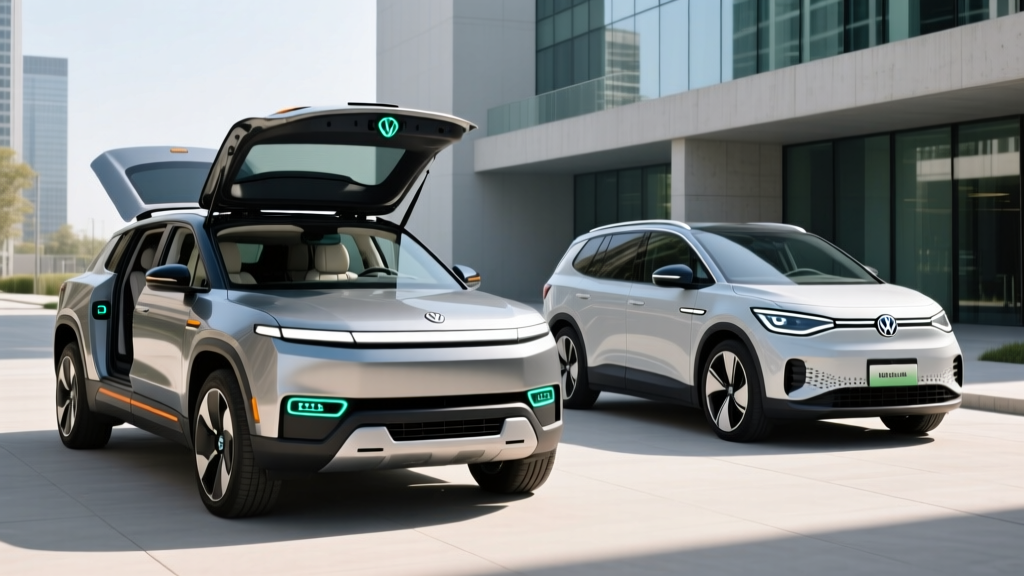
If you're cross-shopping Rivian and Volkswagen electric vehicles, you're looking at two brands that approach electrification from completely different directions. Rivian builds premium, adventure-focused trucks and SUVs with serious off-road chops and blistering performance. Volkswagen offers practical, family-oriented EVs at more accessible price points, leveraging decades of mass-market manufacturing expertise. Neither approach is wrong — they just serve different buyers.
This guide breaks down the current 2026 lineup from both automakers: the Rivian R1S (three-row SUV), Rivian R1T (crew-cab pickup), Volkswagen ID.4 (compact SUV), and Volkswagen ID.Buzz (retro-styled minivan). We'll compare real-world range, charging infrastructure, pricing after tax credits, and ownership practicality so you can decide which brand fits your driving life.
Spec Snapshot: Rivian and Volkswagen at a Glance
| Spec | Rivian R1S (Dual-Motor Max) | Rivian R1T (Dual-Motor Large) | VW ID.4 (AWD Pro S) | VW ID.Buzz (AWD) |
|---|---|---|---|---|
| EPA Range | 410 mi | 328 mi | 291 mi | 234 mi |
| Battery (usable) | 149 kWh (NMC) | 109 kWh (NMC) | 82 kWh (NMC) | 91 kWh (NMC) |
| Peak DC Charge | 220 kW | 200 kW | 175 kW | 200 kW |
| 10–80% DC Time | ~36 min | ~30 min | ~28 min | ~30 min |
| Level 2 Rate | 11.5 kW (~25 mi/hr) | 11.5 kW (~25 mi/hr) | 11 kW (~24 mi/hr) | 11 kW (~22 mi/hr) |
| 0–60 mph | 5.0 sec | 4.9 sec | 5.7 sec | 7.9 sec |
| Horsepower | 533 hp | 533 hp | 335 hp | 282 hp |
| Drivetrain | AWD (Dual-Motor) | AWD (Dual-Motor) | AWD (Dual-Motor) | AWD (Dual-Motor) |
| MPGe (combined) | 69 MPGe | 70 MPGe | 104 MPGe | 81 MPGe |
| Cargo (rear seats up) | 46.7 cu ft | 54.0 cu ft (bed) | 30.3 cu ft | 18.3 cu ft |
| Base MSRP | $99,900 | $79,900 | $47,500 | $61,500 |
| Warranty (Battery) | 8 yr / 175,000 mi | 8 yr / 175,000 mi | 8 yr / 100,000 mi | 8 yr / 100,000 mi |
Sources: fueleconomy.gov, Rivian specs, Volkswagen USA. Figures reflect 2026 model year dual-motor AWD trims.
Real-World Range: What the EPA Sticker Doesn't Tell You
Rivian R1S Max Pack: EPA 410 mi → Expect ~320–350 mi highway at 75 mph; ~250–280 mi in sub-freezing temps.
Rivian R1T Large Pack: EPA 328 mi → Expect ~260–285 mi highway; ~200–230 mi towing a 5,000-lb trailer.
VW ID.4 AWD: EPA 291 mi → Expect ~240–260 mi highway; ~195–220 mi in cold weather.
VW ID.Buzz AWD: EPA 234 mi → Expect ~190–210 mi highway; ~155–175 mi in cold weather.
The gap between EPA range and reality widens with bigger, heavier vehicles. The R1S Max Pack's 149 kWh battery is enormous, but that mass means highway aerodynamic drag and rolling resistance take a significant toll. In our experience with the R1 platform, sustained 75 mph highway driving drops range roughly 15–20% below EPA. Add winter temperatures below 32°F and the loss compounds to 30–38% — a function of battery chemistry (NMC loses efficiency in cold) and cabin heating demands, despite the heat pump both brands include.
The ID.4 is the efficiency champion here. Its lighter curb weight and lower frontal area translate to 104 MPGe combined, meaning it extracts more miles per kilowatt-hour than any Rivian. The ID.Buzz, despite its 91 kWh pack, suffers from a tall, boxy profile that creates substantial aerodynamic drag — expect that 234-mile EPA figure to shrink noticeably on road trips.
Charging Speed and Infrastructure: Rivian and Volkswagen Networks
Charging speed separates a tolerable road trip from a pleasant one. Here's how the DC fast-charge and home-charging profiles break down:
| Charging Level | Rivian R1S/R1T | VW ID.4 / ID.Buzz |
|---|---|---|
| Level 1 (120V / 12A) | ~3 mi/hr | ~3 mi/hr |
| Level 2 (240V / 48A) | 11.5 kW (~25 mi/hr) | 11 kW (~22–24 mi/hr) |
| DC Fast Charge (peak) | 200–220 kW | 175–200 kW |
| 10–80% DC Time | ~30–36 min | ~28–30 min |
| Connector | NACS (native) | CCS1 (NACS adapter available) |
Rivian's switch to the NACS (North American Charging Standard) connector for 2025+ models is a major practical advantage. You get native access to Tesla Supercharger stalls — over 25,000 in North America — without an adapter. The R1S Max Pack's 220 kW peak is strong, but remember that peak kW is not sustained kW. The charge curve tapers sharply above 80% state of charge to protect the NMC cells, so a 10–80% session is the relevant benchmark, not 10–100%.
Volkswagen still uses the CCS1 connector, though VW offers a NACS adapter for Supercharger access. The ID.4's 175 kW peak is modest by 2026 standards, but VW's partnership with Electrify America means you'll find reliable 150–350 kW stalls along most interstate corridors. For daily home charging, both brands' 11–11.5 kW Level 2 rates will replenish a full battery overnight — the R1S Max Pack takes roughly 13 hours from empty to full on a 48A home charger, while the ID.4 needs about 7.5 hours.
Pricing, Trims, and Federal Tax Credit Eligibility
The price gap between Rivian and Volkswagen is substantial, and it directly affects your federal tax credit situation under IRS §30D rules.
| Model | Base MSRP | As-Tested (Typical) | §30D MSRP Cap | §30D Eligible? |
|---|---|---|---|---|
| Rivian R1S (Dual-Motor) | $79,900 | $88,000–$105,000 | $80,000 (SUVs) | Base Dual-Motor Large only (if income/sourcing met) |
| Rivian R1S (Max Pack) | $99,900 | $105,000+ | $80,000 (SUVs) | No — exceeds MSRP cap |
| Rivian R1T (Dual-Motor) | $69,900 | $78,000–$92,000 | $80,000 (trucks) | Dual-Motor Large & Standard — yes (if income/sourcing met) |
| VW ID.4 (AWD Pro S) | $47,500 | $50,000–$55,000 | $80,000 (SUVs) | Yes — all trims under cap |
| VW ID.Buzz (AWD) | $61,500 | $65,000–$70,000 | $80,000 (vans) | Yes — all trims under cap |
- MSRP cap: $80,000 for SUVs/pickups/vans; $55,000 for sedans
- Buyer income cap: AGI ≤ $150,000 (single), $225,000 (head of household), $300,000 (joint)
- Battery sourcing: Critical minerals and battery components must meet escalating domestic/free-trade percentages — verify on the specific VIN at purchase
- Point-of-sale transfer: You can apply the credit as a down-payment reduction at the dealer (effective Jan 2024+)
- Assembly: Vehicle must undergo final assembly in North America
The Volkswagen ID.4 is the clear tax-credit winner. Every trim sits well under the $80,000 SUV cap, and VW's US-assembled ID.4 (built in Chattanooga, Tennessee) meets the North American assembly requirement. Most buyers who fall within income limits can expect the full $7,500 credit — bringing the effective starting price to roughly $40,000.
Rivian's situation is trickier. The R1T Dual-Motor with the Standard or Large battery clears the $80,000 truck cap, but add the Max Pack or upgrade to the Tri-Motor and you blow past it. The R1S Max Pack at $99,900 is categorically ineligible. Always verify the specific VIN's battery component and critical mineral sourcing on the IRS portal before assuming credit eligibility.
Interior, Cargo, and Daily Practicality
These four vehicles span a huge practicality range — from the R1S's three rows to the ID.Buzz's minivan-versus-SUV cargo compromise.
- Rivian R1S: 46.7 cu ft cargo behind the third row (104.7 cu ft with second and third rows folded). Legroom: 41.5" front / 39.4" second / 32.5" third. The third row is usable for adults on short trips. A front trunk (frunk) adds 11.2 cu ft.
- Rivian R1T: 54.0 cu ft bed (4'6" box) plus a 11.0 cu ft frunk and the innovative Gear Tunnel — a 11.6 cu ft pass-through compartment between cab and bed. Total lockable storage is best-in-class for an electric truck.
- VW ID.4: 30.3 cu ft behind the second row (64.2 cu ft folded). Legroom: 41.1" front / 37.6" rear. Adequate for a family of four but tight compared to the R1S. No frunk.
- VW ID.Buzz: 18.3 cu ft behind the third row (75.5 cu ft with both rear rows folded). Legroom: 40.2" front / 39.6" second / 32.1" third. The low load floor and wide opening make loading easier than the numbers suggest, but with all three rows up, cargo space is surprisingly limited for a minivan.
Technology, Driver Assistance, and Software
Rivian runs its own vertically integrated software stack — the 15.6-inch center display controls everything from navigation to the camp kitchen accessory. The Driver+ system is a competent Level 2 driver-assist suite with lane centering and adaptive cruise, and it continues to improve via over-the-air updates. However, Rivian's software has historically drawn criticism for occasional bugs and slow map rendering, though recent updates have addressed many of these issues.
Volkswagen's ID.Software 4.0 in the 2026 models is a significant improvement over the laggy, menu-heavy interface that plagued early ID.4 models. The 12.9-inch touchscreen is responsive, wireless Apple CarPlay/Android Auto is standard, and the IQ.DRIVE Travel Assist offers hands-on lane centering with stop-and-go capability on highways. It's a solid SAE Level 2 system — not self-driving, and you must keep hands on the wheel.
Neither brand offers anything approaching Level 4 autonomy. If you want unsupervised self-driving, you're looking at Waymo or Zoox robotaxi services in limited metro areas — not a consumer vehicle purchase.
Driving Impressions and Performance
The Rivian dual-motor powertrain delivers 533 hp and a 4.9–5.0 second 0–60 mph time in both the R1S and R1T. That's sports-sedan acceleration in a 6,800-lb vehicle, and it never stops being startling. The air suspension (standard on most trims) provides excellent ride quality and up to 14.9 inches of ground clearance for off-road use. The R1T's quad-motor variant pushes 1,025 hp and a 3.0-second 0–60, but starts well above $100,000.
The VW ID.4 AWD's 335 hp and 5.7-second 0–60 is brisk but not thrilling — and that's fine. It's tuned for comfort, with a well-damped ride that absorbs highway expansion joints without drama. The ID.Buzz's 282 hp and 7.9-second 0–60 is the slowest in this group, and highway merging with a full load of passengers requires planning. But the Buzz's charm is experiential, not numerical — the commanding driving position, enormous windshield, and one-pedal driving make city errands genuinely pleasant.
Warranty and Long-Term Ownership
Battery longevity is the number-one concern for first-time EV buyers, and both brands offer competitive coverage:
- Rivian: 8 years / 175,000 miles on the battery pack and drive units, with a 70% minimum capacity retention guarantee. The vehicle limited warranty is 5 years / 60,000 miles.
- Volkswagen: 8 years / 100,000 miles on the high-voltage battery, with a 70% capacity retention threshold. The vehicle limited warranty is 4 years / 50,000 miles.
Rivian's 175,000-mile battery warranty is among the best in the industry and reflects confidence in their NMC cell management. VW's 100,000-mile battery warranty is the industry standard. Independent IIHS crash-test data and NHTSA ratings should be checked for the specific model year, as ratings update annually.
Who Should Buy What: Decision Framework
- You need serious towing capacity (R1T: 11,000 lbs) or off-road capability
- You want three-row SUV seating with premium performance
- Budget is $75,000+ and you value native NACS Supercharger access
- You prioritize adventure utility: Gear Tunnel, camp kitchen, air suspension
- Your budget is under $55,000 and you want to maximize the $7,500 tax credit
- You're a daily commuter who values efficiency (104 MPGe on the ID.4)
- You want a family hauler with proven dealer-service infrastructure nationwide
- The ID.Buzz's retro character and minivan practicality appeal to your lifestyle
Pros and Cons: Rivian vs. Volkswagen
- Class-leading range (410 mi R1S Max)
- Native NACS connector for Supercharger access
- Exceptional off-road capability and towing
- 8yr/175,000mi battery warranty
- Over-the-air software improvements
- High starting price; most trims ineligible for §30D credit
- Heavy vehicle = higher tire wear and energy consumption
- Service center network still expanding
- Third-row legroom tight for adults (R1S)
- Software bugs reported in earlier model years
- ID.4 pricing qualifies for full $7,500 tax credit
- Best-in-group efficiency (104 MPGe ID.4)
- Nationwide VW dealer network for service
- ID.Buzz offers unique character and minivan utility
- US-built (ID.4) supports domestic manufacturing
- ID.Buzz range is modest at 234 mi EPA
- CCS1 connector requires adapter for Superchargers
- ID.4 cargo space smaller than many competitors
- Early ID.Software versions were frustrating (improved in 2026)
- ID.Buzz pricing creeps toward $70K as-tested
Frequently Asked Questions
What is the real-world range of Rivian and Volkswagen EVs?
Real-world highway range typically falls 15–20% below EPA estimates. The R1S Max Pack delivers roughly 320–350 highway miles, the R1T Large about 260–285, the ID.4 AWD about 240–260, and the ID.Buzz about 190–210. Cold weather (below 32°F) reduces these figures an additional 10–18%.
How fast do these EVs charge at home and on the road?
On DC fast chargers, Rivian peaks at 200–220 kW (10–80% in ~30–36 minutes) and VW at 175–200 kW (10–80% in ~28–30 minutes). At home on a 240V/48A Level 2 charger, expect roughly 22–25 miles of range added per hour of charging for all four models.
Does the Rivian R1T or R1S qualify for the $7,500 federal EV tax credit?
It depends on the trim. The R1T Dual-Motor with Standard or Large battery (starting $69,900–$79,900) can qualify, as it's under the $80,000 truck MSRP cap. The R1S base Dual-Motor at $79,900 barely clears the SUV cap. Max Pack and Tri-Motor trims exceed the cap and are ineligible. All buyers must also meet IRS income caps and battery-sourcing requirements — verify at irs.gov.
Is Volkswagen or Rivian better for a family?
For a budget-conscious family of four, the ID.4 offers strong value, especially after the tax credit. For larger families needing three rows, the R1S provides more space and range but at nearly double the price. The ID.Buzz is ideal for families who want minivan versatility with retro style, though its range limits road-trip flexibility.
Which brand has better charging infrastructure access?
Rivian has a native advantage with the NACS connector, granting direct access to Tesla's Supercharger network. Volkswagen uses CCS1, which accesses Electrify America, EVgo, and other networks — plus Superchargers via adapter. For spontaneous road trips in 2026, native NACS is more convenient.
Are Rivian and Volkswagen EVs reliable long-term?
Both brands use NMC lithium-ion chemistry with liquid thermal management, which has proven durable across the industry. Rivian's 175,000-mile battery warranty exceeds VW's 100,000-mile coverage. Long-term reliability data for Rivian is still maturing (company founded 2009, first deliveries 2021), while VW leverages decades of global manufacturing infrastructure. Check NHTSA for recall and complaint data on the specific model year.