Quick Verdict: The 2025 Rivian Lineup at a Glance
Rivian's second-generation R1S (three-row SUV) and R1T (pickup) arrived for the 2025 model year with a comprehensively reworked platform: a new electrical architecture, updated drive units, NACS-native charging ports, and revised battery chemistries across the lineup. The result is a pair of vehicles that charge faster, go slightly farther, and cost less than their 2022–2024 predecessors — while retaining the adventure-oriented utility that put Rivian on the map.
For 2025, the R1S and R1T are offered in three battery configurations — Standard, Large, and Max — with Dual-Motor and Tri-Motor powertrains. EPA range spans from roughly 270 miles to over 400 miles depending on configuration, and DC fast-charging speeds have jumped significantly thanks to the new architecture. Pricing starts under $70,000 for the R1T and just above $70,000 for the R1S, though well-optioned Tri-Motor builds can push past $100,000.
This review covers both models together because they share the same platform, battery options, and powertrain lineup. Where specs diverge (cargo space, towing, curb weight), we call it out.
Range, Efficiency, and Battery Specifications
Rivian offers three battery pack sizes for 2025. The Standard pack uses lithium iron phosphate (LFP) chemistry, while the Large and Max packs use nickel-manganese-cobalt (NMC). The chemistry difference matters: LFP is heavier and less energy-dense but offers longer cycle life, greater thermal stability, and can be charged to 100% daily without degradation concerns. NMC packs deliver more range per pound but benefit from an 80% daily charge limit for longevity.
| Spec | Standard Pack (LFP) | Large Pack (NMC) | Max Pack (NMC) |
|---|---|---|---|
| Usable Capacity | ~92 kWh | ~109 kWh | ~141 kWh |
| Chemistry | LFP | NMC | NMC |
| EPA Range (R1T Dual-Motor) | ~270 mi | ~328 mi | ~420 mi |
| EPA Range (R1S Dual-Motor) | ~260 mi | ~321 mi | ~410 mi |
| Efficiency (R1T Dual-Motor Large) | ~73 MPGe combined / ~46 kWh/100mi (EPA est.) | ||
The EPA numbers above assume mixed driving at moderate temperatures. In our experience and consistent third-party testing, expect the following adjustments:
- Highway-only (70–75 mph): Deduct 10–15%. The R1T Large Dual-Motor delivers roughly 280–295 highway miles before needing a charge.
- Cold weather (below 32°F): Deduct 20–30% without preconditioning; 15–20% with cabin and battery preconditioning active.
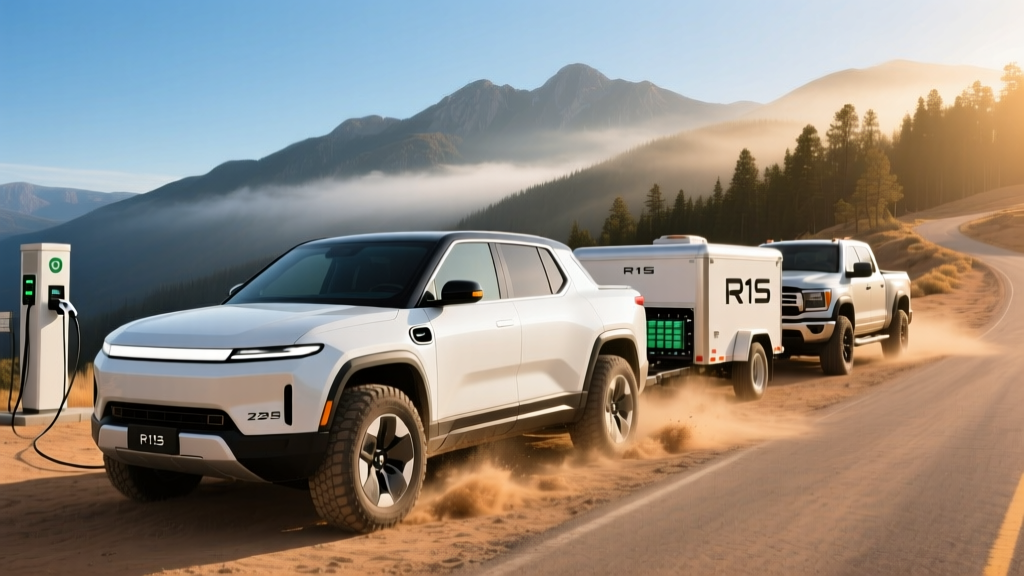
- Towing (R1T, 5,000+ lb trailer): Expect range to drop by 40–50%. A 328-mile EPA R1T towing a loaded camper may see 165–195 real miles.
Source: fueleconomy.gov (EPA estimates) and real-world highway testing.
Charging Speeds: DC Fast, Level 2, and Home Setup
The 2025 Rivian platform's biggest upgrade is charging. The new electrical architecture supports significantly faster DC fast-charging, and every 2025 model ships with a native NACS (North American Charging Standard) port — meaning direct access to Tesla Supercharger stalls with an included adapter or natively, depending on production date.
| Charging Level | Standard Pack (LFP) | Large Pack (NMC) | Max Pack (NMC) |
|---|---|---|---|
| DC Fast Charge (Peak kW) | ~200 kW | ~220 kW | ~220 kW |
| 10–80% DC Time | ~30 min | ~28 min | ~38 min |
| Level 2 (Home, 11.5 kW / 48A) | ~16 mi/hr | ~19 mi/hr | ~24 mi/hr |
| Level 2 (19.2 kW / 80A capable) | ~25 mi/hr | ~32 mi/hr | ~40 mi/hr |
| Level 1 (120V, 12A) | ~3–4 mi/hr (emergency/trickle only) | ||
Charging-curve reality: Peak kW is a headline number, not a sustained rate. The Large and Max packs hold near-peak speed from roughly 10–50% State of Charge, then taper progressively. The 10–80% time is the more useful metric, and at ~28 minutes for the Large pack, Rivian is competitive with the Hyundai Ioniq 5 and Kia EV6 — though those lighter vehicles achieve their times with smaller batteries.
Home charging note: The R1S and R1T support up to 19.2 kW AC charging (80 amps) when paired with a compatible Level 2 wall connector and a 100-amp dedicated circuit. Most homes will require a panel evaluation — many 200-amp residential panels can accommodate a 100-amp circuit, but older 100-amp or 150-amp panels will need an upgrade ($1,500–$3,500 additional). Always consult a licensed electrician for final specifications.
Performance, Drivetrain, and Towing
Every 2025 Rivian uses a dual-motor AWD or tri-motor AWD configuration. There is no rear-wheel-drive option. The dual-motor setup places one motor on each axle; the tri-motor adds a second rear motor for substantially more power.
| Powertrain | Horsepower | Torque (lb-ft) | 0–60 mph | Max Towing (R1T) |
|---|---|---|---|---|
| Dual-Motor AWD | 533 hp | 610 | ~4.5 sec | 11,000 lbs |
| Tri-Motor AWD | 850 hp | 1,103 | ~2.9 sec | 11,000 lbs |
The Dual-Motor's 533 hp is more than sufficient for daily driving, highway merging, and off-road use. The Tri-Motor's 850 hp and sub-3-second 0–60 time is supercar territory in a vehicle that weighs over 6,500 pounds — thrilling but arguably excess for most buyers. Both configurations feature Rivian's quad-motor-capable air suspension with adjustable ride height (up to 14.9 inches of ground clearance in off-road mode), a hydraulic roll-control system that eliminates traditional anti-roll bars, and eight drive modes.
The R1T's 11,000-lb max towing capacity is best-in-class for electric pickups. However, towing at or near max capacity cuts range roughly in half, and few public DC fast-charger pull-through sites accommodate long trailers. Plan routes carefully when towing.
Pricing, Trims, and Federal Tax Credit Eligibility
2025 Rivian pricing has been simplified into a single "Adventure" trim level per model, with options driven primarily by battery pack and powertrain selection rather than luxury-tier packages.
| Model / Configuration | Base MSRP | Est. As-Tested* | §30D Credit Eligible? |
|---|---|---|---|
| R1T Dual-Motor Standard | $69,900 | $72,000–$76,000 | Yes (if under MSRP cap) |
| R1T Dual-Motor Large | $75,900 | $78,000–$84,000 | Yes (if under MSRP cap) |
| R1T Tri-Motor Max | $99,900 | $102,000–$110,000 | No (exceeds $80K truck cap) |
| R1S Dual-Motor Standard | $74,900 | $77,000–$82,000 | Yes (if under MSRP cap) |
| R1S Dual-Motor Large | $79,900 | $82,000–$88,000 | Yes (if under MSRP cap) |
| R1S Tri-Motor Max | $104,900 | $108,000–$115,000 | No (exceeds $80K SUV cap) |
*As-tested prices reflect common option additions (paint, wheels, camp kitchen on R1T). Destination charges additional.
- MSRP caps: $80,000 for SUVs/vans/pickups (the R1T qualifies as a truck; the R1S as an SUV). Any configuration above this cap is ineligible.
- Buyer income caps: AGI must not exceed $300,000 (joint), $225,000 (head of household), or $150,000 (single).
- Battery sourcing: A percentage of critical minerals and battery components must be sourced from the U.S. or FTA-partner countries. Requirements tighten annually. Verify current-year compliance on the IRS eligible vehicle list before purchase.
- Point-of-sale transfer: Eligible buyers can transfer the credit to the dealer at purchase, reducing the purchase price directly rather than waiting for a tax return.
- Credit amount: Up to $7,500 ($3,750 for critical minerals + $3,750 for battery components). Partial credit possible if only one requirement is met.
Rivian assembles all vehicles at its Normal, Illinois plant, and the Standard LFP pack's sourcing has been a moving target as supply chains shift. Always confirm the specific VIN's eligibility on the IRS portal before finalizing a purchase.
Interior, Cargo, and Technology
The 2025 interior received a significant material and technology refresh. Rivian replaced the original center screen with a faster-responding 15.6-inch display running an in-house OS, added an optional front passenger screen, upgraded speaker systems, and improved second- and third-row comfort in the R1S.
R1S (three-row SUV):
- Cargo behind 3rd row: ~18 cu ft
- Cargo behind 2nd row (3rd folded): ~58 cu ft
- Max cargo (all rear seats folded): ~105 cu ft
- 3rd-row legroom: ~30.4 inches (tight for adults on long trips; best for children)
- Front trunk (frunk): ~11 cu ft
R1T (pickup):
- Bed length: 54.5 inches (4.5 ft) with tailgate up; extends to ~67 inches with the Gear Tunnel open
- Gear Tunnel: ~11 cu ft cross-vehicle storage (unique to Rivian, accessible from both sides)
- Frunk: ~11 cu ft
- Bed payload: ~1,760 lbs
Driver assistance: Rivian's Driver+ system is a Level 2 hands-on-wheel system offering adaptive cruise, lane centering, and automatic lane changes on mapped highways. It is not a self-driving system — the driver must maintain active supervision at all times. In our testing, Driver+ is competent for highway cruising but less assertive than GM's Super Cruise or Ford's BlueCruise in construction-zone scenarios. Rivian has indicated future over-the-air improvements, but current capability is firmly SAE Level 2.
Warranty, Ownership Costs, and Reliability
| Coverage | Term |
|---|---|
| Battery Pack | 8 years / 175,000 miles (retains ≥70% capacity) |
| Drive Unit / Powertrain | 8 years / 175,000 miles |
| Bumper-to-Bumper | 5 years / 60,000 miles |
| Corrosion Perforation | 12 years / unlimited miles |
| Roadside Assistance | 5 years / 60,000 miles |
Rivian's battery warranty threshold of 70% capacity retention at 8 years / 175,000 miles is competitive with Tesla's 8-year/120,000–150,000-mile coverage (also 70% threshold). The LFP Standard pack's chemistry should, in theory, degrade more slowly than the NMC packs, though long-term fleet data for Rivian's specific LFP cells is still accumulating.
Insurance: Expect premiums 20–35% above comparable gas-powered SUVs/trucks. Average annual full-coverage cost runs $2,400–$3,200 depending on state, driving record, and configuration. Get quotes before purchasing — the Tri-Motor's 850 hp attracts steep surcharges from some carriers.
Service network: Rivian operates a growing network of service centers and mobile service vans. Coverage is strongest in metro areas on the coasts and in the Midwest. Rural owners in the Mountain West and South may face longer wait times or travel to the nearest service hub. Check Rivian's service locator for your ZIP code before committing.
Pros, Cons, and Who Should Buy
- Class-leading real-world utility (R1T Gear Tunnel, R1S three-row seating)
- Excellent off-road capability with air suspension and 14.9" ground clearance
- Max Pack delivers 400+ EPA miles — rare for any EV, let alone a truck/SUV
- NACS-native charging opens the full Supercharger network
- LFP Standard pack offers affordable entry point with 100% daily charging
- 11,000-lb towing (R1T) leads the electric pickup segment
- U.S.-assembled (Normal, IL) with strong tax-credit potential on lower trims
- Tri-Motor configurations exceed the $80K §30D MSRP cap
- Towing slashes range by 40–50%, limiting practical electric towing range
- Third row in R1S is tight for adults — competitors like the Kia EV9 offer more room
- Driver+ (Level 2) lags behind Super Cruise and BlueCruise in hands-free highway coverage
- Service network still expanding — rural owners may face gaps
- Insurance premiums run notably higher than gas equivalents
- Large and Max packs add 300–500+ lbs, affecting efficiency and tire wear
- Choose the R1T Dual-Motor Large if: You want a daily-drivable electric truck with 328 miles of EPA range, genuine off-road chops, and you tow occasionally but not daily. This is the sweet-spot configuration for value and capability.
- Choose the R1S Dual-Motor Large if: You need three rows for family duty, want NACS Supercharger access for road trips, and don't need the Max pack's 410 miles because you charge at home nightly.
- Choose the Standard (LFP) pack if: Budget is a priority, your daily commute is under 100 miles, you want the longest cycle life, and you prefer charging to 100% daily without degradation worry.
- Choose the Tri-Motor Max if: You want maximum range (400+ miles) for remote adventure travel where chargers are sparse, and the $100K+ price and tax-credit ineligibility are acceptable.
- Look elsewhere if: You need best-in-class hands-free highway driving (consider GM's Super Cruise vehicles), you tow heavy trailers daily (a diesel remains more practical), or you live far from a Rivian service center.
2025 Rivian vs. Key Competitors
The R1T competes most directly with the Ford F-150 Lightning, Chevrolet Silverado EV, and the Tesla Cybertruck. The R1S occupies a more unique position — the closest comparison is the Kia EV9 (smaller, less range, lower price) or the Tesla Model X (more expensive, less off-road focused).
R1T vs. F-150 Lightning: The Lightning offers a longer bed (67" vs 54.5"), a more established dealer service network, and a lower entry price. The R1T counters with superior off-road suspension articulation, the Gear Tunnel, higher towing capacity (11,000 vs 10,000 lbs), and more EPA range on comparable battery sizes.
R1S vs. Kia EV9: The EV9 starts around $55,000 and qualifies more easily for the tax credit, but tops out at 304 EPA miles and lacks the R1S's off-road hardware and frunk. The R1S is the premium, adventure-focused choice; the EV9 is the value-oriented family hauler.
Frequently Asked Questions
What is the real-world range of the 2025 Rivian R1T and R1S?
Real-world range depends heavily on configuration, speed, and temperature. The EPA-rated 328 miles (R1T Large Dual-Motor) translates to roughly 280–295 miles at sustained highway speeds (70–75 mph) in mild weather. In sub-freezing conditions, expect 230–260 miles without preconditioning. The Max Pack's 420-mile EPA rating provides a meaningful buffer, delivering roughly 350–370 highway miles in favorable conditions.
How fast does the 2025 Rivian charge at home and on the road?
On a DC fast charger, the Large Pack peaks at approximately 220 kW and charges from 10–80% in about 28 minutes. At home on a 48-amp Level 2 charger (11.5 kW), you'll add roughly 19 miles per hour — enough to fully replenish overnight. On an 80-amp Level 2 (19.2 kW), recovery speeds up to ~32 miles per hour. Level 1 (standard 120V outlet) adds only 3–4 miles per hour and is suitable only for emergency or very low-mileage use.
Does the 2025 Rivian qualify for the $7,500 federal EV tax credit?
It depends on the configuration and your income. Dual-Motor Standard and Large configurations priced under the $80,000 MSRP cap for trucks/SUVs are potentially eligible, provided the buyer's AGI falls within IRS limits ($300K joint / $150K single) and the vehicle's battery meets current-year critical-mineral and component sourcing requirements. Tri-Motor Max configurations exceed the MSRP cap and are ineligible. Always verify eligibility on the IRS clean vehicle credits page and confirm with a tax professional before purchase.
Is the 2025 Rivian worth buying over the Ford F-150 Lightning or Tesla Cybertruck?
The R1T offers the best combination of off-road capability, range, and adventure-specific features (Gear Tunnel, air suspension) in the electric truck segment. The F-150 Lightning wins on bed length, dealer network breadth, and entry price. The Cybertruck offers polarizing styling and competitive range but has a more limited service network and a stainless-steel body that complicates repair. If off-road use, road-trip range, and build quality are your priorities, the R1T is the strongest choice. If bed utility and budget matter more, the Lightning is worth serious consideration.
What are the biggest drawbacks of owning a 2025 Rivian?
The most common owner pain points are insurance costs (20–35% above gas equivalents), limited service-center coverage in rural areas, significant range loss when towing (40–50%), and the tight third row in the R1S. Additionally, the Tri-Motor's performance exceeds the federal tax credit's MSRP cap, meaning the most powerful configurations receive no federal purchase incentive.
Can I charge a 2025 Rivian at Tesla Superchargers?
Yes. All 2025 Rivian vehicles come with a native NACS charge port, providing direct access to the Tesla Supercharger network without an adapter. Rivian's navigation system integrates Supercharger locations and can precondition the battery for optimal charge speed upon arrival.