If you live in Reno, Nevada, and you're considering a Tesla, you're in one of the most interesting EV markets in the country. Tesla's Gigafactory sits just 20 miles east of downtown in Sparks, making northern Nevada a de facto home turf for the brand. Supercharger stations dot I-80 and US-395, the local utility (NV Energy) offers time-of-use rates favorable to home charging, and the high-desert climate creates a unique set of range and efficiency conditions that don't match coastal EV reviews.
This guide reviews the 2026 Tesla Model Y Long Range AWD — the most popular Tesla in the Reno market — through the lens of northern Nevada ownership. We'll cover real-world range at altitude and in cold, charging infrastructure from Sparks to South Lake Tahoe, and exactly what you'll pay after federal tax credits.
2026 Tesla Model Y: Quick Verdict for Reno Buyers
The 2026 Model Y Long Range AWD remains the default midsize electric SUV for Reno drivers who need year-round capability. With a 320-mile EPA range, dual-motor all-wheel drive, and access to Tesla's Supercharger network — which has dense coverage along the I-80 corridor from Sacramento to Elko — it solves the two biggest EV concerns in rural Nevada: range and charging access.
The Juniper-refreshed Model Y (introduced for the 2025 model year) brought a quieter cabin, ventilated front seats, ambient lighting, and a slightly larger battery pack. For 2026, Tesla continues the Long Range AWD with a 78.1 kWh usable battery (NMC chemistry), a 250 kW peak DC fast-charge rate, and a starting MSRP of $48,990 before destination and incentives.
| Spec | Value |
|---|---|
| EPA Range | 320 miles |
| Battery (usable) | 78.1 kWh, NMC (nickel manganese cobalt) |
| Drivetrain | Dual-motor AWD |
| Horsepower | 384 hp combined |
| 0–60 mph | 4.8 seconds |
| Peak DC Fast Charge | 250 kW (CCS via NACS adapter or native NACS) |
| 10–80% DC Charge Time | ~27 minutes |
| Level 2 Home Charge Rate | 11.5 kW (~44 miles/hr) |
| EPA Efficiency | 111 MPGe combined / 30 kWh/100mi |
| Cargo Volume (rear seats up) | 30.2 cu ft (76.2 cu ft folded) |
| Rear Legroom | 41.6 inches |
| Battery Warranty | 8 years / 120,000 miles (70% minimum retention) |
| Base MSRP | $48,990 (+ $1,390 destination) |
Real-World Range: Reno's High Desert Changes the Math
EPA Estimate: 320 miles
Real-World Highway (I-80, 70–80 mph, 70°F): ~265–285 miles
Real-World Winter (January, 25°F, highway): ~210–240 miles
Reno–Tahoe Round Trip (120 mi, 4,500→7,200 ft elevation): ~220 miles of range consumed
Reno sits at 4,505 feet elevation, and that altitude actually helps EV efficiency slightly — thinner air means less aerodynamic drag at highway speeds. However, the real-world picture is more nuanced than the EPA sticker suggests.
Summer highway driving on I-80 between Reno and Elko (280 miles) is where the Model Y shines. At 70–75 mph in 85°F heat, expect roughly 275–285 miles of usable range on a full charge. The heat pump handles cabin cooling efficiently, and the battery's thermal management system keeps cell temperatures in check.
Winter is where Reno Tesla owners need to plan. January lows average 23°F, and the drive to South Lake Tahoe via US-395 involves climbing from 4,500 to 7,200+ feet in freezing temperatures. Cold batteries accept charge more slowly, and resistive cabin heating (even with the heat pump) draws additional energy. In our experience, a full charge in January yields roughly 210–240 miles of real range at highway speeds with the heater running. That's enough for a Reno–Tahoe round trip, but you'll want to precondition the battery before departing.
Preconditioning matters here. Use the Tesla app to start battery preconditioning 30–45 minutes before a winter departure. This warms the cells to optimal operating temperature, improving both range and regenerative braking effectiveness. On a cold morning without preconditioning, expect regen to feel weak for the first 10–15 minutes as the battery warms up.
Charging in Reno: Superchargers, Home Setup & NV Energy Rates
One of Tesla's biggest advantages in the Reno market is charging infrastructure density. The city and surrounding corridor have robust Supercharger coverage, and NV Energy's residential EV rate plans make home charging affordable.
| Level | Power | Miles Added per Hour | Use Case |
|---|---|---|---|
| Level 1 (120V standard outlet) | 1.4 kW | ~3–4 mi/hr | Emergency/trickle only |
| Level 2 (240V, 48A Wall Connector) | 11.5 kW | ~44 mi/hr | Daily home charging |
| Level 2 (240V, 32A Mobile Connector) | 7.7 kW | ~30 mi/hr | Budget home setup |
| DC Fast Charge (Supercharger V3/V4) | Up to 250 kW peak | ~1,000+ mi/hr (peak) | Road trips |
Home charging with NV Energy. NV Energy offers an Electric Vehicle Time-of-Use (EV-TOU) rate plan that provides significantly discounted electricity during off-peak hours (typically 10 PM–6 AM). At roughly $0.08–0.10/kWh off-peak, a full 78.1 kWh charge costs approximately $6.25–7.80 — compared to $40+ for a tank of gas in an equivalent AWD SUV. A licensed electrician will typically charge $800–2,000 to install a 60-amp circuit for the Tesla Wall Connector, depending on panel proximity and whether your home's electrical panel needs an upgrade (older Reno homes with 100-amp panels may require a $1,500–3,000 panel upgrade).
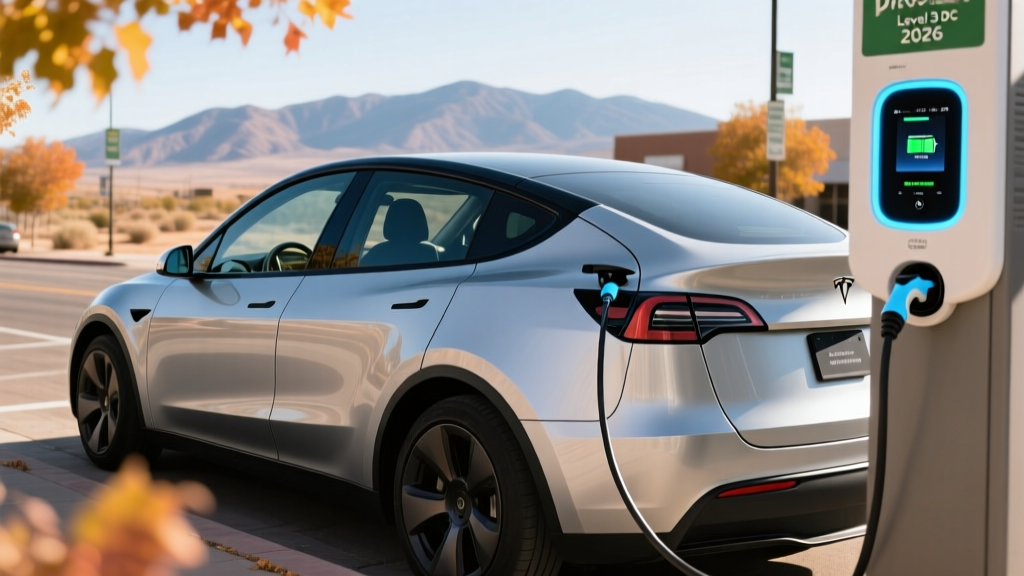
Supercharger coverage. As of early 2026, Tesla operates Supercharger stations in Reno (multiple locations including Summit Ridge and Meadowood), Sparks, Carson City, Fernley, Fallon, Elko, Winnemucca, and South Lake Tahoe. V3 Superchargers deliver up to 250 kW, while newer V4 installations (with CCS compatibility built in) are rolling out along I-80. A 10–80% charge at a V3 station takes approximately 27 minutes — enough time for a quick meal stop.
Charging curve reality: The Model Y peaks at 250 kW only between roughly 10–30% State of Charge. From 30–60%, it sustains around 150–170 kW, and above 80%, the rate tapers sharply to under 50 kW to protect battery health. This is why Tesla (and we) recommend charging to 80% on road trips — the last 20% adds significant time for relatively few miles.
Performance, Tech & the Juniper Refresh
The 2026 Model Y Long Range AWD delivers 384 combined horsepower from its dual-motor setup, with a 4.8-second 0–60 mph time. That's genuinely quick for a family SUV, and the instant torque makes merging onto I-80 or passing on US-395 effortless. The low center of gravity (battery pack under the floor) keeps body roll minimal through the curves on Geiger Grade or the Mt. Rose Highway.
The Juniper refresh (which debuted for the 2025 model year) brought meaningful interior upgrades: a light bar across the dashboard with ambient lighting, ventilated front seats, a rear-seat touchscreen for climate and entertainment controls, power-folding second-row seats, and improved sound insulation. The cabin is noticeably quieter at highway speeds compared to the pre-refresh Model Y.
Autopilot and FSD (Supervised). Every 2026 Tesla includes basic Autopilot — adaptive cruise control and lane-keeping that works well on I-80's long, straight stretches. Full Self-Driving (Supervised), a $8,000 option or $99/month subscription, adds automatic lane changes, intersection handling, and navigation-guided driving. However, FSD remains an SAE Level 2 driver-assistance system — you must keep your hands on the wheel and eyes on the road at all times. It is not self-driving, and Reno's occasional construction zones, snow-covered lane markings, and rural two-lane roads are scenarios where FSD requires heightened driver attention.
Tesla Autopilot and FSD (Supervised) are SAE Level 2 systems. The driver must remain fully engaged, monitor the road, and be prepared to take over instantly. These systems do not make the vehicle autonomous. Snow-covered lane markings, common on Reno roads December–March, can impair lane-keeping functionality.
Notable drawbacks: The Model Y still lacks Apple CarPlay and Android Auto (Tesla uses its proprietary infotainment system, which is capable but polarizing). The rear-seat touchscreen is small (8 inches) and positioned low. Turn-signal buttons on the steering wheel (replacing the traditional stalk in the Juniper refresh) take adjustment. And at $48,990 base, the Model Y is no longer the budget option it once was.
Pricing, Trims & Federal Tax Credit Eligibility
The 2026 Tesla Model Y is available in three main configurations for the US market:
| Trim | MSRP | Est. After §30D Credit* | Drivetrain | Range |
|---|---|---|---|---|
| Long Range RWD | $44,990 | $37,490 | Rear-wheel drive | 320 mi EPA |
| Long Range AWD | $48,990 | $41,490 | Dual-motor AWD | 320 mi EPA |
| Performance | $52,490 | $44,990 | Dual-motor AWD | 293 mi EPA |
*All trims include $1,390 destination charge not reflected above. Tax credit estimates assume full $7,500 §30D eligibility — see requirements below.
Does the Model Y qualify for the $7,500 federal EV tax credit? As of the current IRS rules under IRS §30D, the Model Y qualifies for the full $7,500 credit when purchased new, provided the buyer meets all requirements. Since January 2024, buyers can elect to transfer the credit to the dealer as a point-of-sale discount, effectively reducing the purchase price at signing rather than waiting for a tax refund.
- MSRP Cap: Vehicle MSRP must not exceed $80,000 for SUVs (all Model Y trims qualify)
- Buyer Income Cap: Modified AGI ≤ $150,000 (single) / $225,000 (head of household) / $300,000 (joint)
- Final Assembly: Must be assembled in North America (Model Y: Fremont, CA — qualifies)
- Battery Sourcing: Critical minerals and battery components must meet phased domestic-content thresholds (Tesla sources from approved suppliers; verify current-year compliance at purchase)
- Transfer Option: Credit can be applied at point of sale to reduce purchase price
Rules are subject to change. Confirm eligibility at fueleconomy.gov and consult a tax professional before purchase.
For Reno buyers specifically, Nevada has no state income tax, which means the federal credit is your primary incentive — there's no additional state EV rebate. However, NV Energy has periodically offered residential EV charger rebates (check current availability at nvenergy.com), and some Nevada dealers may offer complimentary home charger installation promotions.
Model Y vs. Competitors: What Else Should Reno Buyers Consider?
| Attribute | Tesla Model Y LR AWD | Hyundai Ioniq 5 AWD | Ford Mustang Mach-E ER AWD |
|---|---|---|---|
| EPA Range | 320 mi | 290 mi | 300 mi |
| Battery | 78.1 kWh NMC | 84.0 kWh NMC | 91.0 kWh NMC |
| Peak DC Charge | 250 kW | 240 kW | 150 kW |
| 10–80% Time | ~27 min | ~18 min | ~45 min |
| 0–60 mph | 4.8 sec | 5.1 sec | 5.4 sec |
| Base MSRP (AWD) | $48,990 | $52,500 | $51,995 |
| Charging Network | Tesla Supercharger (native) | NACS (Tesla SC access 2025+) | NACS (Tesla SC access 2025+) |
| Cargo (rear up) | 30.2 cu ft | 27.2 cu ft | 29.7 cu ft |
The Model Y's advantages in Reno are clear: longest EPA range in the segment, native Supercharger access (no adapter needed), and the strongest charging infrastructure along Nevada's highway corridors. The Ioniq 5 charges faster (18 vs 27 minutes 10–80%) thanks to its 800V architecture, and the Mach-E offers a more traditional driving feel with physical controls. But for a Reno driver who regularly travels I-80 to Elko or US-50 to Fallon, the Tesla Supercharger network's reliability and density in rural Nevada is a decisive edge.
Hyundai and Ford now have NACS ports or adapters granting Supercharger access, but adapter-based charging can be slightly slower and requires carrying an additional cable. Native NACS integration (as on the Tesla) remains the most seamless experience.
Who Should Buy the Tesla Model Y in Reno?
- You commute daily in Reno/Sparks (20–60 miles round trip) and can charge at home
- You regularly drive I-80 to Elko, Winnemucca, or Sacramento and need reliable Supercharger stops
- You want AWD for occasional Sierra Nevada snow without a gas vehicle's fuel cost
- You value over-the-air software updates that add features over time
- You need 30+ cu ft of cargo space for gear, ski equipment, or family hauling
- You can't install a Level 2 home charger (apartment/condo with no garage access)
- You frequently tow heavy loads (Model Y is rated for 3,500 lbs — fine for a small utility trailer, not a boat or camper)
- You want Apple CarPlay or physical buttons for climate and media controls
- Your household income exceeds §30D caps, making the effective price less competitive
For Reno's most common use case — a daily commuter who occasionally drives to Tahoe or across northern Nevada — the Model Y Long Range AWD remains the strongest all-around choice in 2026. The combination of range, AWD, Supercharger access, and low running costs (roughly $0.03–0.04 per mile on NV Energy's off-peak rates vs. $0.12–0.15 per mile for a comparable gas SUV) makes the ownership math work decisively in the EV's favor for anyone with home charging access.
Frequently Asked Questions
What is the real-world range of the Tesla Model Y in Reno?
Expect approximately 265–285 miles on the highway in summer and 210–240 miles in winter at highway speeds. The EPA rates the Model Y Long Range AWD at 320 miles, but real-world highway driving, cold temperatures, and elevation changes reduce that figure. Preconditioning the battery before winter departures helps recover some lost range.
How fast does the Model Y charge at home and on the road?
At home with a Tesla Wall Connector (48A, 240V), you'll add about 44 miles of range per hour — a full charge takes roughly 8 hours overnight. On the road, V3 Superchargers deliver up to 250 kW peak, adding 10–80% in about 27 minutes. The charging rate tapers significantly above 80% SoC.
How much does the Model Y cost after the federal tax credit?
The Long Range AWD starts at $48,990 + $1,390 destination. With the full $7,500 §30D credit applied at point of sale, the effective price drops to approximately $41,490 + destination. Eligibility depends on buyer income (≤$300,000 joint AGI), and the vehicle must meet battery-sourcing requirements. Verify current-year eligibility at fueleconomy.gov.
Is the Tesla Model Y worth buying over competitors in 2026?
For Reno buyers who prioritize range and charging infrastructure, the Model Y's 320-mile EPA range and native Supercharger access are difficult to beat. The Hyundai Ioniq 5 charges faster and the Ford Mach-E offers a more conventional interface, but Tesla's Supercharger network along I-80 and US-395 gives it a practical edge for northern Nevada road trips.
Does the Model Y handle well in Reno snow?
Yes. The dual-motor AWD system provides excellent traction in snow, and the low center of gravity (from the floor-mounted battery) improves stability. Pair it with all-season or dedicated winter tires (many Reno owners swap to winter tires November–March), and the Model Y is among the most capable AWD vehicles in Sierra Nevada conditions. Regenerative braking on snow can be aggressive — Tesla's "Chill" acceleration mode and reduced regen settings help.
Can I charge a non-Tesla EV at Reno Superchargers?
Yes. Tesla has opened select Supercharger stations to non-Tesla EVs via the NACS connector or CCS adapter. However, not all Reno-area Superchargers are open to non-Tesla vehicles yet, and stalls designed for Tesla's form factor can be tight for larger vehicles. Check the Tesla app for station compatibility before planning a trip.