Quick Answer: Should You Buy a Renault Zoe EV?
The Renault Zoe EV is one of Europe's best-selling compact electric cars, offering up to 245 miles of WLTP range from a 52 kWh battery and low running costs. However, it is not sold new in the United States and does not qualify for the federal §30D tax credit. For US buyers, importing a used Zoe involves compliance hurdles (FMVSS, EPA certification) that make it impractical for most. If you're a European buyer or considering a grey-market import, this guide covers the real numbers you need — range, charging, total cost of ownership, and how it stacks up against gas and hybrid alternatives.
Renault Zoe EV: Core Specs at a Glance
The Zoe has been a staple of the European EV market since 2012, with a major refresh in 2019 that introduced the current 52 kWh battery pack. Renault discontinued the Zoe in late 2024, replacing it with the Renault 5 E-Tech. However, used examples and remaining stock continue to circulate, and the Zoe remains highly relevant as a second-hand EV purchase or a European-market daily driver.
| Specification | Renault Zoe (R135 / Z.E. 50) |
|---|---|
| Battery (usable) | 52 kWh (NMC chemistry) |
| WLTP Range | 245 mi (395 km) |
| Real-World Range (est.) | ~175–210 mi (varies by season) |
| Motor Output | 134 hp (100 kW) / 181 lb-ft torque |
| 0-62 mph (0-100 km/h) | 9.5 seconds |
| Top Speed | 87 mph (140 km/h) |
| DC Fast Charge (peak) | 50 kW (CCS2) |
| 10–80% DC Charge Time | ~55–60 minutes |
| AC Level 2 Charge (max) | 22 kW (3-phase) / 7.4 kW (1-phase) |
| Length / Curb Weight | 160.6 in / ~3,300 lbs |
| Euro NCAP Safety | 5 stars (2013, updated 2019) |
Real-World Range vs. WLTP Sticker
The Zoe's 245-mile WLTP figure is optimistic for American driving patterns. WLTP testing includes more city driving and lower average speeds than US EPA cycles. In real-world European testing by EV Database, the Zoe achieves roughly 195 miles in mild weather (mixed driving) and drops to approximately 140–155 miles in cold winter conditions at highway speeds. If the Zoe were EPA-rated, expect a sticker around 170–185 miles — comparable to a base Nissan Leaf.
Charging the Zoe: What to Expect
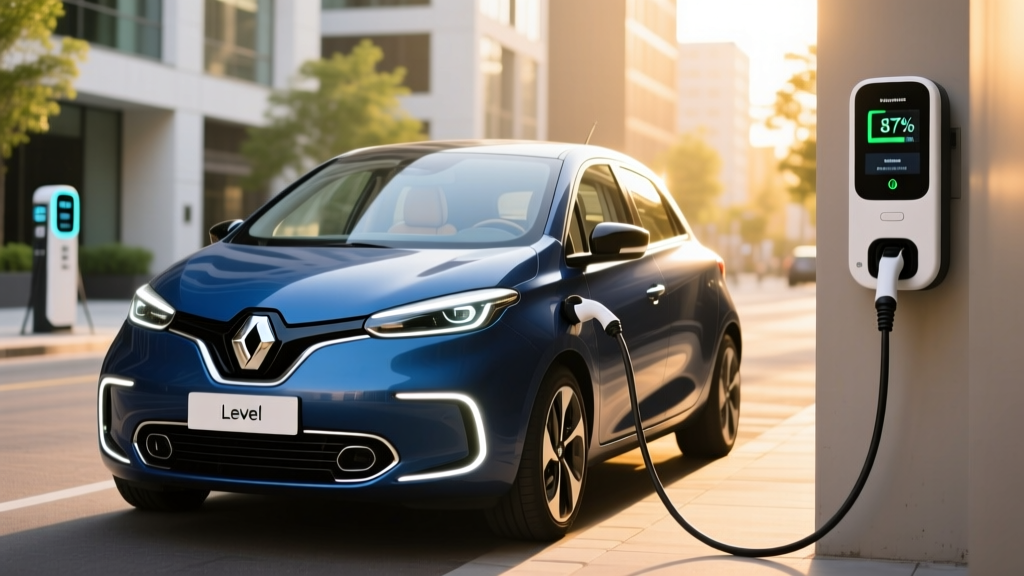
The Zoe's charging profile is its most significant limitation by 2026 standards. While most modern EVs support 150–350 kW DC fast charging, the Zoe tops out at 50 kW on CCS2 (the European standard; US models would use CCS1 or NACS). This means highway road trips require patience.
| Charging Level | Power (kW) | Miles Added per Hour | Full Charge Time |
|---|---|---|---|
| Level 1 (120V, 10A) | ~1.2 kW | ~4 mi/hr | ~44 hours |
| Level 2 (240V, single-phase) | 7.4 kW | ~25 mi/hr | ~7.5 hours |
| Level 2 (3-phase, EU) | 22 kW | ~75 mi/hr | ~2.5 hours |
| DC Fast (CCS2) | 50 kW peak | ~120 mi/hr (at peak) | 10–80% in ~55 min |
The Zoe's 22 kW AC onboard charger is a standout feature — it's one of the few compact EVs that can accept full 3-phase AC, making it exceptionally flexible on European public AC chargers. However, 3-phase power is rare in US residential settings, so American owners would be limited to 7.4 kW on a standard Level 2 home charger.
Charging curve reality: The Zoe's 50 kW peak is sustained only from roughly 10–40% state of charge. Above 60%, the charge rate tapers significantly, dropping below 25 kW. This is why the 10–80% time stretches to nearly an hour — the last 20% is painfully slow compared to vehicles with 150+ kW capability.
Cost Breakdown: Zoe vs. Gas and Hybrid Alternatives
For European buyers, the Zoe's economics are compelling. For US importers, the picture is more complicated. Let's break down the numbers.
| Cost Factor | Renault Zoe EV (Used EU) | Toyota Yaris Hybrid | Ford Fiesta (Gas, discontinued) |
|---|---|---|---|
| Purchase Price (used, ~2022) | €12,000–16,000 (~$13,000–$17,500) | €16,000–20,000 (~$17,500–$21,800) | €10,000–13,000 (~$11,000–$14,200) |
| Fuel/Energy per 100 mi | €3.50–5.00 (home charging) | €8.50–10.00 (gasoline) | €10.00–12.00 (gasoline) |
| Annual Fuel (7,500 mi/yr) | €260–375 | €640–750 | €750–900 |
| Maintenance (annual est.) | €150–250 | €350–500 | €400–600 |
| Insurance (annual, EU avg.) | €450–700 | €350–550 | €350–500 |
| 5-Year Total Running Cost | €4,300–6,500 | €6,700–9,000 | €7,500–10,500 |
Key takeaway: The Zoe saves roughly €2,000–4,000 over five years compared to a gas equivalent, primarily through fuel and maintenance savings. EVs have fewer moving parts — no oil changes, no exhaust systems, no transmission fluid — which keeps maintenance costs low. Brake pad life is also extended significantly thanks to regenerative braking.
US Import Costs: The Reality Check
Importing a Renault Zoe to the United States involves several barriers:
- FMVSS Compliance: The Zoe was never certified to US Federal Motor Vehicle Safety Standards. Converting and certifying a non-compliant vehicle can cost $10,000–30,000+ through a Registered Importer.
- EPA Certification: The vehicle must meet US emissions and environmental standards, requiring additional testing.
- 25-Year Rule: Vehicles not originally US-spec can only be imported freely once they are 25 years old (the earliest Zoe would qualify in 2037).
- No Federal Tax Credit: The §30D credit requires new vehicles sold by OEMs with US distribution. Used imports do not qualify. The used-EV credit (§25E, up to $4,000) also requires the vehicle to have been originally sold in the US.
Bottom line: US importation of the Zoe is not financially practical for the vast majority of buyers. The compliance costs alone exceed the vehicle's value.
Battery Longevity and Degradation
The Zoe uses an NMC (nickel manganese cobalt) lithium-ion battery pack manufactured by LG Energy Solution. Renault provided an 8-year/100,000-mile (160,000 km) battery warranty guaranteeing at least 66% capacity retention (though many Zoe batteries perform much better).
Real-world degradation data from European fleet studies and owner reports shows:
- Year 1–2: ~2–4% capacity loss (initial settling)
- Year 3–5: ~1–2% per year
- Year 6–8: ~1% per year, stabilizing
- Expected 8-year SoH: 85–92% for most vehicles (well above warranty threshold)
The Zoe's battery uses passive air cooling rather than active liquid thermal management. This is a notable limitation: in hot climates or during repeated fast-charging sessions, the battery can heat-soak, accelerating degradation and triggering charge-rate throttling. For buyers in Mediterranean or Southern European climates, this is worth considering. Northern European Zoe owners report excellent longevity.
Battery replacement cost: A new 52 kWh Zoe battery pack costs approximately €8,000–12,000 ($8,700–$13,000) through Renault. However, very few owners have needed replacements, and the used-EV battery aftermarket in Europe is growing.
Common Misconceptions About the Renault Zoe
| Myth | Fact |
|---|---|
| "The Zoe only has 100 miles of range." | The original 2012 Zoe had ~90 mi range, but the 2019+ Z.E. 50 model achieves 245 mi WLTP (~175–210 mi real-world). |
| "You have to lease the battery separately." | Early Zoes offered battery leasing (€79–149/mo), but since 2020, Renault includes the battery in the purchase price. Used buyers should verify whether a specific car has an owned or leased battery. |
| "The Zoe can't do highway speeds." | The R135 motor reaches 87 mph comfortably. It's not a performance car, but it handles motorway driving at 70 mph without issue — though range drops significantly at sustained high speeds. |
| "It's easy to import to the US." | FMVSS and EPA compliance make importing a Zoe to the US extremely costly and impractical for all but the most determined collectors. |
| "The Zoe charges as fast as modern EVs." | At 50 kW peak DC, the Zoe charges roughly 3–5x slower than vehicles like the Hyundai Ioniq 5 (240 kW) or Tesla Model 3 (250 kW). |
Who Is the Renault Zoe For? A Decision Framework
Choose the Renault Zoe If:
- You live in Europe and want an affordable used EV for city and suburban commuting
- Your daily driving is under 80 miles round-trip
- You have access to home charging (even a standard 240V outlet adds ~25 mi/hr)
- You value low running costs over performance or fast-charging speed
- You can find a post-2020 model with the 52 kWh battery and owned (not leased) battery
Look Elsewhere If:
- You live in the United States — import costs make this impractical
- You frequently drive more than 150 miles in a single trip
- You need fast DC charging for road trips (50 kW is slow by 2026 standards)
- You live in a very hot climate and lack garage parking (air-cooled battery limitation)
- You want a vehicle with the latest ADAS features — the Zoe has basic lane-keep and AEB but nothing like Tesla Autopilot or GM Super Cruise (both SAE Level 2 systems)
US-Based Alternatives to Consider
If you're a US buyer drawn to the Zoe's compact size and affordability, consider these available alternatives:
- Chevrolet Bolt EV (used): 259 mi EPA range, CCS charging, widely available under $20,000 used, and may qualify for the $4,000 used-EV tax credit (§25E)
- Nissan Leaf (used): 149–226 mi EPA range depending on battery, CHAdeMO charging, strong US parts availability
- Hyundai Kona Electric (new/used): 261 mi EPA range, 100 kW DC charging, available new with potential §30D eligibility
- Renault 5 E-Tech (Europe only, for now): The Zoe's spiritual successor with 249 mi WLTP range and 100 kW DC charging
Ownership Costs Over 5 Years: Zoe vs. Gas Comparison
| Category | Renault Zoe (EU Used, 2022) | Comparable Gas Car (e.g., VW Polo) |
|---|---|---|
| Purchase Price | ~€14,000 ($15,300) | ~€12,000 ($13,100) |
| 5-Year Energy/Fuel | €1,500 ($1,635) | €5,500 ($6,000) |
| 5-Year Maintenance | €900 ($980) | €2,500 ($2,730) |
| 5-Year Insurance | €3,000 ($3,270) | €2,400 ($2,620) |
| 5-Year Tax/Registration | €300 ($327) — many EU countries exempt EVs | €800 ($872) |
| Depreciation (est. 5-yr) | €5,500 ($6,000) | €4,500 ($4,910) |
| Total 5-Year Cost | ~€25,200 ($27,500) | ~€27,700 ($30,200) |
The Zoe breaks even or saves money over five years despite a slightly higher purchase price, primarily through dramatically lower fuel and maintenance costs. In European markets with EV purchase incentives (France's bonus écologique, Germany's former Umweltbonus, etc.), the Zoe's cost advantage grows substantially.
Frequently Asked Questions
Can I buy a Renault Zoe in the United States?
Not through any official channel. Renault does not sell vehicles in the US market. Importing a used Zoe requires FMVSS compliance conversion through a Registered Importer, EPA certification, and significant cost (often exceeding the car's value). It is technically possible but financially impractical for nearly all buyers.
What is the real-world range of the Renault Zoe?
The 2019+ Zoe Z.E. 50 (52 kWh battery) achieves approximately 195 miles in mild weather mixed driving and 140–155 miles in cold weather at highway speeds, per independent testing by EV Database. The 245-mile WLTP figure is achievable only in ideal city-driving conditions at moderate temperatures.
How long does it take to charge the Zoe at home?
On a standard 240V / 32A single-phase Level 2 charger (7.4 kW), a full charge from empty takes roughly 7.5 hours — easily manageable with overnight charging. On European 3-phase 22 kW AC, that drops to about 2.5 hours. On a standard 120V household outlet (Level 1), expect roughly 44 hours for a full charge — only practical for emergency top-ups.
Does the Renault Zoe qualify for any US tax credits?
No. The federal §30D new EV credit and the §25E used EV credit both require vehicles originally sold through US-certified manufacturers. Since Renault has no US distribution, the Zoe is ineligible for any federal EV tax incentive. See IRS guidelines on clean vehicle credits for full eligibility rules.
Is the Zoe's battery leased or owned?
This depends on the model year and original purchase agreement. Before 2020, many Zoes were sold with battery leasing (€79–149/month), which lowered the purchase price but added an ongoing cost. Since 2020, Renault bundled the battery into the vehicle price. When buying used, always verify battery ownership status — an assumed purchase that turns out to have a leased battery creates a costly surprise.
How does the Zoe compare to the Renault 5 E-Tech?
The Renault 5 E-Tech, launched in 2024, replaces the Zoe with a more modern platform, 100 kW DC fast charging (vs. 50 kW), liquid-cooled battery, updated infotainment, and up to 249 miles WLTP range from a 52 kWh pack. It is a significant upgrade in every dimension, though at a higher starting price (~€25,000 new in Europe).
What should a first-time EV buyer know about the Zoe?
Three things: (1) Always charge at home if possible — public DC charging at 50 kW is slow and expensive compared to home Level 2. (2) Range drops 20–30% in cold weather; plan trips accordingly. (3) The Zoe's regenerative braking is relatively mild compared to newer EVs — it does not offer true one-pedal driving like a Nissan Leaf or Chevrolet Bolt. Expect to use the friction brakes more often.